<?xml version="1.0" encoding="utf-8"?>
<feed xmlns="http://www.w3.org/2005/Atom">
  <title>Flat Fee Advisors Blog</title>
	<subtitle>We post about flat fee and fee-only financial advising. We also spend time talking about our service, including the mechanics behind it, the features, and the advisors we work with.</subtitle>
	<link href="https://www.flatfeeadvisors.us/blog/feed.xml" rel="self"/>
	<link href="https://www.flatfeeadvisors.us/blog/"/>
	<updated>2026-05-07T00:00:00Z</updated>
	<id>https://www.flatfeeadvisors.us/blog</id>
	<author>
    <name>Flat Fee Advisors</name>
    <email>hello@flatfeeadvisors.us</email>
	</author>
	
    
    <entry>
      <title>What Are the Steps in the Financial Planning Process?</title>
      <link href="https://www.flatfeeadvisors.us/blog/what-are-the-steps-financial-planning-process/"/>
      <updated>2026-05-07T00:00:00Z</updated>
      <id>https://www.flatfeeadvisors.us/blog/what-are-the-steps-financial-planning-process/</id>
      <content type="html"><![CDATA[
        <p>You're earning well and making smart moves, but do the pieces feel fully connected? That's the problem the financial planning process is designed to solve. The <a href="https://www.cfp.net/ethics/compliance-resources/2018/11/focus-on-ethics---the-7-step-financial-planning-process">Certified Financial Planner Board of Standards (CFP Board)</a> defines it as a collaborative process that integrates every element of your personal and financial picture to help you meet your life goals. Here's how that breaks down in practice.</p>
<h2>Step 1: Should Your Goals Drive the Entire Plan?</h2>
<p>Yes, and most people treat this step too casually. Real financial goals are specific, measurable, time-bound, and prioritized. &quot;Retire at 58 with $12,000 per month in after-tax income&quot; is a goal. &quot;I want to retire comfortably&quot; is a wish.</p>
<p>The goal-setting step also forces tradeoffs into the open. Do you want to retire early, fund full college tuition for two kids, and buy a vacation home in the next five years? You can probably do two of those. Which two? For high earners juggling <a href="https://flatfeeadvisors.us/blog/executives-business-owners-specialized-help/">equity compensation</a>, college funding, and aging parents alongside retirement, getting priorities in the right order is half the work.</p>
<h2>Step 2: What Financial Data Do You Need to Gather?</h2>
<p>A real plan can't be built on approximations. You need a complete picture of where you stand -- this step alone often surfaces surprises like outdated beneficiary designations or accounts opened without any <a href="https://obliviousinvestor.com/financial-planning-priorities/">asset location strategy</a>. Gather documents across all seven categories:</p>
<div class="table-wrapper">
<table>
<thead>
<tr>
<th>Category</th>
<th>What to Gather</th>
</tr>
</thead>
<tbody>
<tr>
<td><strong>Income</strong></td>
<td>W-2, business income, Restricted Stock Units (RSUs), stock options, rental income</td>
</tr>
<tr>
<td><strong>Assets</strong></td>
<td>Brokerage accounts, 401(k), 403(b), Individual Retirement Account (IRA), Roth IRA, Health Savings Account (HSA), 529 plans, real estate, business equity</td>
</tr>
<tr>
<td><strong>Liabilities</strong></td>
<td>Mortgage, business debt, student loans, auto loans</td>
</tr>
<tr>
<td><strong>Insurance</strong></td>
<td>Life, disability, long-term care, umbrella liability (coverage amounts and terms)</td>
</tr>
<tr>
<td><strong>Cash Flow</strong></td>
<td>Actual income in vs. spending out, not estimates</td>
</tr>
<tr>
<td><strong>Tax History</strong></td>
<td>Last two to three years of returns, effective rate, carryforward losses</td>
</tr>
<tr>
<td><strong>Estate Documents</strong></td>
<td>Will, trusts, beneficiary designations, Power of Attorney (POA), healthcare directives</td>
</tr>
</tbody>
</table>
</div>
<h2>Step 3: How Do You Analyze Your Current Financial Position?</h2>
<p>With the data in hand, the next step is honest analysis, not action yet. A thorough review covers five key areas:</p>
<div class="table-wrapper">
<table>
<thead>
<tr>
<th>Analysis Area</th>
<th>What You're Looking For</th>
</tr>
</thead>
<tbody>
<tr>
<td><strong>Cash Flow Efficiency</strong></td>
<td>Is your savings rate on track? Where is money leaking to taxes or misaligned spending?</td>
</tr>
<tr>
<td><strong>Investment Allocation</strong></td>
<td>Does your asset allocation match your timeline, and are assets located in the right account types for <a href="https://obliviousinvestor.com/asset-location-fundamentals-which-investments-to-own-in-which-account/">tax efficiency</a> (for example, bonds in tax-deferred accounts, stocks in taxable ones)?</td>
</tr>
<tr>
<td><strong>Insurance Gaps</strong></td>
<td>Are you adequately covered? High earners are frequently underinsured on disability (see note below)</td>
</tr>
<tr>
<td><strong>Tax Exposure</strong></td>
<td>Are you optimizing around your marginal rate? Is your Roth conversion strategy aligned with your projected retirement income?</td>
</tr>
<tr>
<td><strong>Retirement Readiness</strong></td>
<td>Based on your savings rate and realistic return assumptions, what does your actual retirement trajectory look like?</td>
</tr>
</tbody>
</table>
</div>
<p><strong>On disability coverage:</strong> According to the <a href="https://thecdia.org/how-gltd-can-impact-high-income-earners/">Council for Disability Income Awareness</a> (2025), standard group long-term disability (LTD) plans cap benefits at a fixed monthly ceiling, meaning a $10,000 per month cap can result in actual income replacement of just 25-30% for a $250,000 per year earner, far below the advertised 60%. The <a href="https://www.ssa.gov/disabilityresearch/">Social Security Administration</a> estimates about 1 in 4 of today's 20-year-olds will experience a disability before retirement age. White Coat Investor's <a href="https://www.whitecoatinvestor.com/the-big-holes-in-your-financial-plan/">overview of the most common financial plan gaps</a> covers this in depth.</p>
<h2>Step 4: What Goes Into a Comprehensive Financial Plan?</h2>
<p>This is where everything gets synthesized into a written, coordinated roadmap. A <a href="https://flatfeeadvisors.us/blog/what-every-250K-earner-should-demand-from-financial-advisor/">comprehensive financial plan</a> covers:</p>
<ul>
<li><strong>Cash flow and savings strategy:</strong> how much, where it goes, and in what order</li>
<li><strong>Investment allocation:</strong> coordinated across all account types for tax efficiency</li>
<li><strong>Proactive tax planning:</strong> <a href="https://www.madfientist.com/traditional-ira-vs-roth-ira/">Roth conversions</a>, tax-loss harvesting, income timing</li>
<li><strong>Risk management:</strong> the right insurance coverage for your actual situation</li>
<li><strong>Estate planning:</strong> wills, trusts, beneficiary designations, and Powers of Attorney</li>
<li><strong>Retirement income sequencing:</strong> withdrawal strategy, Social Security timing, and safe withdrawal rate</li>
</ul>
<p>A note on Roth conversions: this strategy involves moving money from a pre-tax retirement account into a tax-free Roth account during lower-income years, reducing the taxes you owe in retirement. For high earners approaching retirement, the timing and amount converted each year can make a significant difference in lifetime tax liability.</p>
<p>Morningstar's December 2025 <a href="https://www.morningstar.com/retirement/whats-safe-retirement-withdrawal-rate-2026">State of Retirement Income research</a> suggests a safe starting withdrawal rate of approximately 3.9% for someone retiring at 65 and 3.3% for someone retiring at 55, meaning on a $1 million portfolio, year-one income drops from $39,000 to $33,000, a gap that compounds significantly over a longer retirement.</p>
<h2>Step 5: How Do You Implement the Plan?</h2>
<p>A financial plan that never gets executed doesn't improve your situation. Implementation means coordinating multiple moving parts at the right time, including:</p>
<ul>
<li>Rebalancing portfolios across all account types</li>
<li>Updating estate documents with an attorney</li>
<li>Adjusting insurance coverage</li>
<li>Coordinating with a Certified Public Accountant (CPA) on tax strategy year-round, not just at filing</li>
<li>Executing equity compensation decisions: when to exercise options, when to sell RSUs, how to manage concentrated positions</li>
</ul>
<p>Before implementation begins, it pays to know <a href="https://flatfeeadvisors.us/blog/11-essential-questions-to-ask-a-financial-advisor/">the right questions to ask your advisor</a> to confirm they are equipped to coordinate all of it.</p>
<h2>Step 6: Why Does the Financial Planning Process Require Ongoing Review?</h2>
<p>Plans need to evolve as your life does. At minimum, a full review should happen annually. Certain events warrant an immediate revisit:</p>
<ul>
<li>A significant income change (promotion, career change, business exit or sale)</li>
<li>Marriage, divorce, or the death of a spouse</li>
<li>A new child or dependent</li>
<li>A large inheritance or financial windfall</li>
<li>A major tax law change</li>
<li>Approaching retirement within three to five years</li>
</ul>
<h2>Does Your Advisor's Fee Structure Affect the Financial Planning Process?</h2>
<p>How your advisor is paid influences what they recommend, whether they realize it or not. The table below shows how compensation structure creates real differences in the advice you receive. For a deeper look at why this matters, see <a href="https://flatfeeadvisors.us/blog/why-flat-fee-financial-advisors-beat-commission-aum/">Why Flat Fee Financial Advisors Beat Commission and AUM Models</a>.</p>
<div class="table-wrapper">
<table>
<thead>
<tr>
<th>Factor</th>
<th>Assets Under Management (AUM) Advisor</th>
<th>Flat-Fee Fiduciary Advisor</th>
</tr>
</thead>
<tbody>
<tr>
<td><strong>Compensation model</strong></td>
<td>Typically 1% of assets annually. Fee grows as your portfolio grows</td>
<td>Fixed fee based on scope of work, not portfolio size</td>
</tr>
<tr>
<td><strong>Fee on a $2M portfolio</strong></td>
<td>Approximately $20,000 per year (at 1%, the industry standard as of 2025)</td>
<td>Often $5,000-$12,000 per year</td>
</tr>
<tr>
<td><strong>Pay off mortgage vs. invest?</strong></td>
<td>Potential conflict: recommending payoff reduces AUM and their fee</td>
<td>Flat-fee structure: recommends what is actually best for you</td>
</tr>
<tr>
<td><strong>Retire now vs. work longer?</strong></td>
<td>Potential conflict: delaying retirement keeps assets and fees growing</td>
<td>Flat-fee structure: retirement timing is based solely on your plan</td>
</tr>
<tr>
<td><strong>Invest in your business?</strong></td>
<td>Potential conflict: capital leaving their management reduces their fee</td>
<td>Flat-fee structure: supports whatever genuinely serves your goals</td>
</tr>
<tr>
<td><strong>Scope of advice</strong></td>
<td>Often weighted toward investment management</td>
<td>Comprehensive: tax, cash flow, insurance, estate, retirement</td>
</tr>
<tr>
<td><strong>Fiduciary standard</strong></td>
<td>Required for Registered Investment Advisors (RIAs); not always applied to every service</td>
<td>Always, by definition</td>
</tr>
</tbody>
</table>
</div>
<p>A <a href="/blog/what-is-a-flat-fee-financial-advisor/">flat-fee advisor</a> is compensated for the quality of the plan, not the size of your portfolio, which means every step of this process stays focused on your outcomes. For a broader look at when and why to hire an advisor at all, Ben Carlson at A Wealth of Common Sense offers a thoughtful <a href="https://awealthofcommonsense.com/2024/02/when-should-you-hire-a-financial-advisor/">breakdown of the decision</a>.</p>
<h2>Ready to Work with a Flat-Fee Advisor?</h2>
<p>Our directory features vetted flat-fee advisors who specialize in working with high earners, compensated for expertise and planning rather than asset gathering.</p>
<p><a href="/advisors"><strong>Browse the Advisor Directory</strong></a></p>
<p>Not sure what type of advisor fits your situation? Our quick quiz matches you with advisors based on your income, goals, and planning needs. No commitment required.</p>
<p><a href="/match"><strong>Take the Advisor Match Quiz</strong></a></p>
<h2>Up Next</h2>
<p>If you've been questioning whether your current advisor is truly working in your best interest, our latest post is for you. <em>Thinking of Switching Financial Advisors? Read This</em> breaks down the real reasons high earners make a change, how to spot the fee structures and conflicts that may be working against you, and exactly how straightforward the transition process actually is.</p>
<div class="citations flow"><h2>Sources and References</h2>
<ol>
<li><strong>CFP Board.</strong> <a href="https://www.cfp.net/ethics/compliance-resources/2018/11/focus-on-ethics---the-7-step-financial-planning-process">“The 7-Step Financial Planning Process</a>.” November 21, 2018.</li>
<li><strong>Council for Disability Income Awareness</strong>. <a href="https://thecdia.org/how-gltd-can-impact-high-income-earners/">“How Group Long-Term Disability Insurance Can Impact High-Income Earners</a>.” November 20, 2025.</li>
<li><strong>Social Security Administration</strong>. “<a href="https://www.ssa.gov/disabilityresearch/">Disability Research</a>.”</li>
<li><strong>Morningstar</strong>. <a href="https://www.morningstar.com/retirement/whats-safe-retirement-withdrawal-rate-2026">“What's a Safe Retirement Withdrawal Rate for 2026?</a>” December 3, 2025.</li>
</ol>
</div>

      ]]></content>
    </entry>
	
    
    <entry>
      <title>Divorce Financial Planning: Are You Protecting Your Assets?</title>
      <link href="https://www.flatfeeadvisors.us/blog/divorce-financial-planning-protecting-your-assets/"/>
      <updated>2026-04-16T00:00:00Z</updated>
      <id>https://www.flatfeeadvisors.us/blog/divorce-financial-planning-protecting-your-assets/</id>
      <content type="html"><![CDATA[
        <p>Divorce is one of the few financial events that can undo decades of wealth-building in months. At Flat Fee Advisors, we connect high-income earners with vetted, <a href="/advisors">fee-only financial advisors</a>, and this article covers the divorce financial planning essentials most people wish they had understood sooner.</p>
<p>If you're earning $250,000 or more, you're restructuring a financial life that includes multiple retirement accounts, real estate, stock compensation, and possibly a business interest. What you accept, fight for, or leave on the table can shape your finances for decades.</p>
<h2>What's the Biggest Divorce Financial Planning Mistake High Earners Make</h2>
<p>The most expensive mistake in high-income divorce negotiations is negotiating on face value rather than after-tax value. A $500,000 IRA and a $500,000 Roth IRA look identical on paper but are very different after taxes, and a brokerage account with a low cost basis (you paid far less than it's worth, so most of the value is taxable profit) is not the same as cash. The table below shows why <a href="/blog/asset-location-strategy-100k-tax-savings/">account type matters as much as balance</a>:</p>
<div class="table-wrapper">
<table>
<thead>
<tr>
<th>Asset Type</th>
<th>Face Value</th>
<th>Estimated Tax Drag</th>
<th>Approx. After-Tax Value</th>
<th>Key Watch-Out</th>
</tr>
</thead>
<tbody>
<tr>
<td>Roth IRA</td>
<td>$500,000</td>
<td>None</td>
<td>$500,000</td>
<td>Often one of the most valuable assets to receive; distributions are fully tax-free</td>
</tr>
<tr>
<td>Traditional IRA / 401(k)</td>
<td>$500,000</td>
<td>~22-37% federal ordinary income in 2025 (higher with state taxes)</td>
<td>$315,000-$390,000</td>
<td>Every dollar taxed as regular income when withdrawn; your rate depends on your tax bracket in retirement</td>
</tr>
<tr>
<td>Taxable brokerage (low cost basis)</td>
<td>$500,000</td>
<td>15-23.8% federal on embedded gains in 2025 (the profit built up since you bought the investment)</td>
<td>Varies by basis</td>
<td>Hidden liability; the taxable gain you inherit becomes your future tax bill when you sell</td>
</tr>
<tr>
<td>Primary residence equity</td>
<td>$500,000</td>
<td>Depends on gain; up to $250K (single) or $500K (married) of profit may be excluded from tax under current IRS rules</td>
<td>Variable</td>
<td>Illiquid; carrying costs are real, and selling isn't free</td>
</tr>
</tbody>
</table>
</div>
<p>A settlement that looks equal on paper can be materially skewed after taxes (e.g., 55/45 or worse). Always model net-of-tax values before you sign.</p>
<p>Two tax traps to know:</p>
<ul>
<li><strong>No Qualified Domestic Relations Order (QDRO), no transfer.</strong> Splitting a 401(k) requires a QDRO, a court-approved order instructing the account's administrator to divide and transfer funds. Without one, the transfer triggers taxes and penalties. <a href="https://obliviousinvestor.com/transferring-an-ira-and-401k-in-a-divorce/">Oblivious Investor covers the full transfer rules</a>.</li>
<li><strong>Alimony is no longer deductible.</strong> Under the Tax Cuts and Jobs Act (TCJA), alimony finalized after December 31, 2018 is not deductible by the payer or taxable to the recipient.</li>
</ul>
<h2>What Should You Inventory Before Divorce Negotiations Begin?</h2>
<p>Solid divorce financial planning starts with a complete inventory of everything you own and owe:</p>
<p><strong>Assets:</strong></p>
<ul>
<li><a href="/blog/tax-diversification-and-liquidity/">Brokerage and retirement accounts</a>, noting type and tax treatment</li>
<li>Real estate with original purchase prices (for capital gains calculations)</li>
<li>Restricted Stock Units (RSUs) and stock options, vested and unvested</li>
<li>Deferred compensation plans and Health Savings Accounts (HSAs)</li>
</ul>
<p><strong>Liabilities:</strong></p>
<ul>
<li>Mortgages, credit lines, and credit card balances</li>
<li>Student loans and personal guarantees on business debt</li>
</ul>
<p>Joint debts assigned to a spouse can still follow you if they default. Pre-marital assets, gifts, and inheritances are generally separate property but lose protection if commingled with marital funds.</p>
<p>Nine states use community property rules (assets acquired during marriage owned 50/50): AZ, CA, ID, LA, NV, NM, TX, WA, WI. The rest use equitable distribution, where a judge decides what is fair.</p>
<h2>What Needs to Change Financially After the Divorce Is Final?</h2>
<p>Once the ink is dry, work through this checklist (White Coat Investor also has a <a href="https://www.whitecoatinvestor.com/financial-chores-to-complete-after-divorce/">solid post-divorce financial checklist</a>):</p>
<ul>
<li><a href="/blog/estate-planning-mistakes-cost-diy-investors-100k/"><strong>Update beneficiary designations</strong></a> on your 401(k), IRA, and life insurance. They override your will, and your ex may still be named.</li>
<li><strong>Revise estate documents:</strong> will, healthcare directive, and power of attorney.</li>
<li><strong>Retitle accounts and property</strong> that changed hands.</li>
<li><strong>Review insurance coverage:</strong> health, life, disability, and umbrella.</li>
<li><strong>Update tax withholding</strong> for your new single-filer status.</li>
<li><a href="/blog/hiring-a-financial-advisor-2026/"><strong>Rebuild your financial plan</strong></a><strong>.</strong> Divorce financial planning doesn't end at settlement.</li>
</ul>
<p>Divorce is a disruption, not a setback.</p>
<h2>Ready to Work with a Flat Fee Advisor?</h2>
<p>In divorce, fee structure matters. AUM and commission-based advisors have financial incentives that may not align with your best settlement outcome. Flat fee, fee-only advisors in our directory are fiduciary, compensated for their expertise, not for what you keep, sell, or move.</p>
<p><a href="/advisors">Find a Flat Fee Advisor</a></p>
<p>Not sure where to start? Take our quick quiz for a personalized recommendation.</p>
<p><a href="/match">Take the Advisor Match Quiz</a></p>
<h2>Up Next</h2>
<p>If you're a high earner making smart financial moves, but the pieces feel disconnected, the formal financial planning process is designed to solve that. <a href="/blog/what-are-the-steps-financial-planning-process/">This guide</a> breaks down the six essential steps, starting with setting specific, prioritized goals and gathering detailed financial data to perform an honest analysis of your current position. The process culminates in a comprehensive, written roadmap that coordinates your investments, proactive tax planning, risk management, and estate strategy. Finally, you'll learn why ongoing review is crucial and how choosing a Flat-Fee Fiduciary Advisor ensures your plan remains objective and focused purely on your long-term success.</p>
<div class="citations flow"><h2>Sources and References</h2>
<ul>
<li><strong>Internal Revenue Service.</strong> &quot;<a href="https://www.irs.gov/taxtopics/tc452">Alimony, Separate Maintenance</a>.&quot;</li>
<li><strong>Internal Revenue Service.</strong> &quot;<a href="https://www.irs.gov/retirement-plans/plan-participant-employee/retirement-topics-qdro-qualified-domestic-relations-order">Retirement Topics -- QDRO -- Qualified Domestic Relations Order</a>.&quot;</li>
<li><strong>Internal Revenue Service.</strong> &quot;<a href="https://www.irs.gov/taxtopics/tc409">Topic No. 409: Capital Gains and Losses</a>.&quot;</li>
<li><strong>Internal Revenue Service.</strong> &quot;<a href="https://www.irs.gov/publications/p504">Publication 504: Divorced or Separated Individuals</a>.&quot;</li>
<li><strong>American Bar Association.</strong> &quot;<a href="https://www.americanbar.org/groups/legal_services/milvets/aba_home_front/information_center/family_law/marriage_and_divorce/annulment_separation_divorce/separating_property_awarding_alimony/separating_property/">Separating Property</a>.&quot; December 3, 2020.</li>
<li><strong>Financial Industry Regulatory Authority (FINRA).</strong> &quot;<a href="https://www.finra.org/investors/insights/will-your-financial-accounts-survive-your-divorce">Will Your Financial Accounts Survive Your Divorce?</a>&quot; April 17, 2025.</li>
<li><strong>Kitces, Michael.</strong> &quot;<a href="https://www.kitces.com/blog/divorce-planning-clients-financial-advisor-ethical-challenges-considerations-fiduciary-duty/">Navigating Divorce And Ethical Challenges With Clients</a>.&quot; December 10, 2025.</li>
</ul>
</div>

      ]]></content>
    </entry>
	
    
    <entry>
      <title>Is a Flat Fee Financial Tax Advisor Right for Your Strategy?</title>
      <link href="https://www.flatfeeadvisors.us/blog/flat-fee-financial-tax-advisor-right-strategy/"/>
      <updated>2026-04-02T00:00:00Z</updated>
      <id>https://www.flatfeeadvisors.us/blog/flat-fee-financial-tax-advisor-right-strategy/</id>
      <content type="html"><![CDATA[
        <p>If you're earning north of $250,000, having a tax strategy isn't optional. It's one of your highest-return opportunities. The question: does your current financial advisor's fee structure allow them to be the ideal financial tax advisor?</p>
<p><strong>Here's the truth most high earners discover too late:</strong></p>
<ul>
<li>The way your financial tax advisor gets paid significantly influences the tax advice they give you</li>
<li>With multiple income streams, equity compensation, and seven-figure portfolios, these influences cost tens of thousands in unnecessary taxes annually</li>
<li>Fee structure conflicts can quietly erode your wealth over decades</li>
</ul>
<h2>Why Tax Strategy Matters at Higher Incomes</h2>
<p><strong>The $250,000+ tax reality:</strong></p>
<ul>
<li>Marginal federal tax rates of 32-37%, plus state taxes ranging from 0% to 13%+ depending on state</li>
<li>At combined marginal rates of 40-50%, each dollar you legally shield from taxation can be worth 40-50 cents saved</li>
<li>Difference between mediocre and sophisticated tax strategy: potentially $10,000-$50,000 annually (varies by individual situation)</li>
<li>Over two decades, that compounds to serious wealth preservation or erosion</li>
</ul>
<h2>The Fee Structure Problem Nobody Talks About</h2>
<p>Here's where things get interesting. Traditional financial tax advisors who charge based on Assets Under Management (AUM) face an inherent conflict when it comes to tax strategy.</p>
<p><em>For a clear explanation of how different advisor fee models create different incentives, this overview table from Oblivious Investor walks through the trade-offs between asset-based, hourly, and flat-fee arrangements, and why incentive alignment matters when evaluating financial advice. Learn more: <a href="https://obliviousinvestor.com/financial-advice-hourly-fees-asset-based-fees-or-annual-fee/">https://obliviousinvestor.com/financial-advice-hourly-fees-asset-based-fees-or-annual-fee/</a></em></p>
<h3>Fee Structure Impact on Tax Strategy Recommendations</h3>
<div class="table-wrapper">
<table>
<thead>
<tr>
<th>Tax Strategy</th>
<th>Impact on Managed Assets</th>
<th>AUM Advisor Incentive</th>
<th>Flat Fee Advisor Incentive</th>
</tr>
</thead>
<tbody>
<tr>
<td><strong>Roth Conversions</strong></td>
<td>May reduce billed assets (tax payment)</td>
<td>Can reduce annual fees</td>
<td>No impact on compensation</td>
</tr>
<tr>
<td><strong>401(k) Maximization</strong></td>
<td>May move assets to unbilled accounts</td>
<td>Can reduce fee base</td>
<td>No impact on compensation</td>
</tr>
<tr>
<td><strong>Charitable Giving</strong></td>
<td>Typically removes assets from billing</td>
<td>Can reduce fees</td>
<td>No impact on compensation</td>
</tr>
<tr>
<td><strong>Mortgage Paydown</strong></td>
<td>Usually reduces investable assets</td>
<td>Can lower managed assets</td>
<td>No impact on compensation</td>
</tr>
<tr>
<td><strong>529 Plan Funding</strong></td>
<td>Often moves assets to unbilled accounts</td>
<td>Can reduce fee base</td>
<td>No impact on compensation</td>
</tr>
<tr>
<td><strong>Asset Location Optimization</strong></td>
<td>May shift assets to unbilled accounts</td>
<td>Can reduce billed assets</td>
<td>No impact on compensation</td>
</tr>
</tbody>
</table>
</div>
<p><strong>Key Insight</strong>: Many sophisticated tax strategies can reduce the assets AUM advisors bill on (depending on their fee arrangement), creating a potential conflict between optimal advice and advisor compensation.</p>
<h3>When Good Tax Advice Reduces Advisor Compensation</h3>
<p><strong>Scenario:</strong> You have $200,000 in your brokerage account. Your AUM advisor charges 1% annually ($2,000/year).</p>
<p><strong>Optimal tax strategy suggests:</strong></p>
<ul>
<li>Max out 401(k) employee deferral: $23,500</li>
<li>Backdoor Roth IRA: $7,000</li>
<li>529 education savings: $10,000</li>
<li>Mortgage paydown: $40,000</li>
</ul>
<p><strong>The conflict:</strong> These moves reduce investable assets by $80,500, which can reduce the assets an AUM advisor bills on (depending on whether 401(k) and other accounts are included in their fee arrangement). Are they motivated to recommend this?</p>
<h3>The Tax-Loss Harvesting Double Standard</h3>
<p>Most AUM advisors only implement tax-loss harvesting on accounts they directly manage. What about your old 401(k), company stock plan, investment properties, or accounts at other institutions? When advisor compensation depends on assets they control, they're less motivated to optimize accounts they don't manage.</p>
<h2>What a Flat Fee Financial Tax Advisor Does Differently</h2>
<p><a href="/blog/what-is-a-flat-fee-financial-advisor/">Flat fee advisors</a> charge predetermined fees ($150-$400/hour or $2,000-$8,000 annually) regardless of portfolio size. Their compensation stays the same whether you have $2 million or $500,000, enabling them to recommend strategies that optimize your overall financial picture, even if those strategies reduce investable assets.</p>
<p><strong>Example:</strong> Recommending $200,000 from your brokerage to purchase life insurance for estate planning could save heirs $100,000+ in taxes. An AUM advisor (1% fee) loses $2,000 annually. A flat fee advisor's compensation doesn't change.</p>
<p><em>Important note:</em> Many AUM advisors provide excellent advice despite this conflict. However, the structural incentive remains and may unconsciously influence recommendations.</p>
<h3>Comprehensive Tax Coordination</h3>
<p>Because flat fee advisors aren't tied to specific accounts, they coordinate tax strategies across your entire financial life:</p>
<ul>
<li>Cross-institution optimization (harvesting losses from Schwab to offset E*TRADE gains and Restricted Stock Unit (RSU) sales)</li>
<li>Multi-year tax planning (timing Roth conversions, charitable contributions)</li>
<li>Business structure optimization (S-Corp elections, retirement plans) without bias toward gathering assets</li>
</ul>
<h2>Tax Strategies Flat Fee Advisors Excel At</h2>
<h3>1. Strategic Roth Conversions</h3>
<p>Converting traditional IRA assets to Roth creates a taxable event now to eliminate future taxes, but often requires pulling money from taxable accounts to pay conversion taxes.</p>
<p><strong>The conflict:</strong> Converting $200,000 costs the client $60,000+ in taxes. If paid from a brokerage account, the AUM advisor loses $60,000 in managed assets ($600 in annual fees, forever). A flat fee advisor's fee stays the same.</p>
<p><strong>Example:</strong> A 52-year-old executive with $500,000 in traditional IRA converts $50,000 annually over 10 years, staying in the 32% bracket. Total taxes: $160,000. Tax savings in retirement (avoiding 37% bracket): $225,000+. Net benefit: $65,000+.</p>
<p><em>Note: This is an illustrative hypothetical. Actual tax savings depend on individual circumstances including filing status, state taxes, future tax rates, income sources in retirement, and other deductions. Results will vary significantly by situation.</em></p>
<h3>2. Asset Location Optimization</h3>
<p>Different investments have different tax treatments. Optimal asset location often means placing significant assets in accounts your advisor doesn't manage (401(k)s, Health Savings Accounts (HSAs), IRAs at other institutions).</p>
<p><strong>AUM challenge:</strong> Optimizing across all accounts means accepting best-performing assets should be elsewhere.</p>
<p><strong>Flat fee advantage:</strong> Can place tax-inefficient bonds/Real Estate Investment Trusts (REITs) in 401(k)s, high-growth stocks in Roth IRAs, and tax-efficient index funds in taxable accounts without concern for where assets are held.</p>
<p><strong>Example:</strong> Couples with $3 million moves bonds generating 4.5% taxable income from taxable accounts to 401(k)s. Annual tax savings: $12,000+. An AUM advisor might resist because $800,000 in bonds moving out means $8,000 in lost annual fees.</p>
<p><em>Note: This is an illustrative scenario. Tax savings depend on the marginal tax bracket, state taxes, and specific bond holdings. Individual results will vary.</em></p>
<h3>3. Business Owner Tax Planning</h3>
<p>Business ownership creates unique tax opportunities that can dwarf investment management value. Strategies often require moving assets in ways that <a href="/blog/ditch-the-aum-find-a-flat-fee-advisor-near-you/">don't benefit AUM fee structures</a>.</p>
<p><strong>Key strategies:</strong></p>
<ul>
<li><strong>Simplified Employee Pension (SEP) IRA/Solo 401(k):</strong> Total contribution limits up to $70,000 for 2025 (employee + employer contributions combined, varies by plan type and age)</li>
<li><strong>Cash Balance Plans:</strong> Older, high-earning owners can contribute $200,000-$400,000+ annually (depending on age/income), providing massive tax deductions</li>
<li><strong>S-Corp election:</strong> Potentially save $15,000-$50,000 annually in self-employment taxes by splitting income between salary and distributions (savings vary significantly based on business income and reasonable salary requirements)</li>
</ul>
<p><strong>Example:</strong> 55-year-old consultant earning $600,000 establishes cash balance plan. Annual contribution: $250,000. Tax savings at 45% rate: $112,500. Flat fee advisor's fee: $8,000 annually. AUM alternative would need $800,000 additional assets to match revenue.</p>
<p><em>Note: This is an illustrative scenario. Cash balance plan contributions and tax savings vary significantly based on age, income, business structure, and existing retirement plans. S-Corp savings depend on reasonable salary determination and state tax treatment. Consult with a tax professional for your specific situation.</em></p>
<h3>4. Charitable Giving Strategies</h3>
<p>Sophisticated charitable giving strategies often move assets out of taxable accounts.</p>
<p><strong>Key strategies:</strong></p>
<ul>
<li><strong>Donor-Advised Funds (DAFs):</strong> Immediate tax deduction, distributed to charities over time, but assets leave managed portfolio</li>
<li><strong>Qualified Charitable Distributions (QCDs):</strong> For 70½+, distribute up to $108,000 annually from IRAs directly to charity (2025 limit, indexed annually), satisfying Required Minimum Distributions (RMDs) without taxable income</li>
</ul>
<p><strong>Example:</strong> 62-year-old contributes $100,000 appreciated stock (cost basis: $30,000) to DAF. Tax deduction saves $37,000, avoids $14,000 capital gains. Total benefit: $51,000. Assets permanently leave the managed portfolio. AUM advisor loses $1,000 annually; flat fee advisor still charges $7,500.</p>
<p><em>Note: This is an illustrative scenario. Actual tax benefits depend on marginal tax rate, state taxes, itemization status, AGI limitations, and capital gains holding period. Individual results will vary.</em></p>
<h2>When a Flat Fee Financial Tax Advisor Makes the Most Sense</h2>
<p><em>For a practitioner-focused perspective on when flat-fee planning can make sense for high earners, The White Coat Investor outlines how advisor fee structures influence behavior and why many professionals prefer paying for planning separately from investment management in the table below. Learn more:</em><br>
<em>https://www.whitecoatinvestor.com/asset-under-management-aum-fee-for-financial-advisors/</em></p>
<h3>Decision Framework: Which Fee Model Fits Your Situation?</h3>
<div class="table-wrapper">
<table>
<thead>
<tr>
<th>Your Situation</th>
<th>AUM May Work Well</th>
<th>Flat Fee Likely Superior</th>
</tr>
</thead>
<tbody>
<tr>
<td><strong>Portfolio Size</strong></td>
<td>$250K-$750K</td>
<td>$1M+</td>
</tr>
<tr>
<td><strong>Tax Complexity</strong></td>
<td>W-2 income, standard deductions</td>
<td>Multiple income streams, equity comp, business ownership</td>
</tr>
<tr>
<td><strong>Account Concentration</strong></td>
<td>Most assets in 1-2 accounts</td>
<td>Assets across 5+ accounts/institutions</td>
</tr>
<tr>
<td><strong>Primary Need</strong></td>
<td>Portfolio management &amp; rebalancing</td>
<td>Tax optimization &amp; comprehensive planning</td>
</tr>
<tr>
<td><strong>Tax Strategy Frequency</strong></td>
<td>Annual tax prep, occasional planning</td>
<td>Ongoing multi-year tax strategies</td>
</tr>
</tbody>
</table>
</div>
<p>Consider flat fee advisors if you have: multiple account types across institutions, <a href="/blog/executives-business-owners-specialized-help/">complex compensation</a> (stock options, RSUs, ESPPs), business ownership with unique tax opportunities, interest in Roth conversions, or are approaching retirement with multi-year tax planning needs.</p>
<h2>The Cost Comparison</h2>
<p><em>To better understand how recurring fees compound over time, this analysis from Of Dollars And Data explains why percentage-based advisory fees can have a much larger long-term impact on portfolio outcomes than most investors expect, even when annual costs appear modest. Learn more: <a href="https://ofdollarsanddata.com/how-hedge-funds-get-rich/">https://ofdollarsanddata.com/how-hedge-funds-get-rich/</a></em></p>
<p><strong>Traditional AUM Advisor ($2M portfolio):</strong></p>
<ul>
<li>Fee: 1% annually = $20,000/year initially</li>
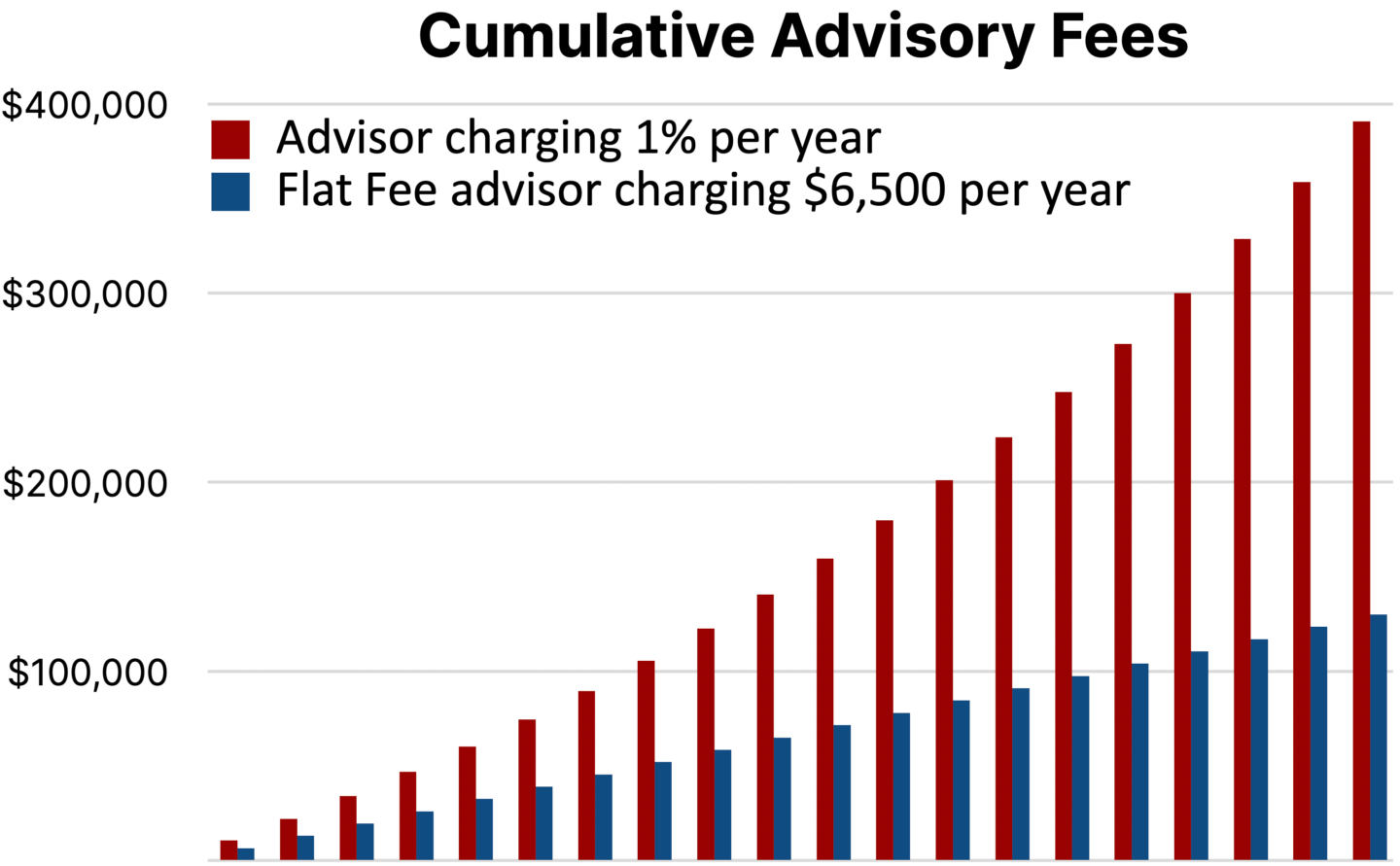
<li>10-year cumulative fees: approximately $263,000 (assuming 1% fee deducted from beginning-of-year balance, then portfolio grows at 7% annually)*</li>
<li>Best for: Intensive portfolio management, portfolios under $1M</li>
</ul>
<p><a href="/blog/flat-fee-financial-advisors-about-transparency/"><strong>Flat Fee Advisor</strong></a> <strong>($2M portfolio):</strong></p>
<ul>
<li>Typical fee: $6,000-$10,000/year</li>
<li>10-year cost: $60,000-$100,000</li>
<li>Potential fee savings: $163,000-$203,000</li>
<li>Best for: Larger portfolios, complex tax situations, asset-reducing strategies</li>
</ul>
<p>*Methodology note: Calculation assumes 1% fee is deducted from the account at the beginning of each year, then the remaining balance grows at 7% annually. If fees are charged quarterly or calculated on average daily balance, actual costs will vary. This illustration shows fees paid only; it excludes the opportunity cost of those fees not remaining invested in the portfolio.</p>
<p>The key question: Will flat fee structures that minimize conflicts around tax strategies generate value exceeding fee savings? For many high-income earners with complex situations, yes.</p>
<h2>How to Evaluate Your Current Advisor</h2>
<p>Questions revealing whether fee structure influences tax recommendations:</p>
<ol>
<li><strong>&quot;Can you show me a comprehensive tax projection for the next 5-10 years?&quot;</strong> - Many AUM advisors focus on investments, skimp on tax projections</li>
<li><strong>&quot;What tax strategies have you recommended involving assets outside your management?&quot;</strong> - Reveals holistic thinking</li>
<li><strong>&quot;Have you modeled the lifetime tax impact of Roth conversions?&quot;</strong> - AUM advisors may not prioritize this since conversions reduce managed assets</li>
<li><strong>&quot;How do you coordinate asset location across all my accounts?&quot;</strong> - Should have clear strategy beyond just managed accounts</li>
<li><strong>&quot;What tax strategies have you recommended that reduce my investable assets?&quot;</strong> - If &quot;none,&quot; that's a red flag</li>
</ol>
<h2>What to Look For in a Flat Fee Tax-Focused Advisor</h2>
<p><strong>Credentials:</strong> <a href="/blog/navigating-financial-advisor-certifications/">Certified Financial Planner (CFP) with Certified Public Accountant (CPA), Enrolled Agent (EA), or Personal Financial Specialist (PFS)</a> demonstrates both planning and tax expertise</p>
<p><strong>Specialization:</strong> Tax planning listed as core service, track record with similar clients</p>
<p><strong>Proactive approach:</strong> Annual tax planning sessions, multi-year projections, year-end recommendations</p>
<p><strong>Cross-institution coordination:</strong> Works with accounts across multiple institutions without pressure to consolidate</p>
<p><strong>Transparent pricing:</strong> Clear fee schedule, no hidden costs</p>
<h2>The Bottom Line</h2>
<p>For $250,000+ earners with complex situations, tax strategy is one of your highest-return opportunities. The question: does your advisor's fee structure support optimal tax advice?</p>
<p><strong>AUM models work well when:</strong></p>
<ul>
<li>Portfolio is $500K-$1M (flat fees proportionally higher)</li>
<li>Tax situation is straightforward</li>
<li>You value intensive portfolio management and automatic fee scaling</li>
</ul>
<p><strong>Flat fee models excel when:</strong></p>
<ul>
<li>Portfolio exceeds $1-2 million</li>
<li>You need strategies that reduce managed assets (Roth conversions, 401k maximization)</li>
<li>You're a business owner with complex tax needs</li>
<li>You want advice on accounts at multiple institutions</li>
</ul>
<p>Neither model is universally superior. What matters: alignment between advisor compensation and your optimal strategies. For high earners with complex situations, <a href="/blog/flat-fee-financial-advice-from-a-flat-fee-financial-advisor/">flat fee structures</a> minimize conflicts around tax strategies that reduce managed assets, often translating to tens of thousands in annual tax savings.</p>
<p><strong>Ready to Work with a Flat Fee Advisor?</strong></p>
<p>Understanding fee structures is the first step. The next is finding an advisor whose compensation aligns with your tax optimization goals.</p>
<p><strong>The table below focuses on how different fee models create conflicts when it comes to tax strategy:</strong></p>
<div class="table-wrapper">
<table>
<thead>
<tr>
<th>Fee Model</th>
<th>How They're Paid</th>
<th>Key Conflicts with Tax Strategies</th>
</tr>
</thead>
<tbody>
<tr>
<td><strong>Commission-Based</strong></td>
<td>Selling financial products</td>
<td>Incentivized to recommend products with highest commissions, not optimal tax strategies</td>
</tr>
<tr>
<td><strong>AUM (1% annually)</strong></td>
<td>Percentage of managed assets</td>
<td>Discouraged from recommending strategies that reduce portfolio (401k max, Roth conversions, charitable giving, mortgage paydown)</td>
</tr>
<tr>
<td><strong>Flat Fee</strong></td>
<td>Fixed annual or hourly fee</td>
<td>Minimal conflicts - compensated for expertise and planning, not asset accumulation</td>
</tr>
</tbody>
</table>
</div>
<p><strong>Why this matters for your taxes:</strong> The strategies that save you the most in taxes (Roth conversions, retirement maximization, asset location optimization) often reduce the assets AUM advisors manage. Flat fee advisors face no penalty for recommending what's truly optimal.</p>
<h3>Find Your Flat Fee Financial Tax Advisor</h3>
<p>If you're looking for comprehensive tax planning from an advisor compensated for expertise rather than asset gathering, we can help.</p>
<p><a href="/advisors"><strong>Browse Our Directory of Vetted Flat Fee Advisors</strong></a> - All advisors are fee-only, fiduciary, and specialize in working with high earners.</p>
<p><strong>Not sure what type of advisor is right for your situation?</strong> <a href="/match">Take our 60-second quiz</a> to get matched with advisors suited to your specific tax planning needs.</p>
<h2>Up Next</h2>
<p>Divorce isn't the only financial event that can derail years of careful wealth-building. In <a href="/blog/divorce-financial-planning-protect-your-assets/">Divorce Financial Planning: Are You Protecting Your Assets?</a>, we break down the tax traps high-income earners consistently miss in divorce negotiations, including why a $500,000 IRA and a $500,000 Roth IRA are not the same asset, how to build a complete asset inventory before negotiations begin, and what needs to change financially once the settlement is signed. If a major life transition is on the horizon, this is worth a read before you sit down at the table.</p>
<div class="citations flow"><h2>Sources and References</h2>
<ol>
<li><strong>Internal Revenue Service</strong>. &quot;<a href="https://www.irs.gov/retirement-plans/plan-participant-employee/retirement-topics-ira-contribution-limits">Retirement Topics: IRA Contribution Limits</a>.&quot;</li>
<li><strong>Internal Revenue Service</strong>. &quot;<a href="https://www.irs.gov/newsroom/401k-limit-increases-to-23500-for-2025-ira-limit-remains-7000">401(k) limit increases to $23,500 for 2025, IRA limit remains $7,000.</a>&quot;</li>
<li><strong>Internal Revenue Service</strong>. &quot;<a href="https://www.irs.gov/pub/irs-drop/n-24-80.pdf">Notice 2024-80 (PDF): 2025 Cost-of-Living Adjustments for Retirement Plans and IRAs</a>.&quot;</li>
<li><strong>Federation of Tax Administrators</strong>. &quot;<a href="https://taxadmin.org/tax-rates-new/">Tax Rates (State Individual Income Tax Information).</a>&quot;</li>
<li><strong>Oblivious Investor</strong>. &quot;<a href="https://obliviousinvestor.com/financial-advice-hourly-fees-asset-based-fees-or-annual-fee/">Financial Advice: Hourly Fees, Asset-Based Fees, or Annual Fee?</a>&quot;</li>
<li><strong>Michael Kitces</strong>. &quot;<a href="https://www.kitces.com/blog/fee-model-conflict-of-interest-commissions-aum-2/">Kitces &amp; Carl Ep 19: Is Any Financial Advisor Business Model Truly Conflict Free?</a>&quot; October 24, 2019.</li>
<li><strong>Michael Kitces</strong>. &quot;<a href="https://www.kitces.com/blog/financial-planner-fees-based-on-financial-advisor-cost-value-affordability/">How To Set Your Financial Planning Fees Based On Advisor Cost, Value, And Affordability.</a>&quot; September 12, 2016.</li>
<li><strong>Michael Kitces</strong>. &quot;<a href="https://www.kitces.com/blog/financial-advisor-average-fee-2020-aum-hourly-comprehensive-financial-plan-cost/">Financial Advisor Fee Trends And The Fee Compression Mirage.</a>&quot; <a href="https://www.kitces.com/blog/financial-advisor-average-fee-2020-aum-hourly-comprehensive-financial-plan-cost/">February 8, 2021.</a></li>
<li><strong>Vanguard</strong>. &quot;<a href="https://investor.vanguard.com/investor-resources-education/portfolio-management/rebalancing-your-portfolio">Rebalancing your portfolio: How to rebalance.</a>&quot;</li>
<li><strong>Vanguard</strong>. &quot;<a href="https://workplace.vanguard.com/content/dam/inst/iig-transformation/insights/pdf/assessing-the-value-of-advice.pdf">Assessing the value of advice.</a>&quot; <a href="https://workplace.vanguard.com/content/dam/inst/iig-transformation/insights/pdf/assessing-the-value-of-advice.pdf">September 2019.</a></li>
<li><strong>FPA Journal, William Reichenstein</strong>. &quot;<a href="https://www.financialplanningassociation.org/sites/default/files/2023-02/JUL07%20Reichenstein.pdf">Calculating After-Tax Asset Allocation Is Key to Determining Risk, Returns, and Asset Location.</a>&quot;</li>
<li><strong>David Blanchett and Paul Kaplan</strong>. &quot;<a href="https://www.morningstar.com/content/dam/marketing/shared/research/foundational/677796-AlphaBetaGamma.pdf">Alpha, Beta, and Now...Gamma</a>.&quot; August 28, 2013.</li>
<li><strong>CFP Board</strong>. &quot;<a href="https://www.cfp.net/ethics/code-of-ethics-and-standards-of-conduct">Code of Ethics and Standards of Conduct</a>.&quot;</li>
<li><strong>Fidelity</strong>. &quot;<a href="https://www.fidelity.com/learning-center/personal-finance/retirement/qcds">Donating to a charity using a qualified charitable distribution (QCD).</a>&quot; December 12, 2025.</li>
<li><strong>Of Dollars And Data (Nick Maggiulli)</strong>. &quot;<a href="%20%20https://ofdollarsanddata.com/how-hedge-funds-get-rich/">How Hedge Funds Get Rich (Hint: It’s Not Their Returns)</a>.&quot;January 2, 2017.</li>
</ol>
</div>

      ]]></content>
    </entry>
	
    
    <entry>
      <title>Fee-Only vs Flat Fee Advisors: The $660K Truth Exposed</title>
      <link href="https://www.flatfeeadvisors.us/blog/fee-only-vs-flat-fee-advisors-660k-truth-exposed/"/>
      <updated>2026-03-19T00:00:00Z</updated>
      <id>https://www.flatfeeadvisors.us/blog/fee-only-vs-flat-fee-advisors-660k-truth-exposed/</id>
      <content type="html"><![CDATA[
        <h1>Fee-Only vs Flat Fee Advisors: The $660K Truth Exposed</h1>
<p>If you're researching financial advisors, you've probably encountered terms like &quot;fee-only&quot; and &quot;flat fee&quot; floating around. Maybe you've even wondered if they mean the same thing. They don't, and understanding the distinction of fee-only vs flat fee advisors could significantly impact how much of your wealth you actually get to keep.</p>
<p>These terms get confused constantly, even by people who should know better. And that confusion can be expensive. So let's clear this up once and for all.</p>
<h2>Fee-Only: The Foundation</h2>
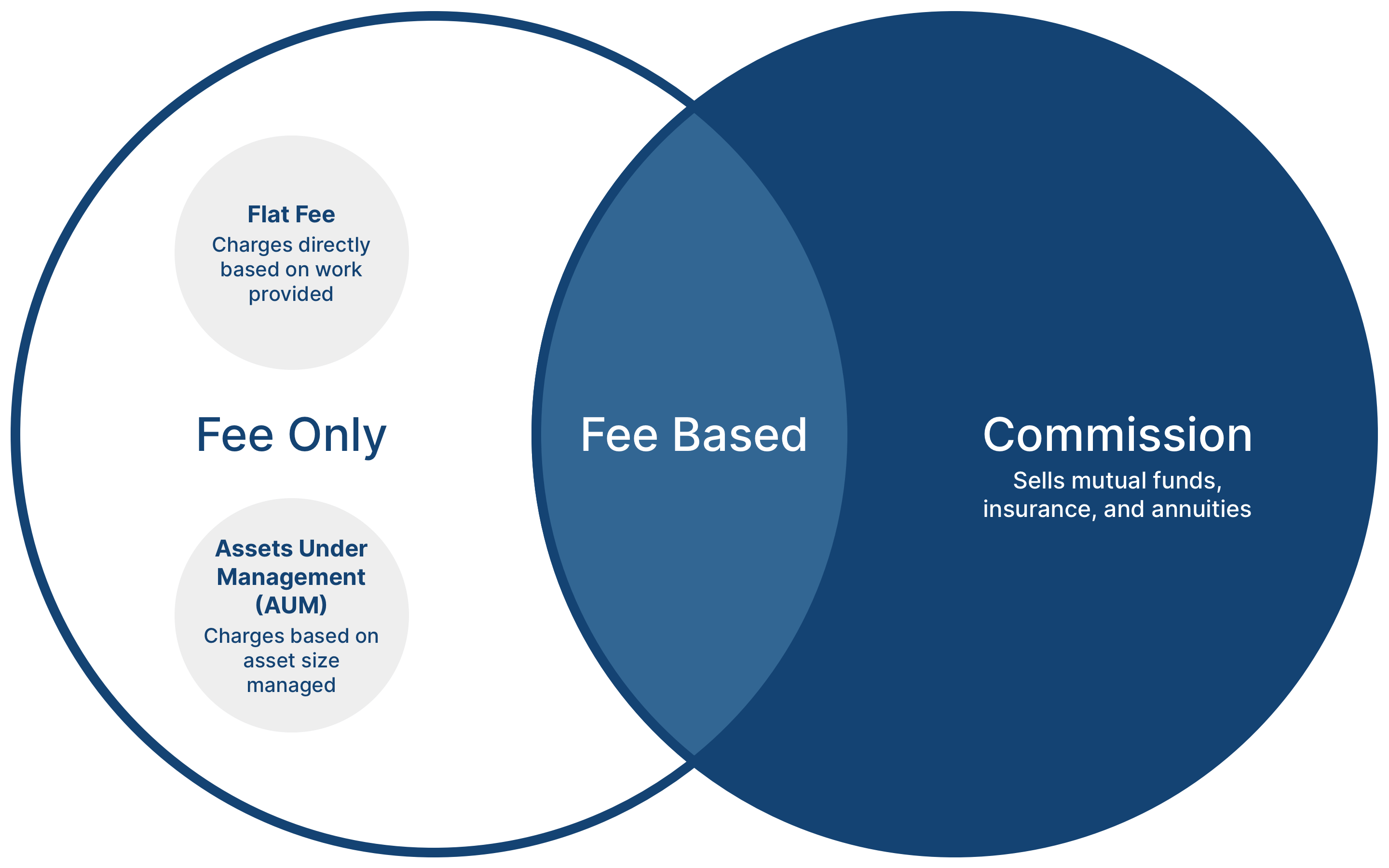
<p>Fee-only means exactly what it sounds like: the advisor gets paid only by their clients, never through commissions from selling financial products. This significantly reduces several common conflicts of interest:</p>
<ul>
<li>No revenue sharing or third-party compensation from mutual fund companies</li>
<li>No bonuses for pushing certain insurance policies</li>
<li>No hidden compensation from investment products</li>
</ul>
<p>This matters because it eliminates a massive conflict of interest. A fee-only advisor isn't incentivized to recommend products based on which ones pay them the most. They're operating under a fiduciary duty, a legal obligation to act in your best interest (Source 8). If you want to understand more about why avoiding commission-based advisors matters, read our guide on <a href="/blog/avoid-commisions-why-fee-only-advisor-benefits-you/">why fee-only advisors benefit you</a>.</p>
<p>The problem? &quot;Fee-only&quot; tells you how an advisor <em>doesn't</em> get paid, but it doesn't tell you what you'll actually be charged.</p>
<h2>The Fee-Only Universe: Three Different Worlds</h2>
<p>Within the fee-only category, advisors charge in three fundamentally different ways. The table below compares how different advisors charge, the typical cost, and who each model is best for.</p>
<div class="table-wrapper">
<table>
<thead>
<tr>
<th>Fee Structure</th>
<th>How It Works</th>
<th>Typical Cost</th>
<th>Best For</th>
</tr>
</thead>
<tbody>
<tr>
<td><strong>Assets Under Management (AUM)</strong></td>
<td>Percentage of portfolio value (typically 0.5-1.5%)</td>
<td>$20,000/year on $2M portfolio at 1%</td>
<td>Smaller portfolios ($250K-$500K) or simple investment-only needs</td>
</tr>
<tr>
<td><strong>Hourly/Project</strong></td>
<td>Pay per hour or per project</td>
<td>$150-$400/hour; $2,000-$7,500 for comprehensive plan</td>
<td>Do-It-Yourself (DIY) investors needing occasional guidance</td>
</tr>
<tr>
<td><strong>Flat Fee</strong></td>
<td>Fixed annual amount regardless of assets</td>
<td>$6,000-$15,000/year depending on complexity</td>
<td>Larger portfolios ($1M+) with comprehensive planning needs</td>
</tr>
</tbody>
</table>
</div>
<p>All three are fee-only. But the cost difference between them can be staggering, especially as your wealth grows.</p>
<p><em>If you want a more nuanced view of how different advisor compensation models create different incentives, this overview from Oblivious Investor explains how hourly, flat fee, and assets under management pricing each influence advisor behavior in distinct ways.</em></p>
<p><em>Learn more: <a href="https://obliviousinvestor.com/how-do-you-pay-your-financial-advisor/">https://obliviousinvestor.com/how-do-you-pay-your-financial-advisor/</a></em></p>
<h2>Why Flat Fee Advisors Are Different</h2>
<p>Here's what most people miss: flat fee advisors are a specific subset of fee-only advisors. Every flat fee advisor is fee-only, but not every fee-only advisor charges a flat fee.</p>
<p>Think of it this way:</p>
<ul>
<li><strong>&quot;Fee-only&quot;</strong> describes <em>what</em> you're buying (conflict-free advice)</li>
<li><strong>&quot;Flat fee&quot;</strong> describes <em>how much</em> you're paying for it (a fixed, transparent price)</li>
</ul>
<p>When you work with a flat fee advisor, you know exactly what you'll pay before you write the check. If you're quoted $8,000 annually, that's what you'll pay:</p>
<ul>
<li>Whether your portfolio is $1 million or $5 million</li>
<li>Whether the market is up 20% or down 15%</li>
<li>Regardless of how many times you meet or how complex your situation becomes within the agreed scope</li>
</ul>
<h2>The Assets Under Management (AUM) Model: Understanding the Trade-Offs</h2>
<p>Most fee-only advisors still charge based on AUM. And while they're certainly better than commission-based advisors, the AUM model creates different dynamics that are worth understanding. (For a deeper dive into why flat fee advisors outperform both commission-based and AUM models, see our comprehensive guide: <a href="/blog/why-flat-fee-financial-advisors-beat-commission-aum/">Why Flat Fee Financial Advisors Beat Commission Based &amp; AUM Advisors</a>).</p>
<p>Consider a typical scenario: You've built a $3 million portfolio and you're working with a fee-only AUM advisor charging 1%. That's $30,000 annually.</p>
<p>Now suppose you're considering some smart financial moves:</p>
<ul>
<li>Paying off your $200,000 mortgage early to eliminate interest payments</li>
<li>Making a substantial charitable contribution to reduce your tax burden</li>
<li>Funding your daughter's business startup with $150,000</li>
<li>Purchasing a vacation property with cash to avoid mortgage rates</li>
</ul>
<p>All of these might be excellent financial decisions for your situation. But here's the reality: each of these decisions may reduce your advisor's revenue under an Assets Under Management model.</p>
<p><em>If you want a deeper look at why percentage-based advisor fees can become increasingly expensive as portfolios grow, this analysis from The White Coat Investor breaks down how assets under management pricing scales with wealth even when planning complexity does not.</em></p>
<p><em>Learn more: <a href="https://www.whitecoatinvestor.com/the-aum-fee-dilemma/">https://www.whitecoatinvestor.com/the-aum-fee-dilemma/</a></em></p>
<p>Does that mean AUM advisors will give you bad advice? Not necessarily. Most advisors genuinely want to help their clients. But compensation structure influences perspective, even for well-intentioned professionals. It's worth considering whether you want your advisor's revenue to potentially decrease when you make moves that might improve your overall financial picture.</p>
<p><strong>The AUM Argument:</strong></p>
<p>Proponents argue that AUM creates alignment:</p>
<ul>
<li>When your portfolio grows, both you and your advisor benefit</li>
<li>During market downturns, your advisor's fees decrease alongside your portfolio value</li>
<li>This model provides behavioral coaching value, potentially preventing costly emotional decisions during volatility</li>
</ul>
<p><strong>The Counter-Argument:</strong></p>
<p>Critics point out several concerns:</p>
<ul>
<li>Portfolio size doesn't correlate with planning complexity</li>
<li>A $3 million portfolio doesn't require three times the work of a $1 million portfolio</li>
<li>AUM advisors may unconsciously favor keeping assets invested rather than recommending strategies that reduce portfolio size but improve overall financial health</li>
<li>The fee structure can create subtle conflicts even when the advisor has fiduciary obligations</li>
</ul>
<p>For more examples of how AUM fee structures can create conflicts of interest, read <a href="/blog/ditch-the-aum-find-a-flat-fee-advisor-near-you/">Ditch the AUM: Find Flat Fee Financial Advisors Near You</a>.</p>
<h2>Real Numbers: What This Actually Costs You</h2>
<p>Let's look at a straightforward comparison using a $2 million portfolio growing at 7% annually.</p>
<p><em>If you want a data-driven perspective on when the cost of financial advice is actually justified, this analysis from Of Dollars and Data explores how the value of an advisor depends more on complexity and decision support than on portfolio size alone. The table below shows how the costs of fee-only vs flat fee advisors compare over time.</em></p>
<p><em>Learn more: <a href="https://ofdollarsanddata.com/when-should-you-hire-a-financial-advisor/">https://ofdollarsanddata.com/when-should-you-hire-a-financial-advisor/</a></em></p>
<div class="table-wrapper">
<table>
<thead>
<tr>
<th>Timeframe</th>
<th>Fee-Only AUM (1%)</th>
<th>Flat Fee ($8,000/year)</th>
<th>Difference</th>
</tr>
</thead>
<tbody>
<tr>
<td>Year 1</td>
<td>$20,000</td>
<td>$8,000</td>
<td>$12,000</td>
</tr>
<tr>
<td>Year 10</td>
<td>$36,769</td>
<td>$8,000</td>
<td>$28,769</td>
</tr>
<tr>
<td>Total after 10 years</td>
<td>~$276,000</td>
<td>$80,000</td>
<td>~$196,000</td>
</tr>
<tr>
<td>Total after 20 years</td>
<td>~$820,000</td>
<td>$160,000</td>
<td>~$660,000</td>
</tr>
</tbody>
</table>
</div>
<p>In this illustration, both advisors are assumed to be fee-only fiduciaries providing comprehensive planning. The difference in what you actually pay? Approximately $660,000 over 20 years.</p>
<p><strong>Key takeaways from this comparison:</strong></p>
<ul>
<li>Year 1 costs are already 2.5x higher with AUM ($20,000 vs $8,000)</li>
<li>By Year 10, you're paying nearly 4.6x more per year with AUM ($36,769 vs $8,000)</li>
<li>Cumulative 20-year difference: approximately $660,000 that could stay invested in your portfolio</li>
<li>That AUM fee keeps growing as your portfolio grows. If your $2 million becomes $4 million, you're now paying $40,000 annually for the same level of service</li>
<li>Important: These fees also reduce your net investment returns, further compounding the long-term impact on wealth accumulation</li>
</ul>
<p>These figures assume a 1% AUM fee calculated on portfolio value at the start of each year, and a fixed $8,000 annual flat fee, with 7% nominal annual portfolio growth (a commonly used long-term planning assumption, not a forecast). Individual results will vary based on actual market performance and specific fee arrangements.</p>
<h2>When AUM Might Make Sense</h2>
<p>To be fair, there are situations where AUM pricing might be appropriate:</p>
<p><strong>Smaller portfolios:</strong></p>
<ul>
<li>If you have $300,000 invested, a 1% AUM fee ($3,000 annually) could cost less than a flat fee advisor charging $6,000 to $8,000 for comprehensive planning (Source 10)</li>
<li>The percentage-based model may be more affordable for those just starting to build wealth</li>
</ul>
<p><strong>Simpler financial situations:</strong></p>
<ul>
<li>If you primarily need investment management without complex tax planning, estate strategies, or business planning, a basic AUM relationship might suffice</li>
<li>Less comprehensive planning needs may justify lower overall costs</li>
</ul>
<p><strong>Early wealth accumulation:</strong></p>
<ul>
<li>If you're just starting out and need hands-on investment help as you build assets, an AUM advisor who can grow with you might provide good value</li>
<li>The behavioral coaching during volatile markets can prevent costly mistakes</li>
</ul>
<p>But here's the reality: if you're earning $250,000 or more annually and have accumulated significant assets, you've likely moved past the stage where AUM pricing makes financial sense. For high earners specifically, we've written a detailed guide on <a href="/blog/what-every-250K-earner-should-demand-from-financial-advisor/">what every $250K+ earner should demand from their financial advisor</a>.</p>
<h2>The Services Should Be the Same</h2>
<p>One critical point: the breadth of services shouldn't differ based on fee structure. A comprehensive flat fee advisor should provide everything an AUM advisor does:</p>
<ul>
<li>Detailed financial planning across all areas</li>
<li>Investment management and portfolio oversight</li>
<li>Tax planning and optimization strategies</li>
<li>Retirement income planning</li>
<li>Estate planning coordination</li>
<li>Regular reviews and strategy updates</li>
</ul>
<p>The difference isn't in <em>what</em> they do. It's in <em>how</em> they charge for doing it, and how that charging structure affects their incentives. Learn more about <a href="/blog/flat-fee-financial-advice-from-a-flat-fee-financial-advisor/">what comprehensive flat fee financial advice looks like</a>.</p>
<h2>How to Evaluate Your Options</h2>
<p>When you're comparing advisors, here's what to look for:</p>
<p><strong>Ask about fee structure explicitly:</strong></p>
<ul>
<li>&quot;Are you fee-only? If so, do you charge a flat fee, an hourly rate, or a percentage of assets?&quot;</li>
<li>Don't assume all fee-only advisors charge the same way</li>
</ul>
<p><strong>Calculate the actual dollar amount:</strong></p>
<ul>
<li>If an advisor charges 1% AUM, do the math</li>
<li>One percent sounds small, but on a $3 million portfolio, that's $30,000 every single year</li>
</ul>
<p><strong>Compare services, not just fees:</strong></p>
<ul>
<li>Make sure you're comparing apples to apples</li>
<li>What exactly does each advisor provide for their fee?</li>
<li>Check their credentials and specializations (learn more about <a href="/blog/navigating-financial-advisor-certifications/">understanding financial advisor certifications</a>)</li>
</ul>
<p><strong>Consider your trajectory:</strong></p>
<ul>
<li>Will your assets likely grow significantly?</li>
<li>If so, how will that affect your total fees over time?</li>
</ul>
<p><strong>Think about your planning needs:</strong></p>
<ul>
<li>Do you need complex tax strategies, business planning, or estate coordination?</li>
<li>Or are you primarily looking for investment management?</li>
</ul>
<h2>The Transparency Advantage</h2>
<p>Perhaps the biggest advantage of flat fee advisors isn't just the potential cost savings but the clarity.</p>
<p>With flat fee pricing, you get:</p>
<ul>
<li><strong>Predictable costs:</strong> You know exactly what you'll pay</li>
<li><strong>Clear value assessment:</strong> You can evaluate whether the services justify the cost</li>
<li><strong>Confident decision-making:</strong> You can have conversations about financial strategies without wondering whether your advisor's compensation is influencing their recommendations</li>
<li><strong>No hidden escalation:</strong> Your fees don't automatically increase just because your portfolio grows or the market performs well</li>
</ul>
<p>When your advisor suggests keeping more money invested rather than paying off your mortgage, you can evaluate that advice purely on its merits, not through the lens of &quot;does this recommendation increase their fee?&quot;</p>
<p>Sara Grillo, a marketing consultant for fee-only advisors and advocate for the Transparent Advisor Movement, emphasizes that <a href="/blog/flat-fee-financial-advisors-about-transparency/">flat fee advisors are really about transparency</a>, not just cost savings.</p>
<h2>Questions to Ask Yourself</h2>
<p>Before you choose between a flat fee advisor and an AUM fee-only advisor, consider:</p>
<p><strong>Portfolio size and growth:</strong></p>
<ul>
<li>What's my current portfolio size, and where do I expect it to be in 10, 20, or 30 years?</li>
<li>How will fee structures impact my costs as my wealth grows?</li>
</ul>
<p><strong>Planning complexity:</strong></p>
<ul>
<li>Do I need comprehensive financial planning beyond investment management?</li>
<li>Am I looking for tax strategies, estate planning, business guidance, or just portfolio management?</li>
</ul>
<p><strong>Fee structure preferences:</strong></p>
<ul>
<li>Am I comfortable with my advisor fees increasing every time my portfolio grows, even if the complexity of my situation stays the same?</li>
<li>Do I value knowing exactly what I'll pay each year, or am I comfortable with fees that fluctuate with market performance?</li>
</ul>
<p><strong>Financial goals and strategies:</strong></p>
<ul>
<li>Are there financial strategies (charitable giving, paying off debt, funding business ventures) that might reduce my investable assets but improve my overall financial picture?</li>
<li>Do I want my advisor's compensation tied to keeping my assets under their management?</li>
</ul>
<h2>The Bottom Line</h2>
<p>Both flat fee and AUM advisors can be fee-only, operating under the same fiduciary standard and providing conflict-free advice regarding product selection. The critical difference lies in how their compensation structure affects the range of strategies they might recommend and what you ultimately pay for their services.</p>
<p><strong>For high-income earners with substantial portfolios:</strong></p>
<p>Flat fee advisors often provide:</p>
<ul>
<li>The same comprehensive services at a fraction of the long-term cost</li>
<li>Incentives aligned with your goals, even when those goals involve strategies that reduce your investable assets</li>
<li>Transparent pricing that doesn't increase just because your portfolio grows</li>
</ul>
<p><strong>The financial impact is significant:</strong></p>
<p>Understanding the distinction between fee-only and flat fee isn't just financial jargon. It's the difference between:</p>
<ul>
<li>Paying $160,000 over 20 years (flat fee)</li>
<li>Paying approximately $820,000 over 20 years (1% AUM)</li>
</ul>
<p>That's money that could fund your retirement, support your family, or create the legacy you envision.</p>
<p><strong>Ready to Work with a Flat Fee Advisor?</strong></p>
<p>Understanding fee structures is just the first step. If you're looking for comprehensive financial planning from an advisor whose compensation aligns with your goals rather than your portfolio size, we can help.</p>
<p>**Different fee models create different incentives:</p>
<ul>
<li><strong>Commission-based advisors</strong> earn more when they sell you products, creating pressure to recommend high-commission options</li>
<li><strong>AUM advisors</strong> earn more when your investable assets grow, which can discourage strategies that reduce assets under management (like paying off debt or making charitable gifts)</li>
<li><strong>Flat fee advisors</strong> earn a predetermined amount regardless of your portfolio size or the products you use, minimizing conflicts around asset accumulation</li>
</ul>
<p>Our directory features vetted flat fee, fee-only advisors who specialize in working with high earners and complex financial situations.</p>
<p><a href="/advisors"><strong>Find Your Flat Fee Advisor</strong></a></p>
<p>Not sure what type of advisor is right for your situation? Take our quick quiz to get matched with advisors suited to your specific needs.</p>
<p><a href="/match"><strong>Take the Advisor Match Quiz</strong></a></p>
<h2>Up Next</h2>
<p><a href="/blog/flat-fee-financial-tax-advisor-right-strategy/"><strong>Is a Flat Fee Advisor Right for Your Tax Strategy?</strong></a></p>
<p>If you're earning $250,000+ and wondering why tax planning feels like an afterthought with your current advisor, the answer might lie in how they're compensated. In our next article, we explore how AUM fee structures create hidden conflicts around the tax strategies that could save you tens of thousands annually—from Roth conversions to asset location optimization. Discover why flat fee tax advisors are structurally positioned to recommend strategies that reduce your lifetime tax burden, the specific questions to ask your current advisor, and when it makes sense to consider switching. For high earners with complex situations, this could be worth $50,000+ in annual tax savings.</p>
<div class="citations flow"><h2>Sources and References</h2>
<ol>
<li><strong>Securities and Exchange Commission</strong>. “<a href="https://www.sec.gov/news/studies/2011/913studyfinal.pdf">Study on Investment Advisers and Broker-Dealers</a>.” January 2011.</li>
<li><strong>Securities and Exchange Commission, Office of Investor Education and Advocacy</strong>. “<a href="https://www.sec.gov/investor/alerts/ib_fees_expenses.pdf">Investor Bulletin: How Fees and Expenses Affect Your Investment Portfolio.</a>”</li>
<li><strong>Investor.gov (U.S. Securities and Exchange Commission)</strong>. “<a href="https://www.investor.gov/introduction-investing/general-resources/news-alerts/alerts-bulletins/investor-bulletins/updated">How Fees and Expenses Affect Your Investment Portfolio (Updated Investor Bulletin).</a>” July 23, 2025.</li>
<li><strong>Michael Kitces</strong>. “<a href="https://www.kitces.com/blog/independent-financial-advisor-fees-comparison-typical-aum-wealth-management-fee/">Financial Advisor Fees Comparison – All-In Costs For The Typical Financial Advisor?</a>” July 31, 2017.</li>
<li><strong>Michael Kitces</strong>. “<a href="https://www.kitces.com/blog/financial-advisors-charge-services-fee-structure-advisory-firm-profession-aum-pricing-insight/">Trends In Financial Advice Fees: What Financial Advisors Are Actually Charging For Their Services.</a>” June 16, 2025.</li>
<li><strong>Vanguard</strong>. “<a href="https://www.ch.vanguard/content/dam/intl/europe/documents/en/putting-a-value-on-your-value-quantifying-vanguard-adviser-alpha-eu-en-pro.pdf">Putting a value on your value: Quantifying Vanguard Adviser’s Alpha.</a>” June 2020.</li>
<li><strong>National Association of Personal Financial Advisors</strong>. “<a href="https://www.napfa.org/financial-planning/what-is-fee-only-advising">What is Fee-Only Financial Planning?</a>”</li>
<li><strong>Financial Industry Regulatory Authority</strong>. “<a href="https://www.finra.org/rules-guidance/key-topics/conflicts-of-interest">Conflicts of Interest.</a>”</li>
<li><strong>Financial Industry Regulatory Authority</strong>. “<a href="https://www.finra.org/sites/default/files/Industry/p359971.pdf">Report on Conflicts of Interest.</a>” October 2013.</li>
<li><strong>U.S. Government Accountability Office</strong>. “<a href="https://www.gao.gov/assets/gao-24-104632.pdf">Retirement Investments: Agencies Can Better Oversee Conflicts of Interest between Fiduciaries and Investors</a>.” July 2024.</li>
<li><strong>Securities and Exchange Commission</strong>. “<a href="https://www.sec.gov/about/divisions-offices/division-trading-markets/broker-dealers/staff-bulletin-standards-conduct-broker-dealers-investment-advisers-conflicts-interest">Staff Bulletin: Standards of Conduct for Broker-Dealers and Investment Advisers on Conflicts of Interest.</a>” August 3, 2022.</li>
<li><strong>SmartAsset</strong>. “<a href="https://smartasset.com/financial-advisor/flat-fee-vs-aum-based-financial-advisors">Flat-Fee vs. AUM-Based Financial Advisors.</a>” August 20, 2025.</li>
<li><strong>Investopedia</strong>. “<a href="https://www.investopedia.com/articles/basics/04/022704.asp">Fee vs. Commission-Based Advisors: Key Differences Explained.</a>” November 22, 2025.</li>
</ol>
</div>

      ]]></content>
    </entry>
	
    
    <entry>
      <title>Financial Planning for Young Professionals Earning $250K+</title>
      <link href="https://www.flatfeeadvisors.us/blog/financial-planning-young-professionals-250k/"/>
      <updated>2026-03-05T00:00:00Z</updated>
      <id>https://www.flatfeeadvisors.us/blog/financial-planning-young-professionals-250k/</id>
      <content type="html"><![CDATA[
        <p>There’s one lesson many young professionals discover the hard way. Investment management is only one piece of the puzzle in financial planning for young professionals, and often not even the most complicated one. Yet if you walk into a traditional advisory firm, that's usually what they'll lead with: their portfolio performance, their investment philosophy, their proprietary models.</p>
<p>Don't get me wrong, investment management matters. But when you're earning $250,000-plus and have decades of earnings ahead of you, how you structure your income, optimize your taxes, and coordinate your benefits often creates more value than squeezing out an extra 50 basis points of portfolio returns.</p>
<p>A truly comprehensive financial plan should include:</p>
<ul>
<li>
<p><strong>Cash flow optimization</strong> - Understanding your true savings rate, identifying where dollars create the most value, and ensuring your spending aligns with your actual priorities rather than lifestyle creep. When you're bringing home $15,000 a month, it's remarkably easy to spend $14,500 without much to show for it. <a href="/blog/what-every-250K-earner-should-demand-from-financial-advisor/">See what every high earner should demand from their advisor</a>.</p>
</li>
<li>
<p><strong>Tax-advantaged savings strategies</strong> - Beyond the standard 401(k) contributions, you should be exploring:</p>
<ul>
<li>Health Savings Account (HSA) maximization</li>
<li>529 education savings plans (if kids are part of the picture)</li>
<li>Backdoor Roth IRAs</li>
<li>Mega backdoor Roth conversions (if your plan allows them)</li>
<li>Each requires specific knowledge about contribution limits, income phaseouts, and coordination strategies</li>
</ul>
</li>
<li>
<p><strong>Goal prioritization and scenario planning</strong> - Your plan should address questions like:</p>
<ul>
<li>What if I want to retire by 50?</li>
<li>Should I start my own business in five years?</li>
<li>How do I weigh a job offer with lower salary, but better equity?</li>
<li>What are the implications of moving to a lower cost-of-living area?</li>
<li>A good financial plan shows you the tradeoffs between competing goals before you make major life decisions</li>
</ul>
</li>
<li>
<p><strong>Tax-Advantaged Account Contribution Limits (2025)</strong></p>
</li>
</ul>
<p>The table below looks at the contribution limit, eligibility based on income, and key benefits of the different retirement account types.</p>
<div class="table-wrapper">
<table>
<thead>
<tr>
<th>Account Type</th>
<th>Contribution Limit</th>
<th>Income Phaseout (Single/Married Filing Jointly)</th>
<th>Key Benefits</th>
</tr>
</thead>
<tbody>
<tr>
<td>401(k) Employee Deferrals</td>
<td>$23,500</td>
<td>None</td>
<td>Tax-deferred growth; employer match</td>
</tr>
<tr>
<td>401(k) Total Limit</td>
<td>$70,000</td>
<td>None</td>
<td>Includes employer + after-tax contributions</td>
</tr>
<tr>
<td>Traditional/Roth IRA</td>
<td>$7,000</td>
<td>$150K-$165K / $236K-$246K</td>
<td>Tax-deferred or tax-free growth</td>
</tr>
<tr>
<td>Backdoor Roth IRA</td>
<td>$7,000</td>
<td>None (conversion strategy)</td>
<td>Bypasses income limits for Roth</td>
</tr>
<tr>
<td>Mega Backdoor Roth</td>
<td>Up to $46,500</td>
<td>None (if plan allows)</td>
<td>Massive tax-free growth potential</td>
</tr>
<tr>
<td>HSA (Individual)</td>
<td>$4,300</td>
<td>None</td>
<td>Triple tax advantage</td>
</tr>
<tr>
<td>HSA (Family)</td>
<td>$8,550</td>
<td>None</td>
<td>Triple tax advantage</td>
</tr>
<tr>
<td>529 Plan</td>
<td>$19,000 (gift tax limit)</td>
<td>None</td>
<td>Tax-free growth for education</td>
</tr>
</tbody>
</table>
</div>
<p><em>Note: Catch-up contributions of $7,500 available for 401(k) participants age 50+. The 529 contribution limit shown reflects the 2025 annual gift tax exclusion per donor per beneficiary; 5-year gift tax averaging is also available.</em></p>
<h2>The Tax Opportunity in Financial Planning for Young Professionals Most Advisors Miss</h2>
<p>Let's talk about something that could save you tens of thousands of dollars annually: proactive tax planning. And I'm not talking about basic tax-loss harvesting, though that's useful. I'm talking about comprehensive strategies that require your advisor to actually understand the tax code, not just investments.</p>
<p>For young professionals, several tax strategies deserve attention:</p>
<p><em>High-income earners have far more tax planning opportunities than most people realize. Provident CPAs recently published an excellent summary of 2025 tax strategies specifically for high earners, including Roth conversions, tax-advantaged savings, and timing-based income strategies.</em></p>
<p><em>Read the guide: <a href="https://providentcpas.com/2025-guide-11-ways-high-income-individuals-can-save-on-taxes/">https://providentcpas.com/2025-guide-11-ways-high-income-individuals-can-save-on-taxes/</a></em></p>
<p><strong>Backdoor and mega backdoor Roth conversions:</strong></p>
<ul>
<li>If you're earning above the Roth IRA income limits (phaseout begins at $150,000 for single filers and $236,000 for married filing jointly in 2025), the backdoor Roth is essential</li>
<li>The mega backdoor Roth lets you contribute an additional $46,000 or more in after-tax 401(k) contributions (total 401(k) limit is $70,000 for 2025)</li>
<li>You can immediately convert after-tax contributions to Roth, creating substantial tax-free growth potential</li>
<li>The catch: You need an advisor who understands the mechanics, knows the pro-rata rule pitfalls, and can coordinate this with your overall tax picture</li>
</ul>
<p><strong>Asset location strategy:</strong></p>
<ul>
<li>Not all accounts are created equal from a tax perspective</li>
<li>Bonds in taxable accounts - paying ordinary income rates on interest</li>
<li>Better strategy: Bonds in tax-deferred accounts, equities in taxable accounts</li>
<li>This improves your after-tax returns without changing a single investment</li>
<li>Impact grows as your portfolio increases</li>
</ul>
<p><strong>Tax-loss harvesting with a strategy:</strong></p>
<ul>
<li>Anyone can harvest losses when the market drops</li>
<li>The real question: What are you doing with those harvested losses?</li>
<li>Strategic uses:
<ul>
<li>Offset high-income years</li>
<li>Plan Roth conversions with losses to offset the tax bill</li>
<li>Carry forward to future years</li>
</ul>
</li>
<li>Don't let losses expire unused</li>
</ul>
<p>Now here's where advisor compensation comes into play. Academic research has documented how compensation structures influence financial advisor recommendations. An advisor compensated based on assets under management might be less enthusiastic about strategies that move money outside their management - like funding a business venture or real estate investment - even when those moves make perfect financial sense for you.</p>
<h2>Equity Compensation: Where Most Advisors Are Out of Their Depth</h2>
<p>If you work in tech, at a startup, or in an executive role, equity compensation likely represents a significant portion of your total compensation. Each type has its own complexity. <a href="/blog/executives-business-owners-specialized-help/">Executives and business owners need specialized financial planning</a>.</p>
<p><strong>Common equity compensation types:</strong></p>
<ul>
<li>Stock options</li>
<li>Restricted Stock Units (RSUs)</li>
<li>Incentive Stock Options (ISOs)</li>
<li>Employee Stock Purchase Plans (ESPPs)</li>
</ul>
<p>Each has its own tax rules, timing considerations, and optimization strategies. Frankly, most financial advisors don't understand them well.</p>
<p><strong>The costly mistakes to avoid:</strong></p>
<p><strong>Incentive Stock Options (ISOs):</strong></p>
<ul>
<li>Exercise them incorrectly → trigger Alternative Minimum Tax (AMT) costing you thousands</li>
<li>Time them right (considering both AMT and regular tax implications) → significantly reduce your tax burden</li>
</ul>
<p><strong>83(b) election for restricted stock:</strong></p>
<ul>
<li>Miss the 30-day filing deadline → lose a potentially valuable tax strategy forever</li>
<li>This is a one-time opportunity with no do-overs</li>
</ul>
<p><strong>Red flags your advisor doesn't understand equity compensation:</strong></p>
<ul>
<li>Can't clearly explain the difference between ISOs and Non-Qualified Stock Options (NSOs)</li>
<li>Doesn't know what a Section 83(b) election is</li>
<li>Treats all equity compensation the same way</li>
<li>Can't discuss Alternative Minimum Tax implications</li>
</ul>
<p>You need someone who specializes in this area, not someone learning on your dime.</p>
<h3>Equity Compensation: Key Differences and Planning Considerations</h3>
<p>The table below explores differences in the types of equity compensations, including tax considerations, timing considerations, and common mistakes people make with each type.</p>
<div class="table-wrapper">
<table>
<thead>
<tr>
<th>Type</th>
<th>Tax at Grant</th>
<th>Tax at Exercise/Vest</th>
<th>Tax at Sale</th>
<th>Key Timing Consideration</th>
<th>Common Mistake</th>
</tr>
</thead>
<tbody>
<tr>
<td><strong>ISO</strong></td>
<td>None</td>
<td>AMT potential</td>
<td>Long-term capital gains (if held correctly)</td>
<td>Must hold 2 years from grant, 1 year from exercise</td>
<td>Triggering unexpected AMT</td>
</tr>
<tr>
<td><strong>NSO</strong></td>
<td>None</td>
<td>Ordinary income on spread</td>
<td>Capital gains on growth</td>
<td>Exercise timing affects tax bracket</td>
<td>Not planning for tax withholding</td>
</tr>
<tr>
<td><strong>RSU</strong></td>
<td>None</td>
<td>Ordinary income at vest</td>
<td>Capital gains on growth post-vest</td>
<td>No control over vesting timing</td>
<td>Over-concentration in company stock</td>
</tr>
<tr>
<td><strong>ESPP</strong></td>
<td>None</td>
<td>Varies by holding period</td>
<td>Ordinary income + capital gains</td>
<td>Purchase period elections</td>
<td>Not understanding qualifying disposition</td>
</tr>
<tr>
<td><strong>Restricted Stock</strong></td>
<td>Can elect 83(b)</td>
<td>Ordinary income at vest (unless 83(b) filed)</td>
<td>Capital gains</td>
<td>30-day 83(b) deadline</td>
<td>Missing the 83(b) election deadline</td>
</tr>
</tbody>
</table>
</div>
<p><em>Note: ISO qualification requires meeting specific holding periods. Consult with a tax advisor for your specific situation.</em></p>
<h2>The Fee Structure Problem Nobody Talks About</h2>
<p>Let's address something that affects every aspect of the advice you receive: how your advisor gets paid. This isn't just about cost (though that matters too); it's about incentive alignment.</p>
<p><strong>The traditional AUM model:</strong></p>
<ul>
<li>Average fee: 1% of Assets Under Management (AUM)</li>
<li>On a $2 million portfolio = $20,000 annually</li>
<li>As your portfolio grows to $3M, $4M, $5M, so does the fee</li>
<li>Work required often stays the same</li>
<li>Over 20 years = hundreds of thousands in cumulative fees</li>
<li><a href="/blog/ditch-the-aum-find-a-flat-fee-advisor-near-you/">Learn why AUM fees can cost you more than you think</a></li>
</ul>
<p><strong>The hidden conflicts when advisor income is tied to your portfolio size:</strong></p>
<ul>
<li>Discourage you from paying off your mortgage early (reduces their assets)</li>
<li>Push back on using portfolio funds for a business opportunity (takes money away from their management)</li>
<li>Recommend keeping substantial cash in managed accounts rather than using it strategically</li>
<li>Avoid recommending assets they can't manage, like real estate or private investments</li>
</ul>
<p>None of this makes them bad people. But incentives matter, and when their revenue is tied to portfolio size rather than the value they provide, there's inherent friction.</p>
<p><em>For a clear, independent breakdown of how advisor fee structures influence incentives and long-term costs, this analysis in the table below from The Physician Philosopher explains the practical differences between assets under management fees and flat-fee models, particularly for high earners.</em></p>
<p><em>Read the analysis: <a href="https://thephysicianphilosopher.com/aum-vs-flat-fee/">https://thephysicianphilosopher.com/aum-vs-flat-fee/</a></em></p>
<h3>Financial Advisor Fee Structure Comparison</h3>
<p>In the table below, let’s explore an example of how different fee models work, what they could cost for higher earners, and the primary conflicts of interest.</p>
<div class="table-wrapper">
<table>
<thead>
<tr>
<th>Fee Model</th>
<th>How It Works</th>
<th>Annual Cost Example (on $2M portfolio)</th>
<th>20-Year Total Cost*</th>
<th>Primary Conflict of Interest</th>
</tr>
</thead>
<tbody>
<tr>
<td><strong>AUM (1.0%)</strong></td>
<td>Percentage of portfolio value</td>
<td>$20,000</td>
<td>~$750,000+</td>
<td>Maximizing assets under management; discouraging portfolio withdrawals</td>
</tr>
<tr>
<td><strong>AUM (0.75%)</strong></td>
<td>Percentage of portfolio value</td>
<td>$15,000</td>
<td>~$560,000+</td>
<td>Same as above, lower magnitude</td>
</tr>
<tr>
<td><strong>Flat Fee (Annual)</strong></td>
<td>Fixed annual retainer</td>
<td>$8,000</td>
<td>$160,000</td>
<td>Minimal; may take longer on tasks</td>
</tr>
<tr>
<td><strong>Flat Fee (Monthly)</strong></td>
<td>Fixed monthly subscription</td>
<td>$10,800 ($900/mo)</td>
<td>$216,000</td>
<td>Minimal; incentive to retain clients</td>
</tr>
<tr>
<td><strong>Hourly</strong></td>
<td>Per-hour rate ($300-$500/hr)</td>
<td>Varies ($6,000-$18,000)</td>
<td>$120,000-$360,000</td>
<td>Time inflation; less holistic planning</td>
</tr>
<tr>
<td><strong>Project-Based</strong></td>
<td>One-time comprehensive plan</td>
<td>$3,000-$7,500 (one-time)</td>
<td>$3,000-$7,500</td>
<td>Limited to initial planning only</td>
</tr>
</tbody>
</table>
</div>
<p><em>Illustrative examples only. AUM totals assume 7% annual portfolio growth; actual costs will vary based on market performance, contributions, and withdrawals. Flat fee totals assume consistent annual pricing.</em></p>
<p>This is where transparent, fixed-fee structures can help eliminate these conflicts. When you pay a predetermined fee for planning services (whether monthly, quarterly, or annually), that fee doesn't change based on your portfolio size or where you invest. The advisor's compensation is decoupled from your asset allocation decisions, which means they can focus on what's actually best for your financial picture without worrying about how it affects their revenue. <a href="/blog/flat-fee-financial-advice-from-a-flat-fee-financial-advisor/">Discover the benefits of flat fee financial advice</a>.</p>
<p>Want to take $500,000 out of your portfolio to start a business? An advisor with transparent pricing can objectively help you analyze whether that makes sense. Considering moving substantial assets into real estate? There's no financial disincentive for them to support that decision if it aligns with your goals.</p>
<h2>What Comprehensive Financial Planning for Young Professionals Should Include</h2>
<p>So what should you actually expect if you're working with a quality financial advisor? Let's get specific.</p>
<p><strong>Initial planning phase:</strong></p>
<ul>
<li>Comprehensive discovery process covering:
<ul>
<li>Complete financial picture (not just investment accounts)</li>
<li>Cash flow analysis</li>
<li>Benefits and equity compensation</li>
<li>Tax situation</li>
<li>Goals and concerns</li>
</ul>
</li>
<li>Results in a detailed financial plan that serves as your roadmap</li>
</ul>
<p><strong>Ongoing tax planning:</strong></p>
<ul>
<li>At least annual tax planning meetings (ideally before year-end)</li>
<li>Proactive identification of tax-saving opportunities</li>
<li>Coordination with your Certified Public Accountant (CPA)</li>
<li>Or work with an advisor who has tax credentials themselves</li>
</ul>
<p><strong>Investment management with purpose:</strong></p>
<ul>
<li>Clearly articulated investment philosophy</li>
<li>Preferably: low-cost, tax-efficient index funds</li>
<li>Regular rebalancing</li>
<li>Tax-loss harvesting</li>
<li>Asset location optimization</li>
<li>This should be the supporting act, not the main show</li>
</ul>
<p><strong>Benefit optimization:</strong></p>
<ul>
<li>Clear strategies for:
<ul>
<li>Stock options</li>
<li>Employee Stock Purchase Plans (ESPPs)</li>
<li>Deferred compensation plans</li>
<li>Other complex benefits</li>
</ul>
</li>
<li>Advisor proactively reaches out when decisions are needed</li>
<li>No waiting for you to ask</li>
</ul>
<p><strong>Regular review and adjustment:</strong></p>
<ul>
<li>Minimum: annual check-ins</li>
<li>Progress review and adjustments</li>
<li>Address questions and concerns</li>
<li>Your financial plan shouldn't gather dust in a drawer</li>
</ul>
<h2>Finding the Right Advisor for Your Situation</h2>
<p>If you're in the market for a financial advisor, here's your checklist:</p>
<p><strong>✓ Relevant expertise:</strong></p>
<ul>
<li>Do they work with professionals in your situation?</li>
<li>Have they managed similar equity compensation scenarios?</li>
<li>Can they speak your language without looking up basic terms?</li>
</ul>
<p><strong>✓ Transparent fee structure:</strong></p>
<ul>
<li>Is the fee model clear: flat fee, hourly, or project-based?</li>
<li>Do you know exactly what you're paying and what you're getting?</li>
<li>Are the fee structures predictable? Do they create conflicts of interest?</li>
<li>Can they clearly explain fees in simple dollar terms? (If not, this is a red flag.)</li>
</ul>
<p><strong>✓ Fiduciary standard:</strong></p>
<ul>
<li>Are they held to a fiduciary standard?
<ul>
<li>Legally obligated to act in your best interest</li>
<li>Not just &quot;suitable&quot; product recommendations</li>
<li>All fee-only advisors meet this standard</li>
<li>Important: Not all advisors who work for a fee are fee-only (confusing, right?)</li>
<li>Ask directly: &quot;Are you a fiduciary 100% of the time?&quot;</li>
</ul>
</li>
</ul>
<p><a href="/blog/flat-fee-financial-advisors-about-transparency/">Learn why fee-only fiduciary advisors are essential</a>.</p>
<p><strong>✓ Advanced credentials:</strong></p>
<ul>
<li>Are they a Certified Financial Planner (CFP)? (This should be the minimum.)</li>
<li>For tax-focused work, are they a:
<ul>
<li>CPA?</li>
<li>PFS (Personal Financial Specialist)?</li>
<li>EA (Enrolled Agent)?</li>
</ul>
</li>
</ul>
<p>Learn more about <a href="/blog/navigating-financial-advisor-certifications/">what these credentials mean and which ones matter most</a></p>
<p><strong>✓ Independence:</strong></p>
<ul>
<li>Are they independent and able to recommend any investment or strategy?</li>
<li>Are they limited to products from their parent company?</li>
<li>Can they objectively evaluate all options?</li>
</ul>
<h2>The DIY Question</h2>
<p>If you're reading this, you're probably comfortable managing some aspects of your finances yourself. That's great - financial literacy is valuable. But here's something worth considering: the cost of DIY (do-it-yourself) isn't always obvious.</p>
<p><strong>What you might be missing by going solo:</strong></p>
<ul>
<li>Are you capturing all the tax optimization opportunities?</li>
<li>Are you making optimal decisions about your equity compensation?</li>
<li>Have you structured your estate plan to minimize taxes and protect your assets?</li>
<li>Are you confident you're not making expensive mistakes in areas outside your expertise?</li>
<li>Is your asset allocation unnecessarily more risky for the performance?</li>
</ul>
<p><strong>The hidden value of professional advice:</strong></p>
<p>The value isn't always in what your advisor tells you to do - sometimes it's in preventing the costly mistakes you didn't know you were about to make:</p>
<ul>
<li>That 83(b) election you missed? Could cost tens of thousands</li>
<li>The ISO exercise you mistimed? Triggered unnecessary Alternative Minimum Tax (AMT)</li>
<li>The mega backdoor Roth your plan allowed but you didn't know about? Years of tax-free growth lost</li>
</ul>
<p>Even if you want to stay hands-on with day-to-day decisions, having an advisor who provides strategic guidance and catches the things you might miss can be worth far more than their fee.</p>
<h2>Next Steps in Financial Planning for Young Professionals</h2>
<p>You've worked hard to get where you are financially. The earning years ahead of you represent your biggest wealth-building opportunity - but only if you optimize how you save, invest, and plan strategically for the future.</p>
<p><strong>What to look for in an advisor:</strong></p>
<ul>
<li>Expertise that matches your complexity</li>
<li>Fee structure that aligns with your interests (not their asset accumulation goals)</li>
<li>Technical competence in your specific needs (equity comp, tax planning, etc.)</li>
<li>Relevant experience with professionals in your situation</li>
<li>Transparent fees with no hidden conflicts</li>
<li>Genuine interest in your success</li>
</ul>
<p><strong>What to avoid:</strong></p>
<ul>
<li>Advisors learning on the job with your money</li>
<li>Structural conflicts that work against your best interests</li>
<li>The advisor with the best marketing or fanciest office (substance over flash)</li>
<li>Anyone who can't clearly explain their fees and services</li>
</ul>
<p><strong>Your action items:</strong></p>
<ul>
<li>Assess your current advisor relationship (if you have one)</li>
<li>Identify gaps in your financial planning</li>
<li>Research advisors who specialize in your situation</li>
<li>Ask the hard questions about fees and conflicts of interest</li>
<li>Demand advice tailored to where you are and where you want to go</li>
</ul>
<p>You've earned the income. Now it's time to make sure you're building real wealth with it.</p>
<p><strong>Understanding Advisor Fee Structures</strong></p>
<p>When evaluating financial advisors, understanding how they're compensated helps you make an informed decision. Here's a quick overview of the main models:</p>
<p><strong>Assets Under Management (AUM) - typically 0.75-1.0%:</strong></p>
<ul>
<li>Fee grows with your portfolio size</li>
<li>May create incentives to keep all assets under management</li>
<li>Can discourage strategies that reduce investable assets (debt payoff, real estate purchases)</li>
</ul>
<p><strong>Commission-Based:</strong></p>
<ul>
<li>Advisor earns commissions on products sold</li>
<li>May not have fiduciary duty to act in your best interest</li>
<li>Product recommendations could be influenced by compensation</li>
</ul>
<p><strong>Flat Fee - fixed annual or monthly amount:</strong></p>
<ul>
<li>Compensation independent of portfolio size</li>
<li>No financial incentive regarding where you keep your money</li>
<li>Allows for objective advice on all strategies</li>
</ul>
<p>The key is finding an advisor whose compensation structure aligns with your planning needs and allows them to provide objective guidance across all aspects of your financial life.</p>
<p><em>If you're trying to understand how these fee models impact what you actually pay an advisor, Altruist provides a helpful breakdown of advisor fee structures and what to watch for as a consumer.</em></p>
<p><em>Learn more: <a href="https://www.altruistwealthmanagement.com/resources/understanding-financial-advisor-fees">https://www.altruistwealthmanagement.com/resources/understanding-financial-advisor-fees</a></em></p>
<p><strong>Ready to explore your options?</strong></p>
<p><a href="/advisors"><strong>Find Financial Advisors in Your Area</strong></a>
Browse qualified advisors by specialty, fee structure, and credentials.</p>
<p><a href="/match"><strong>Get Personalized Advisor Recommendations</strong></a>
Take our brief quiz to find advisors who match your specific situation and planning needs.</p>
<h2>Up Next</h2>
<p>Not all fee-only advisors charge the same way, and the difference could cost you over half a million dollars. In <a href="/blog/fee-only-vs-flat-fee-advisors-660k-truth-exposed/">Fee-Only vs Flat Fee Advisors: The $660K Truth Exposed</a>, we break down the three distinct fee structures within the fee-only universe and show you exactly how much each one costs over 20 years. If you're earning $250K+ and wondering whether your advisor's 1% fee is actually a good deal, this detailed comparison reveals why flat fee advisors often deliver the same comprehensive services at a fraction of the cost—with fewer conflicts of interest. Read the full analysis to see the real numbers and decide which fee model aligns with your financial goals.</p>
<div class="citations flow"><h2>Sources and References</h2>
<ol>
<li><strong>Internal Revenue Service</strong>. &quot;<a href="https://www.irs.gov/newsroom/401k-limit-increases-to-23500-for-2025-ira-limit-remains-7000">401(k) Limit Increases to $23,500 for 2025, IRA Limit Remains $7,000.</a>&quot; November 1, 2024.</li>
<li><strong>Internal Revenue Service</strong>. &quot;<a href="https://www.irs.gov/retirement-plans/plan-participant-employee/retirement-topics-ira-contribution-limits">Retirement topics - IRA contribution limits</a>.”</li>
<li><strong>Cornell Law School</strong>. &quot;<a href="https://www.law.cornell.edu/uscode/text/26/83">26 U.S. Code § 83 - Property Transferred in Connection with Performance of Services.</a>&quot;</li>
<li><strong>Kitces, Michael</strong>. &quot;<a href="https://www.kitces.com/kitces-report-how-financial-planners-actually-do-financial-planning/">How Financial Planners Actually Do Financial Planning.</a>” 2024.</li>
<li><strong>Charles Schwab Corporation</strong>. “<a href="https://content.schwab.com/web/retail/public/about-schwab/Schwab-RIA-Compensation-Report-2024.pdf?">2024 RIA Compensation Report</a>.”</li>
<li><strong>CFP Board</strong>. &quot;<a href="https://www.cfp.net/ethics/code-of-ethics-and-standards-of-conduct">CFP Board Standards of Professional Conduct</a>.&quot;</li>
<li><strong>Internal Revenue Service</strong>. &quot;<a href="https://www.irs.gov/publications/p525">Publication 525: Taxable and Nontaxable Income - Stock Options.</a>&quot;</li>
<li><strong>Internal Revenue Service</strong>. &quot;<a href="https://www.irs.gov/taxtopics/tc556">Topic No. 556, Alternative Minimum Tax</a>.&quot;</li>
<li><strong>National Association of Personal Financial Advisors (NAPFA)</strong>. &quot;<a href="https://www.napfa.org/">Fiduciary Resources for Consumers</a>.&quot;</li>
<li><strong>Securities and Exchange Commission (SEC)</strong>. &quot;<a href="https://adviserinfo.sec.gov/">Investment Adviser Public Disclosure (IAPD) - Advisor Verification Database</a>.&quot;</li>
<li><strong>Morningstar</strong>. “<a href="https://www.morningstar.com/financial-advisors/why-financial-advice-is-growing-more-valuable-than-ever">Why Financial Advice Is Growing More Valuable Than Ever</a>.” October 20, 2025</li>
</ol>
</div>

      ]]></content>
    </entry>
	
    
    <entry>
      <title>Hiring a Financial Advisor in 2026</title>
      <link href="https://www.flatfeeadvisors.us/blog/hiring-a-financial-advisor-2026/"/>
      <updated>2026-02-19T00:00:00Z</updated>
      <id>https://www.flatfeeadvisors.us/blog/hiring-a-financial-advisor-2026/</id>
      <content type="html"><![CDATA[
        <p>Is having or hiring a financial advisor in 2026 really worth it? You've done well for yourself. You're earning a solid income, you've mastered the basics of investing, and you've probably read enough personal finance books to understand concepts like tax-loss harvesting and asset allocation. But here's what keeps coming up: are you overpaying your financial advisor, and if so, how do you find one who's actually worth the fee?</p>
<p>It's a fair question. Fee structures can dramatically impact your long-term wealth. The financial advisory industry has changed dramatically over the past decade, and 2026 brings even more options to the table. Between robo-advisors, <a href="/blog/avoid-commisions-why-fee-only-advisor-benefits-you/">commission-based advisors</a>, assets under management (AUM) advisors, and flat fee advisors, the landscape can feel overwhelming. And for someone who's already financially literate, paying for advice you might not need feels like throwing money away.</p>
<p>Let's cut through the noise. This guide will help you evaluate whether you need an advisor at all, and if you do, how to find one who genuinely adds value to your financial life without draining your portfolio through excessive fees.</p>
<h2>Do You Actually Need a Financial Advisor in 2026?</h2>
<p>Before we dive into how to choose an advisor, let's address the fundamental question: do you even need one?</p>
<h3>Signs You Might Benefit From Professional Help</h3>
<p><strong>Financial Complexity Has Outgrown Your Expertise</strong></p>
<p>You're earning $250,000+ and dealing with:</p>
<ul>
<li>Stock options, RSUs (Restricted Stock Units), or other complex compensation structures</li>
<li>Multiple account types that need coordination (401(k), IRA, taxable, 529s, HSAs (Health Savings Accounts))</li>
<li>Business ownership with irregular income streams</li>
<li>Estate planning needs that extend beyond a simple will</li>
<li>Tax situations that make your head spin every April</li>
</ul>
<p><strong>Time Constraints Are Real</strong></p>
<p>You understand personal finance, but often spending double-digit hours per quarter on financial management feels like a part-time job. Sometimes paying for expertise means buying back time for higher-value activities.</p>
<p><strong>Behavioral Challenges Cost You Money</strong></p>
<p>DALBAR research consistently shows average investors underperform market indices by meaningful margins over long periods due to emotional decision-making. An advisor's behavioral coaching can prevent costly mistakes during market volatility.</p>
<p><strong>You Need Specialized Knowledge</strong></p>
<p>Complex situations demand expertise you may not have: sophisticated retirement withdrawal strategies, managing substantial inheritances, or navigating business succession planning.</p>
<h3>When DIY Still Makes Sense</h3>
<p>Not everyone needs an advisor, even with substantial assets. You might be fine managing your own finances if:</p>
<ul>
<li>Your financial situation is relatively straightforward</li>
<li>You have the time and interest to stay current on tax laws and investment strategies</li>
<li>You can maintain investment discipline during market volatility</li>
<li>You're comfortable making complex financial decisions independently</li>
<li>You don't have specialized planning needs (business succession, executive compensation, etc.)</li>
</ul>
<p>The key is honest self-assessment. If you're spending significant time on your finances and consistently making optimal decisions, paying an advisor might not add enough value to justify the cost.</p>
<p><em>If you want a clean framework for deciding when hiring an advisor is actually worth it, Nick Maggiulli lays out a simple set of scenarios where complexity, time, and behavioral risk justify paying for help. Learn more: <a href="https://ofdollarsanddata.com/when-should-you-hire-a-financial-advisor/">https://ofdollarsanddata.com/when-should-you-hire-a-financial-advisor/</a></em></p>
<h2>The Fee Structure Decision: What Actually Matters</h2>
<p>If you've decided professional help makes sense, understanding how different fee structures affect both advice quality and your long-term wealth is critical. The table below explores the differences in the three main compensation models when it comes to how advisors are paid, typical costs, and possible conflicts of interest.</p>
<h3>The Three Main Compensation Models</h3>
<div class="table-wrapper">
<table>
<thead>
<tr>
<th>Fee Model</th>
<th>How They're Paid</th>
<th>Typical Costs</th>
<th>Primary Conflict of Interest</th>
</tr>
</thead>
<tbody>
<tr>
<td><strong>Commission-Based</strong></td>
<td>Selling financial products</td>
<td>Varies by product</td>
<td>Motivated to sell highest-commission products</td>
</tr>
<tr>
<td><strong>Assets Under Management (AUM)</strong></td>
<td>Percentage of portfolio</td>
<td>0.5% - 1.5% annually[^1]</td>
<td>Motivated to increase assets under management</td>
</tr>
<tr>
<td><strong>Flat Fee</strong></td>
<td>Fixed fee regardless of portfolio size</td>
<td>Varies widely by complexity</td>
<td>Minimal conflicts beyond retaining clients</td>
</tr>
</tbody>
</table>
</div>
<p><em>If you want a balanced explanation of the incentive issues baked into each pricing model, Mike Piper at Oblivious Investor breaks down how hourly, assets under management, and flat annual fees can each create different conflicts depending on how the advisor structures service. Learn more: <a href="https://obliviousinvestor.com/financial-advice-hourly-fees-asset-based-fees-or-annual-fee/">https://obliviousinvestor.com/financial-advice-hourly-fees-asset-based-fees-or-annual-fee/</a></em></p>
<h3>Why Fee Structure Shapes Advice Quality</h3>
<p>Here's what many people miss: how your advisor gets paid fundamentally influences the advice you receive, often in subtle ways you won't notice.</p>
<p><strong>The AUM Problem</strong></p>
<p>When your advisor earns 1% of your assets annually, <a href="/blog/ditch-the-aum-find-a-flat-fee-advisor-near-you/">their incentives don't always align with your best interests</a>. Consider these scenarios:</p>
<ul>
<li>
<p><strong>Paying off debt early</strong>: If you have a $200,000 mortgage at 3.5% interest and $200,000 in investments, paying off that mortgage might make sense from a risk-reduction perspective. But your AUM advisor loses $2,000 in annual revenue if you do.</p>
</li>
<li>
<p><strong>Funding a business venture</strong>: Using $300,000 from your portfolio to start a business could be the right move for your long-term wealth, but it immediately costs your advisor $3,000 in annual fees.</p>
</li>
<li>
<p><strong>Charitable giving</strong>: Making a substantial charitable contribution reduces assets under management. While good advisors will still recommend this, the fee structure creates friction.</p>
</li>
</ul>
<p>The numbers tell the story in this modeled example:</p>
<ul>
<li>An advisor charging 1% on a $2 million portfolio earns $20,000 in the first year</li>
<li>As your portfolio grows to $3 million, that same advisor now earns $30,000 annually</li>
<li>That's a 50% raise for your advisor without providing any additional service to you</li>
</ul>
<p><em>If you want a real-world breakdown of how assets under management fees scale as portfolios grow, White Coat Investor walks through why flat-fee planning is still relatively rare and why the incentives behind the pricing model matter more than most investors realize. Learn more: <a href="https://www.whitecoatinvestor.com/flat-fee-planning-for-physicians-aum-model/">https://www.whitecoatinvestor.com/flat-fee-planning-for-physicians-aum-model/</a></em></p>
<p><strong>The Commission-Based Trap</strong></p>
<p><a href="/blog/avoid-commisions-why-fee-only-advisor-benefits-you/">Commission-based advisors</a> earn money by selling you products. The conflicts are clear: higher-commission products become more attractive to recommend, and their income depends on sales, not your outcomes.</p>
<p><strong>The Flat Fee Advantage</strong></p>
<p><a href="/blog/flat-fee-financial-advisors-about-transparency/">Flat fee advisors</a> charge a predetermined amount (perhaps $6,000 annually) regardless of your portfolio size or which strategies they recommend. This structure removes many conflicts inherent in other models:</p>
<ul>
<li>They can recommend paying off debt without losing revenue</li>
<li>They can suggest strategies that reduce investable assets if it improves your overall financial picture</li>
<li>They can work with accounts held at other institutions without compensation bias</li>
<li>Their fee stays predictable even as markets fluctuate</li>
</ul>
<p>Let's look at the long-term cost difference in the table below:</p>
<div class="table-wrapper">
<table>
<thead>
<tr>
<th>Portfolio Size</th>
<th>1% AUM (20 Years)</th>
<th>$6,000 Flat Fee (20 Years)</th>
<th>Savings</th>
</tr>
</thead>
<tbody>
<tr>
<td>$1,000,000</td>
<td>$390,657</td>
<td>$120,000</td>
<td>$270,657</td>
</tr>
<tr>
<td>$1,500,000</td>
<td>$585,985</td>
<td>$120,000</td>
<td>$465,985</td>
</tr>
<tr>
<td>$2,000,000</td>
<td>$781,314</td>
<td>$120,000</td>
<td>$661,314</td>
</tr>
<tr>
<td>$3,000,000</td>
<td>$1,171,970</td>
<td>$120,000</td>
<td>$1,051,970</td>
</tr>
</tbody>
</table>
</div>
<p><em>This is a hypothetical illustration for educational purposes. Assumes 7% annual portfolio growth and fee savings reinvested. Calculations represent cumulative fees over 20 years. The flat fee remains constant in nominal terms (not inflation-adjusted). Actual results will vary significantly based on market performance, fee structures, inflation, and individual circumstances.</em></p>
<p>Over two decades, the difference between a 1% AUM fee and a $6,000 flat fee on a $2 million portfolio could exceed $660,000. That's real money that compounds in your portfolio rather than your advisor's pocket.</p>
<h2>Credentials That Matter When Hiring a Financial Advisor</h2>
<p>Once you've decided on a fee structure that aligns with your needs, you need to evaluate the advisor's actual qualifications. Not all credentials signal the same level of expertise. For a deeper dive into <a href="/blog/navigating-financial-advisor-certifications/">financial advisor certifications and what they mean</a>, we've created a comprehensive guide.</p>
<h3>The Certifications That Matter</h3>
<p><strong>CFP (Certified Financial Planner)</strong></p>
<p>The gold standard for comprehensive financial planning. Certified Financial Planner (CFP) professionals must complete rigorous education, pass a comprehensive exam, maintain experience requirements, and adhere to strict ethical standards. For most high-income earners, this should be your baseline requirement.</p>
<p><strong>CPA (Certified Public Accountant) with Financial Planning</strong></p>
<p>For complex tax situations, an advisor who's also a Certified Public Accountant (CPA) brings valuable tax expertise. The CFP/CPA combination is particularly powerful since tax implications touch every financial decision.</p>
<p><strong>CFA (Chartered Financial Analyst)</strong></p>
<p>The Chartered Financial Analyst (CFA) designation represents the pinnacle of investment analysis credentials. CFAs excel at sophisticated portfolio analysis but may provide less comprehensive financial planning than CFPs.</p>
<p><strong>Other Valuable Designations</strong></p>
<ul>
<li><strong>ChFC (Chartered Financial Consultant)</strong>: Similar breadth to CFP with stronger insurance focus</li>
<li><strong>PFS (Personal Financial Specialist)</strong>: Exclusive to CPAs, signals deep tax and planning integration</li>
<li><strong>RICP (Retirement Income Certified Professional)</strong>: Valuable for pre-retirees and retirees</li>
</ul>
<h3>What About AI and Robo-Advisors?</h3>
<p>Technology plays a bigger role than ever in 2026. Good advisors leverage sophisticated software for portfolio management, tax optimization, and scenario modeling, which improves accuracy and efficiency.</p>
<p>However, pure robo-advisors lack nuanced judgment for complex situations. They handle basic portfolio management well but can't coordinate equity compensation with estate planning, navigate complex tax strategies across multiple accounts, or provide behavioral coaching during volatility.</p>
<p>The optimal approach: a human advisor who uses technology for routine tasks while bringing strategic thinking and behavioral coaching to complex decisions.</p>
<h2>Key Questions to Ask During Your Search</h2>
<p>When you're interviewing potential advisors, here are the crucial questions that separate truly valuable advisors from mediocre ones:</p>
<h3>About Their Services</h3>
<ol>
<li>
<p><strong>&quot;What specific services are included in your fee?&quot;</strong></p>
<p>You need crystal-clear documentation of what you're paying for. Comprehensive financial planning should include investment management, tax planning, retirement planning, estate planning coordination, and ongoing reviews. If they just manage your portfolio and meet with you annually, that's not comprehensive planning.</p>
</li>
<li>
<p><strong>&quot;How do you coordinate with my other professionals?&quot;</strong></p>
<p>Your advisor should work with your CPA, estate attorney, and insurance professionals to ensure all strategies align. If they operate in a silo, you're missing significant value.</p>
</li>
<li>
<p><strong>&quot;Can you show me examples of value you've added for similar clients?&quot;</strong></p>
<p>Specific examples matter. &quot;We saved a client $40,000 in taxes through strategic Roth conversions and tax-loss harvesting&quot; is much more compelling than vague statements about &quot;comprehensive planning.&quot;</p>
</li>
</ol>
<h3>About Their Fee Structure</h3>
<ol start="4">
<li>
<p><strong>&quot;What exactly will I pay you each year, and under what circumstances does that change?&quot;</strong></p>
<p>Demand absolute clarity on costs. If they charge AUM fees, calculate exactly what you'll pay at different portfolio values. If they charge hourly or project fees on top of an annual retainer, understand those triggers.</p>
</li>
<li>
<p><strong>&quot;Do you receive any compensation from third parties for recommending specific products?&quot;</strong></p>
<p>The answer should be an unequivocal no. Any &quot;yes&quot; or hedging reveals potential conflicts of interest.</p>
</li>
</ol>
<h3>About Their Investment Philosophy</h3>
<ol start="6">
<li>
<p><strong>&quot;What's your typical portfolio construction approach, and why?&quot;</strong></p>
<p>Be wary of complex strategies that sound impressive but lack clear rationale. The best advisors often use relatively simple, low-cost index fund portfolios because research shows this approach outperforms most active management over time.</p>
</li>
<li>
<p><strong>&quot;How do you handle behavioral coaching during market volatility?&quot;</strong></p>
<p>This reveals whether they see their role as portfolio manager or comprehensive financial advisor. The best advisors prevent you from making emotional mistakes that could cost far more than their annual fee.</p>
</li>
</ol>
<h3>About Their Experience and Client Base</h3>
<ol start="8">
<li>
<p><strong>&quot;What's your typical client profile?&quot;</strong></p>
<p>You want an advisor experienced with situations similar to yours. An advisor specializing in retirees with $500,000 portfolios probably isn't the best fit for a 40-year-old business owner with $3 million in assets.</p>
</li>
<li>
<p><strong>&quot;Can you provide references from clients in similar situations?&quot;</strong></p>
<p>Good advisors will readily connect you with existing clients who can speak to their experience. If they refuse this request, that's a red flag.</p>
</li>
</ol>
<h2>Red Flags to Watch Out For</h2>
<p>Certain warning signs should make you immediately walk away:</p>
<ul>
<li><strong>The Sales Pitch Disguised as Advice</strong> If the initial meeting feels like a product presentation rather than a conversation about your goals, leave. Genuine advisors lead with questions about your situation, not solutions they want to sell.</li>
<li><strong>Vague or Complex Fee Structures</strong> &quot;It depends&quot; isn't acceptable. If you can't easily calculate your annual costs or the fee structure has multiple confusing layers, keep looking.</li>
<li><strong>Promises of Outsized Returns</strong> Any advisor guaranteeing consistent market-beating performance is lying. Value comes from planning, tax optimization, and behavioral coaching, not impossible return promises.</li>
<li><strong>Pressure to Move All Assets Immediately</strong> While consolidation sometimes makes sense, immediate pressure to transfer everything raises concerns. Confident advisors don't rush major decisions.</li>
<li><strong>Limited Communication or Availability</strong> If they seem busy or dismissive during initial meetings, imagine the service quality once you're paying. Responsive communication matters, especially during volatility.</li>
</ul>
<h2>The Fiduciary Standard: Non-Negotiable Requirement</h2>
<p>Not all financial advisors must act in your best interest. <strong>Fee-only Registered Investment Advisers (RIAs)</strong> typically operate under a fiduciary standard when providing advisory services, legally required to put your interests first and disclose conflicts. <strong>Fee-based advisors</strong> may switch between fiduciary and non-fiduciary roles.</p>
<p>Demand fiduciary status in writing, covering 100% of your relationship. Verify their status as a Registered Investment Adviser.</p>
<h2>Making Your Final Decision</h2>
<p>After you've interviewed several advisors and checked their credentials, how do you make the final choice?</p>
<h3>Trust Your Gut (But Verify Everything)</h3>
<p>You'll share intimate financial details with this person. If something feels off, pay attention to that instinct.</p>
<p>Verify everything: Check regulatory records through FINRA BrokerCheck or the SEC's Investment Adviser Public Disclosure database, verify credentials through issuing organizations, and review their Form ADV Part 2 for services, fees, conflicts, and disciplinary history.</p>
<h3>Consider the Complete Picture</h3>
<p>The best advisor isn't always the cheapest or most credentialed. Evaluate value delivered, communication style, and relevant specialization. Consider starting with a trial period before committing long-term. Learn more about <a href="/blog/what-every-250K-earner-should-demand-from-financial-advisor/">what services you should expect</a>.</p>
<h2>Special Considerations for Hiring a Financial Advisor</h2>
<p>The advisory landscape continues evolving. Look for advisors using technology effectively while providing human judgment for complex decisions. The best advisors coordinate all financial aspects into unified strategies. Transparency is now standard: clients demand clear fees and straightforward communication. There is growing momentum toward fee-only and flat fee models, though assets under management pricing still dominates.</p>
<h2>The Bottom Line</h2>
<p>Choosing the right financial advisor comes down to three factors: <strong>expertise match</strong> (does their knowledge fit your complexity?), <strong>fee structure alignment</strong> (transparent costs that align with your interests), and <strong>value justification</strong> (can you measure what you're getting?). Understanding <a href="/blog/what-is-a-flat-fee-financial-advisor/">what makes flat fee advisors different</a> is crucial.</p>
<p>For educated, high-income earners, <a href="/blog/why-flat-fee-financial-advisors-beat-commission-aum/">flat fee advisors often provide superior value</a> by eliminating fee conflicts. An advisor charging $8,000 annually focuses on optimizing your entire financial picture without protecting their revenue stream.</p>
<p>Look for comprehensive planning services, relevant credentials (especially CFP and CPA combinations), proven experience with similar clients, and compatible communication styles.</p>
<p>The right advisor makes your financial life simpler, provides clarity on complex decisions, coordinates strategies across all areas, and helps you avoid costly mistakes.</p>
<h2>Ready to Find Your Flat Fee Advisor?</h2>
<p>Different fee structures create different conflicts of interest:</p>
<p><strong>Commission-Based Advisors</strong> are motivated to sell products generating the highest commissions, not necessarily what's best for you.</p>
<p><strong>AUM Advisors</strong> earn more when you keep assets invested with them, which can influence recommendations about debt, business ventures, or charitable giving.</p>
<p><strong>Flat Fee Advisors</strong> minimize these conflicts by charging predetermined fees regardless of portfolio size or investment decisions. Their compensation doesn't change based on your account balance, which means recommendations focus purely on optimizing your outcomes.</p>
<p>If you're ready to work with advisors whose fee structure aligns with your interests, we can help:</p>
<p><a href="/advisors"><strong>Browse our directory</strong></a> of vetted flat fee advisors specializing in high-income professionals. Filter by services, location, and expertise.</p>
<p><strong>Not sure which advisor is right?</strong> Take our <a href="/match">60-second quiz</a> for personalized recommendations on hiring a financial advisor.</p>
<h2>Up Next</h2>
<p>Ready to take control of your financial future? If you're earning $250K+ but feel like you're not building the wealth you should be, our guide <strong><a href="/blog/financial-planning-young-professionals-250k/">&quot;Financial Planning for Young Professionals Earning $250K+&quot;</a></strong> breaks down exactly what comprehensive planning looks like for high earners. Learn how to optimize equity compensation, maximize tax-advantaged accounts with 2025 contribution limits, understand the true cost of different advisor fee structures, and discover why flat fee pricing often makes more sense than traditional AUM models. Whether you're managing ISOs, RSUs, or complex tax situations, this article gives you the framework to make informed decisions about your financial planning strategy.</p>
<div class="citations flow"><h2>Sources and References</h2>
<ol>
<li><strong>Certified Financial Planner Board of Standards (CFP Board).</strong> &quot;<a href="https://www.cfp.net/certification-process/education-requirement">Education Requirement for CFP Certification.</a>&quot;</li>
<li><strong>DALBAR, Inc.</strong> &quot;<a href="https://www.prnewswire.com/news-releases/investors-missed-the-best-of-2024s-market-gains-latest-dalbar-investor-behavior-report-finds-302416023.html">Investors Missed the Best of 2024’s Market Gains, Latest DALBAR Investor Behavior Report Finds.</a>&quot; March 31, 2025.</li>
<li><strong>Financial Industry Regulatory Authority (FINRA).</strong> &quot;<a href="https://brokercheck.finra.org/">BrokerCheck: Research Brokers, Investment Advisers, and Firms.</a>&quot;</li>
<li><strong>U.S. Securities and Exchange Commission.</strong> &quot;<a href="https://adviserinfo.sec.gov/">Investment Adviser Public Disclosure (IAPD)</a>.&quot;</li>
<li><strong>Alden Investment Group.</strong> &quot;<a href="https://aldeninvestmentgroup.com/blog/financial-advisor-fee-structures/">Financial Advisor Fee Structures: Comparing Flat Fee and AUM.</a>&quot; January 14, 2025.</li>
<li><strong>Kitces, Michael.</strong> &quot;<a href="https://www.kitces.com/blog/financial-advisor-average-fee-2020-aum-hourly-comprehensive-financial-plan-cost/">Financial Advisor Fee Trends And The Fee Compression Mirage</a>.&quot; February 8, 2021.</li>
<li><strong>Vanguard.</strong> &quot;<a href="https://www.vanguard.ca/content/dam/intl/americas/canada/en/documents/gas/quantifying-your-value-research.pdf">Putting a Value on Your Value: Quantifying Vanguard Advisor’s Alpha.</a>&quot; February 2019.</li>
<li><strong>American Institute of Certified Public Accountants (AICPA-CIMA).</strong> &quot;<a href="https://www.aicpa-cima.com/membership/landing/personal-financial-specialist-pfs-credential">Personal Financial Specialist (PFS) Credential.</a>&quot;</li>
<li><strong>Investopedia.</strong> &quot;<a href="https://www.investopedia.com/terms/f/financial-advisor.asp">Financial Advisor: What They Do, How to Choose One.</a>&quot; September 12, 2025.</li>
</ol>
</div>

      ]]></content>
    </entry>
	
    
    <entry>
      <title>Buy Now Pay Later Apps: Pitfalls High Earners Must Know</title>
      <link href="https://www.flatfeeadvisors.us/blog/buy-now-pay-later-apps-pitfalls/"/>
      <updated>2026-02-05T00:00:00Z</updated>
      <id>https://www.flatfeeadvisors.us/blog/buy-now-pay-later-apps-pitfalls/</id>
      <content type="html"><![CDATA[
        <p>If you shop online, you need to understand the Buy Now Pay Later apps pitfalls. You've definitely noticed those &quot;Pay in 4&quot; buttons at checkout. Klarna, Affirm, Afterpay, these Buy Now Pay Later (BNPL) services have become as ubiquitous as credit card logos. And if you're earning $250,000 or more annually, you might be thinking: &quot;I don't need this. I can afford what I'm buying.&quot; But here's the thing that should worry you: your teenage kids can access it too, and the way BNPL is structured creates financial risks that even sophisticated earners might overlook.</p>
<p>Let's talk about what's really happening with BNPL and why it deserves your attention, not because you can't manage your own finances, but because the invisible nature of this debt can undermine the comprehensive financial planning you've worked hard to build.</p>
<h2>Understanding Buy Now Pay Later Apps Pitfalls: More Than Just a Payment Option</h2>
<p>The numbers tell a compelling story:</p>
<ul>
<li><strong>15% of U.S. adults</strong> used BNPL in 2024, up from just 12% in 2022</li>
<li><strong>Nearly one in five Americans under 45</strong> have used these services, according to Federal Reserve data</li>
<li><strong>BNPL's share of global e-commerce</strong> grew from 2.9% in 2021 to a projected 5.3% in 2025, according to Worldpay's Global Payments Report</li>
<li><strong>Market continues rapid expansion</strong> across both online and in-store retail</li>
</ul>
<h3>BNPL Adoption Growth in the U.S.</h3>
<p>The table below notes the percentage of adults using Buy Now Pay Later options each year and how much of the global e-commerce share the options represent from 2021–2025.</p>
<div class="table-wrapper">
<table>
<thead>
<tr>
<th style="text-align:left">Year</th>
<th style="text-align:left">Percentage of Adults Using BNPL</th>
<th style="text-align:left">Global E-Commerce Share</th>
</tr>
</thead>
<tbody>
<tr>
<td style="text-align:left">2021</td>
<td style="text-align:left">Not available</td>
<td style="text-align:left">2.9% (Worldpay)</td>
</tr>
<tr>
<td style="text-align:left">2022</td>
<td style="text-align:left">12%</td>
<td style="text-align:left">Growing</td>
</tr>
<tr>
<td style="text-align:left">2023</td>
<td style="text-align:left">14%</td>
<td style="text-align:left">Growing</td>
</tr>
<tr>
<td style="text-align:left">2024</td>
<td style="text-align:left">15%</td>
<td style="text-align:left">Growing</td>
</tr>
<tr>
<td style="text-align:left">2025 (projected)</td>
<td style="text-align:left">Continuing growth</td>
<td style="text-align:left">5.3% (Worldpay)</td>
</tr>
</tbody>
</table>
</div>
<p>But here's what catches my attention: the way people are using BNPL has fundamentally shifted. It's no longer just about financing that $800 designer jacket. People are using it for:</p>
<ul>
<li>Groceries and everyday essentials</li>
<li>Routine clothing purchases</li>
<li>Items they previously would have paid for outright</li>
</ul>
<p>A 2025 Motley Fool survey found that <strong>nearly 60% of users admit they've used BNPL to finance purchases they couldn't otherwise afford.</strong></p>
<p>That shift matters because it signals something deeper about consumer behavior and financial stress, even among those who, on paper, shouldn't be financially stressed. When you're working on <a href="/blog/what-every-250K-earner-should-demand-from-financial-advisor/">comprehensive financial planning</a>, understanding these behavioral patterns becomes crucial.</p>
<h2>The Hidden Complexity Most People Miss</h2>
<p>You know how, when you're working with a <a href="/blog/what-every-250K-earner-should-demand-from-financial-advisor/">comprehensive financial advisor</a>, they want to see everything? Your 401(k), your taxable accounts, your real estate holdings, your debt obligations? There's a reason for that. You can't build an effective financial plan without understanding the complete picture.</p>
<p>BNPL creates a massive blind spot in that picture.</p>
<p><em>For a practical, real-world discussion of the trade-offs involved, this thread from the Bogleheads investing community highlights how Buy Now Pay Later plans can complicate cash-flow tracking and obscure true monthly obligations.</em></p>
<p><strong>Learn more:</strong> <a href="https://www.bogleheads.org/forum/viewtopic.php?t=418990">https://www.bogleheads.org/forum/viewtopic.php?t=418990</a></p>
<p><strong>Here's the problem:</strong> Historically, most BNPL loans weren't reported to credit bureaus, though reporting practices are rapidly evolving. For example, Affirm began reporting all payment plans (including on-time and late payments) to Experian for plans issued on or after April 1, 2025, and to TransUnion for plans starting May 1, 2025. This means:</p>
<ul>
<li>When you apply for a mortgage or refinance your home, some BNPL obligations may now be visible while others remain hidden</li>
<li>Your financial advisor may not see all BNPL activity when evaluating your debt-to-income ratio</li>
<li>The landscape is changing quickly, creating inconsistency across providers</li>
<li>Even you might lose track of them across multiple platforms with different reporting practices</li>
</ul>
<p>The Consumer Financial Protection Bureau found that <strong>21% of consumers with a credit record</strong> used BNPL services from at least one of the six major providers they examined during 2022. That's potentially billions of dollars in &quot;phantom debt&quot; that doesn't show up on traditional credit reports.</p>
<p>And before you think&quot;, &quot;Well, I'd never lose track of my obligations,&quot; consider this: a Motley Fool study found that nearly one in three BNPL users have lost track of their loan payments. These are often financially competent people who simply underestimated how easy it is to juggle four or five different payment schedules across multiple platforms.</p>
<h2>The Math That Should Worry You</h2>
<p>Let's do some quick calculations. Say you make a few BNPL purchases across different platforms: maybe $600 on Affirm, $400 on Klarna, $500 on Afterpay. Each one seems manageable: four payments of $150, $100, and $125 respectively. That's just $375 every two weeks, right?</p>
<h3>BNPL Payment Schedule Example</h3>
<p>The table below reviews examples of Buy Now Pay Later payment schedules and rules per platform.</p>
<div class="table-wrapper">
<table>
<thead>
<tr>
<th style="text-align:left">Platform</th>
<th style="text-align:left">Total Purchase</th>
<th style="text-align:left">Payment Amount</th>
<th style="text-align:left">Payment Frequency</th>
<th style="text-align:left">Monthly Impact</th>
</tr>
</thead>
<tbody>
<tr>
<td style="text-align:left">Affirm</td>
<td style="text-align:left">$600</td>
<td style="text-align:left">$150</td>
<td style="text-align:left">Every 2 weeks</td>
<td style="text-align:left">$300</td>
</tr>
<tr>
<td style="text-align:left">Klarna</td>
<td style="text-align:left">$400</td>
<td style="text-align:left">$100</td>
<td style="text-align:left">Every 2 weeks</td>
<td style="text-align:left">$200</td>
</tr>
<tr>
<td style="text-align:left">Afterpay</td>
<td style="text-align:left">$500</td>
<td style="text-align:left">$125</td>
<td style="text-align:left">Every 2 weeks</td>
<td style="text-align:left">$250</td>
</tr>
<tr>
<td style="text-align:left"><strong>Total</strong></td>
<td style="text-align:left"><strong>$1,500</strong></td>
<td style="text-align:left"><strong>$375</strong></td>
<td style="text-align:left"><strong>Every 2 weeks</strong></td>
<td style="text-align:left"><strong>$750</strong></td>
</tr>
</tbody>
</table>
</div>
<p>But here's where it gets interesting. If you're making strategic financial decisions (let's say you're considering whether to max out your backdoor Roth Individual Retirement Account (IRA) contribution, or you're evaluating whether to accelerate your mortgage payments) that $750 monthly obligation matters. It might not matter much in isolation, but when you're optimizing your entire financial picture, every dollar counts.</p>
<p>More concerning is what happens to your kids or younger family members who don't have your financial literacy. The Federal Reserve data shows troubling trends:</p>
<ul>
<li><strong>Nearly 24% of BNPL users have missed payments</strong>, up from 18% in 2023</li>
<li><strong>Late fees vary by provider and can add up quickly</strong>; for example, Klarna charges a late fee of up to $7 per missed payment</li>
<li><strong>Some BNPL providers are now reporting missed payments</strong> to credit bureaus; Affirm, for instance, reports all payment activity including late and missed payments for plans started on or after April 1, 2025</li>
<li>A seemingly harmless &quot;Pay in 4&quot; option on a $200 purchase could <strong>damage a credit score that took years to build</strong></li>
</ul>
<h2>The Behavioral Finance Problem</h2>
<p>There's fascinating research from Harvard Business Review that examined the spending patterns of 75,000 BNPL users compared to 200,000 non-users. When shoppers used BNPL, their likelihood of completing a purchase jumped from 17% to 26%. That's a significant behavioral shift—and it's exactly what the retailers and BNPL providers are counting on.</p>
<p><em>If you want a deeper look at how installment payments change consumer behavior, this analysis from A Wealth of Common Sense explains why breaking purchases into smaller future payments can increase spending even when total costs stay the same.</em></p>
<p><em><strong>Learn more:</strong> <a href="https://awealthofcommonsense.com/2021/09/save-now-buy-later/">https://awealthofcommonsense.com/2021/09/save-now-buy-later/</a></em></p>
<p>Think about it from an incentive perspective. When you swipe your credit card for a $400 purchase, you feel the psychological impact of that $400. When you split it into four $100 payments, each individual payment feels less painful. The total cost is identical, but the perception changes. And perception drives behavior.</p>
<p>This is the same behavioral finance principle that makes it easier to spend money on a credit card than with cash. BNPL takes this one step further by making the initial commitment feel even smaller. Before you know it, you've got multiple overlapping payment schedules, and the cognitive load of tracking all of them becomes genuinely challenging.</p>
<h2>The Regulatory Response: Too Little, Too Late?</h2>
<p>In May 2024, the Consumer Financial Protection Bureau (CFPB) finally classified BNPL lenders as credit card providers under the Truth in Lending Act. This means BNPL providers must now:</p>
<ul>
<li>Investigate disputes</li>
<li>Credit refunds for returned products</li>
<li>Provide billing statements</li>
</ul>
<p>However, these protections <strong>only apply to &quot;pay-in-four&quot; loans</strong>.</p>
<p>That's progress, though federal oversight of BNPL has been in flux. In May 2025, the CFPB announced it would not prioritize enforcement actions based on the May 2024 BNPL interpretive rule, effectively weakening consumer protections. More importantly, the regulations don't address the core issue: inconsistent credit reporting practices create information asymmetry that can lead to over-extension.</p>
<p>Financial regulators are particularly concerned about systemic risk. While BNPL is still relatively small compared to the $18.59 trillion in total U.S. household debt (as of Q3 2025), it's growing rapidly. The Richmond Federal Reserve noted in early 2025 that BNPL could become &quot;phantom debt&quot; that introduces systemic risk because:</p>
<ul>
<li><strong>Lower lending standards</strong> make approval easier</li>
<li><strong>Lack of credit reporting</strong> creates information gaps</li>
<li><strong>Entry point for risk spillover</strong> into other consumer credit products</li>
<li><strong>Potential for over-consuming</strong> and debt accumulation among certain groups</li>
</ul>
<h2>What This Means for Your Financial Planning</h2>
<p>If you're working with a comprehensive financial advisor, or if you manage your own finances with a do-it-yourself (DIY) approach, here's what you need to consider:</p>
<p><strong>Disclose all BNPL obligations in your financial plan</strong></p>
<ul>
<li>Even short-term obligations matter when evaluating cash flow</li>
<li>Critical for tax strategy optimization</li>
<li>Important for major financial decisions (buying a second home, funding a business venture)</li>
</ul>
<p><strong>Have the BNPL conversation with your household</strong></p>
<ul>
<li>Services are designed to be frictionless and appealing to young consumers</li>
<li>More than half of Gen Z and millennials prefer BNPL over credit cards</li>
<li>This preference could set them up for financial challenges down the road</li>
<li>Young adults often lack the financial experience to understand the risks</li>
</ul>
<p><strong>Evaluate whether BNPL provides genuine value</strong></p>
<ul>
<li>Using it for convenience is one thing</li>
<li>Needing it for cash flow flexibility might signal a deeper issue</li>
<li>Could indicate problems with your financial structure that deserve attention</li>
</ul>
<h2>The Better Alternative</h2>
<p>Here's my honest take: if you're earning $250,000 or more and you're using BNPL for cash flow management, something's off. Either:</p>
<ul>
<li>You're not optimizing your cash flow effectively</li>
<li>You're carrying too much consumer debt relative to your income</li>
<li>You've got too many assets tied up in illiquid investments</li>
</ul>
<p>A comprehensive financial advisor can help you address these underlying issues rather than papering over them with installment payment plans. And if you're earning at this level, you should absolutely be working with an advisor who provides more than just investment management, someone who looks at your complete financial picture, including cash flow, tax optimization, debt management, and long-term planning.</p>
<h3>Why Advisor Fee Structure Matters for BNPL Issues</h3>
<p>The flat fee advisor model is particularly relevant here because it eliminates a conflict of interest you might not have considered:</p>
<p><strong>Assets Under Management (AUM) Advisors:</strong></p>
<ul>
<li>Charge based on your portfolio size (typically 1%)</li>
<li>Might discourage paying down debt (reduces their managed assets)</li>
<li>Could discourage holding cash reserves (reduces their fee)</li>
<li>Incentive structure may not align with optimal cash flow strategies</li>
</ul>
<p><strong>Flat Fee Advisors:</strong></p>
<ul>
<li>Charge a set fee regardless of portfolio size</li>
<li>No disincentive to recommend paying down debt</li>
<li>Can objectively advise on cash flow optimization</li>
<li>Incentive is keeping you happy with quality advice, not gathering assets</li>
</ul>
<p>Learn more about <a href="/blog/why-flat-fee-financial-advisors-beat-commission-aum/">how different fee structures create different incentives</a> in our comprehensive comparison.</p>
<h2>Ready to Work with a Flat Fee Advisor?</h2>
<p>If you're noticing that you or your family members are increasingly relying on BNPL services, it might be time for a broader conversation about cash flow management, spending habits, and whether your financial plan is actually working the way it should.</p>
<p><strong>Looking for comprehensive financial planning from an advisor compensated for expertise rather than asset gathering?</strong></p>
<p>Our directory features vetted flat fee advisors who specialize in working with high earners like you. These advisors focus on your complete financial picture, not just managing your investments.</p>
<p><a href="/advisors"><strong>Browse Our Directory of Flat Fee Advisors</strong></a> who can help you avoid buy now pay later pitfalls. <br/></p>
<p><strong>Not sure what type of advisor is right for your situation?</strong></p>
<p>Take our quick quiz to get personalized recommendations based on your income, needs, and financial goals.</p>
<p><a href="/match"><strong>Take the Advisor Match Quiz</strong></a></p>
<h2>The Bottom Line on Buy Now Pay Later Apps Pitfalls</h2>
<p>Buy Now Pay Later services aren't inherently evil. They're tools, and like any tool, they can be used responsibly or irresponsibly. The problem is that the design of these services nudges users toward behaviors that may not serve their long-term financial interests:</p>
<ul>
<li><strong>Frictionless experience</strong> makes it too easy to accumulate obligations</li>
<li><strong>Lack of credit reporting</strong> creates blind spots in financial planning</li>
<li><strong>Psychological framing</strong> of smaller payments encourages overspending</li>
</ul>
<p><strong>For high-income earners, the real risks are:</strong></p>
<ul>
<li>Accumulation of small obligations that complicate your financial picture</li>
<li>Phantom debt that doesn't show up in comprehensive planning</li>
<li>Behavioral drift toward financing purchases you could afford outright</li>
</ul>
<p>If you're serious about comprehensive financial planning, and at your income level you should be, then BNPL deserves the same scrutiny you'd give to any other financial decision. Track it, disclose it, and question whether it's actually adding value or just adding complexity to your financial life.</p>
<h2>Up Next</h2>
<p>Ready to take control of your financial future? Our comprehensive guide, <a href="/blog/hiring-a-financial-advisor-2026/">&quot;Hiring a Financial Advisor in 2026&quot;</a>, breaks down everything high-income earners need to know before hiring an advisor. Discover why flat fee advisors can save you $500K+ over 20 years compared to traditional AUM models, learn which credentials actually matter (spoiler: CFP and CPA combinations are invaluable), and get the exact 9 questions to ask during interviews. Whether you're managing stock options, navigating complex tax situations, or simply tired of overpaying for mediocre advice, this strategic framework helps you find advisors who genuinely add value without draining your portfolio. Stop guessing and start making informed decisions about who manages your wealth.</p>
<div class="citations flow"><h2>Sources and References</h2>
<ol>
<li><strong>Federal Reserve Board</strong>. &quot;<a href="https://www.federalreserve.gov/consumerscommunities/shed.htm">Survey of Household Economics and Decisionmaking (SHED)</a>.&quot;</li>
<li><strong>The Motley Fool</strong>. &quot;<a href="https://www.fool.com/money/research/buy-now-pay-later-statistics/">2025 Buy Now, Pay Later Trends Study</a>.&quot; November 14, 2025.</li>
<li><strong>Consumer Financial Protection Bureau</strong>. &quot;<a href="https://www.consumerfinance.gov/about-us/newsroom/cfpb-takes-action-to-ensure-consumers-can-dispute-charges-and-obtain-refunds-on-buy-now-pay-later-loans/">CFPB Takes Action to Ensure Consumers Can Dispute Charges and Obtain Refunds on Buy Now, Pay Later Loans</a>.&quot; May 22, 2024.</li>
<li><strong>Consumer Financial Protection Bureau.</strong> “<a href="https://www.consumerfinance.gov/about-us/newsroom/cfpb-announcement-regarding-enforcement-actions-related-to-buy-now-pay-later-loans/">CFPB Announcement Regarding Enforcement Actions Related to Buy Now, Pay Later Loans</a>.” May 6, 2025.</li>
<li><strong>Federal Reserve Bank of Kansas City</strong>. &quot;<a href="https://www.kansascityfed.org/research/economic-review/financial-constraints-among-buy-now-pay-later-users/">Financial Constraints Among Buy Now, Pay Later Users</a>.&quot; May 29, 2025.</li>
<li><strong>Federal Reserve Bank of Richmond</strong>. &quot;<a href="https://www.richmondfed.org/publications/research/economic_brief/2025/eb_25-03">Buy Now, Pay Later: Market Impact and Policy Considerations</a>.&quot; January 2025.</li>
<li><strong>Federal Reserve Bank of New York</strong>. &quot;<a href="https://www.newyorkfed.org/microeconomics/hhdc">Quarterly Report on Household Debt and Credit</a>.&quot; Q3 2025.</li>
<li><strong>Worldpay from FIS</strong>. &quot;<a href="https://worldpay.com/en/global-payments-report">Global Payments Report 2025</a>.&quot; 2025.</li>
<li><strong>Affirm</strong>. &quot;<a href="https://helpcenter.affirm.com/s/article/affirm-credit-reporting">How does Affirm report to credit bureaus?</a>&quot; Affirm Help Center.</li>
<li><strong>NerdWallet.</strong> “<a href="https://www.nerdwallet.com/article/loans/personal-loans/buy-now-pay-later">What Is Buy Now, Pay Later (BNPL)?</a>”  October 3, 2025</li>
<li><strong>Harvard Business Review.</strong> “<a href="https://hbr.org/2024/11/research-how-buy-now-pay-later-is-changing-consumer-spending">Research: How “Buy Now, Pay Later” Is Changing Consumer Spending.</a>” November 26, 2024.</li>
<li><strong>Morgan Stanley Research.</strong> “<a href="https://www.morganstanley.com/insights/articles/buy-now-pay-later-trends-2025">Who Bears the Risk of 'Buy Now, Pay Later'?</a>” June 9, 2025.</li>
<li><strong>Charles Schwab.</strong> “<a href="https://www.schwab.com/learn/story/5-risks-buy-now-pay-later">5 Risks of Buy Now, Pay Later</a>.” December 4, 2024.</li>
<li><strong>LendingTree.</strong> “<a href="https://www.lendingtree.com/personal/buy-now-pay-later-loan-statistics/">Buy Now, Pay Later Payment Behavior Study</a>.” December 19, 2025.</li>
</ol>
</div>

      ]]></content>
    </entry>
	
    
    <entry>
      <title>New Year Financial Planning for High-Income Earners</title>
      <link href="https://www.flatfeeadvisors.us/blog/new-year-financial-planning-high-income/"/>
      <updated>2026-01-21T00:00:00Z</updated>
      <id>https://www.flatfeeadvisors.us/blog/new-year-financial-planning-high-income/</id>
      <content type="html"><![CDATA[
        <p>The new year brings fresh opportunities to optimize your financial strategy. For professionals earning $250,000 or more, this annual reset matters more than you might realize. While many people make vague resolutions about &quot;saving more&quot; or &quot;investing better,&quot; high-income earners have specific planning moves that can create substantial value when done right and significant missed opportunities when ignored.</p>
<p>Here's the thing about year-end and early-year planning: the strategies that matter most often have strict deadlines or limited windows. Miss them, and you're not just postponing optimization until next year; you're permanently losing opportunities that can't be recovered.</p>
<h2>Why January Matters for Your Financial Plan</h2>
<p>There's nothing magical about January 1st from a financial perspective. Tax years don't reset until April, retirement contribution limits span the full calendar year, and your investment strategy should be consistent regardless of the date.</p>
<p>So why does the new year still matter for serious financial planning?</p>
<p>Because it represents your last clear window to address what you didn't optimize in the previous year and your first opportunity to implement strategies for the current year before the chaos of daily life takes over. High-income professionals who wait until &quot;things slow down&quot; often find themselves in November wondering where the year went.</p>
<p>The professionals we work with who see the best results treat early January like a financial audit period. They're reviewing what worked, what didn't, and what needs to change before the year builds momentum.</p>
<h2>Tax Planning Beyond the Obvious</h2>
<p>You probably already know the basics: maximize your 401(k) (tax-deferred retirement account) contributions, use your HSA (Health Savings Account) if you're eligible, and keep good records for deductions. At the $250,000+ income level, those strategies are just the starting point. For a deeper look at what comprehensive planning should include at your income level, see our guide on <a href="/blog/what-every-250K-earner-should-demand-from-financial-advisor/">what every $250K+ earner should demand from their financial advisor</a>.</p>
<p>Here are the tax planning opportunities that separate comprehensive advisors from basic ones:</p>
<p><strong>Retirement contribution strategies worth examining:</strong></p>
<ul>
<li>Backdoor Roth IRA (Individual Retirement Account) conversions if you're above income limits (2025 phase-out begins at $153,000 single/$242,000 married filing jointly)</li>
<li>Mega backdoor Roth if your employer plan allows after-tax contributions beyond the $24,500 standard limit</li>
<li>Cash balance plans for business owners and partners, which can allow six-figure annual contributions, and in some cases $200,000+, depending on age and plan design</li>
<li>Deferred compensation decisions if you have access through your employer</li>
</ul>
<p><em>If you want a deeper breakdown of how the backdoor Roth IRA actually works, including the pro-rata rule and the most common reporting mistakes (Form 8606), <a href="https://www.whitecoatinvestor.com/backdoor-roth-ira-tutorial/">this step-by-step tutorial from White Coat Investor</a> is one of the clearest explanations available for high-income earners.</em></p>
<p>Here's how the key retirement accounts compare for high-income earners in 2025:</p>
<div class="table-wrapper">
<table>
<thead>
<tr>
<th style="text-align:left">Account Type</th>
<th style="text-align:left">2026 Contribution Limit</th>
<th style="text-align:left">Income Restrictions</th>
<th style="text-align:left">Tax Treatment</th>
</tr>
</thead>
<tbody>
<tr>
<td style="text-align:left">401(k)</td>
<td style="text-align:left">$24,500 ($32,500 age 50+)</td>
<td style="text-align:left">None</td>
<td style="text-align:left">Tax-deferred contributions, taxed on withdrawal</td>
</tr>
<tr>
<td style="text-align:left">Traditional IRA</td>
<td style="text-align:left">$7,500 ($8,600 age 50+)</td>
<td style="text-align:left">Deduction phases out $79k-$89k single, $126k-$146k married</td>
<td style="text-align:left">Tax-deferred if deductible</td>
</tr>
<tr>
<td style="text-align:left">Backdoor Roth IRA</td>
<td style="text-align:left">$7,500 ($8,600 age 50+)</td>
<td style="text-align:left">None (contribution method bypasses income limits)</td>
<td style="text-align:left">Tax-free growth and withdrawals</td>
</tr>
<tr>
<td style="text-align:left">HSA</td>
<td style="text-align:left">$4,400 individual/$8,750 family</td>
<td style="text-align:left">Must have high-deductible health plan</td>
<td style="text-align:left">Triple tax-advantaged: deductible, grows tax-free, withdrawals tax-free for medical</td>
</tr>
<tr>
<td style="text-align:left">Mega Backdoor Roth</td>
<td style="text-align:left">Up to $72,000 total (including employer match)</td>
<td style="text-align:left">Plan must allow after-tax contributions and in-service conversions</td>
<td style="text-align:left">Tax-free growth after conversion</td>
</tr>
</tbody>
</table>
</div>
<p><strong>Year-end tax moves you might have missed:</strong> If you didn't execute tax-loss harvesting in December, you've lost that opportunity for 2025 tax reduction. But you can start a systematic approach for 2026 right now. The goal isn't timing the market; it's capturing losses when they occur and maintaining your desired allocation.</p>
<p><strong>Estimated tax payment planning:</strong> High earners with variable income, bonuses, or investment income often underpay quarterly estimates and face penalties. A comprehensive approach involves projecting your full-year income and adjusting payments accordingly. This becomes especially important if you received a large bonus in the previous year that won't repeat or if you're expecting significant income changes.</p>
<h2>Investment Strategy Reset</h2>
<p>January provides a natural checkpoint for portfolio review, but be careful with this one. The investment industry loves to create urgency around &quot;new year portfolio rebalancing&quot; or &quot;2026 market predictions.&quot; Most of that is noise designed to generate activity and fees.</p>
<p>What actually matters for high-income investors:</p>
<p><strong>Contribution planning across account types:</strong> With multiple accounts, 401(k), backdoor Roth, taxable brokerage, HSA, 529s, the order and timing of contributions can impact your tax efficiency. A comprehensive strategy considers which accounts to prioritize based on your specific tax situation and cash flow patterns.</p>
<p><strong>Asset location review:</strong> This is different from asset allocation. Asset location means putting the right investments in the right account types. Tax-inefficient investments like bonds and REITs generally belong in tax-deferred accounts, while tax-efficient index funds work well in taxable accounts where you might need to sell for tax-loss harvesting.</p>
<p><em>If you want a deeper breakdown of how asset location decisions can improve after-tax returns over time, <a href="https://www.fidelity.com/viewpoints/investing-ideas/asset-location-lower-taxes">this guide from Fidelity</a> explains how placing investments across taxable, tax-deferred, and tax-free accounts can meaningfully affect long-term tax efficiency, especially for high-income investors.</em></p>
<p>Some advisors won't mention this because it can reduce the assets they directly manage if you spread investments across multiple institutions. This is where advisor fee structure matters. If they're compensated based on assets under management, they're financially incentivized to keep everything consolidated even when splitting across institutions might be more tax-efficient.</p>
<p><strong>Performance and fee audit:</strong> Take a hard look at what you actually paid in investment fees last year. This includes expense ratios, advisor fees, and any transaction costs. For someone with a $2 million portfolio paying 1% AUM (Assets Under Management) fees, that's $20,000 annually. Over 20 years with typical market growth, those fees could easily exceed $500,000 in cumulative costs and lost compounding.</p>
<p>Compare that to comprehensive financial planning with a flat fee structure, where you might pay $5,000-$15,000 annually regardless of portfolio size. The math is worth examining. Learn more about <a href="/blog/why-flat-fee-financial-advisors-beat-commission-aum/">why flat fee advisors beat commission and AUM-based models</a>.</p>
<p>Here's what the numbers actually look like over time:</p>
<div class="table-wrapper">
<table>
<thead>
<tr>
<th style="text-align:left">Portfolio Size</th>
<th style="text-align:left">1% AUM Annual Fee</th>
<th style="text-align:left">Flat Fee (avg $10,000)</th>
<th style="text-align:left">Illustrative 10-Year Difference*</th>
<th style="text-align:left">Illustrative 20-Year Difference*</th>
</tr>
</thead>
<tbody>
<tr>
<td style="text-align:left">$1,000,000</td>
<td style="text-align:left">$10,000</td>
<td style="text-align:left">Break-even</td>
<td style="text-align:left">$100,000+</td>
</tr>
<tr>
<td style="text-align:left">$2,000,000</td>
<td style="text-align:left">$20,000</td>
<td style="text-align:left">$10,000</td>
<td style="text-align:left">$110,000+</td>
<td style="text-align:left">$280,000+</td>
</tr>
<tr>
<td style="text-align:left">$3,000,000</td>
<td style="text-align:left">$30,000</td>
<td style="text-align:left">$10,000</td>
<td style="text-align:left">$220,000+</td>
<td style="text-align:left">$560,000+</td>
</tr>
<tr>
<td style="text-align:left">$5,000,000</td>
<td style="text-align:left">$50,000</td>
<td style="text-align:left">$10,000</td>
<td style="text-align:left">$440,000+</td>
<td style="text-align:left">$1,120,000+</td>
</tr>
</tbody>
</table>
</div>
<p>* Hypothetical projections assuming 7% annual portfolio growth and including opportunity cost of fees. These are simplified projections and will vary based on fee schedules, actual returns, and whether fees are paid from the portfolio. Actual results may differ significantly based on market performance and specific fee arrangements.</p>
<h2>Cash Flow and Savings Rate Analysis</h2>
<p>High income doesn't automatically translate to a high savings rate. We've seen plenty of $300,000 earners saving less than $50,000 annually because lifestyle expenses absorbed the rest. Meanwhile, similar earners bank $150,000+ by being more intentional about major expenses.</p>
<p>Early in the year is the ideal time to conduct a cash flow analysis:</p>
<p><strong>Where your money actually went last year:</strong> Most people are genuinely surprised when they see annual totals for categories like restaurants, subscriptions, or discretionary purchases. We're not suggesting extreme budgeting, but awareness creates options. If you spent $30,000 on restaurants and got tremendous value, great. If you can't remember half the meals, that's information worth having.</p>
<p><strong>Major expense planning for the current year:</strong> Are you planning a home renovation? Considering private school? Looking at a vehicle purchase? Planning these expenses explicitly allows you to prepare rather than react and helps you make trade-off decisions consciously.</p>
<p><strong>Bonuses and variable income:</strong> For professionals with significant variable compensation, having a plan before the bonus arrives makes decision-making clearer. This doesn't mean you can't enjoy your compensation. It means deciding deliberately what portion goes toward current lifestyle versus future goals.</p>
<h2>Estate Planning Considerations</h2>
<p>Estate planning feels less urgent than tax planning because the consequences aren't immediate. That's precisely why people delay until a triggering event makes it urgent.</p>
<p>For high-income earners, basic estate planning mistakes can create significant complications:</p>
<p><strong>Document review and updates:</strong> When was the last time you reviewed your beneficiary designations, will and trust documents, and life insurance policies? Beneficiary designations override what's in your will. If you got divorced and remarried but never updated your 401(k) beneficiaries, your ex-spouse might receive those assets.</p>
<p><strong>Life insurance adequacy:</strong> The rule of thumb of &quot;10x income&quot; is oversimplified for high earners. Your life insurance needs depend on your specific obligations, lifestyle, and existing assets. Someone with $250,000 income, $2 million in liquid assets, and grown children has very different insurance needs than someone with the same income, minimal savings, and three young children.</p>
<p><strong>Trust considerations:</strong> At higher income and wealth levels, revocable living trusts provide privacy and probate avoidance. Irrevocable trusts can offer estate tax benefits. The estate tax exemption for 2026 is now $15 million per individual. This means fewer estates will face federal estate taxes, though individual state estate taxes may still apply depending on where you live.</p>
<h2>The Specialized Needs of Equity Compensation</h2>
<p>If you receive stock options, RSUs (Restricted Stock Units), or other equity compensation, you're dealing with complexity that most generalist advisors don't handle well. For executives and business owners with substantial equity compensation, <a href="/blog/executives-business-owners-specialized-help/">specialized financial planning expertise is essential</a>.</p>
<p><strong>ISO versus NSO tax planning:</strong> Incentive Stock Options (ISOs) create Alternative Minimum Tax (AMT) implications that require multi-year planning. Exercising too much in one year can trigger substantial AMT. Not exercising enough means potentially missing the long-term capital gains benefit. Non-Qualified Stock Options (NSOs) have different tax treatment and require separate planning considerations.</p>
<p><strong>RSU tax withholding considerations:</strong> When RSUs vest, they're taxed as ordinary income. Many employers withhold at the IRS flat supplemental wage rate of 22%, which may be below your actual marginal rate at the $250,000+ income level, depending on how your company processes equity compensation. This creates an underpayment problem and potential penalties.</p>
<p><strong>Concentration risk management:</strong> Having significant company stock can create massive concentration risk. However, selling immediately upon vesting isn't always optimal from a tax perspective. This requires balancing tax efficiency with risk management and, most importantly, not letting tax considerations convince you to take inappropriate risk.</p>
<h2>What to Demand from Your Advisor</h2>
<p>If you're working with a financial advisor or considering hiring one, the new year is an excellent time to evaluate whether you're getting true comprehensive planning or just investment management with a fancy title.</p>
<p>Here's what comprehensive planning for high-income earners should include:</p>
<p><strong>Proactive recommendations, not reactive responses:</strong> Your advisor should be bringing tax planning ideas to you, identifying optimization opportunities, and suggesting strategy adjustments before you ask. If you're always initiating the conversation about planning moves, that's a warning sign.</p>
<p><strong>Multi-year tax projection:</strong> Single-year tax planning misses opportunities. For example, Roth conversion strategies work best when planned across multiple years. Decisions about exercising stock options or accelerating income need multi-year context.</p>
<p><strong>Coordination across all your financial accounts:</strong> Comprehensive planning means your advisor considers 401(k) decisions, HSA contributions, taxable account investments, real estate holdings, and any business interests. If they only focus on the accounts they directly manage, you're not getting comprehensive advice.</p>
<p><strong>Fee structure that aligns with your interests:</strong> This matters more than many people realize. If your advisor charges 1% of assets under management, they're financially incentivized to maximize the assets they control. That can conflict with recommendations like paying down mortgage debt, contributing to employer plans they don't manage, or holding cash for near-term goals. Read more about these <a href="/blog/ditch-the-aum-find-a-flat-fee-advisor-near-you/">conflicts in AUM-based fee structures</a>.</p>
<p>Flat fee advisors charge for the work they perform, not a percentage of your wealth. This eliminates the conflict between growing their revenue and giving you objective recommendations.</p>
<h2>Common New Year Planning Mistakes to Avoid</h2>
<p>Based on patterns we see repeatedly with high-income professionals, here are the critical mistakes worth avoiding:</p>
<p><strong>Overcomplicating the fundamentals:</strong> High income creates the temptation to pursue complex strategies: private placements, alternative investments, sophisticated tax schemes. Often, the highest-value moves are straightforward: maximize tax-deferred savings, maintain appropriate asset allocation, keep fees low, and avoid behavioral mistakes.</p>
<p><strong>Assuming your current advisor is comprehensive:</strong> Many advisors call themselves &quot;comprehensive&quot; or &quot;holistic&quot; while focusing almost exclusively on investment management. If you're not receiving proactive tax planning recommendations, equity compensation analysis, and estate planning coordination, you're not getting comprehensive service regardless of what it's called.</p>
<h2>Making This Year Different</h2>
<p>The gap between high-income professionals who build substantial wealth and those who don't usually comes down to systems and planning rather than investment performance or income level. Professionals who build wealth systematically have clear savings targets with automated contributions, review their full financial picture at least quarterly, make tax planning decisions proactively, and work with advisors whose fee structure aligns with comprehensive planning. Those who struggle despite high income tend to make financial decisions reactively, focus primarily on investment returns while neglecting tax efficiency, pay for portfolio management disguised as financial planning, and delay important decisions waiting for perfect clarity.</p>
<p>The new year provides a natural checkpoint to assess which category you're in and make adjustments if needed.</p>
<h2>Finding Comprehensive Planning That Works</h2>
<p>The financial advisory industry makes finding comprehensive, conflict-free advice harder than it should be. Many advisors market themselves as comprehensive while operating on fee structures that create conflicts of interest.</p>
<p>If you're looking for an advisor who provides genuine comprehensive planning without the conflicts inherent in commission-based or assets-under-management fee structures, consider focusing on <a href="/blog/flat-fee-financial-advice-from-a-flat-fee-financial-advisor/">flat fee, fee-only financial planners</a>. Their compensation comes from the planning work they perform, not from accumulating more of your assets or selling financial products.</p>
<p>This alignment matters especially for high-income earners making complex decisions about equity compensation, tax optimization, and estate planning. You need advice that's oriented toward your overall financial health, not strategies that maximize assets under an advisor's control. When evaluating advisors, understanding their <a href="/blog/navigating-financial-advisor-certifications/">professional certifications and credentials</a> can help you assess their expertise.</p>
<p>Ready to take control of your financial planning this year? Consider working with an advisor whose fee structure and expertise match your complexity and goals. <a href="/">Find flat fee advisors in your area</a> who specialize in serving high-income professionals. Your income level creates opportunities most people don't have, make sure your planning strategy is taking full advantage of them.</p>
<h2>Up Next</h2>
<p>Think Buy Now Pay Later apps are just for people who can't afford their purchases? Think again. “<a href="/blog/buy-now-pay-later-apps-pitfalls/">Buy Now Pay Later Apps Pitfalls High Earners Must Know</a>” exposes how BNPL creates phantom debt that complicates financial planning for $250K+ earners, and why your teenage kids' spending habits might be undermining your carefully built financial strategy.</p>
<div class="citations flow"><h2>Sources and References</h2>
<ol>
<li><strong>Internal Revenue Service</strong>. “<a href="https://www.irs.gov/newsroom/401k-limit-increases-to-23500-for-2025-ira-limit-remains-7000">401(k) limit increases to $23,500 for 2025, IRA limit remains $7,000.</a>”</li>
<li><strong>Internal Revenue Service</strong>. “<a href="https://www.irs.gov/pub/irs-drop/n-24-80.pdf">Notice 2024-80: 2025 Amounts Relating to Retirement Plans and IRAs, as Adjusted for Changes in Cost-of-Living.</a>”</li>
<li><strong>Internal Revenue Service</strong>. “<a href="https://www.irs.gov/pub/irs-drop/rp-24-25.pdf">Revenue Procedure 2024-25</a>.”</li>
<li><strong>Internal Revenue Service</strong>. “<a href="https://www.irs.gov/pub/irs-pdf/p15.pdf">Publication 15 (Circular E), Employer’s Tax Guide.</a>”</li>
<li><strong>Morgan Lewis</strong>. “<a href="https://www.morganlewis.com/pubs/2024/10/irs-announces-increased-gift-and-estate-tax-exemption-amounts-for-2025">IRS Announces Increased Gift and Estate Tax Exemption Amounts for 2025.</a>” October 24, 2024.</li>
<li><strong>Morgan Lewis</strong>. “<a href="https://www.morganlewis.com/pubs/2025/08/estate-tax-alert-new-15-million-federal-exemption-becomes-law">Estate Tax Alert: New $15 Million Federal Exemption Becomes Law.</a>” August 21, 2025.</li>
<li><strong>Vanguard</strong>. “<a href="https://www.vanguardsouthamerica.com/content/dam/intl/americas/documents/latam/en/2022/08/mx-sa-2335954-putting-a-value-on-your-value-quantifying-vanguard-advisors-alpha.pdf">Putting a value on your value: Quantifying Vanguard Advisor’s Alpha.</a>” July 2022.</li>
<li><strong>Fidelity</strong>. “<a href="https://www.fidelity.com/learning-center/smart-money/401k-contribution-limits">401(k) Contribution Limits 2025 and 2026.</a>” December 19, 2025.</li>
<li><strong>Fidelity</strong>. “<a href="https://www.fidelity.com/learning-center/personal-finance/what-is-the-estate-tax-exemption">What is the Estate Tax Exemption?</a>” August 25, 2025.</li>
<li><strong>Charles Schwab</strong>. “<a href="https://www.schwab.com/learn/story/estate-tax-and-lifetime-gifting">The Estate Tax and Lifetime Gifting.</a>” <a href="https://www.schwab.com/learn/story/estate-tax-and-lifetime-gifting?utm_source=chatgpt.com">February 12, 2025.</a></li>
</ol>
</div>

      ]]></content>
    </entry>
	
    
    <entry>
      <title>11 Essential Questions to Ask a Financial Advisor Before Hiring</title>
      <link href="https://www.flatfeeadvisors.us/blog/11-essential-questions-to-ask-a-financial-advisor/"/>
      <updated>2026-01-08T00:00:00Z</updated>
      <id>https://www.flatfeeadvisors.us/blog/11-essential-questions-to-ask-a-financial-advisor/</id>
      <content type="html"><![CDATA[
        <p>You've probably read the basics: &quot;Does the advisor have a Certified Financial Planner (CFP) designation?&quot; &quot;Are they a fiduciary?&quot; &quot;How much do they charge?&quot;</p>
<p>Those questions matter, but if you're earning $250K+ and have been managing your own finances with some success, you already know to ask those questions. What you really need to know is how to dig deeper and separate advisors who will genuinely add value from those who'll just drain your wealth through fees and conflicts of interest.</p>
<p>Here's something most articles won't tell you: the questions that reveal the most aren't always direct. Sometimes the most valuable insights come from how an advisor responds to a seemingly simple question, or from the questions they struggle to answer clearly.</p>
<p>Let's cut through the noise and focus on the questions to ask a financial advisor that actually matter for someone at your level.</p>
<h2>Essential Questions to Ask a Financial Advisor About Fee Structure and Compensation</h2>
<p>Most people stop at &quot;What do you charge?&quot; That's a mistake. The structure of how an advisor gets paid tells you far more about their incentives than the raw number ever could.</p>
<h3>Question #1: &quot;Walk me through exactly how you get paid, not just the percentage, but the total dollar amount I'll pay you over the next year based on my current situation.&quot;</h3>
<p><strong>Why this matters:</strong> This question forces transparency. An Assets Under Management (AUM) advisor charging &quot;only&quot; 1% might sound reasonable until you realize:</p>
<ul>
<li>On a $2 million portfolio, that's <strong>$20,000 annually</strong></li>
<li>Over ten years, that's approximately <strong>$244,000 in fees</strong></li>
<li>This doesn't include the compounding effect of those fees being withdrawn from your portfolio</li>
</ul>
<p>Here's how different fee structures compare:</p>
<div class="table-wrapper">
<table>
<thead>
<tr>
<th>Fee Structure</th>
<th>$2M Portfolio - Year 1</th>
<th>10-Year Total</th>
<th>Difference</th>
</tr>
</thead>
<tbody>
<tr>
<td>AUM (1%)</td>
<td>$20,000</td>
<td>~$244,000</td>
<td>Baseline</td>
</tr>
<tr>
<td>Flat Fee</td>
<td>$8,000*</td>
<td>$80,000</td>
<td>~$164,000 less</td>
</tr>
</tbody>
</table>
</div>
<p>*Example assumes $8,000 annual flat fee for comparable services; assumes 7% annual growth before fees</p>
<h3>Question #2: &quot;What services do I get for that fee, and what would cost extra?&quot;</h3>
<p><strong>Why this matters:</strong> This reveals whether comprehensive planning is actually included or if you're paying primarily for investment management.</p>
<p>You're not paying for someone to rebalance your portfolio quarterly. That's work you could automate or do yourself. You're paying for:</p>
<ul>
<li>Sophisticated tax planning</li>
<li>Estate coordination</li>
<li>Strategic advice that actually moves the needle on your wealth</li>
</ul>
<p>If you're a <a href="https://www.flatfeeadvisors.us/blog/what-every-250K-earner-should-demand-from-financial-advisor/">high earner making $250K+ annually</a>, you should demand comprehensive services beyond basic portfolio management.</p>
<h3>Question #3: &quot;How does your compensation change if I follow your advice?&quot;</h3>
<p><strong>Why this matters:</strong> This question exposes conflicts of interest that advisors often don't realize they have. Consider these scenarios:</p>
<ul>
<li><strong>Pay off your mortgage or invest the cash?</strong> An AUM advisor's fee depends on you keeping that money invested with them</li>
<li><strong>Invest in your business?</strong> An AUM advisor loses revenue if you do, even if that's objectively your best financial decision</li>
<li><strong>Retire this year or work another year?</strong> An advisor charging based on assets benefits from you delaying retirement</li>
</ul>
<p><a href="https://www.flatfeeadvisors.us/blog/avoid-commisions-why-fee-only-advisor-benefits-you/">Understanding these conflicts of interest</a> is critical to making an informed decision. Fee-only advisors who charge flat fees have fewer inherent conflicts because their compensation isn't tied to your asset levels.</p>
<h2>Essential Questions to Ask a Financial Advisor About Their Expertise</h2>
<p>If you're earning $250K+, you likely have complexity in your financial life. These situations require specialized expertise:</p>
<ul>
<li>Stock options</li>
<li>Business ownership</li>
<li>Investment properties</li>
<li>Concentrated positions</li>
</ul>
<p>Generic advice won't cut it.</p>
<h3>Question #4: &quot;Tell me about the last client you worked with who had [your specific situation]. What strategies did you implement?&quot;</h3>
<p><strong>Why this matters:</strong> This isn't just asking about experience. It's asking for proof.</p>
<p><strong>Examples of what you need:</strong></p>
<ul>
<li><strong>Have ISOs?</strong> You need someone who can explain Alternative Minimum Tax (AMT) implications without looking it up</li>
<li><strong>Business owner considering a sale?</strong> You need someone who understands 1202 gain exclusions and charitable remainder trusts</li>
<li><strong>Executive compensation?</strong> You need expertise in RSUs, NQSOs, and timing strategies</li>
</ul>
<p>For executives and business owners with <a href="https://flatfeeadvisors.us/blog/executives-business-owners-specialized-help/">specialized compensation structures</a>, generic advice simply won't cut it.</p>
<h3>Question #5: &quot;What certifications and specializations do you have, and which ones actually matter for my situation?&quot;</h3>
<p><strong>Why this matters:</strong> Not all certifications are created equal. <a href="https://www.flatfeeadvisors.us/blog/navigating-financial-advisor-certifications/">Understanding financial advisor certifications</a> can help you evaluate whether an advisor has relevant expertise.</p>
<div class="table-wrapper">
<table>
<thead>
<tr>
<th>Certification</th>
<th>Full Name</th>
<th>Relevant For</th>
<th>Pass Rate</th>
</tr>
</thead>
<tbody>
<tr>
<td>CFP®</td>
<td>Certified Financial Planner</td>
<td>Comprehensive planning</td>
<td>~65%¹</td>
</tr>
<tr>
<td>CFA®</td>
<td>Chartered Financial Analyst</td>
<td>Investment analysis</td>
<td>~43%²</td>
</tr>
<tr>
<td>CPWA®</td>
<td>Certified Private Wealth Advisor</td>
<td>High-net-worth ($5M+)</td>
<td>Not published</td>
</tr>
<tr>
<td>CPA/PFS</td>
<td>Certified Public Accountant/Personal Financial Specialist</td>
<td>Complex tax situations</td>
<td>Varies</td>
</tr>
</tbody>
</table>
</div>
<p><strong>The key question isn't just what letters come after their name.</strong> It's whether those credentials are relevant to your specific needs.</p>
<h3>Question #6: &quot;What's your investment philosophy, and can you explain why you believe it's the right approach?&quot;</h3>
<p><strong>Why this matters:</strong> If they claim they can consistently beat the market, that's a massive red flag.</p>
<p><strong>The data is clear:</strong></p>
<ul>
<li>92% of large-cap active fund managers underperformed the S&amp;P 500 over 20 years³</li>
<li>Only 12% of top performers repeat their success in following years⁴</li>
</ul>
<p><strong>The right answer should include:</strong></p>
<ul>
<li>Evidence-based investing approach</li>
<li>Low-cost index funds or Exchange-Traded Funds (ETFs)</li>
<li>Appropriate diversification</li>
<li>Tax-efficient portfolio management</li>
</ul>
<p><strong>Red flag:</strong> If they're talking about their &quot;proprietary investment strategy,&quot; or even “alternative investments” be very skeptical.</p>
<h2>Questions About Behavioral Finance and Value-Add</h2>
<h3>Question #7: &quot;How do you help clients avoid behavioral mistakes during market downturns?&quot;</h3>
<p><strong>Why this matters:</strong> This matters more than you might think.</p>
<p><strong>The behavioral finance reality:</strong></p>
<ul>
<li>In 2024, the average equity investor earned 16.54%</li>
<li>The S&amp;P 500 returned 25.05%</li>
<li>That's an underperformance of 8.51 percentage points⁵</li>
<li>This was the <strong>15th consecutive year</strong> average investors underperformed the market⁶</li>
</ul>
<p><strong>The bottom line:</strong> One of the most valuable services an advisor provides isn't picking investments. It's keeping you from making costly emotional decisions during market volatility.</p>
<h2>The Conflict of Interest Questions You Must Ask</h2>
<h3>Question #8: &quot;Do you receive any compensation from anyone other than me? Any referral fees, revenue sharing, or other arrangements?&quot;</h3>
<p><strong>Why this matters:</strong> Fee-only means they're only paid by clients. But some &quot;fee-only&quot; advisors receive referral fees for recommending other professionals. This isn't necessarily wrong, but you should know about it.</p>
<p><a href="https://www.flatfeeadvisors.us/blog/dont-get-sold-avoiding-fee-based-financial-advisors/">Understanding the difference between fee-only and fee-based advisors</a> is crucial, as fee-based advisors can receive commissions that create conflicts of interest.</p>
<h3>Question #9: &quot;Can you provide financial planning services for accounts held elsewhere?&quot;</h3>
<p><strong>Why this matters:</strong> If an advisor only provides planning for accounts they directly manage, that reveals their priorities.</p>
<p><strong>A truly comprehensive advisor should be willing to advise on:</strong></p>
<ul>
<li>Your employer's 401(k)</li>
<li>Real estate holdings</li>
<li>Business assets</li>
<li>All accounts, regardless of whether they earn fees on those assets</li>
</ul>
<p><strong>Different fee structures handle this differently:</strong></p>
<ul>
<li>Advisors who charge based on portfolio size may be reluctant to advise on assets they don't manage</li>
<li>Advisors who charge fixed fees typically have more flexibility to provide holistic advice</li>
</ul>
<p>Learn more about <a href="https://flatfeeadvisors.us/blog/why-flat-fee-financial-advisors-beat-commission-aum/">why flat fee structures can reduce conflicts</a>.</p>
<h2>Critical Questions About Values Alignment</h2>
<h3>Question #10: &quot;How do you stay current on tax law changes and new planning strategies?&quot;</h3>
<p><strong>Why this matters:</strong> The financial planning landscape changes constantly.</p>
<p><strong>Minimum requirements:</strong></p>
<ul>
<li>According to the <a href="https://www.cfp.net/">CFP Board</a>, certified financial planners must complete <strong>30 hours of continuing education every two years</strong></li>
<li>Including <strong>2 hours of ethics training</strong>⁷</li>
</ul>
<p><strong>Ask:</strong> What specific steps do they take beyond the minimum requirements?</p>
<h3>Question #11: &quot;Tell me about a time you recommended a client do something that reduced your fee income.&quot;</h3>
<p><strong>Why this matters:</strong> This question is gold.</p>
<p><strong>If they can't think of an example:</strong> That's telling.</p>
<p><strong>If they can (examples):</strong></p>
<ul>
<li>Recommending a client pay off their mortgage</li>
<li>Invest business assets back into their company</li>
<li>Suggesting they don't need ongoing management for a portion of their portfolio</li>
</ul>
<p><strong>This shows:</strong> They prioritize your interests over their revenue.</p>
<h2>Red Flags You Can't Ignore</h2>
<p>Some answers should immediately disqualify an advisor:</p>
<div class="table-wrapper">
<table>
<thead>
<tr>
<th>Red Flag</th>
<th>Why It Matters</th>
<th>What to Do</th>
</tr>
</thead>
<tbody>
<tr>
<td>Can't clearly explain fees</td>
<td>Incompetence or obfuscation</td>
<td>Walk away immediately</td>
</tr>
<tr>
<td>Guarantees returns</td>
<td>Dishonest or delusional</td>
<td>Disqualify completely</td>
</tr>
<tr>
<td>Pressure to act quickly</td>
<td>Sales tactic, not advice</td>
<td>Find someone else</td>
</tr>
<tr>
<td>Dismissive of your concerns</td>
<td>You're hiring help, not a lecturer</td>
<td>Look elsewhere</td>
</tr>
<tr>
<td>Evasive about conflicts</td>
<td>Transparency is essential</td>
<td>Major concern</td>
</tr>
</tbody>
</table>
</div>
<h2>The Final Test: The Follow-Up Question</h2>
<p>After they answer any question, ask: <strong>&quot;Can you explain that in simpler terms?&quot;</strong></p>
<p><strong>Why this matters:</strong></p>
<p>If an advisor can't explain something clearly and simply, they either:</p>
<ul>
<li>Don't understand it well enough themselves, or</li>
<li>Are intentionally using complexity to obscure something (usually fees or conflicts of interest)</li>
</ul>
<p><strong>The best advisors:</strong> Can make complex concepts accessible.</p>
<h2>What To Do With The Answers</h2>
<p>After meeting with several advisors, create a simple spreadsheet comparing:</p>
<ul>
<li><strong>Total annual fee</strong> (in dollars, not just percentages)</li>
<li><strong>Fee structure and potential conflicts</strong></li>
<li><strong>Specific expertise</strong> relevant to your situation</li>
<li><strong>Service model and meeting frequency</strong></li>
<li><strong>Fiduciary status</strong> at all times</li>
<li><strong>Your gut feeling</strong> about communication and fit</li>
</ul>
<p><strong>Look for patterns:</strong></p>
<ul>
<li>The advisor who scored highest on technical expertise might have the most distant communication style</li>
<li>The most personable advisor might lack specific experience with your situation</li>
<li>There's rarely a perfect choice, but there should be a <strong>best choice for your specific needs</strong></li>
</ul>
<h2>Don't Rush the Process</h2>
<p><strong>Take the time to:</strong></p>
<ul>
<li>Interview at least <strong>three advisors</strong></li>
<li>Ask these questions to ask a financial advisor</li>
<li>Trust your gut about who you'd actually want to work with for years to come</li>
</ul>
<p><strong>Remember:</strong> Hiring the wrong advisor can cost you tens or hundreds of thousands of dollars over time, far more than a few months of delay.</p>
<p>When you're ready to start your search, <a href="https://www.flatfeeadvisors.us/match">use our free matching tool</a> to connect with vetted fee-only, flat fee financial advisors who specialize in your specific situation.</p>
<h2>The Most Important Question of All</h2>
<p>After everything else, ask yourself:</p>
<p><strong>&quot;Would I happily pay this advisor's fee even if my portfolio decreased in value?&quot;</strong></p>
<p><strong>If the answer is no:</strong> If the value proposition is primarily about investment returns, you might be working with an investment manager when what you really need is a comprehensive financial planner.</p>
<p><strong>Remember:</strong> The investments are often the easy part.</p>
<p><strong>What research shows:</strong></p>
<ul>
<li>Low-cost index funds outperform the vast majority of actively managed alternatives over time</li>
</ul>
<p><strong>What you can't easily do yourself:</strong></p>
<ul>
<li>Sophisticated tax planning</li>
<li>Comprehensive estate coordination</li>
<li>Behavioral coaching during market volatility</li>
<li>Strategic advice that accounts for all aspects of your financial life</li>
</ul>
<p><strong>That's what you should be paying for.</strong> These 11 essential questions to ask a financial advisor will help you find someone who delivers comprehensive planning, not just portfolio management.</p>
<p><strong>Ready to Find Your Advisor?</strong></p>
<p>If you're looking for an advisor who's compensated for expertise rather than asset gathering, we can help. Our directory features vetted flat fee advisors who specialize in working with high earners like you.</p>
<p><a href="https://www.flatfeeadvisors.us/advisors"><strong>Find Your Flat Fee Advisor</strong></a></p>
<p>Not sure what type of advisor is right for your situation? Take our quick quiz to get personalized recommendations.</p>
<p><a href="https://www.flatfeeadvisors.us/match"><strong>Take the Advisor Match Quiz</strong></a></p>
<h2>Up Next</h2>
<p><a href="/blog/new-year-financial-planning-high-income/">New Year Financial Planning for High-Income Earners</a>:</p>
<p>High-income earners have unique financial planning opportunities that most advisors miss. From advanced tax strategies like mega backdoor Roth contributions to managing equity compensation and evaluating advisor fee structures, this guide covers the strategic moves that matter most in January. Learn what comprehensive planning should look like at your income level and why flat fee advisors often deliver better outcomes than traditional AUM-based models.</p>
<div class="citations flow"><h2>Sources and References</h2>
<ol>
<li><strong>CFP Board</strong>. &quot;<a href="https://www.cfp.net/certification-process/exam-requirement/about-the-cfp-exam/scoring-and-results/exam-statistics">CFP® Certification Exam Statistics</a>.&quot;</li>
<li><strong>300hours</strong>. &quot;<a href="https://300hours.com/cfp-pass-rates/">CFP Pass Rates: How Difficult Is The CFP Exam?</a>&quot; June 2025.</li>
<li><strong>American Enterprise Institute</strong>. &quot;<a href="https://www.aei.org/carpe-diem/more-evidence-that-its-really-hard-to-beat-the-market-over-time-90-of-finance-professionals-cant-do-it-2/">More Evidence That It's Really Hard to 'beat the Market' over Time.</a>&quot; April 1, 2021.</li>
<li><strong>DALBAR, Inc.</strong> &quot;<a href="https://www.prnewswire.com/news-releases/dalbars-latest-investor-behavior-research-reveals-continued-outperformance-by-variable-annuity-investors-302473701.html">Quantitative Analysis of Investor Behavior Report 2025</a>.&quot; June 4, 2025.</li>
<li><strong>PLANADVISER</strong>. &quot;<a href="https://www.planadviser.com/investors-bad-behavior-led-sharp-underperformance-2024/">Investors' Bad Behavior Led to Sharp Underperformance in 2024</a>.&quot; April 17, 2025.</li>
<li><strong>CFP Board</strong>. &quot;<a href="https://www.cfp.net/certification-process">How to Become a Certified Financial Planner: The Process.</a>&quot; <a href="https://www.cfp.net/certification-process">https://www.cfp.net/certification-process</a></li>
<li><strong>NerdWallet</strong>. “<a href="https://www.nerdwallet.com/financial-advisors/learn/how-to-choose-a-financial-advisor?utm_source=chatgpt.com">How to Choose a Financial Advisor in 5 Steps</a>.” October 6, 2025.</li>
<li><strong>Forbes Advisor</strong>. “<a href="https://www.forbes.com/advisor/investing/how-to-choose-a-financial-advisor/?utm_source=chatgpt.com">How To Choose A Financial Advisor in 2025</a>.” August 5, 2025.</li>
<li><strong>CNBC</strong>. “<a href="https://www.cnbc.com/2019/10/23/guide-to-choosing-the-right-financial-professional-for-you.html?utm_source=chatgpt.com">A 6-Step Guide to Choosing the Right Financial Professional for You.</a>” Oct 23 2019.</li>
</ol>
</div>

      ]]></content>
    </entry>
	
    
    <entry>
      <title>Year-End Financial Checklist for High Earners 2025</title>
      <link href="https://www.flatfeeadvisors.us/blog/year-end-financial-checklist-high-earners/"/>
      <updated>2025-12-11T00:00:00Z</updated>
      <id>https://www.flatfeeadvisors.us/blog/year-end-financial-checklist-high-earners/</id>
      <content type="html"><![CDATA[
        <p>If you're earning $250,000+ annually, the end of the year isn't just about holiday parties and New Year's resolutions. It's your last chance to make strategic financial moves that could save you thousands in taxes and set you up for a stronger financial position in the coming year.</p>
<p><strong>Key Deadlines to Remember:</strong></p>
<ul>
<li><strong>December 31:</strong> 401(k) contributions, Roth conversions, tax-loss harvesting, charitable gifts, annual gift exclusions</li>
<li><strong>January 15, 2026:</strong> Q4 2025 estimated tax payment</li>
<li><strong>April 15, 2026:</strong> HSA and IRA contributions for 2025</li>
</ul>
<p>Here's the thing most high earners discover too late: procrastinating on your year-end financial checklist can cost you. Miss the December 31st deadline for certain strategies, and you've locked in unnecessary tax bills and missed optimization opportunities that won't come around again until next year.</p>
<p>This isn't your typical checklist telling you to &quot;review your budget&quot; or &quot;set financial goals.&quot; You already know that stuff. Instead, we're focusing on the specific, time-sensitive actions that matter most for professionals with complex financial situations and substantial income.</p>
<h2>Tax-Deferred Account Optimization</h2>
<h3>Max Out Those Contribution Limits</h3>
<p>This seems obvious, but you'd be surprised how many high earners leave money on the table. For 2025, make sure you're hitting these limits before December 31st:</p>
<p><strong>2025 Contribution Limits:</strong></p>
<div class="table-wrapper">
<table>
<thead>
<tr>
<th>Account Type</th>
<th>Standard Limit</th>
<th>Age 50+ Catch-up</th>
<th>Age 60-63 Enhanced*</th>
</tr>
</thead>
<tbody>
<tr>
<td>401(k) Employee Deferrals</td>
<td>$23,500</td>
<td>$7,500</td>
<td>$11,250</td>
</tr>
<tr>
<td>Traditional/Roth IRA (Individual Retirement Account)</td>
<td>$7,000</td>
<td>$1,000</td>
<td>N/A</td>
</tr>
<tr>
<td>HSA (Health Savings Account) Individual</td>
<td>$4,300</td>
<td>$1,000</td>
<td>N/A</td>
</tr>
<tr>
<td>HSA (Health Savings Account) Family</td>
<td>$8,550</td>
<td>$1,000</td>
<td>N/A</td>
</tr>
</tbody>
</table>
</div>
<p>*The enhanced catch-up for ages 60-63 is available under SECURE 2.0, but not all plans have adopted this provision yet. Check with your HR department or plan administrator to confirm availability.</p>
<p>If you're self-employed or own a business, you have even more opportunities. SEP-IRAs (Simplified Employee Pension IRAs) allow contributions up to 25% of compensation or $70,000 (whichever is less). A Solo 401(k) can let you contribute up to $70,000 in total contributions if you're under 50.</p>
<p><strong>Action item:</strong> Check your year-to-date contributions now. If you're not on track to max out, increase your contributions for your remaining paychecks.</p>
<h3>The Backdoor Roth Strategy</h3>
<p>If your income exceeds the Roth IRA phase-out thresholds (2025: $150,000-$165,000 for singles, $236,000-$246,000 for married filing jointly), you can't contribute directly to a Roth IRA. But that doesn't mean you should skip this powerful tool.</p>
<p>The backdoor Roth IRA strategy:</p>
<ul>
<li>Contribute $7,000 ($8,000 if 50+) to a traditional IRA without taking a deduction</li>
<li>Immediately convert to Roth IRA</li>
<li>Pay minimal taxes on the conversion (only on any gains between contribution and conversion)</li>
</ul>
<p><strong>Watch out for:</strong> The pro-rata rule. If you have existing traditional IRA balances, this strategy gets more complex and potentially less beneficial. Consider rolling old IRAs into your current 401(k) before executing a backdoor Roth.</p>
<h3>Mega Backdoor Roth (If Your Plan Allows)</h3>
<p>This is one of the most underutilized strategies for high earners. If your 401(k) plan allows after-tax contributions and in-plan Roth conversions or in-service withdrawals, you can funnel tens of thousands of additional dollars into Roth accounts annually.</p>
<p>After maxing your $23,500 employee deferral, you can make after-tax contributions up to the overall 401(k) limit ($70,000 in 2025, or $77,500 if you're 50+ and your plan allows the standard catch-up), then immediately convert those after-tax dollars to Roth.</p>
<p><strong>Action item:</strong> Contact your Human Resources (HR) department or plan administrator to ask if your plan allows after-tax contributions and in-service distributions or in-plan Roth conversions.</p>
<h2>Strategic Year-End Tax Planning Moves</h2>
<h3>Tax-Loss Harvesting</h3>
<p>If you have taxable investment accounts, tax-loss harvesting should be an annual discipline, not an afterthought. The strategy is straightforward: sell investments that have lost value to offset capital gains from profitable investments you've sold during the year.</p>
<p>The math:</p>
<ul>
<li>Capital losses offset capital gains dollar-for-dollar</li>
<li>If losses exceed gains, you can deduct up to $3,000 against ordinary income</li>
<li>Remaining losses carry forward to future years</li>
</ul>
<p><strong>Example:</strong> You sold company stock earlier this year, realizing a $50,000 capital gain. By harvesting $30,000 in losses from underperforming positions in your taxable account, you reduce your taxable gain to $20,000. Assuming you're in the 24% federal bracket plus 3.8% net investment income tax, that's about $8,340 in tax savings.</p>
<p><strong>Critical detail:</strong> Watch out for the wash sale rule. You can't buy the same (or substantially identical) security within 30 days before or after the sale. But you can immediately buy a similar investment to maintain market exposure.</p>
<p><strong>Action item:</strong> Execute the trade (trade date) by December 31st. Be mindful of the 61-day wash-sale window (30 days before and after the loss sale). Most brokerages offer free tax-loss harvesting tools to identify opportunities.</p>
<p>Worth noting: Some Assets Under Management (AUM) advisors are less motivated to implement tax-loss harvesting across accounts they don't manage directly (like old 401(k)s or accounts at other institutions) since they don't earn fees on those assets. A comprehensive approach should optimize your entire financial picture, regardless of which accounts generate advisor fees.</p>
<h3>Bunching Charitable Contributions</h3>
<p>If you're charitably inclined but your itemized deductions typically hover around the standard deduction ($30,000 for married filing jointly in 2025), bunching contributions into alternating years can significantly increase your tax benefit.</p>
<p><strong>The strategy:</strong> Instead of donating $15,000 annually, donate $30,000 every other year. In the &quot;on&quot; year, your itemized deductions exceed the standard deduction, providing greater tax savings. In the &quot;off&quot; year, you take the standard deduction.</p>
<p><strong>Even better: Use a donor-advised fund (DAF)</strong></p>
<ul>
<li>Contribute two years' worth of donations this year</li>
<li>Take the immediate tax deduction</li>
<li>Distribute from the DAF to your chosen charities over the next two years</li>
</ul>
<p><strong>Advanced move: Donate appreciated securities</strong></p>
<ul>
<li>Donate securities directly to charity or your DAF instead of cash</li>
<li>Avoid capital gains tax on the appreciation</li>
<li>Get a deduction for the full fair market value</li>
<li>This double tax benefit saves significantly more than cash donations</li>
</ul>
<p><strong>Action item:</strong> If you're planning charitable contributions, execute them before December 31st. Credit card donations count if charged by year-end, even if you pay the bill in January. For appreciated securities, initiate the transfer at least two weeks before year-end to ensure completion for a proper receipt. Settlement timing depends on your broker and the receiving charity/DAF so confirm the delivery date with both your custodian and the charity.</p>
<h3>Year-End Roth Conversions</h3>
<p>Once you know your 2025 income and where you stand relative to tax brackets, December is prime time for strategic Roth conversions. The goal: fill up your current tax bracket with conversions without bumping into the next bracket.</p>
<p><strong>Why this matters:</strong> If you're a high earner now but expect lower income in retirement (or in a transitional year like early retirement or between jobs), paying taxes today at known rates to secure tax-free growth might make sense.</p>
<p>The calculation gets more complex when you factor in:</p>
<ul>
<li>Net Investment Income Tax (NIIT) thresholds</li>
<li>Medicare premium surcharges (IRMAA, Income-Related Monthly Adjustment Amount) for those 63+</li>
<li>State tax implications</li>
<li>Future Required Minimum Distribution (RMD) projections</li>
</ul>
<p>This type of detailed, multi-variable analysis is where advisor fee structures matter. Comprehensive tax modeling takes significant time and expertise, work that benefits you directly but may not increase an AUM advisor's compensation. Make sure whoever handles your year-end planning is incentivized to dive deep into these calculations rather than just reviewing portfolio performance.</p>
<p><strong>2025 Federal Income Tax Brackets (Married Filing Jointly):</strong></p>
<div class="table-wrapper">
<table>
<thead>
<tr>
<th>Tax Rate</th>
<th>Income Range</th>
<th>Strategy Consideration</th>
</tr>
</thead>
<tbody>
<tr>
<td>22%</td>
<td>$96,951 - $206,700</td>
<td>Often optimal conversion range</td>
</tr>
<tr>
<td>24%</td>
<td>$206,701 - $394,600</td>
<td>Still favorable for many high earners</td>
</tr>
<tr>
<td>32%</td>
<td>$394,601 - $501,050</td>
<td>Evaluate carefully against future rates</td>
</tr>
<tr>
<td>35%</td>
<td>$501,051 - $751,600</td>
<td>Generally less favorable for conversions</td>
</tr>
<tr>
<td>37%</td>
<td>$751,601+</td>
<td>Rarely optimal unless expecting higher future rates</td>
</tr>
</tbody>
</table>
</div>
<p><strong>Action item:</strong> Calculate your 2025 projected income and identify how much room you have before hitting the next tax bracket. Consider converting traditional IRA dollars up to that threshold. Remember: conversions must be completed by December 31st (unlike IRA contributions, which can extend to the tax filing deadline).</p>
<h2>Equity Compensation Review</h2>
<h3>Stock Option Assessment</h3>
<p>If you receive equity compensation, year-end is crucial for reviewing your position and making strategic decisions.</p>
<p><strong>Key considerations by type:</strong></p>
<p><strong>Incentive Stock Options (ISOs):</strong> Check which options expire soon (typically 10 years from grant, or 90 days after leaving employment). Calculate potential Alternative Minimum Tax (AMT) implications before exercising, consider partial exercises to stay under AMT thresholds. The 2025 AMT exemption amounts are $88,100 for singles and $137,000 for married filing jointly (per IRS Revenue Procedure 2024-40).</p>
<p><strong>Restricted Stock Units (RSUs):</strong> RSUs vesting in 2025 count as ordinary income. Review your withholding rate, the default 22% supplemental wage rate often under-withholds for high earners in higher brackets. Consider whether holding vested RSU shares creates concentration risk.</p>
<p><strong>Non-Qualified Stock Options (NQSOs):</strong> The spread between exercise price and fair market value is taxed as ordinary income. Consider timing exercises in lower-income years if you have that flexibility.</p>
<p><strong>Action item:</strong> Review your equity compensation statements, identify any options expiring in early 2026, and model the tax impact before exercising.</p>
<h3>Employee Stock Purchase Plan (ESPP) Planning</h3>
<p>If your company offers an ESPP, review your 2025 purchases and plan for 2026. The tax treatment depends entirely on your holding period:</p>
<p><strong>ESPP Sale Tax Treatment:</strong></p>
<div class="table-wrapper">
<table>
<thead>
<tr>
<th>Holding Period</th>
<th>Discount Treatment</th>
<th>Gain Treatment</th>
<th>Tax Efficiency</th>
</tr>
</thead>
<tbody>
<tr>
<td>Less than 2 years from grant AND less than 1 year from purchase</td>
<td>Ordinary income</td>
<td>Short-term capital gains</td>
<td>Least favorable</td>
</tr>
<tr>
<td>2+ years from grant BUT less than 1 year from purchase</td>
<td>Ordinary income</td>
<td>Short-term capital gains</td>
<td>Unfavorable</td>
</tr>
<tr>
<td>2+ years from grant AND 1+ year from purchase (Qualifying Disposition)</td>
<td>Ordinary income (on discount only)</td>
<td>Long-term capital gains</td>
<td>Most favorable</td>
</tr>
</tbody>
</table>
</div>
<p>The qualifying disposition is the sweet spot: only the original purchase discount (typically 15%) gets taxed as ordinary income, while all additional appreciation receives favorable long-term capital gains treatment.</p>
<p><strong>Action item:</strong> Review ESPP holding periods and consider whether qualifying disposition sales make sense in 2025. If you're over-concentrated in company stock, diversification often trumps minor tax optimization.</p>
<h2>Estate Planning Updates</h2>
<h3>Gift Tax Exclusion Opportunities</h3>
<p>The annual gift tax exclusion for 2025 is $19,000 per recipient ($38,000 for married couples gifting jointly). This is a use-it-or-lose-it opportunity, unused exclusion amounts don't roll over to future years.</p>
<p><strong>Strategic moves include:</strong></p>
<ul>
<li>Direct cash or asset gifts up to the annual exclusion</li>
<li>Direct payments to educational institutions or medical providers (unlimited and doesn't count against the exclusion)</li>
<li>529 plan superfunding: $95,000 upfront using five years of exclusions at once</li>
</ul>
<p><strong>Action item:</strong> If you're planning financial gifts to family members, execute them before December 31st to use this year's exclusion.</p>
<h2>Business Owner Specific Items</h2>
<p>If you own a business, you have additional year-end planning opportunities.</p>
<h3>Retirement Plan Contributions</h3>
<p>Business owners can make employer profit-sharing contributions to SEP-IRAs, SIMPLE IRAs, or Solo 401(k)s. While you have until your tax filing deadline (including extensions) to make these contributions, planning ahead ensures you understand the cash flow impact.</p>
<p>For high-earning business owners, cash balance plans deserve consideration; these allow much larger contributions than standard 401(k)s, potentially $200,000+ annually depending on age and income. This is where transparent fee structures benefit you: an advisor compensated for planning expertise rather than asset accumulation has every reason to explore these high-value strategies.</p>
<p><strong>Action item:</strong> Work with your Certified Public Accountant (CPA) to estimate 2025 business income and calculate maximum allowable retirement plan contributions.</p>
<h2>Important Year-End Financial Checklist Deadlines</h2>
<p>Let's recap the critical year-end deadlines:</p>
<div class="table-wrapper">
<table>
<thead>
<tr>
<th>Action</th>
<th>Deadline</th>
<th>Notes</th>
</tr>
</thead>
<tbody>
<tr>
<td>401(k) contributions</td>
<td>December 31, 2025</td>
<td>Must be through payroll deduction</td>
</tr>
<tr>
<td>HSA contributions</td>
<td>April 15, 2026</td>
<td>Can extend past year-end, unlike 401(k)</td>
</tr>
<tr>
<td>IRA contributions (including backdoor Roth)</td>
<td>April 15, 2026</td>
<td>Same as HSA</td>
</tr>
<tr>
<td>Roth conversions</td>
<td>December 31, 2025</td>
<td>No extensions allowed</td>
</tr>
<tr>
<td>Tax-loss harvesting sales</td>
<td>December 31, 2025</td>
<td>Trade date must be by year-end</td>
</tr>
<tr>
<td>Charitable contributions</td>
<td>December 31, 2025</td>
<td>Credit card charges by year-end count</td>
</tr>
<tr>
<td>Annual gift tax exclusion</td>
<td>December 31, 2025</td>
<td>Gifts must clear recipient's account</td>
</tr>
<tr>
<td>Required Minimum Distributions (RMDs) for those 73+</td>
<td>December 31, 2025</td>
<td>First RMD can extend to April 1 of following year</td>
</tr>
<tr>
<td>Estimated tax payment (Q4)</td>
<td>January 15, 2026</td>
<td>Technically Q4 2025 payment</td>
</tr>
</tbody>
</table>
</div>
<h2>The Fee Structure Advantage in Year-End Planning</h2>
<p>Here's something worth considering: the quality of your year-end tax planning often depends on your advisor's fee structure.</p>
<p>An advisor charging 1% of assets under management makes the same amount whether they spend two hours or twenty hours on your year-end planning. Their income comes from gathering and managing your assets, not from comprehensive tax strategy.</p>
<p>Compare this to a flat fee financial advisor whose compensation is specifically for planning work. They're incentivized to provide thorough year-end reviews, explore every tax-saving strategy, and coordinate complex planning, because that's precisely what you're paying them to do.</p>
<p>Consider: If your advisor could save you $15,000 through careful year-end tax planning, but they're already earning $20,000+ annually from your AUM fee, how motivated are they to spend the extra time required? Conversely, a flat fee advisor being paid specifically for this planning work has every incentive to maximize the value they provide.</p>
<p><strong>Ready for flat fee financial advice?</strong> If you want an advisor who is structured to take a comprehensive look at strategies like those in this checklist, without incentives tied to asset gathering, consider working with a flat fee advisor. <a href="https://flatfeeadvisors.us/match">Take our 60-second quiz</a> to get matched with vetted flat fee advisors who specialize in serving high earners.</p>
<h2>Final Thoughts</h2>
<p>The items on this checklist aren't one-size-fits-all. Your specific situation will determine which strategies provide the most value:</p>
<ul>
<li>Income level and tax bracket</li>
<li>Family situation</li>
<li>Business ownership</li>
<li>Equity compensation</li>
<li>Retirement timeline</li>
<li>State tax considerations</li>
</ul>
<p>That's why cookie-cutter year-end advice doesn't cut it for high earners with complex financial situations. You need someone who understands the interplay between different strategies and can model which combinations optimize your specific situation.</p>
<p><strong>The key is starting early enough to avoid December 31st panic.</strong> Many of these strategies require:</p>
<ul>
<li>Coordination with your CPA</li>
<li>Time to execute trades</li>
<li>Paperwork processing that can take several weeks</li>
</ul>
<p>If you haven't already started your year-end financial checklist, make it a priority this week. The tax savings and optimization opportunities are real and substantial, but only if you act before the calendar turns to January.</p>
<h2>Up Next</h2>
<p>If you are serious about choosing a financial advisor who will do more than manage your investments and actually strengthen every part of your financial life, this guide is your next step. In <a href="/blog/11-essential-questions-to-ask-a-financial-advisor/">11 Essential Questions to Ask a Financial Advisor Before Hiring</a>, you will learn the exact questions sophisticated investors use to expose hidden fees, uncover conflicts of interest, and separate true experts from salespeople. Before you schedule your next advisor meeting, read this article to make sure you walk in with more clarity, confidence, and leverage.</p>
<div class="citations flow"><h2>Sources and References</h2>
<ul>
<li><strong>Internal Revenue Service</strong>. &quot;<a href="https://www.irs.gov/newsroom/401k-limit-increases-to-23500-for-2025-ira-limit-remains-7000">401(k) limit increases to $23,500 for 2025, IRA limit remains $7,000</a>.” November 1, 2024.</li>
<li><strong>Internal Revenue Service</strong>. “<a href="https://www.irs.gov/newsroom/irs-releases-tax-inflation-adjustments-for-tax-year-2025">IRS releases tax inflation adjustments for tax year 2025</a>.” October 22, 2024.</li>
<li><strong>Internal Revenue Service</strong>. &quot;<a href="https://www.irs.gov/businesses/small-businesses-self-employed/frequently-asked-questions-on-gift-taxes">Frequently Asked Questions about Gift Taxes.</a>&quot;</li>
<li><strong>Internal Revenue Service</strong>. &quot;<a href="https://www.irs.gov/retirement-plans/plan-participant-employee/retirement-topics-ira-contribution-limits">Retirement Topics - IRA Contribution Limits.</a>&quot;</li>
<li><strong>Internal Revenue Service</strong>. &quot;<a href="https://www.irs.gov/publications/p946">Section 179 Deduction.</a>&quot;</li>
<li><strong>Internal Revenue Service</strong>. &quot;<a href="https://www.irs.gov/businesses/small-businesses-self-employed/estimated-taxes">Estimated Taxes.</a>&quot;</li>
<li><strong>Vanguard</strong>. “<a href="https://investor.vanguard.com/investor-resources-education/article/charitable-giving-strategies">Charitable giving: How to strategize your donations</a>.” November 15, 2024.</li>
<li><strong>Fidelity</strong>. “<a href="https://www.fidelity.com/viewpoints/personal-finance/tax-loss-harvesting">How to reduce investment taxes</a>.” November 3, 2025.</li>
<li><strong>Charles Schwab</strong>. “<a href="https://www.schwab.com/learn/story/backdoor-roth-is-it-right-you">The Backdoor Roth: Is It Right for You?</a>” October 10, 2024.</li>
<li><strong>Kitces, Michael</strong>. &quot;<a href="https://www.kitces.com/blog/category/1-taxes/">2025 End-of-Year Tax Planning Under OBBBA</a>.” November 5, 2025.</li>
</ul>
</div>

      ]]></content>
    </entry>
	
    
    <entry>
      <title>Tax Diversification and Liquidity - Your 401(k) Might Be Too Much Of A Good Thing</title>
      <link href="https://www.flatfeeadvisors.us/blog/tax-diversification-and-liquidity/"/>
      <updated>2025-11-25T00:00:00Z</updated>
      <id>https://www.flatfeeadvisors.us/blog/tax-diversification-and-liquidity/</id>
      <content type="html"><![CDATA[
        <p>Many families dutifully contribute as much as they can afford to their employers’ 401(k) plans. In fact, plenty of families invest so faithfully into their 401(k) plans that they end up without flexible liquidity and with limited tax tools when it comes time to use their portfolios. This lack of diversification, from both a tax and liquidity standpoint, can create some unforeseen financial pickles.</p>
<p>In a world where tax brackets rise and fall and opportunities often appear well before retirement, it’s worth pausing to consider what types of accounts fill out a portfolio. While the tried-and-true 401(k) delivers valuable tax-deferral, it also locks up the investment assets until retirement and ensures every distribution is taxed as ordinary income. It’s essential to build out sensible liquidity and broader tax options through an emergency fund, a taxable brokerage account, and, when available, Roth contributions.</p>
<h2>Big Beautiful Basket</h2>
<p>Diligent and well-intended 401(k) contributions mixed with time, compounding returns, and employer matches can offer impressive and financially supporting account balances. However, that big beautiful singular basket does little to help with a change of residence, to pursue an immediate opportunity, or to enable a range of tax strategies when the time comes to use that basket.</p>
<p>A 401(k) timeline is informative here:</p>
<ol>
<li>
<p>While there is a healthy list of exceptions, notably the age 55 rule, generally distributions prior to age 59 1⁄2 are subject to a 10% additional tax penalty.</p>
</li>
<li>
<p>Even after age 59½, distributions are subject to ordinary income taxation on the full amount of every distribution. Taxable brokerage accounts do generate taxable dividends and interest along the way, but receive favorable capital gains tax treatment, including a step up in cost basis to heirs, when utilized. Roth accounts, though requiring after-tax contributions, accumulate and can be distributed tax-free.</p>
</li>
<li>
<p>Then, under Secure 2.0 Act rules, required minimum distributions (RMDs) begin at age 73, moving to age 75 in 2033.</p>
</li>
</ol>
<p>Building more than one basket matters. Variety is the key to balancing liquidity, opportunity, and tax efficiency. When the transmission fails, the medical bills arrive, or it’s time for a temporary bridge to a new job opportunity, an emergency fund proves useful. When it comes time to purchase that lot next door, finish the basement, or your furnace heats the home for the last time, the liquidity of a taxable brokerage account keeps untimely loans at bay. When you bump up against an unknown future income tax bracket threshold, tax-free Roth distribution options are a pleasant nod to the taxman. In all of these situations, it’s possible to end up with no choice but to generate taxable income or borrow when cash is called upon. Account type dispersion allows for strategically minimizing Social Security taxation, taking advantage of 0% capital gains rates, or ducking Medicare IRMAA surcharges.</p>
<h2>Retirement’s Wiggle</h2>
<p>Lower taxation is not a guaranteed retirement state. When employment income is low, perhaps at the beginning of a career, when one spouse retires, or during job transition, a couple can temporarily move into a lower tax bracket compared to what they might face in retirement. Pension payments, Social Security benefits, and required minimum distributions can add up for a retiree, who may ultimately find tax bracket increases hard to fend off.</p>
<p>Medicare IRMAA surcharges should also be considered. These quiet surcharges speak up when Modified Adjusted Gross Income exceeds certain thresholds. Large required minimum distributions can become an unforgiving adversary in this situation. Our nation, and certainly Medicare, face meaningful financial challenges. Evolving, less favorable, laws are likely across a range of yet to be clearly identified targets.</p>
<p>Tax rates themselves are regularly in motion. Rising tax rates are no friend to a portfolio over-allocated to the ordinary income tax consequences of 401(k) plans. Given our two-party political system, portfolio strategies need all the flexibility they can muster as we weave in and out of dueling political priorities.</p>
<h2>Tax Diversification and Liquidity Matters</h2>
<p>Some couples position themselves to retire in their 50s and others want to start a new business. A modest emergency fund is insufficient for both purposes. A more substantial taxable brokerage account goes further to offer the often-forgotten liquidity half of the diversification puzzle.</p>
<p>A savvy investor can choose investments that pair nicely with the liquidity of a taxable brokerage account. Some stocks make smaller or zero dividend payments and municipal bonds are tax-free. Properly positioning these investment options within the context of a larger portfolio, that surely includes other investment options in still important tax-deferred accounts, allows for a range of liquidity and tax strategies.</p>
<h2>Inheritance Impact</h2>
<p>Each account type also behaves differently when inherited. For beneficiaries, there are requirements regarding timing and taxation of distributions. A mix of account types can offer survivors a range of options.</p>
<p>In common law states, when spouses inherit a taxable brokerage account, they receive a step up in cost basis to the value at time of inheritance for half the account. If sickness clarifies what spouse is likely to pass away first, a full step up in cost basis can be pursued with a change of account ownership. This step up effectively wipes out unrealized capital gains, allowing heirs, in this case a spouse, to sell inherited assets immediately without triggering years of accumulated capital gains tax. A spouse can treat an inherited IRA or 401(k) plan as their own. This is possible with Roth accounts, too. Roth accounts offer this advantage and do not have required minimum distributions so their favorable tax treatment can continue.</p>
<p>When a nonspouse inherits a taxable brokerage account, they receive a full step up in cost basis. An IRA, either traditional or Roth, requires complete distribution of the inherited account within ten years by nonspouse beneficiaries. An inherited Roth account can be held for the ten-year period and liquidated tax-free at the end, allowing tax-free growth to continue for the duration. A traditional IRA or 401(k) may require distributions during the ten-year period. If the original account owner began required minimum distributions during their lifetime, they must be continued by the beneficiary. This requirement forces ordinary income taxation and makes it unlikely that most beneficiaries will choose to hold sizable balances until the tenth year. If they do, the entire account value would be subject to income tax in the year of distribution.</p>
<h2>Case Study</h2>
<p>Consider two families, each with a $1,000,000 portfolio. One family, let’s call them the Goodwins, has 90% of their wealth in their employers’ 401(k) plans. The other, the Prudence family, has an even mix of deferred, Roth, and taxable investment accounts.</p>
<p>During their lifetimes, they experience a series of common events. They want to purchase a piece of land upon which to build their dream home. The Goodwins either need to borrow to fund the land, at potentially unfavorable interest rates, if they can even afford the down payment, or move into a temporary housing situation to free up their housing equity while their dream home is built. The Prudence family, who prioritized access to liquid capital, can make the capital available to purchase the land which can be replenished when their housing equity is freed up at a time of their choosing.</p>
<p>Then, both families do well for themselves and wish to retire in their mid-50s. At best, the Goodwins might be able to take advantage of the age 55 rule permitting access to their considerable 401(k) funds, though tiptoeing around marginal tax brackets will not be a luxury they’ll enjoy. Meanwhile, the Prudence family does not need to rely on the age 55 rule, which may not be available when the time comes. They also have the flexibility to generate income in a range of ways that are adaptive to the tax laws in force when they transition into retirement.</p>
<p>Lastly, the Goodwins and the Prudence family are fortunate to have left a sizable inheritance. The beneficiaries of the Goodwin estate largely inherit an uncompromising 401(k) plan with required minimum distributions that are not sensitive in the least to their taxable income realities. The Prudence beneficiaries receive a full-step up in cost basis of the investment assets held in the taxable brokerage account, the luxury of retaining the Roth investments and its tax-free accumulation for ten years before distribution, and a more manageable 401(k) value with its ordinary income implications.</p>
<h2>Conclusion</h2>
<p>Give some thought to your personal approach. Are you dutifully contributing all you can to your 401(k). Have you left room for life’s twists and turns with liquidity and tax diversification? Here is a quick checklist of next steps:</p>
<ul>
<li>Go get the corporate match available in your 401(k), then consider your investment account type options as you build out your all-weather financial approach.</li>
<li>Build some liquidity, with a taxable brokerage account. Don’t think, what do I need to get through a rough weekend? Think, what do I need to call the shots? $100,000?</li>
<li>Remember the Roth, after-tax contributions with tax-free accumulations and distributions. Some balance between traditional and Roth is sensible.</li>
</ul>
<p>Through decades of experience, flat fee financial advisors, like FinancialFamilies, understand the many nuances of our financial world and the impact on the families that must navigate them. It’s not necessary to allow surprises to catch you financially unaware. True financial strength comes not just from saving more, but from saving smarter – with tax and liquidity flexibility built in.</p>
<h2>Up Next</h2>
<p>If you're earning $250,000+, this <a href="/blog/year-end-financial-checklist-high-earners/">High Earner's Year-End Financial Checklist for 2025</a> is your essential guide to tax-saving strategies that could save you thousands before December 31st. From maxing out retirement contributions and backdoor Roth conversions to tax-loss harvesting and equity compensation optimization, numerous high-impact moves expire at year-end. Discover the time-sensitive actions that matter most for high earners—but only if you act now.</p>
<div class="citations flow"><h2>Sources and References</h2>
<ul>
<li><strong>Internal Revenue Service. <a href="https://www.irs.gov/retirement-plans/plan-participant-employee/401k-resource-guide-plan-participants-general-distribution-rules">“401(k) resource guide – Plan participants – General distribution rules”</a></strong></li>
<li><strong>T. Rowe Price. <a href="https://www.troweprice.com/personal-investing/resources/insights/a-closer-look-at-rmds-and-the-new-secure-20-rules.html">“A closer look at RMDs and the SECURE 2.0 rules”</a></strong></li>
<li><strong>Internal Revenue Service. <a href="https://www.cms.gov/newsroom/fact-sheets/2025-medicare-parts-b-premiums-and-deductibles">“2025 Medicare Parts A &amp; B Premiums and Deductibles”</a></strong></li>
<li><strong>Social Security Administration. <a href="https://www.ssa.gov/forms/ssa-44.pdf">“Medicare Income-Related Monthly Adjustment Amount – Life-Changing Event”</a> (12-2024)</strong></li>
<li><strong>Tax Foundation. <a href="https://taxfoundation.org/data/all/federal/historical-income-tax-rates-brackets/">“Historical US Federal Individual Income Tax Rates &amp; Brackets, 1862-2025”</a> August 15, 2025</strong></li>
<li><strong>Tax Policy Center. <a href="https://taxpolicycenter.org/statistics/historical-highest-marginal-income-tax-rates">“Historical Highest Marginal Income Tax Rates”</a></strong></li>
<li><strong>Internal Revenue Service. <a href="https://www.irs.gov/publications/p590b">“Publication 590-B (2024), Distributions from Individual Retirement Arrangements (IRAs)”</a></strong></li>
</ul>
</div>

      ]]></content>
    </entry>
	
    
    <entry>
      <title>Asset Location Strategy: Stop Leaving $100K+ in Tax Savings</title>
      <link href="https://www.flatfeeadvisors.us/blog/asset-location-strategy-100k-tax-savings/"/>
      <updated>2025-11-13T00:00:00Z</updated>
      <id>https://www.flatfeeadvisors.us/blog/asset-location-strategy-100k-tax-savings/</id>
      <content type="html"><![CDATA[
        <p>You've probably spent countless hours researching which investments to buy. But here's a question that doesn't get nearly enough attention: where should you actually hold those investments?</p>
<p>If you're earning $250K+ and managing a diversified portfolio across multiple account types, the location of your investments matters just as much as the investments themselves. Get it right, and you could save tens of thousands in taxes annually. Get it wrong, and you're essentially volunteering to pay more than necessary to Uncle Sam.</p>
<p>This isn't about exotic strategies or complicated maneuvers. Asset location is simply the practice of placing your investments in the account types where they'll work hardest for you. Let's break down how to think about this strategically from three different angles: taxes, goals, and returns.</p>
<h2>The Three-Dimensional Approach to an Asset Location Strategy</h2>
<p>Most articles about asset location focus exclusively on tax efficiency. That's important, but it's only one piece of the puzzle. High-income earners with complex financial lives need to think about asset location from three perspectives simultaneously:</p>
<ol>
<li><strong>Tax Efficiency</strong>: Minimizing the tax drag on your portfolio</li>
<li><strong>Goal Alignment</strong>: Ensuring you have the right assets available when you need them</li>
<li><strong>Return Optimization</strong>: Positioning your highest-growth investments where they'll compound most effectively</li>
</ol>
<p>Let's explore each dimension and how they work together.</p>
<h2>Dimension 1: Tax-Efficient Asset Location – Stop Giving the IRS Free Money</h2>
<p>Here's the uncomfortable truth: bonds and other fixed-income investments are tax nightmares in taxable accounts. The interest they generate is taxed as ordinary income, which for high earners means rates up to 37% at the federal level, plus state taxes.</p>
<p>Meanwhile, you're probably holding equities in your traditional Individual Retirement Account (IRA) that could be generating qualified dividends and long-term capital gains taxed at preferential rates in a taxable account.</p>
<p>That's backwards.</p>
<h3>The Tax Treatment Hierarchy</h3>
<p>Different investments face dramatically different tax treatments:</p>
<div class="table-wrapper">
<table>
<thead>
<tr>
<th>Investment Type</th>
<th>Tax Treatment</th>
<th>Optimal Account Location</th>
</tr>
</thead>
<tbody>
<tr>
<td><strong>Tax-Inefficient Assets</strong></td>
<td></td>
<td></td>
</tr>
<tr>
<td>Bonds and bond funds</td>
<td>Interest taxed as ordinary income (up to 37%+ federal)</td>
<td>Tax-deferred (Traditional 401k/IRA)</td>
</tr>
<tr>
<td>REITs (Real Estate Investment Trusts)</td>
<td>Dividends taxed as ordinary income</td>
<td>Tax-deferred (Traditional 401k/IRA)</td>
</tr>
<tr>
<td>Actively managed funds</td>
<td>Short-term gains taxed as ordinary income</td>
<td>Tax-deferred (Traditional 401k/IRA)</td>
</tr>
<tr>
<td>High-dividend stocks</td>
<td>Dividends taxed as ordinary income</td>
<td>Tax-deferred (Traditional 401k/IRA)</td>
</tr>
<tr>
<td><strong>Tax-Efficient Assets</strong></td>
<td></td>
<td></td>
</tr>
<tr>
<td>Total market index funds</td>
<td>Qualified dividends (15-20%), long-term gains (15-20%)</td>
<td>Taxable accounts</td>
</tr>
<tr>
<td>Individual stocks (buy &amp; hold)</td>
<td>Long-term capital gains (15-20%)</td>
<td>Taxable accounts</td>
</tr>
<tr>
<td>Tax-managed funds</td>
<td>Minimal distributions, tax-loss harvesting</td>
<td>Taxable accounts</td>
</tr>
<tr>
<td>Municipal bonds</td>
<td>Tax-free interest for high earners</td>
<td>Taxable accounts</td>
</tr>
<tr>
<td><strong>Highest Growth Potential</strong></td>
<td></td>
<td></td>
</tr>
<tr>
<td>Small-cap value funds</td>
<td>Long-term growth, higher volatility</td>
<td>Tax-free (Roth IRA, HSA)</td>
</tr>
<tr>
<td>Emerging markets</td>
<td>Long-term growth, highest volatility</td>
<td>Tax-free (Roth IRA, HSA)</td>
</tr>
<tr>
<td>Individual growth stocks</td>
<td>Potential for outsized long-term gains</td>
<td>Tax-free (Roth IRA, HSA)</td>
</tr>
</tbody>
</table>
</div>
<h3>A Real-World Tax-Efficient Asset Location Example</h3>
<p>Consider a hypothetical high-earning couple with a $2 million portfolio split 60/40 between stocks and bonds across three account types:</p>
<div class="table-wrapper">
<table>
<thead>
<tr>
<th>Account Type</th>
<th>Poor Asset Location</th>
<th>Optimized Asset Location</th>
</tr>
</thead>
<tbody>
<tr>
<td><strong>Taxable Account ($500K)</strong></td>
<td>60% stocks, 40% bonds</td>
<td>100% tax-efficient stock index funds</td>
</tr>
<tr>
<td><strong>Traditional IRA ($1M)</strong></td>
<td>60% stocks, 40% bonds</td>
<td>80% bonds, 20% stocks</td>
</tr>
<tr>
<td><strong>Roth IRA ($500K)</strong></td>
<td>60% stocks, 40% bonds</td>
<td>100% high-growth stocks</td>
</tr>
<tr>
<td><strong>Annual Tax on Bond Interest</strong></td>
<td>$3,360</td>
<td>$0</td>
</tr>
<tr>
<td><strong>20-Year Cost (with 7% reinvestment)</strong></td>
<td>$137,500 lost to taxes</td>
<td>$137,500 in portfolio</td>
</tr>
</tbody>
</table>
</div>
<p><strong>The breakdown:</strong> The bonds in their taxable account generate roughly $8,000 in annual interest income (assuming a 4% yield). At a 37% marginal federal rate plus 5% state tax, that's $3,360 in annual taxes on just the bond interest.</p>
<p>By relocating all bonds to the Traditional IRA, they eliminate that $3,360 annual tax bill. Over 20 years, assuming they reinvest those tax savings at 7% annually, that's an additional $137,500 in their portfolio. (Calculation: $200K bonds × 4% yield = $8,000 interest; taxed at 42% effective rate = $3,360 annual savings; reinvested at 7% for 20 years = $137,500.)</p>
<p>Same investments. Same risk level. Dramatically different outcome.</p>
<h2>Dimension 2: Goal Alignment – Having Money When You Actually Need It</h2>
<p>Tax optimization is important, but it's not the only consideration. You also need to think about when you'll need to access different portions of your portfolio.</p>
<p>This is where many purely tax-focused strategies fall apart. What good is a perfectly tax-optimized portfolio if all your bonds are locked in retirement accounts and you need stability in your taxable account for a near-term goal?</p>
<h3>The Timing Framework</h3>
<p>Think about your goals across three timeframes:</p>
<div class="table-wrapper">
<table>
<thead>
<tr>
<th>Time Horizon</th>
<th>Recommended Investments</th>
<th>Account Location</th>
<th>Key Principle</th>
</tr>
</thead>
<tbody>
<tr>
<td><strong>Short-term (0-3 years)</strong></td>
<td>Money market funds, high-yield savings, short-term bonds</td>
<td>Taxable accounts or cash accounts</td>
<td>Immediate access without penalties; stability matters more than growth</td>
</tr>
<tr>
<td><strong>Medium-term (3-10 years)</strong></td>
<td>Balanced mix of stocks and bonds</td>
<td>Primarily taxable accounts</td>
<td>Access before retirement age without penalties; time to weather some volatility</td>
</tr>
<tr>
<td><strong>Long-term (10+ years)</strong></td>
<td>Heavy stock allocation, small-cap, emerging markets</td>
<td>All account types, with highest-growth in Roth/HSA</td>
<td>Time to recover from volatility; maximize long-term growth</td>
</tr>
</tbody>
</table>
</div>
<h3>Real-Life Goal Scenarios</h3>
<p>Let's look at some common situations where goal alignment might override pure tax optimization:</p>
<p><strong>Scenario: The aspiring early retiree</strong></p>
<p>Sarah, 45, earns $400,000 annually and wants to retire at 55. She needs her taxable account to bridge the decade until she can access retirement accounts penalty-free at 59½.</p>
<p>Traditional advice would say: &quot;Put all your bonds in tax-deferred accounts!&quot;</p>
<p>Better advice: &quot;Keep 3-4 years of expenses in stable, bond-heavy investments in your taxable account. Yes, you'll pay some taxes on bond interest, but you'll have the liquidity and stability you need for early retirement without forced stock sales in a down market.&quot;</p>
<p>The tax cost? Maybe $3,000 annually. The value of sleeping soundly knowing your early retirement plan won't implode during a bear market? Priceless.</p>
<p><strong>Scenario: The business owner with lumpy income</strong></p>
<p>Michael owns a consulting business with highly variable annual income ranging from $200,000 to $600,000. In low-income years, he sometimes needs to tap his investment accounts.</p>
<p>Pure tax optimization would pile all bonds into retirement accounts. But Michael needs stability and accessibility in his taxable account to smooth out income volatility without selling equities at inopportune times.</p>
<p>His approach: Maintain 12-18 months of expenses in short-term bonds and stable value funds in his taxable account, accepting the modest tax drag as insurance against forced equity sales during lean years.</p>
<h3>The Withdrawal Sequence Strategy</h3>
<p>When you're actually drawing down your portfolio, the goal-based framework determines which accounts you tap first:</p>
<ol>
<li><strong>Required Minimum Distributions (RMDs)</strong>: Take what you must from Traditional IRAs starting at age 73</li>
<li><strong>Taxable accounts</strong>: Generally next, to let tax-advantaged accounts continue growing</li>
<li><strong>Tax-deferred accounts</strong>: Before RMDs force your hand</li>
<li><strong>Roth accounts and HSAs</strong>: Last, maximizing tax-free compound growth</li>
</ol>
<p>But this sequence gets modified based on your specific tax situation each year. Having bonds accessible in your taxable account gives you flexibility to generate income without selling stocks in a down market.</p>
<h2>Dimension 3: Return Optimization – Putting Your Best Assets in Your Best Accounts</h2>
<p>Here's where sophisticated investors really separate themselves: understanding that your most valuable accounts should hold your most valuable assets.</p>
<p>Not all tax-advantaged accounts are created equal. Roth IRAs and Health Savings Accounts (HSAs) are in a league of their own because withdrawals are completely tax-free. Traditional IRAs and 401(k)s are good, but withdrawals face ordinary income tax.</p>
<p>This creates a clear hierarchy for where you should place your highest-returning (and typically highest-volatility) investments.</p>
<h3>The Account Value Hierarchy</h3>
<div class="table-wrapper">
<table>
<thead>
<tr>
<th>Account Tier</th>
<th>Account Types</th>
<th>Tax Treatment</th>
<th>Best Investments</th>
<th>Why</th>
</tr>
</thead>
<tbody>
<tr>
<td><strong>Tier 1: Crown Jewels</strong></td>
<td>Roth IRA, HSA</td>
<td>Tax-free growth AND withdrawals</td>
<td>Small-cap value, emerging markets, high-growth stocks, concentrated positions</td>
<td>Last accounts to tap; maximum time for volatile assets to compound; never pay taxes on gains</td>
</tr>
<tr>
<td><strong>Tier 2: Solid Performers</strong></td>
<td>Traditional 401(k), Traditional IRA</td>
<td>Tax-deferred growth; ordinary income tax on withdrawal</td>
<td>Bonds, REITs, balanced funds, moderate-growth stocks</td>
<td>Tax deferral helps but eventually taxed as ordinary income; better for stable, income-generating assets</td>
</tr>
<tr>
<td><strong>Tier 3: Workhorses</strong></td>
<td>Taxable brokerage</td>
<td>Annual taxes on dividends/interest; capital gains on sales</td>
<td>Tax-efficient index funds, individual stocks, municipal bonds</td>
<td>Flexibility and liquidity come at tax cost; minimize drag with tax-efficient holdings</td>
</tr>
</tbody>
</table>
</div>
<h3>Why High-Return Assets Belong in Roth Accounts</h3>
<p>Let's run the numbers on why this matters so much.</p>
<p>Imagine you have $50,000 to invest and you're choosing between two options:</p>
<ul>
<li>Option A: S&amp;P 500 index fund (expected 10% annual return)</li>
<li>Option B: Small-cap value fund (expected 12% annual return, but more volatile)</li>
</ul>
<p>You also have two account types to choose from:</p>
<ul>
<li>Traditional IRA (tax-deferred, 24% tax on withdrawal)</li>
<li>Roth IRA (completely tax-free)</li>
</ul>
<p><strong>Scenario 1: S&amp;P in Roth, small-cap in Traditional IRA</strong></p>
<p>After 25 years:</p>
<ul>
<li>Roth IRA (S&amp;P at 10%): $541,735 (tax-free)</li>
<li>Traditional IRA (small-cap at 12%): $850,000 pre-tax → $646,000 after 24% tax</li>
</ul>
<p>Total: $1,187,735</p>
<p><strong>Scenario 2: Small-cap in Roth, S&amp;P in Traditional IRA</strong></p>
<p>After 25 years:</p>
<ul>
<li>Roth IRA (small-cap at 12%): $850,000 (tax-free)</li>
<li>Traditional IRA (S&amp;P at 10%): $541,735 pre-tax → $411,719 after 24% tax</li>
</ul>
<p>Total: $1,261,719</p>
<p>The difference? Nearly $74,000, just from strategic placement of the same investments. And that's assuming the same 24% tax rate in retirement. If tax rates rise or you're in a higher bracket, the gap widens further.</p>
<h3>The Volatility Paradox</h3>
<p>Here's something that trips up a lot of investors: the most volatile investments should go in your longest-term accounts.</p>
<p>Why? Because volatility is only a problem when you need to sell. If you're holding small-cap stocks that might lose 40% in a bear market, you need the luxury of time to recover. Roth IRAs and HSAs, which you won't touch for decades, provide exactly that runway.</p>
<p>Meanwhile, your taxable account, which might need to provide income in 3-5 years, should emphasize stability even if it means accepting lower expected returns.</p>
<p>This is the opposite of what many investors instinctively do. They think: &quot;My Roth is precious, so I'll put safe investments there.&quot; Then they load up on volatile assets in taxable accounts they might need soon.</p>
<p>That's precisely backwards.</p>
<h2>Bringing It All Together: The Integrated Approach</h2>
<p>The magic happens when you think about all three dimensions simultaneously. Here's how a comprehensive asset location strategy might look for a high-earning couple:</p>
<p><strong>Investor Profile:</strong></p>
<ul>
<li>Ages: 45 and 43</li>
<li>Combined income: $500,000</li>
<li>Total portfolio: $2.5 million</li>
<li>Goals: Retire at 60, fund two children's college, maintain lifestyle</li>
</ul>
<p><strong>Account Breakdown:</strong></p>
<p><strong>Taxable Account ($750,000)</strong></p>
<ul>
<li>50% total U.S. stock market index fund (tax-efficient)</li>
<li>25% total international stock index fund (tax-efficient)</li>
<li>25% intermediate-term municipal bonds (tax-free interest)</li>
<li>Purpose: College funding in 10-12 years, bridge to retirement at 60</li>
</ul>
<p><strong>Traditional 401(k)/IRA ($1.25 million)</strong></p>
<ul>
<li>60% total bond market index</li>
<li>20% REIT index</li>
<li>20% dividend-focused equity fund</li>
<li>Purpose: Primary retirement income source starting at age 60</li>
</ul>
<p><strong>Roth IRA ($400,000)</strong></p>
<ul>
<li>50% small-cap value index</li>
<li>30% emerging markets index</li>
<li>20% total international stock index</li>
<li>Purpose: Maximum growth for late-retirement and legacy wealth</li>
</ul>
<p><strong>HSA ($100,000)</strong></p>
<ul>
<li>100% aggressive growth equity fund or small-cap index</li>
<li>Purpose: Healthcare in retirement and wealth transfer (treating as supplemental Roth)</li>
</ul>
<h3>What Makes This Strategy Work</h3>
<ol>
<li>
<p><strong>Tax efficiency</strong>: Bonds and REITs sheltered in Traditional accounts, avoiding high ordinary income taxes. Municipal bonds in taxable accounts generate tax-free income.</p>
</li>
<li>
<p><strong>Goal alignment</strong>: Taxable account has balanced allocation with munis providing stability for near-term college expenses. Won't need to sell stocks in a down market.</p>
</li>
<li>
<p><strong>Return optimization</strong>: Highest expected return assets (small-cap, emerging markets) in Roth and HSA where they'll compound tax-free for 30+ years. These volatile assets have maximum time to recover from drawdowns.</p>
</li>
</ol>
<h2>Common Mistakes to Avoid</h2>
<p>Even sophisticated investors make these asset location errors:</p>
<p><strong>Mistake 1: Treating all retirement accounts the same</strong></p>
<p>Many people maintain identical allocations across Traditional and Roth accounts. This misses the entire point. Your Roth is vastly more valuable than your Traditional IRA for the same balance because withdrawals are tax-free.</p>
<p><strong>Mistake 2: Letting tax optimization override goal planning</strong></p>
<p>Yes, you'd save some taxes by moving all bonds to your Traditional IRA. But if you're planning to retire early and need stable assets in your taxable account, that tax saving isn't worth the risk of forced stock sales during a bear market.</p>
<p><strong>Mistake 3: Ignoring the HSA's dual nature</strong></p>
<p>Many people invest their HSAs conservatively because they think of them as healthcare accounts. If you can pay current medical expenses from cash flow, your HSA is actually the most powerful retirement account you have. It's better than a Roth IRA because contributions are tax-deductible too. Invest it accordingly.</p>
<p><strong>Mistake 4: The rebalancing trap</strong></p>
<p>You've carefully optimized asset location across accounts. Then you rebalance each account individually back to your target allocation, undoing all your optimization work. Instead, rebalance across your entire portfolio, using contributions and strategic sales to maintain both your target allocation AND your tax-efficient location.</p>
<p><strong>Mistake 5: Forgetting about required minimum distributions</strong></p>
<p>At age 73, you'll start taking RMDs from Traditional accounts whether you need the money or not. If your Traditional accounts are loaded with stocks that have appreciated significantly, those RMDs could push you into higher tax brackets. This is another reason to keep higher-growth assets in Roths when possible.</p>
<h2>When Asset Location Matters Most</h2>
<p>Asset location strategies deliver the biggest impact when you have:</p>
<ul>
<li>
<p><strong>Multiple account types</strong>: The more accounts you have, the more optimization opportunities. Someone with just a 401(k) can't benefit much from asset location.</p>
</li>
<li>
<p><strong>Substantial taxable accounts</strong>: If most of your wealth is in retirement accounts, there's less room to optimize. Asset location really shines when you have significant taxable holdings.</p>
</li>
<li>
<p><strong>High tax rates</strong>: The higher your marginal rate, the more you save by locating tax-inefficient assets in tax-advantaged accounts. This is why asset location is particularly valuable for high-income earners.</p>
</li>
<li>
<p><strong>Long time horizons</strong>: Asset location is a long-term strategy. The benefits compound over decades as tax-free growth accelerates in Roths and HSAs.</p>
</li>
<li>
<p><strong>Complex goals</strong>: The more varied your timeline needs (early retirement, education funding, legacy planning), the more important strategic asset location becomes.</p>
</li>
</ul>
<h2>Working With an Advisor on  an Asset Location Strategy</h2>
<p>Here's something to watch for: how your advisor gets paid can significantly influence their asset location advice.</p>
<p>Advisors who charge based on assets under management (AUM) only get paid on accounts they directly manage. Your 401(k) at work? They earn zero on that. Your HSA through your employer? Zero again.</p>
<p>This creates a subtle but powerful incentive to recommend transferring assets out of these accounts into IRAs or taxable accounts they manage, even when keeping them put might be your optimal strategy.</p>
<p>Questions to ask your advisor:</p>
<ul>
<li>&quot;Do you earn fees on all the accounts you're advising on?&quot;</li>
<li>&quot;Will your asset location recommendations involve moving money into accounts you manage?&quot;</li>
<li>&quot;Can you show me the tax analysis supporting this asset location strategy?&quot;</li>
<li>&quot;How does this strategy change if I leave money in my current 401(k)?&quot;</li>
</ul>
<p>Flat fee financial advisors, who get paid the same regardless of where your assets are held, can provide more objective asset location advice since their compensation isn't tied to gathering your assets into accounts they control.</p>
<h2>The Bottom Line: Strategy Over Set-It-and-Forget-It</h2>
<p>Asset location isn't a one-time decision you make and forget about. It's an ongoing strategy that evolves as your accounts grow, your goals shift, and your tax situation changes.</p>
<p>The fundamental principles remain constant:</p>
<ul>
<li>Put your most tax-inefficient investments in tax-advantaged accounts</li>
<li>Align your account holdings with when you'll need the money</li>
<li>Place your highest-return assets in your most tax-advantaged accounts</li>
</ul>
<p>But the specific implementation depends on your unique situation. A 35-year-old tech executive with massive Roth balances and RSUs should implement this very differently than a 55-year-old business owner preparing for early retirement.</p>
<p>The potential value is substantial. For a high-income household with a diversified portfolio, optimal asset location can add 0.20% to 0.75% in annual after-tax returns. On a $2 million portfolio over 20 years, that 0.20% to 0.75% improvement compounds to approximately $81,000 to $322,000 in additional wealth.</p>
<p>Not bad for something that's simply about putting the right investments in the right accounts.</p>
<h2>Up Next</h2>
<p>For many, the 401(k) is the cornerstone of retirement planning, built up dutifully over decades. But what if that 'big beautiful basket' turns out to be a financial cage, limiting your options for liquidity and subjecting every distribution to ordinary income tax? Wealth advisor <a href="https://flatfeeadvisors.us/advisors/OH/carroll/tim-hamilton-5153936">Tim Hamilton</a> of <a href="http://financialfamilies.com">FinancialFamilies</a> shares a critical perspective: an over-reliance on a single tax-deferred account can create &quot;unforeseen financial pickles.&quot; Dive into this essential guest post to learn why <a href="/blog/tax-diversification-and-liquidity/">diversifying your retirement savings</a> with taxable brokerage and Roth accounts is the key to mastering tax rates, navigating life's unexpected twists, and ensuring true financial flexibility.</p>
<div class="citations flow"><h2>Sources and References</h2>
<ul>
<li><strong>Vanguard</strong>. “<a href="https://advisors.vanguard.com/insights/article/celebrating-25-years-of-working-to-improve-outcomes-for-you-and-your-clients?cmpgn=FAS:EM:JRNY:509709259660&amp;suid=CONT0298447&amp;crd=1507316&amp;guid=bffb7546-e7b2-e811-a965-000d3a1c53e4&amp;cta=Header&amp;mkt_tok=NDM2LUJHRC03NzYAAAGZ_I8O3ORbkhuLiT9bqP5dgpvPY1nbmVOkngHFz-nRwaqcMErrHd4KQNz8vPeL1ob-IkJMw-Kujj2Ov7kiF4KMRJjjiTLa6uTOyZkEa3mp">Vanguard Advisor’s Alpha: Clients and their advisors thriving together for 25 years</a>.” February 24, 2025.</li>
<li><strong>Morningstar Investment Management</strong>. &quot;<a href="https://www.morningstar.com/content/dam/marketing/shared/research/foundational/677796-AlphaBetaGamma.pdf">Alpha, Beta, and Now…Gamma</a>.&quot; August 28, 2013.</li>
<li><strong>Internal Revenue Service</strong>. &quot;<a href="https://www.irs.gov/newsroom/401k-limit-increases-to-23500-for-2025-ira-limit-remains-7000">401(k) limit increases to $23,500 for 2025, IRA limit remains $7,000</a>.&quot; November 1, 2024.</li>
<li><strong>Internal Revenue Service</strong>. &quot;<a href="https://www.irs.gov/newsroom/irs-releases-tax-inflation-adjustments-for-tax-year-2025">IRS provides tax inflation adjustments for tax year 2025</a>.&quot; October 22, 2024.</li>
<li><strong>Internal Revenue Service</strong>. &quot;<a href="https://www.irs.gov/taxtopics/tc409">Topic No. 409, Capital Gains and Losses</a>.&quot;</li>
<li><strong>Kitces, Michael</strong>. “<a href="https://advisors.vanguard.com/insights/article/celebrating-25-years-of-working-to-improve-outcomes-for-you-and-your-clients?cmpgn=FAS:EM:JRNY:509709259660&amp;suid=CONT0298447&amp;crd=1507316&amp;guid=bffb7546-e7b2-e811-a965-000d3a1c53e4&amp;cta=Header&amp;mkt_tok=NDM2LUJHRC03NzYAAAGZ_I8O3ORbkhuLiT9bqP5dgpvPY1nbmVOkngHFz-nRwaqcMErrHd4KQNz8vPeL1ob-IkJMw-Kujj2Ov7kiF4KMRJjjiTLa6uTOyZkEa3mp">Morningstar Tries To Quantify The Value Of Financial Planning – 1.8% Gamma For Retirees?</a>” November 12, 2012.</li>
<li><strong>Journal of Financial Planning</strong>. &quot;<a href="https://www.financialplanningassociation.org/article/journal/NOV13-asset-location-decision-revisited-0">The Asset Location Decision Revisited</a>.&quot; November 2013.</li>
<li><strong>Shoven &amp; Sialm NBER</strong>. “<a href="https://papers.ssrn.com/sol3/papers.cfm?abstract_id=248597">Asset Location for Retirement Savers</a>.” November 3, 2000.</li>
<li><strong>Dammon, Spatt &amp; Zhang</strong>. “<a href="https://papers.ssrn.com/sol3/papers.cfm?abstract_id=281681">Optimal Asset Location and Allocation with Taxable and Tax-Deferred Investing</a>.” Sep 2, 2001.</li>
</ul>
</div>

      ]]></content>
    </entry>
	
    
    <entry>
      <title>Why $500K Earners Still Live Paycheck to Paycheck</title>
      <link href="https://www.flatfeeadvisors.us/blog/why-500k-earners-live-paycheck-to-paycheck/"/>
      <updated>2025-10-30T00:00:00Z</updated>
      <id>https://www.flatfeeadvisors.us/blog/why-500k-earners-live-paycheck-to-paycheck/</id>
      <content type="html"><![CDATA[
        <p>Here's something that doesn't make sense: you're earning over half a million dollars annually, yet somehow you still feel financially stretched. You're maxing out retirement accounts, driving a nice car, living in a good neighborhood, and taking decent vacations. But when you look at your bank account, you're wondering where all that money actually went.</p>
<p>If this sounds familiar, you're experiencing what financial advisors call lifestyle inflation, and you're definitely not alone. The uncomfortable truth is that earning more money doesn't automatically translate to building more wealth. In fact, many $500K+ earners accumulate wealth slower than colleagues earning $250K simply because of how they manage the difference.</p>
<p>Let's talk about why this happens and what you can actually do about it.</p>
<h2>The Lifestyle Inflation Progression Nobody Warns You About</h2>
<p>Lifestyle inflation doesn't hit you all at once. It creeps in gradually as your income grows, and each step feels completely reasonable in the moment.</p>
<p>Here's how it typically unfolds:</p>
<p><strong>The $150K Income Level:</strong> You're finally making decent money. You upgrade from your starter apartment to a nice rental, maybe lease a reliable car instead of driving that old beater, and start eating out more often. You're saving for retirement, building an emergency fund, and feeling pretty responsible about money.</p>
<p><strong>The $250K Income Level:</strong> Now you're doing really well. That rental feels like throwing money away, so you buy a house in a good school district. The mortgage is higher than your old rent, but you can afford it. You lease a nicer car because, frankly, you've earned it. The kids are in activities, you're taking better vacations, and you're still maxing out your 401(k). Life is good.</p>
<p><strong>The $400K Income Level:</strong> You move to an even better neighborhood because the schools are exceptional and the networking opportunities matter for your career. The house costs more, but so does everything else now, from the club membership that's &quot;essential&quot; for client relationships to private lessons for the kids, the premium gym, and the house cleaner who comes twice a week because your time is valuable.</p>
<p><strong>The $500K+ Income Level:</strong> Here's where it gets interesting. You're in the top 1% of earners nationally (though state thresholds vary: in California and Connecticut it takes over $1 million to reach the top 1%, while in West Virginia it's closer to $420,000). But somehow you're still living paycheck to paycheck. The mortgage on your $2 million home, the two car payments, private school tuition, the second home you use a few weeks per year, the country club, the regular travel to maintain family relationships across the country: it all adds up.</p>
<p>You look around at your peers and everyone seems to be living this way, so it must be normal, right?</p>
<h2>The Math That Doesn't Add Up</h2>
<p>Let's look at what actually happens to a $500,000 income as it flows through a typical high-earner lifestyle. These figures are illustrative—individual circumstances vary based on location, family size, and choices—but they demonstrate common patterns:</p>
<div class="table-wrapper">
<table>
<thead>
<tr>
<th>Category</th>
<th>Annual Amount</th>
<th>Running Balance</th>
</tr>
</thead>
<tbody>
<tr>
<td><strong>Gross Income</strong></td>
<td>$500,000</td>
<td>$500,000</td>
</tr>
<tr>
<td>Taxes (federal, state, and FICA; estimated effective rate ~36% in high-tax states)*</td>
<td>-$180,000</td>
<td>$320,000</td>
</tr>
<tr>
<td><strong>After-Tax Income</strong></td>
<td></td>
<td><strong>$320,000</strong></td>
</tr>
<tr>
<td></td>
<td></td>
<td></td>
</tr>
<tr>
<td><strong>Major Fixed Expenses</strong></td>
<td></td>
<td></td>
</tr>
<tr>
<td>Mortgage ($1.8M-$2.5M home)</td>
<td>-$120,000</td>
<td>$200,000</td>
</tr>
<tr>
<td>Two car payments/leases</td>
<td>-$24,000</td>
<td>$176,000</td>
</tr>
<tr>
<td>Private school (two kids)</td>
<td>-$60,000</td>
<td>$116,000</td>
</tr>
<tr>
<td>Property taxes and insurance</td>
<td>-$30,000</td>
<td>$86,000</td>
</tr>
<tr>
<td>Health insurance and medical</td>
<td>-$18,000</td>
<td>$68,000</td>
</tr>
<tr>
<td></td>
<td></td>
<td></td>
</tr>
<tr>
<td><strong>Lifestyle Expenses</strong></td>
<td></td>
<td></td>
</tr>
<tr>
<td>Travel and vacations</td>
<td>-$25,000</td>
<td>$43,000</td>
</tr>
<tr>
<td>Dining and entertainment</td>
<td>-$18,000</td>
<td>$25,000</td>
</tr>
<tr>
<td>Club memberships and activities</td>
<td>-$12,000</td>
<td>$13,000</td>
</tr>
<tr>
<td>Home maintenance/improvements</td>
<td>-$15,000</td>
<td>-$2,000</td>
</tr>
<tr>
<td>Household help (cleaner, landscaper)</td>
<td>-$10,000</td>
<td>-$12,000</td>
</tr>
<tr>
<td>Shopping and personal care</td>
<td>-$12,000</td>
<td>-$24,000</td>
</tr>
<tr>
<td></td>
<td></td>
<td></td>
</tr>
<tr>
<td><strong>Amount Available for Savings</strong></td>
<td></td>
<td><strong>-$24,000</strong></td>
</tr>
</tbody>
</table>
</div>
<p>You're actually running a deficit before you even get to retirement savings—and this doesn't include clothing, gifts, miscellaneous expenses, or the emergency car repair.</p>
<p>Example tax calculation for high-tax states: This assumes a marginal federal rate leading to an effective federal rate of approximately 24% to 26%, state taxes of approximately 8% to 10% (varies by state; California, New York, and New Jersey have rates of 10% to 13%), and FICA (Federal Insurance Contributions Act) taxes. FICA includes Social Security tax (6.2% on first $176,100 in 2025) and Medicare tax (1.45% on all income, plus 0.9% Additional Medicare Tax on income over $200K for single filers). The combined approximately 36% effective rate applies in high-tax states; lower-tax states would see a lower overall rate.</p>
<p>And here's the kicker: many high earners in this situation convince themselves they're being responsible because they contribute to tax-advantaged retirement plans. While a significant number of high-income professionals do use 401(k) retirement accounts aggressively, in practice only about 14% to 15% of all retirement plan participants actually reach the annual contribution maximum. Even that $23,500 contribution represents less than 5% of a $500,000 gross income. Meanwhile, the house, cars, and lifestyle are consuming everything else.</p>
<h2>Why High Earners Are Particularly Vulnerable</h2>
<p>You'd think people who've achieved significant income would be better at managing money. But several factors make <em>high earners</em> especially susceptible to lifestyle inflation:</p>
<p><strong>Peer Comparison is Brutal at This Level</strong></p>
<p>When you're making $500,000, you're comparing yourself to people making $2 million. You see the bigger houses, nicer cars, better vacations. And because you can technically afford a version of that lifestyle (with leverage), you pursue it. The problem? The person earning $2 million has four times your income but probably doesn't have four times your expenses.</p>
<p><strong>The &quot;I Earned It&quot; Justification</strong></p>
<p>The question isn't whether you deserve a good life—you absolutely do. The question is whether your current spending pattern is actually delivering the quality of life improvement you think it is, or whether it's trapping you in a cycle that prevents you from achieving actual financial freedom.</p>
<p><strong>Fixed Costs Disguised as Lifestyle Choices</strong></p>
<p>The dangerous thing about lifestyle inflation at high income levels is how quickly lifestyle choices become fixed costs. That club membership you joined for networking? You can't quit without social awkwardness. The private school your kids attend? Switching them feels like failing them. What started as choices become commitments, and suddenly your $500,000 income has zero flexibility.</p>
<p><strong>Tax Bracket Confusion</strong></p>
<p>Many high earners don't fully grasp that as income increases, the marginal value of each dollar decreases due to taxes. In the 35% federal bracket plus 10% state tax, each additional dollar nets you only 55 cents. That $50,000 boat you're financing? You had to earn nearly $91,000 pre-tax to afford it.</p>
<h2>The Hidden Costs of Lifestyle Inflation</h2>
<p>Beyond the obvious issue of spending more money, lifestyle inflation creates several hidden problems that can derail even high earners:</p>
<p><strong>Reduced Career Flexibility</strong></p>
<p>When you're earning $500,000 but spending $480,000, you've locked yourself into a very specific career trajectory. Want to take a lower-stress job? Start a business? Make a career change? Take a sabbatical? You can't, because your lifestyle requires that $500,000.</p>
<p>We've seen executives stay in jobs they genuinely dislike for years because they can't figure out how to maintain their lifestyle on anything less than their current income.</p>
<p><strong>Retirement Readiness Reality Check</strong></p>
<p>Here's a question worth considering: if you need $400,000 annually to maintain your current lifestyle, how much do you need saved to retire?</p>
<p>Using the 4% rule as a rough guideline, you'd need $10 million in retirement savings to safely generate $400,000 annually. If you're 45 years old and have $1.5 million saved, you'd need to save approximately $205,000 per year for the next 20 years to hit that target.*</p>
<p>But if you're spending $480,000 of your $500,000 income, where's that $205,000 going to come from?</p>
<p>*Calculation assumes 7% annual returns, end-of-year contributions, 20 years until retirement, and no taxes or fees on growth for simplicity. Actual results will vary based on market performance, inflation, tax rates, and individual circumstances.</p>
<p><strong>Decreased Resilience Against Life Changes</strong></p>
<p>Life happens. Companies restructure. Industries change. Health issues arise. Recessions hit. When your entire income is spoken for before it arrives, you have zero buffer for these inevitable changes.</p>
<p>During the 2008 to 2009 financial crisis and again during the 2020 pandemic, we saw high-earning professionals who'd been making $500,000*+* suddenly facing income disruptions. Those with reasonable lifestyles adjusted and recovered. Those who'd inflated their lifestyles to match their peak income faced genuine financial distress, despite having earned millions over their careers.</p>
<h2>Breaking Free from the High-Income Trap</h2>
<p>The good news? If you're a high earner experiencing lifestyle inflation, you have substantial income that can be redirected. Here's how to start:</p>
<p><strong>Run Your Actual Numbers</strong></p>
<p>Pull up the last 12 months of expenses across all accounts and credit cards. Categorize everything. When you see &quot;$43,000 on dining and entertainment&quot; in black and white, it hits differently than a vague sense that &quot;we eat out a lot.&quot;</p>
<p><strong>Identify Your Life Satisfaction Baseline</strong></p>
<p>Research in happiness economics consistently shows that beyond a certain point, increased spending provides diminishing returns on life satisfaction. Go through your major expense categories and honestly assess: Does this expense materially improve our quality of life? Would we genuinely miss it if it were gone?</p>
<p>You might discover that your family actually preferred the smaller house with a shorter commute, or that the expensive club membership is mainly used out of obligation.</p>
<p><strong>Implement a Savings Floor, Not a Spending Ceiling</strong></p>
<p>Instead of budgeting expenses (which feels restrictive), establish a non-negotiable savings target first.</p>
<p>A reasonable target for someone earning $500,000 might look like:</p>
<div class="table-wrapper">
<table>
<thead>
<tr>
<th>Savings Category</th>
<th>Annual Amount</th>
<th>% of Gross Income</th>
</tr>
</thead>
<tbody>
<tr>
<td>401(k) contributions</td>
<td>$23,500</td>
<td>4.7%</td>
</tr>
<tr>
<td>Additional retirement savings</td>
<td>$76,500</td>
<td>15.3%</td>
</tr>
<tr>
<td>529 college savings plan contributions</td>
<td>$20,000</td>
<td>4.0%</td>
</tr>
<tr>
<td>Taxable investment accounts</td>
<td>$30,000</td>
<td>6.0%</td>
</tr>
<tr>
<td><strong>Total Annual Savings</strong></td>
<td><strong>$150,000</strong></td>
<td><strong>30%</strong></td>
</tr>
</tbody>
</table>
</div>
<p>You can spend whatever's left after this savings floor, but the savings happen automatically and first. For many high earners, this approach works better than trying to restrict spending in dozens of categories.</p>
<p><strong>Use Percentage Allocation as Income Increases</strong></p>
<p>When you get a raise or bonus, implement the 50/30/20 rule:</p>
<div class="table-wrapper">
<table>
<thead>
<tr>
<th>Income Increase Component</th>
<th>Percentage</th>
<th>Example: $50,000 Raise</th>
</tr>
</thead>
<tbody>
<tr>
<td>Additional savings/investments</td>
<td>50%</td>
<td>$25,000</td>
</tr>
<tr>
<td>Additional tax burden</td>
<td>30%</td>
<td>$15,000</td>
</tr>
<tr>
<td>Lifestyle improvements</td>
<td>20%</td>
<td>$10,000</td>
</tr>
</tbody>
</table>
</div>
<p>This allows you to enjoy income growth while preventing lifestyle inflation from consuming everything.</p>
<p><strong>Create &quot;Lifestyle Inflation Insurance&quot;</strong></p>
<p>One practical strategy: instead of immediately increasing your recurring expenses when income rises, put those increases in a separate savings account for 6 to 12 months. If you still want that lifestyle upgrade after a year and your savings are on track, you can implement it. But often, the initial enthusiasm fades and you realize you didn't actually need it.</p>
<h2>The Advisor's Role in Addressing Lifestyle Inflation</h2>
<p>Here's something worth considering: how your financial advisor gets compensated can influence the type of guidance you receive around spending versus saving decisions.</p>
<p><strong>Different Advisor Models</strong></p>
<p>Financial advisors typically use one of three compensation structures, each with different incentive alignments:</p>
<div class="table-wrapper">
<table>
<thead>
<tr>
<th>Fee Structure</th>
<th>How They're Paid</th>
<th>Potential Consideration</th>
</tr>
</thead>
<tbody>
<tr>
<td><strong>Assets Under Management (AUM)</strong></td>
<td>Percentage of invested assets (typically 0.5%-1.5%)</td>
<td>Advisors earn more when you invest more; may influence recommendations about spending vs. investing</td>
</tr>
<tr>
<td><strong>Commission-Based</strong></td>
<td>Selling financial products</td>
<td>Incentivized to recommend products that generate commissions</td>
</tr>
<tr>
<td><strong>Flat Fee</strong></td>
<td>Fixed annual or hourly fee regardless of asset size</td>
<td>Compensation unaffected by whether you spend or invest; can provide objective guidance</td>
</tr>
</tbody>
</table>
</div>
<p>Understanding these differences helps you evaluate whether your advisor's recommendations align with your best interests or their compensation structure.</p>
<p><strong>What Comprehensive Lifestyle Planning Looks Like</strong></p>
<p>Regardless of fee structure, a good advisor should help you:</p>
<ul>
<li>Calculate your true required savings rate to meet retirement and other long-term goals</li>
<li>Model different lifestyle scenarios to see their long-term impact</li>
<li>Identify which expenses provide genuine value versus which are habitual or pressure-driven</li>
<li>Create systems that automate savings before lifestyle expenses can consume them</li>
<li>Provide objective accountability when lifestyle inflation starts creeping in</li>
</ul>
<p>This type of planning should happen at least annually, with specific focus on lifestyle decisions whenever major income changes occur.</p>
<h2>Real Client Example: The Tech Executive's Lifestyle Reset</h2>
<p>Consider this real situation (details changed for privacy): A client earning $550,000 annually came to us stressed about money despite his substantial income. He and his wife had a $2.3 million home, two leased luxury cars, three kids in private school, and membership in an exclusive club.</p>
<p>They were saving $45,000 annually—less than 10% of gross income. Their retirement accounts had $900,000, impressive for their age of 42, but nowhere near enough to maintain their lifestyle in retirement.</p>
<p>After running the numbers, they faced a hard truth: maintaining their current lifestyle would require saving $300,000 annually for the next 23 years. Their current trajectory had them running out of money in their early 70s.</p>
<p>They had three options:</p>
<div class="table-wrapper">
<table>
<thead>
<tr>
<th>Option</th>
<th>Description</th>
<th>Feasibility</th>
</tr>
</thead>
<tbody>
<tr>
<td><strong>1. Increase savings to $300K annually</strong></td>
<td>Maintain current lifestyle while saving enough for retirement</td>
<td>Impossible with current spending pattern</td>
</tr>
<tr>
<td><strong>2. Plan dramatic lifestyle reduction in retirement</strong></td>
<td>Continue current spending, retire with less</td>
<td>Psychologically difficult and risky</td>
</tr>
<tr>
<td><strong>3. Make strategic lifestyle changes now</strong></td>
<td>Reduce spending thoughtfully to enable adequate savings</td>
<td>Achievable and sustainable</td>
</tr>
</tbody>
</table>
</div>
<p>They chose option three. Here's what they implemented:</p>
<ul>
<li>Kept the house but refinanced to a 15-year mortgage (similar payment, faster payoff)</li>
<li>Moved one child to public school (saved $28,000)</li>
<li>Switched to owning reliable cars instead of leasing luxury vehicles (saved $15,000)</li>
<li>Dropped the club membership they rarely used (saved $18,000)</li>
<li>Reduced vacation spend from $40,000 to $25,000 (still substantial, but more targeted)</li>
</ul>
<p>Total annual reduction: $86,000</p>
<p>That $86,000, added to their existing savings and future raises, put them on track to retire comfortably at 62 with their desired lifestyle. Importantly, they reported their quality of life didn't meaningfully decrease—and in some ways improved because they felt less financial stress.</p>
<h2>The Bottom Line: Income Is Not the Same as Wealth</h2>
<p>Earning $500,000 annually puts you in the <em>top</em> 1% of American households. But the Forbes 400 isn't full of high-earning employees, it's full of people who built substantial assets by spending significantly less than they earned, regardless of income level.</p>
<p>The path to actual wealth requires three things:</p>
<ol>
<li>Earning good income (you've got this covered)</li>
<li>Maintaining reasonable lifestyle relative to that income (this is where many high earners struggle)</li>
<li>Investing the difference consistently over time (this is where the math works its magic)</li>
</ol>
<p>You've already climbed the hardest mountain—getting to a high income level. Don't let lifestyle inflation prevent you from enjoying the view from the top.</p>
<p>The goal isn't to live like you're earning $100,000 when you're earning $500,000. It's to be intentional about the difference, to spend on things that genuinely improve your life while saving enough to build real financial independence. That might mean living like you're earning $400,000 and saving or investing the remaining $100,000.</p>
<p>Because here's the real trap: earning $500,000 while spending $480,000 leaves you just as financially stressed as earning $100,000 while spending $98,000. The numbers are bigger, but the anxiety is the same.</p>
<p>The way out? Start treating wealth-building as a non-negotiable priority, just like your mortgage or car payment. Your future self will thank you.</p>
<h2>Up Next</h2>
<p>Asset Location: Stop Leaving $100K+ in Tax Savings - You've mastered what to invest in, but are you losing six figures by holding those investments in the wrong accounts? Most high earners unknowingly sacrifice $275,000+ over 20 years through poor asset location. Learn the integrated strategy for placing bonds, stocks, and high-growth assets across taxable, traditional, and Roth accounts to minimize taxes, align with your goals, and maximize compound growth where it matters most.</p>
<div class="citations flow"><h2>Sources and References</h2>
<ul>
<li><strong>SmartAsset</strong>. &quot;<a href="https://smartasset.com/data-studies/top-1-percent-income-2025">How Much Do You Need to Earn to Be in the Top 1% in Your State? 2025 Study</a>.&quot; July 22, 2025.</li>
<li><strong>World Population Review</strong>. &quot;<a href="https://worldpopulationreview.com/state-rankings/top-1-percent-threshold-by-state">Top 1 Percent Threshold by State 2025</a>.&quot;</li>
<li><strong>CBS News</strong>. “<a href="https://www.cbsnews.com/news/retirement-savings-more-americans-paycheck-to-paycheck-goldman-sachs/">More Americans are living paycheck to paycheck, putting retirement out of reach, report finds</a>.” October 2, 2025.</li>
<li><strong>Fortune</strong>. “<a href="https://fortune.com/2025/10/14/even-high-income-workers-are-living-paycheck-to-paycheck-broke-personal-finance-wealth-luxury-lifestyle-creep/">Even workers earning more than $500,000 annually are living paycheck to paycheck—thanks to ‘lifestyle inflation,’ they’re continuing to splurge money they don’t have</a>.” October 14, 2025.</li>
<li><strong>Vanguard Group</strong>. &quot;<a href="https://institutional.vanguard.com/insights-and-research/perspective/how-america-uses-how-america-saves.html">How America Saves 2024</a><em>.</em>&quot; August 28, 2024.</li>
<li><strong>CNBC</strong>. &quot;<a href="https://www.cnbc.com/2024/01/04/how-high-earners-can-maximize-their-401k-contributions-in-2024.html">How high earners can maximize their 401(k) contributions in 2024</a>.&quot; January 4, 2024.</li>
<li><strong>Vanguard Research</strong>. &quot;<a href="https://institutional.vanguard.com/insights-and-research/report/how-america-saves-2025.html">How America Saves 2025</a>.&quot;</li>
<li><strong>Consumer Financial Protection Bureau</strong>. “<a href="https://files.consumerfinance.gov/f/documents/cfpb_financial_well_being_2023_08.pdf">Financial well-being: Our latest</a></li>
<li><a href="https://files.consumerfinance.gov/f/documents/cfpb_financial_well_being_2023_08.pdf">research and how to apply it</a>.&quot; March 29, 2023.</li>
<li><strong>U.S. Bureau of Labor Statistics</strong>. &quot;<a href="https://www.bls.gov/cex/">Consumer Expenditure Survey</a>.&quot; 2024.</li>
<li><strong>Internal Revenue Service</strong>. &quot;<a href="https://www.irs.gov/newsroom/irs-releases-tax-inflation-adjustments-for-tax-year-2025">IRS Releases Tax Inflation Adjustments for Tax Year 2025</a>.&quot; October 22, 2024.</li>
</ul>
</div>

      ]]></content>
    </entry>
	
    
    <entry>
      <title>Estate Planning Mistakes That Cost DIY Investors $100K+</title>
      <link href="https://www.flatfeeadvisors.us/blog/estate-planning-mistakes-cost-diy-investors-100k/"/>
      <updated>2025-10-16T00:00:00Z</updated>
      <id>https://www.flatfeeadvisors.us/blog/estate-planning-mistakes-cost-diy-investors-100k/</id>
      <content type="html"><![CDATA[
        <p>If you're the type who manages your own investment portfolio, rebalances your 401(k), and reads financial literature for fun, you've probably mastered the accumulation phase of wealth building. But here's a question that stops most DIY investors in their tracks: what happens to all those carefully constructed portfolios and tax-optimized accounts when you're not around to manage them?</p>
<p>Estate planning probably doesn't give you the same thrill as optimizing your asset allocation or executing a backdoor Roth conversion. But here's the thing: failing to plan your estate properly can undo decades of smart financial decisions in a matter of months.</p>
<p>The good news? As a DIY investor, you already have the analytical mindset needed for effective estate planning. The bad news? Most financial education focuses on accumulation strategies, leaving even sophisticated investors unprepared for wealth transfer planning.</p>
<p>Let's fix that.</p>
<h2>Why DIY Investors Often Delay Estate Planning</h2>
<p>You understand compound interest, tax-loss harvesting, and the efficient frontier. So why is your estate planning still on the &quot;someday&quot; list?</p>
<p><strong>The complexity paradox:</strong> DIY investors often have more complex financial situations precisely because they're sophisticated enough to use multiple strategies. That employer 401(k), your spouse's 403(b), three Roth IRAs (yours, spouse's, and that backdoor conversion account), a taxable account, an HSA you're using as a stealth retirement vehicle, a 529 plan, and maybe some individual stocks you picked up during the pandemic. Each account has different beneficiary designations, tax treatments, and transfer rules.</p>
<p><strong>The &quot;I'm too young&quot; trap:</strong> At 45 with $1.5 million in retirement accounts, you're focused on reaching financial independence, not planning for incapacity or death. But estate planning isn't just about death. It's about control, tax efficiency, and protecting your heirs from costly mistakes.</p>
<p><strong>The assumption that simple means adequate:</strong> Many DIY investors figure they've covered the basics with beneficiary designations and maybe a will from an online service. Then they're surprised to learn their $800,000 IRA is passed to their heirs in the most tax-inefficient way possible because they didn't understand the rules changed in 2020.</p>
<h2>The Foundation: Essential Documents Every DIY Investor Needs</h2>
<p>Before we dive into the investment-specific strategies, let's establish the non-negotiables. Think of these as the index funds of estate planning—boring, essential, and surprisingly effective.</p>
<h3>The Last Will and Testament</h3>
<p>Your will is your instruction manual for asset distribution. For DIY investors, several considerations matter more than for the average person:</p>
<p><strong>Executor selection matters more than you think.</strong> You need someone who can handle complexity. That means understanding the difference between your traditional Individual Retirement Account (IRA) and Roth IRA, knowing not to liquidate your taxable account in a single year, and recognizing that your tech company Restricted Stock Units (RSUs) have specific tax implications.</p>
<p>Example: If you appoint your sister who's financially savvy but busy, and your estate includes Incentive Stock Options (ISO), non-qualified stock options, and a traditional brokerage account, will she know which assets to liquidate first to minimize taxes? Will she understand that those inherited retirement accounts now have required distribution timelines?</p>
<p><strong>Asset-specific bequests get tricky fast.</strong> Leaving your daughter your brokerage account and your son your IRA sounds equal at $500,000 each, but the tax implications are dramatically different. Your daughter receives a step-up in cost basis on the taxable account (potentially tax-free), while your son faces ordinary income tax on every IRA distribution.</p>
<h3>Revocable Living Trust: When It Makes Sense</h3>
<p>For DIY investors, a revocable living trust becomes increasingly valuable as your portfolio grows. Here's when to consider one:</p>
<p><strong>You have taxable accounts exceeding $250,000.</strong> Trusts allow these assets to bypass probate, which means faster access for your heirs and privacy. Probate is public record. Do you really want everyone in your county knowing the details of your investment portfolio?</p>
<p><strong>You have investment real estate.</strong> Rental properties or vacation homes in different states can trigger probate in multiple jurisdictions. A trust consolidates everything under one legal umbrella.</p>
<p><strong>You want control over distribution timing.</strong> Maybe you trust your 25-year-old heir completely, but you don't want them inheriting $600,000 in index funds all at once. A trust can stage distributions: say, one-third at 25, one-third at 30, and the remainder at 35.</p>
<p>The trust tax consideration: <em>Revocable living trusts</em> are &quot;disregarded&quot; for tax purposes during your lifetime, meaning they don't create any additional tax compliance burden. Your assets continue to be taxed exactly as they would in your individual name.</p>
<h3>Durable Power of Attorney</h3>
<p>Here's something most DIY investors miss: who manages your portfolio if you become incapacitated?</p>
<p>Your spouse isn't automatically authorized to manage your individual accounts. If you're hospitalized without a durable power of attorney (POA), your carefully rebalanced portfolio could sit frozen while markets move and opportunities pass.</p>
<p><strong>Financial POA specifics for investors:</strong></p>
<ul>
<li>Explicitly grant authority over all investment accounts</li>
<li>Include language for digital asset access (your brokerage login credentials)</li>
<li>Consider whether you want immediate authority or &quot;springing&quot; power of attorney (POA) that activates upon incapacity</li>
<li>Name someone who understands your investment philosophy. They shouldn't panic-sell your equity allocation during a correction</li>
</ul>
<h3>Healthcare Directives</h3>
<p>This might seem unrelated to investments, but healthcare costs can devastate even substantial portfolios. Long-term care can cost $100,000+ annually. Your healthcare proxy needs to understand your wishes about life-prolonging treatment, but also should be briefed on your financial situation so they can make informed decisions about care options.</p>
<h2>The Investment-Specific Estate Planning Considerations</h2>
<p>Now we get to the parts that matter most for DIY investors. These strategies can save your heirs hundreds of thousands in taxes and prevent costly mistakes.</p>
<h3>Understanding How Different Assets Transfer to Heirs</h3>
<p>Before diving into specific strategies, you need to understand that different account types follow completely different transfer rules. This is where many DIY investors get tripped up—assuming all their accounts work the same way.</p>
<div class="table-wrapper">
<table>
<thead>
<tr>
<th>Account Type</th>
<th>Transfers Via</th>
<th>Avoids Probate?</th>
<th>Tax Treatment to Heir</th>
<th>Key Consideration</th>
</tr>
</thead>
<tbody>
<tr>
<td>Traditional IRA/401(k)</td>
<td>Beneficiary designation</td>
<td>Yes</td>
<td>Ordinary income on all distributions</td>
<td>10-year distribution rule for most heirs</td>
</tr>
<tr>
<td>Roth IRA</td>
<td>Beneficiary designation</td>
<td>Yes</td>
<td>Completely tax-free</td>
<td>Best inheritance asset; spend other accounts first</td>
</tr>
<tr>
<td>Taxable Brokerage</td>
<td>Beneficiary designation (TOD/POD) or Will</td>
<td>If TOD/POD: Yes; If Will: No</td>
<td>Step-up in cost basis eliminates capital gains</td>
<td>Consider Transfer on Death (TOD) designation</td>
</tr>
<tr>
<td>Real Estate</td>
<td>Will, Trust, or Joint Tenancy</td>
<td>Trust or Joint: Yes; Will: No</td>
<td>Step-up in basis</td>
<td>Property in multiple states triggers probate</td>
</tr>
<tr>
<td>Revocable Trust Assets</td>
<td>Trust document provisions</td>
<td>Yes</td>
<td>Depends on underlying asset type</td>
<td>Provides privacy and probate avoidance</td>
</tr>
<tr>
<td>HSA</td>
<td>Beneficiary designation</td>
<td>Yes</td>
<td>Spouse: Remains HSA; Non-spouse: Taxable</td>
<td>Often overlooked in estate planning</td>
</tr>
</tbody>
</table>
</div>
<p><strong>Critical insight:</strong> Notice how beneficiary designations override your will for retirement accounts and can be added to taxable accounts through TOD (Transfer on Death) or POD (Payable on Death) designations. Your will only controls assets that don't have another transfer mechanism, which for most DIY investors is a smaller portion than they realize.</p>
<h3>Beneficiary Designations: Your Most Powerful Estate Planning Tool</h3>
<p>Here's what shocks most DIY investors: beneficiary designations override your will. You can state in your beautifully drafted will that your IRA goes to your daughter, but if your ex-spouse is still listed as beneficiary from 15 years ago, your ex-spouse gets it.</p>
<p><strong>The per stirpes vs. per capita decision:</strong> If you have multiple children and one predeceases you, should their share go to their children (per stirpes) or be redistributed among your surviving children (per capita)? Most DIY investors never consider this until it's too late.</p>
<p>Example: You have three adult children and name them equal beneficiaries per stirpes on your $1.5 million IRA. One child tragically predeceases you but has two young children. Without per stirpes designation, your two surviving children inherit $750,000 each, and your grandchildren receive nothing. With per stirpes, each of your three children's families receives $500,000.</p>
<h3>Understanding the SECURE Act Impact on Inherited IRAs</h3>
<p>If you created your estate planning before 2020, this is critical: the rules changed dramatically with the Setting Every Community Up for Retirement Enhancement (SECURE Act), and most DIY investors haven't adjusted. For a comprehensive overview of the SECURE Act changes and implementation updates, see our detailed guide on <a href="/blog/secure-act-2-implementation-updates/">SECURE Act 2.0 implementation</a>.</p>
<p><strong>The old rules (pre-2020):</strong> Non-spouse beneficiaries could &quot;stretch&quot; inherited IRA distributions over their lifetime. A 30-year-old inheriting a $500,000 IRA could take small required minimum distributions for 50+ years, allowing decades of continued tax-deferred growth.</p>
<p><strong>The new rules (post-SECURE Act):</strong> Most non-spouse beneficiaries must now empty inherited retirement accounts within 10 years. For a high-earning heir, this can create a tax disaster.</p>
<p>Real-world impact: A 40-year-old inheriting a $1 million traditional IRA in a year they're earning $200,000 faces a dilemma. If they withdraw $100,000 annually for 10 years, they're adding $100,000 to their taxable income each year, potentially pushing them into the 35% or 37% federal tax bracket, plus state taxes.</p>
<p><strong>Strategic consideration:</strong> This makes Roth conversions during your lifetime more valuable than ever. If you convert traditional IRA assets to Roth while you're in the 24% bracket, your heirs receive tax-free money rather than assets that'll push them into the 35% bracket.</p>
<p><strong>Fee structure note:</strong> When evaluating Roth conversion strategies, consider how your advisor gets compensated. Advisors charging a percentage of assets under management (AUM) might be less enthusiastic about conversions that temporarily reduce your taxable account balance (which they manage) to pay conversion taxes. Flat fee advisors can focus purely on the optimal tax strategy for your heirs without worrying about short-term impacts to their fee base.</p>
<h3>The Step-Up in Basis Strategy for Taxable Accounts</h3>
<p>This is one of the most powerful wealth transfer strategies available, yet many DIY investors don't fully optimize it.</p>
<p><strong>How it works:</strong> When you die, your heirs inherit taxable investment accounts at their fair market value on your date of death, eliminating all capital gains accumulated during your lifetime.</p>
<p>Example: You purchased index funds in your taxable account 20 years ago for $200,000. They're now worth $800,000 (a $600,000 gain). If you sold them today, you'd owe long-term capital gains tax on that $600,000 (roughly $120,000 at 20% federal rate). But if you die holding those assets, your heirs inherit them at $800,000 basis with zero capital gains tax owed.</p>
<p><strong>The strategic implication:</strong> In retirement, you might want to spend down tax-deferred accounts (traditional IRA, 401(k)) first and preserve taxable accounts for your heirs. This flips the conventional &quot;let tax-deferred accounts grow as long as possible&quot; wisdom on its head.</p>
<p><strong>The concentration risk caveat:</strong> If you're sitting on highly appreciated individual stocks (say, $300,000 of employer stock purchased for $50,000), don't let the step-up tail wag the diversification dog. Your heirs would prefer inheriting a diversified $250,000 portfolio over a concentrated $300,000 position in a single stock that could crash.</p>
<h3>Retirement Account Distribution Strategy</h3>
<p>Different retirement accounts have different optimal uses in estate planning.</p>
<p><strong>Roth IRAs: The superior inheritance asset</strong></p>
<ul>
<li>Tax-free to beneficiaries</li>
<li>No required minimum distributions during your lifetime</li>
<li>Even under the 10-year rule, all distributions remain tax-free</li>
<li>Strategy: Spend traditional IRA/401k assets first, preserve Roth for heirs</li>
</ul>
<p><strong>Traditional IRAs/401(k)s: Plan for the tax hit</strong></p>
<ul>
<li>Every distribution is ordinary income to beneficiaries</li>
<li>Can push heirs into higher tax brackets</li>
<li>Strategy: Consider strategic Roth conversions during low-income years (early retirement, business loss years)</li>
</ul>
<p><strong>The spouse vs. non-spouse beneficiary rules:</strong> Spouses have unique options. They can treat an inherited IRA as their own, roll it into their existing IRA, or maintain it as an inherited IRA. Non-spouse beneficiaries have fewer options and generally face the 10-year distribution rule.</p>
<p>Scenario: You're 58, semi-retired, earning $80,000 annually, with a $600,000 traditional IRA. You're in the 22% tax bracket with plenty of room before hitting the 24% bracket threshold. This is prime Roth conversion territory—convert $50,000 annually for several years, paying 22% tax now, so your heirs receive tax-free Roth assets instead of traditional IRA assets they'd pay 32% or 35% tax on during their peak earning years.</p>
<h3>Charitable Giving Strategies for DIY Investors</h3>
<p>If you're charitably inclined, integrating giving into your estate planning can provide significant tax benefits.</p>
<p><strong>Qualified Charitable Distributions (QCDs):</strong> Once you're 70½, you can donate up to $108,000 annually (2025 limit) directly from your IRA to qualified charities. This satisfies your required minimum distribution (RMD) without increasing your taxable income.</p>
<p>Strategy value: If you don't need your RMDs for living expenses, <em>QCDs</em> provide tax savings over taking the distribution and then donating cash, especially after the increased standard deduction makes itemizing less common.</p>
<p><strong>Donor-Advised Funds (DAFs):</strong> These are like charitable investment accounts. You contribute appreciated securities, get an immediate tax deduction, and recommend grants to charities over time. For DIY investors, DAFs offer portfolio control—you can often direct the investment allocation of assets within the DAF.</p>
<p><strong>Charitable remainder trusts for concentrated positions:</strong> If you're sitting on highly appreciated stock (think early Amazon employee with $2 million in Amazon shares purchased for $40,000), a charitable remainder trust lets you donate the shares, receive income for life, avoid immediate capital gains tax, and eventually benefit charity. This is complex territory that requires professional guidance, but for specific situations, it's remarkably effective.</p>
<h2>Common Estate Planning Mistakes DIY Investors Make</h2>
<p>You've mastered dollar-cost averaging and tax-loss harvesting, but these estate planning mistakes trip up even sophisticated investors.</p>
<p><strong>Mistake #1: Forgetting about asset titling</strong></p>
<p>Your will says your taxable brokerage account goes to your children equally, but the account is titled &quot;Joint Tenant with Rights of Survivorship&quot; with your spouse. Your spouse automatically owns it when you die, your will is irrelevant for that account.</p>
<p><strong>Mistake #2: Naming your estate as IRA beneficiary</strong></p>
<p>If no individual beneficiary is named in your IRA, it defaults to your estate. This is almost always suboptimal. It triggers immediate taxation, accelerates the distribution timeline, and creates probate complications.</p>
<p><strong>Mistake #3: Not coordinating beneficiary designations with overall estate plan</strong></p>
<p>Here's where advisor compensation structures can create blind spots. If you're working with an AUM advisor who only manages part of your assets, they might not have full visibility into (or frankly, financial incentive to optimize) accounts held elsewhere. Your company 401(k) with $800,000 might have outdated beneficiaries because it doesn't contribute to their annual fee. Comprehensive planning requires someone looking at your complete picture, regardless of where assets are held.</p>
<p><strong>Mistake #4: Not considering the tax situation of heirs</strong></p>
<p>Leaving equal dollar amounts sounds fair, but leaving $500,000 in Roth IRA to one heir and $500,000 in traditional IRA to another creates dramatically different after-tax inheritances.</p>
<p><strong>Mistake #5: Ignoring state estate taxes</strong></p>
<p>The federal <em>estate tax</em> exemption is $13.99 million for 2025 ($27.98 million for married couples), so most DIY investors don't worry about federal <em>estate tax</em>. But several states have much lower thresholds than the federal exemption. For example, Oregon's exemption is around $1 million, while Massachusetts' estate rules now effectively exempt estates of $2 million or less after recent state law changes. If you live in one of these states with a $2 million portfolio, state <em>estate tax</em> planning might be necessary.</p>
<p><strong>Mistake #6: Using online documents without professional review</strong></p>
<p>LegalZoom templates might work fine for simple situations, but DIY investors usually don't have simple situations. Those three IRAs, the 401(k) with different beneficiaries, the taxable account, the rental property: all of this creates complexity that generic documents miss.</p>
<h2>When the DIY Investor Should Hire Professional Help</h2>
<p>You're comfortable managing your own portfolio, so when do you need to bring in estate planning professionals?</p>
<p><strong>Trigger points suggesting professional help:</strong></p>
<ul>
<li>Net worth exceeding $1 million</li>
<li>Multiple types of retirement accounts requiring coordination</li>
<li>Appreciated assets creating significant capital gains exposure</li>
<li>Blended family situations requiring specific distribution strategies</li>
<li>Minor children or heirs with special needs</li>
<li>Business ownership or complex compensation (ISO, RSU, Employee Stock Purchase Plan)</li>
<li>Assets in multiple states</li>
<li>Charitable giving as part of legacy planning</li>
</ul>
<p><strong>The fee structure consideration:</strong> Just as you prefer index funds over active management for their lower costs and transparency, consider estate planning professionals who charge flat fees for document preparation rather than percentage-based fees or AUM fees. You want someone focused on creating the optimal plan for your situation, not maximizing assets under management.</p>
<p>Estate planning typically requires intensive work upfront, then periodic updates—a fee structure that naturally aligns with flat fee or project-based pricing. An advisor charging based on AUM might encourage you to keep all assets in accounts they manage (even if your employer's 401(k) offers better options) simply because it increases their ongoing revenue. When estate planning intersects with investment strategy—which it always does for DIY investors—compensation alignment matters.</p>
<h2>The Bottom Line</h2>
<p>You've spent years building wealth through disciplined saving, smart investing, and tax optimization. Don't let poor estate planning undo those gains.</p>
<p>Estate planning for DIY investors isn't about creating complicated trusts or exotic strategies (though those sometimes have their place). It's about ensuring your carefully constructed portfolio passes to your heirs efficiently, minimizes taxes, and prevents costly mistakes.</p>
<p>The analytical skills that make you a successful DIY investor, attention to detail, tax awareness, long-term thinking, are exactly what's needed for effective estate planning. You don't need to become an estate planning expert, but you do need to apply the same rigor to wealth transfer that you apply to wealth accumulation.</p>
<p>Start with the basics: update those beneficiary designations, create essential documents, and understand how different account types transfer to heirs. Then layer in the optimization strategies: Roth conversions, asset location for step-up basis, and distribution planning.</p>
<p>Your heirs will thank you. More importantly, you'll have the peace of mind that comes from knowing your financial legacy is protected.</p>
<h2>Up Next</h2>
<p>Earning $500,000+ should mean financial freedom, right? Yet many high-income professionals find themselves living paycheck to paycheck despite substantial earnings. In &quot;<a href="/blog/why-500k-earners-live-paycheck-to-paycheck/">Why $500K Earners Still Live Paycheck to Paycheck</a>,&quot; we expose how lifestyle inflation quietly consumes income growth and why top earners often accumulate wealth slower than colleagues earning half as much. You'll see the actual math behind where a $500,000 income disappears, understand why high earners are particularly vulnerable to lifestyle creep, and discover practical strategies to break free, including how your advisor's fee structure might be making the problem worse.</p>
<div class="citations flow"><h2>Sources and References</h2>
<ul>
<li><strong>Internal Revenue Service</strong>. &quot;<a href="https://www.irs.gov/newsroom/irs-releases-tax-inflation-adjustments-for-tax-year-2025?utm_source=chatgpt.com">IRS provides tax inflation adjustments for tax year 2025</a>.&quot; October 22, 2024.</li>
<li><strong>Internal Revenue Service</strong>. &quot;<a href="https://www.irs.gov/retirement-plans/plan-participant-employee/retirement-topics-beneficiary">Retirement Topics - Beneficiary</a>.&quot;</li>
<li><strong>Congress.gov</strong>. &quot;<a href="https://www.congress.gov/bill/116th-congress/house-bill/1994">H.R.1994 - Setting Every Community Up for Retirement Enhancement Act of 2019</a>.&quot;</li>
<li><strong>American Bar Association</strong>. &quot;<a href="https://www.americanbar.org/groups/real_property_trust_estate/resources/estate_planning/">Estate Planning Info &amp; FAQs</a>.&quot;</li>
<li><strong>The Tax Foundation</strong>. &quot;<a href="https://taxfoundation.org/data/all/state/estate-inheritance-taxes/?utm_source=chatgpt.com">Estate and Inheritance Taxes by State, 2024</a>.&quot; November 12, 2024.</li>
<li><strong>Fidelity</strong>. &quot;<a href="https://www.fidelity.com/building-savings/learn-about-iras/required-minimum-distributions/overview">Required Minimum Distributions (RMDs): What You Need to Know</a>.&quot;</li>
<li><strong>Vanguard</strong>. “<a href="https://investor.vanguard.com/investor-resources-education/iras/what-are-inherited-iras?">What to do with an inherited IRA.</a>”</li>
<li><strong>DALBAR, Inc</strong>. &quot;<a href="https://www.dalbar.com/ProductsAndServices/QAIB">Quantitative Analysis of Investor Behavior (QAIB)</a>.&quot;</li>
<li><strong>Morningstar</strong>. “<a href="https://www.morningstar.com/personal-finance/inherited-iras-what-know-about-taxes-rmds-more?utm_medium=referral&amp;utm_campaign=linkshare&amp;utm_source=link">Inherited IRAs: What to Know About Taxes, RMDs, and More</a>.” September 29, 2025.</li>
<li><strong>Journal of Accountancy</strong>. “<a href="https://www.journalofaccountancy.com/issues/2020/jul/secure-act-tax-changes/">The SECURE Act’s changes</a>.” July 1, 2020.</li>
<li><strong>Kitces, Michael</strong>. &quot;<a href="https://www.kitces.com/blog/secure-act-stretch-ira-401k-elimination-eligible-designated-beneficiary-retirement-accounts-taxes/">New SECURE Act Stretch IRA Rules For Eligible Designated Beneficiaries</a>.&quot; February 12, 2020.</li>
<li><strong>Financial Planning Association</strong>. &quot;<a href="https://www.financialplanningassociation.org/article/journal/APR20-estate-planning-update">Estate Planning Update</a>.&quot; April 2020.</li>
</ul>
</div>

      ]]></content>
    </entry>
	
    
    <entry>
      <title>International Stocks: Worth It or Waste of Money?</title>
      <link href="https://www.flatfeeadvisors.us/blog/international-stocks-worth-it-or-waste-of-money/"/>
      <updated>2025-10-08T00:00:00Z</updated>
      <id>https://www.flatfeeadvisors.us/blog/international-stocks-worth-it-or-waste-of-money/</id>
      <content type="html"><![CDATA[
        <p>If you've spent any time in personal finance communities—whether on Reddit, Bogleheads forums, or chatting with colleagues at your level, you've likely encountered passionate debates about international stocks. Some investors swear by global diversification. Others argue the S&amp;P 500 (Standard &amp; Poor's 500) has all the international exposure you need. A third group insists emerging markets are essential for growth.</p>
<p>So who's right? And more importantly, what makes sense for your portfolio?</p>
<p>Let's cut through the noise and examine the actual arguments from different investment communities, backed by data and real-world considerations that matter for high-income earners managing substantial portfolios.</p>
<h2>The Case FOR International Diversification</h2>
<h3>The Academic Perspective: Modern Portfolio Theory Isn't Wrong</h3>
<p>The traditional finance argument is straightforward: diversification reduces investment risk without necessarily sacrificing returns. International stocks don't move in perfect lockstep with U.S. markets, providing genuine diversification benefits.</p>
<p>Research consistently shows that developed markets and emerging markets have lower correlations with U.S. stocks than 1.0 (perfect correlation), meaning they provide meaningful diversification. While these correlations have generally increased over recent decades due to globalization, they remain meaningfully below perfect correlation, particularly during certain market stress periods.</p>
<p><strong>Example scenario:</strong> During the 2000-2009 &quot;lost decade&quot; for U.S. stocks, international developed markets delivered modestly positive returns while the S&amp;P 500 returned -0.95% annually. A portfolio with 70% U.S. and 30% international would have performed measurably better during this challenging period, demonstrating portfolio diversification's value during extended downturns.</p>
<h3>The Valuation Argument: Foreign Stocks Are Cheaper</h3>
<p>U.S. stocks currently trade at elevated valuations compared to historical norms and international alternatives. As of mid-2025, U.S. large-cap stocks trade at significantly higher price-to-earnings ratios than developed international and emerging markets.</p>
<p><strong>Simple comparison (using trailing twelve-month P/E ratios as of mid-2025):</strong> The U.S. market trades at a trailing P/E of approximately 27, while developed international markets (MSCI EAFE) trade at about 17, and emerging markets at about 15. You're paying roughly 50-60% more per dollar of earnings for U.S. stocks compared to international alternatives.</p>
<p>Higher valuations aren't inherently bad—they can reflect superior growth prospects or business quality. But they do suggest lower expected future returns, all else being equal. When international stocks trade at meaningful discounts to U.S. equities, as they have in recent years, this creates a potential valuation opportunity.</p>
<p>The valuation-conscious argument goes like this: if you're investing fresh capital today, buying the cheaper international markets might offer better forward returns than paying premium prices for U.S. stocks.</p>
<h3>The Currency Hedge Perspective</h3>
<p>When you invest internationally without currency hedging, you're gaining exposure to foreign currencies—which can work in your favor through currency diversification.</p>
<p>Consider this: if the U.S. dollar weakens, your international investments automatically become more valuable in dollar terms, even if the underlying stocks don't move. This currency component has provided meaningful returns during certain periods of dollar weakness, particularly in the mid-2000s and periodically in the late 2010s and early 2020s.</p>
<p>For <em>high-income earners</em> with substantial portfolios, this currency diversification can serve as a hedge against dollar depreciation—particularly relevant if you're concerned about long-term fiscal policy, inflation, or simply want protection against any single currency's trajectory.</p>
<h2>The Case AGAINST International Diversification</h2>
<h3>The &quot;S&amp;P 500 Is Already Global&quot; Argument</h3>
<p>This perspective, popular in many DIY investing communities, makes a compelling point: America's largest companies already generate substantial revenue internationally, providing S&amp;P 500 international exposure.</p>
<p>The numbers support this view:</p>
<ul>
<li>According to FactSet data (based on most recent fiscal year data as of January 2025), approximately 41% of S&amp;P 500 revenue comes from outside the United States</li>
<li>Major holdings like Apple, Microsoft, and Alphabet operate truly global businesses</li>
<li>You're already getting international economic exposure without the additional complexity</li>
</ul>
<p><strong>The counterargument:</strong> Revenue exposure isn't the same as owning actual foreign companies. When you buy Apple, you own a U.S. company that happens to sell iPhones globally. You don't own foreign competitors, foreign suppliers, or foreign consumers. You own the American intermediary capturing value from international markets.</p>
<h3>The Performance Reality Check: U.S. Has Dominated</h3>
<p>Here's what actually happened over the past decade and a half:</p>
<p>The U.S. market substantially outperformed international alternatives during the 2010-2024 period. While the exact numbers vary by when you start and stop measuring, the pattern is unmistakable. For example, from 2013 through 2023, the S&amp;P 500 delivered 13.6% annualized returns compared to 6.2% for developed international markets, more than double the returns. An even longer view (mid-2008 through 2024) shows U.S. stocks returning 11.9% annually versus just 3.6% internationally.</p>
<p>This isn't theoretical, it's the lived experience of millions of <em>individual investors</em> over the past decade and a half. The &quot;international diversification&quot; advice cost them real money compared to a U.S. only investment strategy during this extended period of American market dominance.</p>
<h3>The &quot;Why Bet Against America?&quot; Argument</h3>
<p>The United States has structural advantages that might persist:</p>
<ul>
<li>Stronger property rights and rule of law</li>
<li>More dynamic entrepreneurship and innovation</li>
<li>Deeper capital markets with better liquidity</li>
<li>English-language advantage in global business</li>
<li>Demographic advantages compared to aging Europe and Japan</li>
</ul>
<p>The philosophical question: if you believe in American exceptionalism, not as nationalism, but as a reasoned assessment of institutional and economic advantages,  why dilute your portfolio with international exposure?</p>
<h3>The Tax Complexity Problem</h3>
<p>International investing introduces real complications for high-income earners:</p>
<p><strong>Foreign tax credits:</strong> When foreign countries withhold taxes on dividends, you can claim foreign tax credits on your U.S. return—but this requires additional tax forms and complexity.</p>
<p><strong>Estate tax treaties:</strong> For substantial portfolios, international holdings can complicate estate planning due to varying treaty provisions across countries.</p>
<p><strong>Currency tax consequences:</strong> Currency gains and losses can create unexpected taxable events, particularly in taxable accounts.</p>
<p>For someone earning $250,000+ with a complex financial situation, these aren't trivial considerations. Your time has value, and portfolio complexity has costs.</p>
<h2>The Emerging Markets Wild Card</h2>
<p>Emerging markets deserve their own discussion because they split both camps further.</p>
<h3>The Bull Case for Emerging Markets</h3>
<ul>
<li><strong>Demographics:</strong> Younger populations with growing middle classes</li>
<li><strong>Growth rates:</strong> Gross Domestic Product (GDP) growth in emerging economies typically exceeds developed markets</li>
<li><strong>Valuation:</strong> Even cheaper than developed international markets</li>
<li><strong>Resource exposure:</strong> Many emerging markets are resource-rich, providing commodity exposure</li>
</ul>
<h3>The Bear Case Against Emerging Markets</h3>
<ul>
<li><strong>Governance risks:</strong> Weaker property rights, political instability, corruption</li>
<li><strong>Currency volatility:</strong> Emerging market currencies can swing wildly</li>
<li><strong>Performance disappointment:</strong> Despite faster GDP growth, stock market returns haven't consistently followed</li>
<li><strong>Concentration risk:</strong> Often dominated by state-owned enterprises or single sectors</li>
</ul>
<p><strong>Real-world example:</strong> Chinese stocks have massively underperformed despite China's economic growth, demonstrating that GDP growth doesn't automatically translate to shareholder returns. Regulatory crackdowns, delisting risks, and corporate governance issues have plagued Chinese equities even as the economy expanded.</p>
<h2>What Different Investment Communities Actually Recommend</h2>
<h3>Bogleheads Forum Consensus</h3>
<p>The Bogleheads community (followers of John Bogle's indexing philosophy) typically recommends:</p>
<ul>
<li><strong>30-40% international allocation</strong> in total stocks</li>
<li>Market-cap weighted approach using broad international index funds</li>
<li>Focus on developed markets, with <em>emerging markets</em> optional</li>
<li>Tax-efficient placement (international in taxable accounts to capture foreign tax credits)</li>
</ul>
<p>Their reasoning: stay diversified because you can't predict which markets will outperform, stick with market weights to avoid market timing.</p>
<h3>Three-Fund Portfolio Approach</h3>
<p>Many simple portfolio advocates recommend:</p>
<ul>
<li>60% U.S. stocks</li>
<li>30% international stocks</li>
<li>10% bonds (adjusted for age)</li>
</ul>
<p>This provides meaningful international exposure while maintaining a U.S.-heavy allocation that reflects both market capitalization and home country bias.</p>
<h3>The &quot;100% U.S.&quot; Advocates</h3>
<p>Growing voices, particularly among younger investors who watched international underperform their entire investing lives, argue:</p>
<ul>
<li>100% U.S. stocks until proven otherwise</li>
<li>&quot;If international outperforms, I'll still do fine with U.S. exposure&quot;</li>
<li>Simplicity has value—fewer funds, easier rebalancing, cleaner taxes</li>
</ul>
<h3>Market-Cap Weight Purists</h3>
<p>Some indexing enthusiasts argue you should match global market weights:</p>
<ul>
<li>Approximately 60% U.S. stocks</li>
<li>Approximately 40% international stocks</li>
<li>This reflects the actual distribution of global equity markets</li>
</ul>
<p>Their logic: the market itself is the ultimate arbiter of value. Overweighting any region is making an active bet.</p>
<h2>What Actually Makes Sense for High-Income Investors?</h2>
<p>After examining these perspectives, here's the practical framework for sophisticated investors in your situation:</p>
<h3>Consider Higher International Allocation If:</h3>
<ul>
<li>You're early in your accumulation phase (under 45) with decades until retirement</li>
<li>You believe U.S. valuations are stretched and expect mean reversion</li>
<li>You want explicit currency diversification as a dollar hedge</li>
<li>Your career income is already heavily tied to the U.S. economy</li>
<li>You have the discipline to maintain international positions during U.S. outperformance</li>
</ul>
<h3>Consider Lower International Allocation If:</h3>
<ul>
<li>You're in or approaching retirement and want simplicity</li>
<li>You have behavioral concerns about holding underperforming assets</li>
<li>Tax complexity is a significant burden given your situation</li>
<li>You believe U.S. structural advantages will persist</li>
<li>Your portfolio is under $500,000 where simplicity matters more</li>
</ul>
<h3>The Middle Ground That Often Works</h3>
<p>For most high-income earners with $1 million+ portfolios, a reasonable approach might be:</p>
<p><strong>70% U.S. / 30% International total stock allocation:</strong></p>
<ul>
<li>Provides meaningful diversification without betting against America</li>
<li>Enough international exposure to benefit if the tide turns</li>
<li>Maintains home country bias that research suggests is reasonable</li>
<li>Simple enough to implement and maintain</li>
</ul>
<p><strong>Alternative: 80% U.S. / 20% International:</strong></p>
<ul>
<li>Lighter international exposure for those skeptical of the diversification benefits</li>
<li>Still provides some hedge against extended U.S. underperformance</li>
<li>Easier to maintain during periods of divergent market performance</li>
</ul>
<h2>The Asset Location Consideration</h2>
<p>Where you hold international stocks matters significantly for high-income earners:</p>
<div class="table-wrapper">
<table>
<thead>
<tr>
<th>Account Type</th>
<th>Best Location for International?</th>
<th>Why</th>
</tr>
</thead>
<tbody>
<tr>
<td>Taxable Brokerage</td>
<td>Yes</td>
<td>Can claim foreign tax credits, reducing double taxation</td>
</tr>
<tr>
<td>Traditional IRA/401(k)</td>
<td>Acceptable</td>
<td>No foreign tax credit benefit, but standard tax treatment</td>
</tr>
<tr>
<td>Roth IRA/401(k)</td>
<td>No</td>
<td>Foreign tax credits wasted in tax-free accounts</td>
</tr>
</tbody>
</table>
</div>
<p><strong>Example:</strong> When foreign countries withhold taxes on your international stock dividends (typically 10-15%), you can claim those as credits against your U.S. taxes, but only in taxable accounts. On a $300,000 international position, this could save you $1,000-$1,500 per year. In a Roth IRA, you'd forfeit these credits entirely since you pay no taxes anyway.</p>
<h2>The Rebalancing Discipline Challenge</h2>
<p>Here's something none of the online debates adequately address: behavioral reality.</p>
<p>Maintaining international exposure requires discipline. You need to regularly rebalance into the underperforming asset class, buying more international stocks when they've lagged the U.S. market for years.</p>
<p><strong>Hypothetical scenario:</strong> An investor starts 2010 with a 70/30 U.S./international split. By 2024, without any rebalancing, U.S. outperformance naturally shifts this to roughly 85/15. To get back to the original target, they'd need to sell U.S. winners and buy more international stocks. This is the exact opposite of what feels comfortable.</p>
<p>Most investors struggle with this discipline. If you know yourself well enough to recognize you'd abandon international exposure after years of underperformance, a smaller initial allocation might be more realistic than a larger allocation you won't maintain.</p>
<h2>The Emerging Markets Decision</h2>
<p>Emerging markets deserve a separate decision beyond developed international:</p>
<p><strong>Conservative approach:</strong> Skip emerging markets entirely, focusing international exposure on developed markets (Europe, Japan, Canada, Australia, etc.).</p>
<p><strong>Moderate approach:</strong> Include emerging markets at market weight within your international allocation—roughly 25% of international, or about 7-8% of your total portfolio.</p>
<p><strong>Aggressive approach:</strong> Overweight emerging markets based on valuation and growth prospects—but recognize this is an active bet with higher volatility and risk.</p>
<p>For most high-income professionals, the conservative or moderate approach provides reasonable exposure without the additional complexity and volatility of significant emerging markets positions.</p>
<h2>Making Your Decision: A Framework</h2>
<p>Rather than prescribing a single allocation, consider these questions:</p>
<p><strong>1. What's your investment time horizon?</strong></p>
<ul>
<li>20+ years: International diversification has more time to potentially benefit from mean reversion</li>
<li>10 years or less: Simplicity and lower volatility might outweigh diversification benefits</li>
</ul>
<p><strong>2. How much complexity can you tolerate?</strong></p>
<ul>
<li>International holdings add tax complexity, rebalancing decisions, and behavioral challenges</li>
<li>This complexity has real costs for your time and mental energy</li>
</ul>
<p><strong>3. What's your career tied to?</strong></p>
<ul>
<li>If your income is heavily dependent on U.S. economic <em>performance</em>, <em>international exposure</em> provides genuine diversification</li>
<li>If you're already globally diversified through your career, maybe your portfolio doesn't need to be</li>
</ul>
<p><strong>4. How disciplined are you with rebalancing?</strong></p>
<ul>
<li>If you'll abandon international after years of underperformance, start with a smaller allocation</li>
<li>If you can mechanically rebalance regardless of performance, you can handle larger allocations</li>
</ul>
<p><strong>5. What does your advisor recommend, and why?</strong></p>
<ul>
<li>If working with an advisor, understand the reasoning behind their international allocation recommendation</li>
<li>Consider whether their fee structure might influence their advice: AUM (Assets Under Management) advisors earn more when you hold more assets they manage, which could affect recommendations about keeping stocks in company retirement accounts versus transferring them</li>
<li>Fee-only advisors charging flat fees have no such conflicts. They can recommend whatever allocation and account structure truly optimizes your situation, even if it means keeping assets in low-cost company plans they don't manage</li>
</ul>
<h2>The Bottom Line</h2>
<p>International diversification isn't binary. The academic case for global diversification remains sound, but U.S. investors faced a 15-year reality where international exposure cost them substantial returns.</p>
<p>For sophisticated investors managing significant wealth, some international exposure (20-40% of stocks) provides reasonable diversification without betting against the U.S. market. Focus on developed markets unless you have strong conviction about emerging markets. Use taxable accounts for international positions to capture foreign tax credits, and maintain rebalancing discipline.</p>
<p>The worst outcome isn't choosing the &quot;wrong&quot; allocation—it's choosing an allocation you won't maintain. Pick a reasonable allocation, implement it efficiently, and focus on what matters more: your savings rate, career progression, and tax optimization.</p>
<p>Remember: your international allocation choice matters less than consistently saving, maintaining low investment costs (including advisor fees), and avoiding behavioral mistakes during market volatility. A 1% AUM fee costs $20,000 annually on a $2 million portfolio regardless of allocation decisions, while a flat fee advisor might charge a fraction of that amount.</p>
<h2>Up Next</h2>
<p><a href="/blog/estate-planning-mistakes-cost-diy-investors-100k/">Estate Planning Mistakes That Cost DIY Investors $100K+</a> - You've mastered portfolio optimization and tax-loss harvesting, but have you considered what happens to your carefully constructed accounts when you're gone? Discover the costly estate planning errors that trip up even sophisticated investors—from beneficiary designation mistakes that override your will to SECURE Act traps that force heirs into higher tax brackets. We'll cover the investment-specific strategies most DIY investors miss: optimizing step-up in basis, coordinating retirement account types for tax-efficient inheritance, and understanding which accounts to spend first in retirement. Learn when those online estate planning templates fall short and how to protect decades of smart financial decisions from being undone in months.</p>
<div class="citations flow"><h2>Sources and References</h2>
<ul>
<li><strong>Dimensional Fund Advisors</strong>. &quot;<a href="https://www.dimensional.com/us-en/insights/a-tale-of-two-decades">A Tale of Two Decades: Lessons for Long-Term Investors.</a>&quot; February 3, 2020.</li>
<li><strong>J.P. Morgan</strong>. &quot;<a href="https://privatebank.jpmorgan.com/eur/en/insights/markets-and-investing/ideas-and-insights/are-you-ready-to-embrace-the-potential-of-global-equities">Are you ready to embrace the potential of global equities?</a>&quot; March 18, 2025.</li>
<li><strong>World P/E Ratio</strong>. &quot;<a href="https://worldperatio.com/area/united-states/">United States Stock Market: current P/E Ratio</a>.&quot; Updated regularly.</li>
<li><strong>World P/E Ratio</strong>. &quot;<a href="https://worldperatio.com/area/developed-ex-us/">MSCI EAFE Stocks: current P/E Ratio</a>.&quot; Updated regularly.</li>
<li><strong>Siblis Research</strong>. &quot;<a href="https://siblisresearch.com/data/emerging-markets-valuations/">Emerging Markets Equity Valuations 2025</a>.&quot;</li>
<li><strong>Vanguard</strong>. &quot;<a href="https://corporate.vanguard.com/content/corporatesite/us/en/corp/vemo/think-differently-about-global-diversification.html">Think differently about global diversification</a>.&quot; January 22, 2025.</li>
<li><strong>Vanguard</strong>. &quot;<a href="https://corporate.vanguard.com/content/corporatesite/us/en/corp/articles/making-case-international-equity-allocations.html">Making the case for international equity allocations</a>.&quot; May 5, 2023.</li>
<li><strong>Vanguard</strong>. &quot;<a href="https://www.vanguardmexico.com/content/dam/intl/americas/documents/mexico/en/global-equity-investing-diversification-sizing.pdf">Global equity investing: The benefits of diversification and sizing your allocation</a>.&quot; April 2020.</li>
<li><strong>RBC Wealth Management</strong>. &quot;<a href="https://www.rbcwealthmanagement.com/en-us/insights/strategic-investing-beyond-north-america">Strategic investing beyond North America</a>.&quot; August 3, 2023.</li>
<li><strong>Fidelity Investments</strong>. “<a href="https://www.fidelity.com/learning-center/trading-investing/international-stocks-outlook">Another Reason to Go Global</a>.” September 2, 2025.</li>
<li><strong>European Central Bank</strong>. &quot;<a href="https://www.ecb.europa.eu/pub/pdf/scpwps/ecb.wp2924~b1233846e9.en.pdf">Is Home Bias Biased? New Evidence from the Investment Fund Sector</a>.&quot;</li>
<li><strong>AllianceBernstein</strong>. &quot;<a href="https://www.alliancebernstein.com/corporate/en/insights/investment-insights/overcoming-inertia-how-home-bias-hurts-us-investors.html">Overcoming Inertia: How Home Bias Hurts US Investors</a>.&quot; July 17, 2024.</li>
</ul>
</div>

      ]]></content>
    </entry>
	
    
    <entry>
      <title>SECURE Act 2.0: Ongoing Implementation Updates</title>
      <link href="https://www.flatfeeadvisors.us/blog/secure-act-2-implementation-updates/"/>
      <updated>2025-10-02T00:00:00Z</updated>
      <id>https://www.flatfeeadvisors.us/blog/secure-act-2-implementation-updates/</id>
      <content type="html"><![CDATA[
        <p><strong>Bottom Line Up Front:</strong> Three major SECURE Act 2.0 changes took effect January 1, 2025, that high earners need to understand: enhanced catch-up contributions for ages 60-63 (up to $34,750 total), mandatory automatic enrollment for new 401(k) plans, and expanded eligibility for part-time workers. Plus, the big Roth catch-up requirement for high earners earning over $145,000 is coming in 2026—giving you time to prepare your tax strategy now.</p>
<p>If you're a high earner who's been following <em>retirement planning</em> news, you've probably heard plenty about the SECURE Act 2.0 since it passed in December 2022. But here's what you might not realize: we're still in the thick of implementation, with significant changes rolling out in 2025 and more coming in 2026.</p>
<p>The challenge? Many of these changes are complex, interconnected, and create both opportunities and potential pitfalls for sophisticated savers. If your financial advisor hasn't proactively discussed these updates with you, that's a red flag—because the implications for high-income earners are substantial.</p>
<p>Let's break down what's happening now, what's coming next, and how these changes might impact your retirement strategy.</p>
<h2>The Three Big Changes That Just Took Effect in 2025</h2>
<h3>1. Enhanced Catch-Up Contributions for Ages 60-63</h3>
<p>This is probably the most immediately valuable change for high earners approaching retirement. Starting in 2025, if you're between ages 60 and 63, you can make catch-up contributions of up to $11,250 to your 401(k), 403(b), or governmental 457(b) plan—that's $3,750 more than the standard $7,500 catch-up limit for those 50 and older.</p>
<p><strong>2025 Contribution Limits at a Glance</strong></p>
<div class="table-wrapper">
<table>
<thead>
<tr>
<th>Age</th>
<th>Base Contribution</th>
<th>Catch-Up Contribution</th>
<th>Total Possible</th>
<th>Tax Savings at 37% Bracket</th>
</tr>
</thead>
<tbody>
<tr>
<td>Under 50</td>
<td>$23,500</td>
<td>$0</td>
<td>$23,500</td>
<td>$8,695</td>
</tr>
<tr>
<td>50-59</td>
<td>$23,500</td>
<td>$7,500</td>
<td>$31,000</td>
<td>$11,470</td>
</tr>
<tr>
<td>60-63</td>
<td>$23,500</td>
<td>$11,250</td>
<td>$34,750</td>
<td>$12,858</td>
</tr>
<tr>
<td>64+</td>
<td>$23,500</td>
<td>$7,500</td>
<td>$31,000</td>
<td>$11,470</td>
</tr>
</tbody>
</table>
</div>
<p>The enhanced catch-up alone (that extra $3,750) could save between $1,200 and $1,388 in federal taxes annually for high earners in the 32% or 37% tax bracket.</p>
<p>But there's a catch—literally. You're only eligible during the calendar years when you turn 60, 61, 62, or 63. Turn 64? You're back to the standard catch-up limits. People who turn 64 before year-end are not eligible for the extra catch-up.</p>
<p><strong>Action item:</strong> If you're in this age range, verify with your employer that your plan has adopted this feature. Eighty-four percent of plans surveyed by T. Rowe Price have adopted the super catch-up, but that means 16% haven't. Don't assume, ask.</p>
<h3>2. Mandatory Automatic Enrollment for New 401(k) Plans</h3>
<p>This change won't affect most readers directly, but it's worth understanding because it signals where retirement policy is headed. Starting January 2025, any 401(k) or 403(b) plan established after December 29, 2022, must automatically enroll eligible employees at a default <em>contribution</em> rate between 3% and 10% of salary, with automatic annual increases of at least 1% until reaching at least 10% but no more than 15%.</p>
<p>The exemptions are notable: businesses with 10 or fewer employees, businesses less than three years old, church and governmental plans, and SIMPLE (Savings Incentive Match Plan for Employees) 401(k) plans are all exempt.</p>
<p>If you're a business owner, this could affect your planning in two ways. First, if you're establishing a new plan, you'll need to build automatic enrollment into your design. Second, small businesses with fewer than 50 employees are eligible for up to $50,000 in tax credits for a newly established plan, which could make now an attractive time to set up a plan.</p>
<h3>3. Expanded Part-Time Worker Eligibility</h3>
<p>SECURE 2.0 redefines &quot;long-term part-time employees&quot; to be employees who complete at least 500 hours of service in two consecutive years, down from the previous requirements of three consecutive years.</p>
<p>Again, this might not affect you personally, but if you're a business owner with part-time employees, you'll need to track hours and potentially extend plan eligibility. The administrative burden is real, but part-time workers are disproportionately women, younger folks and older folks who are working a part-time job before they retire, so this change addresses important coverage gaps.</p>
<h2>The 2026 Change That's Already Affecting Planning: Roth Catch-Up Requirements</h2>
<p>Here's where things get interesting for high earners. Starting in 2026, catch-up contributions for participants aged 50 and older who earned more than $145,000 in the previous year must be made on a Roth basis, meaning after-tax dollars. Note that this $145,000 threshold is indexed for inflation and will be adjusted annually for cost-of-living increases, so the actual threshold in 2026 and beyond will likely be higher.</p>
<p><strong>Important caveat:</strong> This requirement only applies if your plan offers designated Roth contributions. If your employer's plan doesn't have a Roth feature, you may be unable to make catch-up contributions at all once this provision takes effect, unless your employer adds Roth capability to the plan. The IRS final regulations address implementation requirements, but plan sponsors will need to decide whether to add Roth features or potentially limit catch-up availability for affected employees.</p>
<p><strong>SECURE 2.0 Implementation Timeline</strong></p>
<div class="table-wrapper">
<table>
<thead>
<tr>
<th>Effective Date</th>
<th>Change</th>
<th>Who It Affects</th>
<th>Action Required</th>
</tr>
</thead>
<tbody>
<tr>
<td>January 1, 2025</td>
<td>Enhanced catch-up ($11,250)</td>
<td>Ages 60-63</td>
<td>Verify plan adoption; maximize contributions</td>
</tr>
<tr>
<td>January 1, 2025</td>
<td>Automatic enrollment</td>
<td>New 401(k)/403(b) plans established after Dec 29, 2022</td>
<td>Business owners: ensure compliance</td>
</tr>
<tr>
<td>January 1, 2025</td>
<td>Part-time eligibility (500 hrs, 2 years)</td>
<td>Long-term part-time employees</td>
<td>Business owners: track hours</td>
</tr>
<tr>
<td>January 1, 2026</td>
<td>Mandatory Roth catch-up</td>
<td>Earners over $145,000 (previous year wages, indexed for inflation)</td>
<td>Review tax strategy now</td>
</tr>
<tr>
<td>January 1, 2033</td>
<td>RMD (Required Minimum Distribution) age increases to 75</td>
<td>All retirement account holders</td>
<td>Update distribution planning</td>
</tr>
</tbody>
</table>
</div>
<p>This Roth catch-up requirement is a significant change that flips traditional catch-up strategy on its head. Instead of getting an immediate tax deduction for your catch-up contributions, you'll pay taxes upfront but get tax-free withdrawals in retirement.</p>
<p>The financial impact depends on your tax situation, but consider this comparison:</p>
<p><strong>2025 vs. 2026 Catch-Up Contribution Tax Impact Example</strong></p>
<div class="table-wrapper">
<table>
<thead>
<tr>
<th>Scenario</th>
<th>Income</th>
<th>Catch-Up Amount</th>
<th>Tax Treatment</th>
<th>Immediate Tax Impact</th>
<th>Long-term Benefit</th>
</tr>
</thead>
<tbody>
<tr>
<td>2025: Age 55 executive</td>
<td>$300,000</td>
<td>$7,500</td>
<td>Pre-tax (traditional)</td>
<td>Saves ~$2,775 in federal taxes</td>
<td>Taxed at ordinary rates in retirement</td>
</tr>
<tr>
<td>2026: Same executive</td>
<td>$300,000</td>
<td>$7,500</td>
<td>After-tax (Roth)</td>
<td>No immediate tax savings</td>
<td>Tax-free withdrawals in retirement</td>
</tr>
<tr>
<td>Net difference</td>
<td>-</td>
<td>-</td>
<td>-</td>
<td>$2,775 less tax savings in 2026</td>
<td>Depends on retirement tax bracket</td>
</tr>
</tbody>
</table>
</div>
<p><strong>The key question:</strong> Will your tax rate in retirement be higher or lower than your current rate? If you expect to be in a lower bracket in retirement (common for high earners), the forced Roth treatment could cost you. If you expect similar or higher rates, the Roth treatment might actually benefit you.</p>
<p>The IRS has issued final regulations that generally apply to contributions in taxable years beginning after December 31, 2026, with later applicability dates for certain governmental plans and collectively bargained plans. Note that specific applicability and timing can vary by plan type and may be subject to additional IRS guidance.</p>
<p><strong>Action item:</strong> Start discussing this change with your tax advisor now. You have time to adjust your overall tax strategy, potentially shifting some traditional IRA contributions to Roth to balance your future tax situation.</p>
<h2>Other Notable Updates Coming Through 2025</h2>
<h3>Required Minimum Distribution Changes</h3>
<p>The age at which owners of retirement accounts must start taking Required Minimum Distributions (RMDs) increased to 73 as of January 2023, and will increase again to 75 starting in 2033. This gives high earners more time to let retirement accounts grow before forced distributions begin.</p>
<h3>Qualified Longevity Annuity Contracts (QLACs) Expansion</h3>
<p>The dollar limitation for Qualified Longevity Annuity Contract (QLAC) premiums increased to $210,000 from $200,000 as of January 1, 2025, and the law eliminated a previous requirement that limited premiums to 25% of an individual's retirement account balance.</p>
<p>For high earners with substantial retirement account balances, QLACs can be a sophisticated strategy to manage RMD requirements while securing guaranteed income in very late retirement.</p>
<h2>What This Means for Your Planning Strategy</h2>
<p>These changes create several planning opportunities, but only if you're proactive:</p>
<p><strong>For ages 60-63:</strong> Maximize the enhanced catch-up if your plan offers it. Over four years with investment growth, the additional contributions could add over $20,000 to your retirement balance.</p>
<p><strong>For high earners approaching 50:</strong> Start planning for the 2026 Roth catch-up requirement now. Consider whether it makes sense to shift some of your current retirement contributions to Roth accounts to create tax diversification.</p>
<p><strong>For business owners:</strong> Review whether the new plan incentives make sense for your situation, especially if you don't currently offer a retirement plan.</p>
<p><strong>For everyone:</strong> Verify that your current plan has implemented the relevant SECURE 2.0 features. Not all plans move quickly on optional provisions.</p>
<h2>The Fee Structure Problem Gets More Complex</h2>
<p>Here's something most people don't consider: these SECURE 2.0 changes make the choice of financial advisor even more critical. The planning opportunities are real, but they require expertise in areas that many advisors simply don't understand well.</p>
<p>Think about it: optimizing the enhanced catch-up requires understanding not just the contribution limits, but how they interact with your overall tax strategy, your expected retirement timeline, and the 2026 Roth requirement. Planning for QLACs requires knowledge of annuity structures, RMD optimization, and estate planning implications.</p>
<p>If you're paying a 1% annual fee on a $2 million portfolio ($20,000 per year), you should expect this level of proactive guidance. But many AUM-based advisors focus their time on investment management rather than staying current on complex planning strategies—especially when those strategies might result in assets staying in employer plans rather than being rolled over to accounts they manage.</p>
<p>This is another area where flat fee financial advisors often provide superior value. When their compensation isn't tied to gathering assets, they can focus purely on optimizing your situation, even if that means recommending you maximize contributions to your employer plan rather than rolling assets over to their management.</p>
<h2>Implementation Still in Progress</h2>
<p>One of the most important things to understand about SECURE 2.0 is that we're still in the implementation phase. Although the IRS extended the deadline for plans to adopt SECURE 2.0 amendments until December 31, 2026 (December 31, 2028 for collectively bargained plans, December 31, 2029 for governmental plans), plan sponsors must comply operationally with provisions going into effect.</p>
<p>This creates a window where some plans may not have fully implemented all features, some administrative processes are still being refined, and guidance is still being issued. Stay engaged with your plan administrator and advisor to ensure you're not missing opportunities.</p>
<h2>Your Next Steps</h2>
<p>The SECURE Act 2.0 changes are generally positive for retirement savers, but they require active engagement to optimize. Here's what you should do:</p>
<ol>
<li><strong>Review your current contribution strategy</strong> with particular attention to the 2026 Roth catch-up requirement if you're a high earner approaching 50.</li>
<li><strong>Verify your plan's features</strong> if you're in the 60-63 age range or will be soon. Don't assume your plan has adopted the enhanced catch-up.</li>
<li><strong>Assess your advisor's expertise</strong> in these areas. If they haven't proactively discussed SECURE 2.0 implications with you, that suggests they might not be staying current on developments that could significantly impact your planning.</li>
<li><strong>Consider the broader context</strong> of your retirement tax strategy, especially with RMD age increases and the coming Roth catch-up requirements.</li>
</ol>
<p>The retirement planning landscape continues to evolve, and these changes create both opportunities and complexities. Make sure your financial planning approach, and your advisor, can keep pace with these developments.</p>
<h2>Up Next</h2>
<p><a href="/blog/international-stocks-worth-it-or-waste-of-money/">International Stocks: Worth it or Waste of Money?</a> The debate rages across every investing community: Bogleheads swear by 30-40% international allocation, while a growing contingent argues the S&amp;P 500's global revenue makes foreign stocks redundant. The data tells a complicated story. International stocks provided genuine diversification during the 2000s lost decade, but U.S. markets crushed international alternatives by 230+ percentage points over the past 15 years. We'll examine the actual arguments from academics, DIY investors, and fee-only advisors, then provide a practical framework for deciding what allocation makes sense for your portfolio, time horizon, and behavioral reality.</p>
<div class="citations flow"><h2>Sources and References</h2>
<ul>
<li><strong>Internal Revenue Service</strong>. <a href="https://www.irs.gov/newsroom/401k-limit-increases-to-23500-for-2025-ira-limit-remains-7000">&quot;401(k) limit increases to $23,500 for 2025, IRA limit remains $7,000.&quot;</a> November 1, 2024.</li>
<li><strong>Internal Revenue Service</strong>. <a href="https://www.irs.gov/newsroom/treasury-irs-issue-final-regulations-on-new-roth-catch-up-rule-other-secure-2point0-act-provisions">&quot;Treasury, IRS issue final regulations on new Roth catch-up rule, other SECURE 2.0 Act provisions.&quot;</a> September 15, 2025.</li>
<li><strong>Internal Revenue Service</strong>. <a href="https://www.irs.gov/newsroom/treasury-irs-issue-proposed-regulations-on-new-roth-catch-up-rule-other-secure-2-point-0-act-provisions">&quot;Treasury, IRS issue proposed regulations on new Roth catch-up rule, other SECURE 2.0 Act provisions.&quot;</a> January 10, 2025.</li>
<li><strong>Federal Register</strong>. <a href="https://www.federalregister.gov/documents/2025/09/16/2025-17865/catch-up-contributions">&quot;Catch-Up Contributions.&quot;</a> September 16, 2025.</li>
<li><strong>PLANSPONSOR</strong>. <a href="https://www.plansponsor.com/secure-2-0-whats-effective-this-year-and-what-plan-sponsors-need-for-2026/">&quot;SECURE 2.0: What's Effective in 2025 and What Plan Sponsors Need for 2026.&quot;</a> February 3, 2025.</li>
<li><strong>Milliman</strong>. <a href="https://www.milliman.com/en/insight/client-action-bulletin-secure-2-changes-in-2025">&quot;SECURE 2.0 Act changes that go into effect in 2025.&quot;</a> October 16, 2024.</li>
<li><strong>Sidley Austin LLP</strong>. <a href="https://www.sidley.com/en/insights/newsupdates/2025/01/new-year-new-rules-secure-20-provisions-effective-in-2025">&quot;New Year, New Rules: SECURE 2.0 Provisions Effective in 2025.&quot;</a> January 16, 2025.</li>
<li><strong>Fidelity</strong>. <a href="https://www.fidelity.com/learning-center/personal-finance/secure-act-2">&quot;Secure Act 2.0 | What the new legislation could mean for you.&quot;</a> May 20, 2025.</li>
<li><strong>Holland &amp; Knight</strong>. <a href="https://www.hklaw.com/en/insights/publications/2025/05/irs-proposes-key-changes-to-roth-catch-up-contributions">&quot;IRS Proposes Key Changes to Roth Catch-Up Contributions Under SECURE 2.0.&quot;</a> May 29, 2025.</li>
<li><strong>Baker Tilly</strong>. <a href="https://www.bakertilly.com/insights/secure-2-0-changes-to-catch-up-contributions">&quot;SECURE 2.0: Changes to catch-up contributions.&quot;</a> February 8, 2023.</li>
</ul>
</div>

      ]]></content>
    </entry>
	
    
    <entry>
      <title>2025 Tax Law Changes: What You Need to Know</title>
      <link href="https://www.flatfeeadvisors.us/blog/2025-tax-law-changes-what-you-need-to-know/"/>
      <updated>2025-09-25T00:00:00Z</updated>
      <id>https://www.flatfeeadvisors.us/blog/2025-tax-law-changes-what-you-need-to-know/</id>
      <content type="html"><![CDATA[
        <p>If you're earning $250,000+ and have been staying on top of tax planning, 2025 just became a lot more interesting. Between the annual IRS inflation adjustments and the sweeping changes from the One Big Beautiful Bill Act (OBBBA) signed in July, there are significant updates that could impact your tax strategy both this year and for years to come.</p>
<p>The good news? Many of these changes are favorable for high-income earners. The challenge? Understanding which ones actually apply to your situation and how to optimize around them. Let's break down what matters most for educated investors who want to stay ahead of the game.</p>
<h2>The Big Picture: What Changed in 2025</h2>
<p>Two major forces are reshaping the tax landscape this year. First, the Internal Revenue Service (IRS) announced the annual inflation adjustments for tax year 2025, with Revenue Procedure 2024-40 providing detailed information on adjustments and changes to more than 60 tax provisions. Second, the OBBBA, signed into law on July 4, 2025, made permanent many provisions of the Tax Cuts and Jobs Act (TCJA) while adding several new temporary deductions.</p>
<p>Here's what this means in practical terms: some changes affect your 2025 taxes (filed in early 2026), while others kick in for 2026 and beyond. Understanding the timeline is crucial for strategic planning.</p>
<h2>Standard Deduction and Tax Bracket Updates</h2>
<h3>2025 Tax Changes Inflation Adjustments and Legislative Changes</h3>
<p>The standard deduction received both inflation adjustments and legislative enhancements in 2025. Revenue Procedure 2024-40 initially set the 2025 standard deduction at $15,000 (single) and $30,000 (married filing jointly) based on inflation adjustments. However, the OBBBA, signed into law on July 4, 2025, increased those deductions to $15,750 for single filers and $31,500 for married couples filing jointly; the head of household standard deduction is $23,625. These enhanced amounts apply for tax year 2025 and are made permanent going forward.</p>
<p>The tax brackets also received their annual inflation bump. Here's how the key thresholds changed:</p>
<h3>2025 Tax Bracket Changes</h3>
<div class="table-wrapper">
<table>
<thead>
<tr>
<th>Tax Rate</th>
<th>Single Filer Income</th>
<th>Married Filing Jointly</th>
<th>Change from 2024</th>
</tr>
</thead>
<tbody>
<tr>
<td>10%</td>
<td>Up to $11,925</td>
<td>Up to $23,850</td>
<td>Inflation adjusted</td>
</tr>
<tr>
<td>12%</td>
<td>$11,926 - $48,475</td>
<td>$23,851 - $96,950</td>
<td>Inflation adjusted</td>
</tr>
<tr>
<td>22%</td>
<td>$48,476 - $103,350</td>
<td>$96,951 - $206,700</td>
<td>Inflation adjusted</td>
</tr>
<tr>
<td>24%</td>
<td>$103,351 - $197,300</td>
<td>$206,701 - $394,600</td>
<td>Inflation adjusted</td>
</tr>
<tr>
<td>32%</td>
<td>$197,301 - $250,525</td>
<td>$394,601 - $501,050</td>
<td>Inflation adjusted</td>
</tr>
<tr>
<td>35%</td>
<td>$250,526 - $626,350</td>
<td>$501,051 - $751,600</td>
<td>Inflation adjusted</td>
</tr>
<tr>
<td>37%</td>
<td>Over $626,350</td>
<td>Over $751,600</td>
<td>Inflation adjusted</td>
</tr>
</tbody>
</table>
</div>
<p>For high-income filers, the key threshold to watch is $197,300 for single filers and $394,600 for married couples filing jointly - this is the point where you move from the 24% to the 32% tax bracket.</p>
<h3>Enhanced Standard Deductions Starting 2026</h3>
<p>Looking ahead, the standard deduction amounts established by the OBBBA ($15,750 single, $31,500 married filing jointly) will continue to be indexed for inflation after 2025.</p>
<p><strong>Game-Changing New Deductions (2025-2028)</strong></p>
<p>The OBBBA introduces several temporary deductions that could provide significant tax savings for eligible taxpayers. Here's a quick reference guide based on IRS guidance:</p>
<h3>New Temporary Deductions Summary</h3>
<div class="table-wrapper">
<table>
<thead>
<tr>
<th>Deduction Type</th>
<th>Maximum Amount</th>
<th>Income Phase-Out Starts</th>
<th>Income Phase-Out Ends</th>
<th>Eligibility Requirements</th>
</tr>
</thead>
<tbody>
<tr>
<td><strong>Tips</strong></td>
<td>$25,000 annually</td>
<td>$150,000 Single $300,000 Joint</td>
<td>Complete phase-out</td>
<td>Listed occupation, Form W-2/1099 reporting</td>
</tr>
<tr>
<td><strong>Senior (65+)</strong></td>
<td>$6,000 per person&lt;br&gt;($12,000 couples)</td>
<td>$75,000 Single $150,000 Joint</td>
<td>Complete phase-out</td>
<td>Age 65+ by year-end</td>
</tr>
<tr>
<td><strong>Overtime</strong></td>
<td>$12,500 Single&lt;br&gt;$25,000 Joint</td>
<td>$150,000 Single $300,000 Joint</td>
<td>Complete phase-out</td>
<td>Fair Labor Standards Act (FLSA)-covered overtime</td>
</tr>
<tr>
<td><strong>Auto Loan Interest</strong></td>
<td>$10,000 annually</td>
<td>$100,000 Single $200,000 Joint</td>
<td>Complete phase-out</td>
<td>New US-assembled vehicle</td>
</tr>
</tbody>
</table>
</div>
<p><em>All deductions are available for tax years 2025-2028, per IRS One Big Beautiful Bill Act guidance</em></p>
<h3>No Tax on Tips</h3>
<p>The new law allows employees and self-employed individuals to deduct qualified tips received in occupations listed by the IRS as customarily and regularly receiving tips, with a maximum annual deduction of $25,000. The deduction phases out for taxpayers with modified adjusted gross income (MAGI) over $150,000 ($300,000 for joint filers).</p>
<p>While this may not directly impact most $250K+ earners, it's worth understanding if you have family members in tipped occupations or own businesses where tipping is customary.</p>
<h3>Enhanced Senior Deduction</h3>
<p>Here's one that could be particularly valuable: individuals who are age 65 and older may claim an additional deduction of $6,000 per eligible individual (or $12,000 total for a married couple where both spouses qualify). The deduction phases out for taxpayers with modified adjusted gross income (MAGI) over $75,000 ($150,000 for joint filers).</p>
<p>This is in addition to the existing additional standard deduction for seniors, making it a significant benefit for qualifying taxpayers.</p>
<h3>No Tax on Overtime</h3>
<p>The new &quot;No Tax on Overtime&quot; rule allows certain workers to claim a dollar-for-dollar deduction for overtime pay covered by the Fair Labor Standards Act (FLSA), with income eligible for the deduction capped at $12,500 (Single) / $25,000 (Married Filing Jointly). The benefit begins to phase out starting at $150,000 (Single) / $300,000 (Married Filing Jointly).</p>
<h3>Auto Loan Interest Deduction</h3>
<p>For 2025 through 2028, individuals may deduct interest paid on a loan used to purchase a qualified vehicle for personal use, with a maximum annual deduction of $10,000. The deduction phases out for taxpayers with modified adjusted gross income (MAGI) over $100,000 ($200,000 for joint filers).</p>
<p>The catch? The vehicle must have its original use start with the taxpayer (used vehicles don't qualify) and undergo final assembly in the United States.</p>
<h2>Estate Tax: Permanent Relief for High-Net-Worth Families</h2>
<p>This is arguably the biggest win for wealthy families. The OBBBA permanently increases the estate and lifetime gift tax exemption to an inflation-indexed $15 million for single filers and $30 million for joint filers beginning in 2026.</p>
<p>Without this legislation, the lifetime exclusion amount would have automatically decreased on January 1, 2026 to roughly half the current levels. The new law means there is no longer a &quot;use it or lose it&quot; urgency before the end of 2025, though many high-net-worth individuals may still benefit from making strategic gifts now to &quot;lock in&quot; asset growth outside their estate tax exposure.</p>
<h2>SALT Deduction Cap Relief</h2>
<p>The State and Local Tax (SALT) deduction cap increases to $40,000 for incomes under $500,000 ($250,000 for Married Filing Separately), with the cap gradually reduced by 30% for higher incomes until it reaches $10,000. The temporary $40,000 cap and phase-out structure applies for 2025–2029, with the cap reverting to $10,000 in 2030.</p>
<p>This change particularly benefits high-income earners in high-tax states who were previously limited to the $10,000 SALT deduction.</p>
<h2>Business Owner Benefits: QBI Deduction Enhancements</h2>
<p>If you own a pass-through business (S corporation, partnership, sole proprietorship), the changes to Section 199A could be significant.</p>
<h3>Permanent Extension with Improvements</h3>
<p>The OBBBA makes the Qualified Business Income (<em>QBI</em>) deduction permanent and maintains the 20% deduction rate. Starting in 2026, the Act expands the phase-in range for joint filers from $100,000 to $150,000 (the 2026 phase-out range for married filing jointly becomes $394,600–$544,600). For 2025, the current phase-in ranges remain in place.</p>
<h3>Minimum Deduction for Active Owners</h3>
<p>The new law introduces a minimum deduction: if your aggregate QBI from all active qualified trades or businesses is at least $1,000, you'll receive a minimum deduction of $400 (indexed for inflation after 2026), or your regular calculated deduction, whichever is greater. To qualify, you must materially participate in the business. This provision becomes effective starting in 2026.</p>
<h2>Child Tax Credit Enhancement</h2>
<p>The Child Tax Credit increases to $2,200 per child starting in tax year 2025, up from the current $2,000, and is made permanent. While the income phase-outs still apply, this provides additional tax relief for families with qualifying children.</p>
<h2>Key Changes Timeline: When Everything Takes Effect</h2>
<p>Understanding when different provisions kick in is crucial for strategic planning:</p>
<h3>Implementation Timeline</h3>
<div class="table-wrapper">
<table>
<thead>
<tr>
<th>Change</th>
<th>2025 Tax Year</th>
<th>2026 Tax Year</th>
<th>2027+</th>
<th>Notes</th>
</tr>
</thead>
<tbody>
<tr>
<td><strong>IRS Inflation Adjustments</strong></td>
<td>✓ Active</td>
<td>✓ Active</td>
<td>✓ Active</td>
<td>Annual adjustments continue</td>
</tr>
<tr>
<td><strong>Enhanced Standard Deductions</strong></td>
<td>✓ $15,750/$31,500</td>
<td>✓ Permanent</td>
<td>OBBB increases effective 2025</td>
</tr>
<tr>
<td><strong>New Temporary Deductions</strong></td>
<td>✓ Active</td>
<td>✓ Active</td>
<td>✓ Through 2028</td>
<td>Tips, seniors, overtime, auto loans</td>
</tr>
<tr>
<td><strong>Estate Tax Increase</strong></td>
<td>Current levels</td>
<td>✓ $15M/$30M</td>
<td>✓ Permanent</td>
<td>Indexed for inflation</td>
</tr>
<tr>
<td><strong>State and Local Tax (SALT) Cap Increase</strong></td>
<td>✓ $40K cap</td>
<td>✓ $40K + 1%</td>
<td>✓ Through 2029</td>
<td>Reverts to $10K in 2030</td>
</tr>
<tr>
<td><strong>Qualified Business Income (QBI) Deduction Enhanced</strong></td>
<td>Current rules</td>
<td>✓ Expanded ranges + minimum</td>
<td>✓ Permanent</td>
<td>Enhanced provisions start 2026</td>
</tr>
<tr>
<td><strong>Child Tax Credit</strong></td>
<td>✓ $2,200</td>
<td>✓ $2,200</td>
<td>✓ Permanent</td>
<td>Up from $2,000</td>
</tr>
</tbody>
</table>
</div>
<h2>What This Means for Your 2025 Tax Strategy</h2>
<h3>Immediate Actions for 2025</h3>
<ol>
<li><strong>Review withholdings</strong>: If you want to account for the new deductions in your 2025 withholding, you must submit a new 2025 Form W-4 to your employer. The IRS provides detailed guidance on updating withholding to account for tax law changes.</li>
<li><strong>Assess new deductions</strong>: Evaluate whether you qualify for any of the temporary deductions (tips, overtime, senior deduction, auto loan interest).</li>
<li><strong>SALT deduction planning</strong>: If you live in a high-tax state, the increased SALT cap might change whether itemizing makes sense versus taking the standard deduction.</li>
<li><strong>Business planning</strong>: Pass-through business owners should review their entity structure and compensation to maximize QBI benefits under the expanded rules.</li>
</ol>
<h3>Strategic Planning for 2026 and Beyond</h3>
<p>The permanent nature of many changes provides tax planning certainty that hasn't existed since 2017. Estate planning strategies can now be developed with confidence in the higher exemption amounts. Business owners can make long-term decisions knowing the QBI deduction is permanent.</p>
<p>However, some provisions remain temporary through 2028, creating another potential &quot;cliff&quot; for tax planning purposes.</p>
<h2>The Bottom Line</h2>
<p>The 2025 tax changes represent the most significant updates since the original Tax Cuts and Jobs Act. For high-income earners, the combination of permanent extensions, enhanced deductions, and increased thresholds creates meaningful opportunities for tax optimization.</p>
<p>The key is understanding which changes apply to your specific situation and incorporating them into a comprehensive tax strategy. Given the complexity and the mix of permanent and temporary provisions, this is exactly the type of situation where professional guidance can provide substantial value—especially from a financial advisor whose compensation structure aligns with optimizing your outcome rather than managing your assets.</p>
<h2>Up Next</h2>
<p>SECURE Act 2.0 implementation is accelerating, and three major changes that took effect January 1, 2025, could significantly impact your retirement strategy. If you're between ages 60-63, you can now contribute up to $34,750 annually to your 401(k)—but only if your plan has adopted the enhanced catch-up feature. High earners also need to prepare for the 2026 Roth catch-up requirement that will fundamentally change how anyone earning over $145,000 makes catch-up contributions. In &quot;<a href="/blog/secure-act-2-implementation-updates/">SECURE Act 2.0: Ongoing Implementation Updates</a>&quot;, we'll break down these changes, explain the planning opportunities most advisors are missing, and show you how to optimize your strategy before the window closes on some of these benefits.</p>
<div class="citations flow"><h2>Sources and References</h2>
<ul>
<li><strong>Internal Revenue Service</strong>. &quot;<a href="https://www.irs.gov/newsroom/irs-releases-tax-inflation-adjustments-for-tax-year-2025">IRS releases tax inflation adjustments for tax year 2025.</a>&quot; October 22, 2024.</li>
<li><strong>Internal Revenue Service</strong>. &quot;<a href="https://www.irs.gov/pub/irs-drop/rp-24-40.pdf">Revenue Procedure 2024-40.</a>&quot;</li>
<li><strong>Internal Revenue Service</strong>. &quot;<a href="https://www.irs.gov/newsroom/one-big-beautiful-bill-act-tax-deductions-for-working-americans-and-seniors">One, Big, Beautiful Bill Act: Tax deductions for working Americans and seniors.</a>&quot; July 14, 2025.</li>
<li><strong>Internal Revenue Servic</strong>e. &quot;<a href="https://www.irs.gov/newsroom/one-big-beautiful-bill-act-of-2025-provisions">One, Big, Beautiful Bill provisions.</a>&quot;</li>
<li><strong>Internal Revenue Service</strong>. &quot;<a href="https://www.irs.gov/forms-pubs/how-to-update-withholding-to-account-for-tax-law-changes-for-2025">How to update withholding to account for tax law changes for 2025.</a>&quot;</li>
<li><strong>Internal Revenue Service</strong>. &quot;<a href="https://www.irs.gov/publications/p505">Publication 505 (2025), Tax Withholding and Estimated Tax.</a>&quot; 2025.</li>
<li><strong>Internal Revenue Service</strong>. &quot;<a href="https://www.irs.gov/newsroom/estate-and-gift-tax-faqs">Estate and Gift Tax FAQs.</a>&quot;</li>
<li><strong>Internal Revenue Service</strong>. &quot;<a href="https://www.irs.gov/businesses/small-businesses-self-employed/whats-new-estate-and-gift-tax">What's new — Estate and gift tax.</a>&quot;</li>
<li><strong>Tax Foundation</strong>. &quot;<a href="https://taxfoundation.org/research/all/federal/big-beautiful-bill-senate-gop-tax-plan/">One Big Beautiful Bill Act Tax Policies: Details and Analysis.</a>&quot; July 4, 2025.</li>
<li><strong>Tax Foundation</strong>. &quot;<a href="https://taxfoundation.org/data/all/federal/2025-tax-brackets/">2025 Tax Brackets and Federal Income Tax Rates.</a>&quot; October 22, 2024.</li>
<li><strong>U.S. Bank</strong>. &quot;<a href="https://www.usbank.com/wealth-management/financial-perspectives/financial-planning/tax-brackets.html">Tax Laws and Tax Brackets 2025.</a>&quot;</li>
<li><strong>Fidelity Investments</strong>. &quot;<a href="https://www.fidelity.com/learning-center/personal-finance/one-big-beautiful-bill">What is the One Big Beautiful Bill Act and what does it mean for me?</a>&quot; July 10, 2025.</li>
<li><strong>H&amp;R Block</strong>. &quot;<a href="https://www.hrblock.com/tax-center/irs/tax-law-and-policy/one-big-beautiful-bill-taxes/">One Big Beautiful Bill tax changes: How and when they impact you.</a>&quot;</li>
<li><strong>CNBC</strong>. &quot;<a href="https://www.cnbc.com/2025/07/20/trump-big-beautiful-bill-2025-tax-changes.html">Trump's 'big beautiful bill' includes key tax changes for 2025.</a>&quot; July 20, 2025.</li>
<li><strong>CNBC</strong>. &quot;<a href="https://www.cnbc.com/2025/07/03/trump-big-beautiful-bill-tax-changes.html">Tax changes under Trump's 'big beautiful bill' in one chart.</a>&quot; July 3, 2025.</li>
<li><strong>Frost Brown Todd</strong>. &quot;<a href="https://frostbrowntodd.com/one-big-beautiful-bill-act-enacts-a-permanent-increase-in-the-estate-and-gift-tax-lifetime-exclusion-amount-for-2025-and-later-years/">One Big Beautiful Bill Act Enacts a Permanent Increase in the Estate and Gift Tax Lifetime Exclusion Amount for 2025 and Later Years.</a>&quot; July 3, 2025.</li>
<li><strong>Morgan Lewis</strong>. &quot;<a href="https://www.morganlewis.com/pubs/2025/08/estate-tax-alert-new-15-million-federal-exemption-becomes-law">Estate Tax Alert: New $15 Million Federal Exemption Becomes Law.</a>&quot; August 21, 2025.</li>
<li><strong>Kiplinger</strong>. &quot;<a href="https://www.kiplinger.com/taxes/whats-the-new-estate-tax-exemption">Estate Tax Exemption for 2025: What You Need to Know.</a>&quot;</li>
<li><strong>TurboTax</strong>. &quot;<a href="https://turbotax.intuit.com/tax-tips/general/taxes-2021-7-upcoming-tax-law-changes/L3xFucBvV">Taxes 2025-2026: One Big Beautiful Bill Tax Law Changes and How That Impacts You.</a>&quot; August 2, 2025.</li>
</ul>
</div>

      ]]></content>
    </entry>
	
    
    <entry>
      <title>Why Market Timing Doesn&#39;t Work (And What to Do Instead): Behavioral Finance Insights</title>
      <link href="https://www.flatfeeadvisors.us/blog/why-market-timing-doesnt-work-behavioral-finance-insights/"/>
      <updated>2025-09-18T00:00:00Z</updated>
      <id>https://www.flatfeeadvisors.us/blog/why-market-timing-doesnt-work-behavioral-finance-insights/</id>
      <content type="html"><![CDATA[
        <p>You're smart. You've built a successful career, earned a substantial income, and you understand personal finance better than most. So when you see obvious market patterns or hear compelling economic predictions, the urge to time the market can feel logical, even prudent.</p>
<p>Here's the uncomfortable truth: even highly educated, financially sophisticated investors consistently underperform the market when they try to time it. The data is overwhelming, and the behavioral science behind why this happens is both fascinating and essential to understand if you want to build lasting wealth.</p>
<p>Let's examine why market timing fails so predictably, and more importantly, what you should do instead.</p>
<h2>The Market Timing Mirage: Why It Looks So Easy</h2>
<p>Before diving into why market timing doesn't work, let's acknowledge why it's so tempting, especially for successful professionals like yourself.</p>
<p><strong>Pattern Recognition Bias</strong> You didn't reach your income level by ignoring patterns. In your career, pattern recognition probably serves you well. Markets, however, operate differently than most professional environments. What looks like a clear pattern in hindsight was rarely obvious in real time.</p>
<p>Consider this: every market crash looks inevitable in retrospect. The 2008 financial crisis, the dot-com bubble, the COVID crash all seem obvious when you look back. But in real time, even professional investors and economists missed the timing consistently.</p>
<p><strong>The Confidence Trap</strong> High earners often possess above-average confidence in their analytical abilities. This confidence has likely served you well professionally, but it becomes a liability when applied to market timing. Behavioral finance research shows that overconfident investors trade more frequently and underperform passive investors by significant margins.</p>
<h2>The Hard Numbers: Why Market Timing Fails</h2>
<p><strong>Missing the Best Days is Devastating</strong> Here's a statistic that should concern any market timer: missing just the 10 best trading days over a 20-year period can reduce your returns by approximately 50%. Since the best and worst days often cluster together, attempting to time the market almost guarantees you'll miss crucial recovery periods.</p>
<p><strong>Impact of Missing Best Market Days (S&amp;P500, 2004-2024)</strong></p>
<div class="table-wrapper">
<table>
<thead>
<tr>
<th>Investment Strategy</th>
<th>Annual Return</th>
<th>$10,000 Initial Investment After 20 Years</th>
<th>Opportunity Cost</th>
</tr>
</thead>
<tbody>
<tr>
<td>Staying Fully Invested</td>
<td>10.5%</td>
<td>$77,662</td>
<td>-</td>
</tr>
<tr>
<td>Missing 10 Best Days</td>
<td>6.2%</td>
<td>$33,303</td>
<td>$44,359</td>
</tr>
<tr>
<td>Missing 30 Best Days</td>
<td>1.4%</td>
<td>$13,205</td>
<td>$64,457</td>
</tr>
</tbody>
</table>
</div>
<p><strong>The Timing Requirements are Impossible</strong> Successful market timing requires being right twice: when to get out AND when to get back in. Many studies and simulations show that market timing requires very high success rates to overcome transaction costs and taxes (far higher than most investors and many professionals achieve consistently). Even professional fund managers, with armies of analysts and sophisticated models, rarely achieve the success rates needed to justify the attempt.</p>
<p><strong>Professional Track Record</strong> Dalbar's Quantitative Analysis of Investor Behavior consistently shows that the average equity investor significantly underperforms market indices. In 2023, the average equity fund investor earned 5.5% less than the S&amp;P 500—a pattern that's repeated for decades.</p>
<p><strong>Professional Fund Manager Market Timing Track Record</strong></p>
<p>Most actively managed funds consistently fail to outperform their benchmarks over longer time periods, according to Standard &amp; Poor's Indices Versus Active (SPIVA) research. The percentage of U.S. large-cap funds that outperformed the S&amp;P 500 was approximately 40% in 2023, but this success rate drops significantly over longer periods. Over 20-year periods, only 4.66% of active U.S. large-cap funds consistently outperform their benchmark after accounting for fees and expenses.</p>
<p>This professional track record becomes even more relevant when you consider that fund managers have significant advantages over individual investors: research teams, sophisticated models, instant market access, and professional training. If professionals consistently fail at market timing, individual investor success becomes even less likely.</p>
<h2>The Behavioral Science: Why Your Brain Works Against You</h2>
<p><strong>Common Behavioral Biases That Drive Market Timing Mistakes</strong></p>
<div class="table-wrapper">
<table>
<thead>
<tr>
<th>Behavioral Bias</th>
<th>How It Manifests</th>
<th>Market Timing Impact</th>
<th>Evidence-Based Counter-Strategy</th>
</tr>
</thead>
<tbody>
<tr>
<td>Loss Aversion</td>
<td>Feel losses 2x more intensely than gains</td>
<td>Sell during downturns, lock in losses</td>
<td>Systematic rebalancing, written investment policy</td>
</tr>
<tr>
<td>Recency Bias</td>
<td>Overweight recent market performance</td>
<td>Buy high after rallies, sell low after crashes</td>
<td>Dollar-cost averaging, calendar-based investing</td>
</tr>
<tr>
<td>Confirmation Bias</td>
<td>Seek information supporting existing views</td>
<td>Cherry-pick data to justify timing decisions</td>
<td>Diversified information sources, systematic approach</td>
</tr>
<tr>
<td>Overconfidence</td>
<td>Overestimate prediction abilities</td>
<td>Frequent trading, concentrated positions</td>
<td>Passive indexing, broad diversification</td>
</tr>
<tr>
<td>Herding Behavior</td>
<td>Follow crowd actions and sentiment</td>
<td>Buy/sell based on media and peer actions</td>
<td>Contrarian rebalancing, independent decision-making</td>
</tr>
</tbody>
</table>
</div>
<h2>What Actually Works: The Evidence-Based Alternative</h2>
<p>If market timing doesn't work, what should sophisticated investors do instead? The answer involves building systems that work with your psychology rather than against it.</p>
<p><strong>Asset Allocation: The Only Free Lunch</strong> Academic research consistently shows that asset allocation (how you divide your portfolio between stocks, bonds, and other asset classes) explains most of the variance in periodic returns. Individual security selection and market timing contribute minimally to long-term outcomes.</p>
<p>The key is finding an allocation you can maintain through various market cycles. For high-income earners with long time horizons, this often means maintaining substantial equity exposure (typically 70-90%) while using bond allocations to smooth volatility and provide rebalancing opportunities.</p>
<p><strong>Systematic Rebalancing: Mechanical Market Timing</strong> Here's the irony: the one form of &quot;market timing&quot; that works is systematic rebalancing, which automatically sells assets that have performed well and buys those that have performed poorly.</p>
<p>This forces you to sell high and buy low without requiring market predictions. Set calendar-based rebalancing (quarterly or semi-annually) or threshold-based rebalancing (when allocations drift 5-10% from targets).</p>
<p>Example: Your target allocation is 80% stocks, 20% bonds. After a strong stock market year, your portfolio shifts to 85% stocks, 15% bonds. Rebalancing forces you to sell stocks (which have appreciated) and buy bonds (which have relatively underperformed), positioning you to benefit when bonds outperform stocks in subsequent periods.</p>
<p>For a $2 million portfolio, this 5% drift represents $100,000 that needs rebalancing, a meaningful amount that demonstrates why systematic approaches matter at higher wealth levels.</p>
<p><strong>Tax-Loss Harvesting: Adding Value Through Volatility</strong> Rather than trying to avoid market volatility, systematic tax-loss harvesting uses volatility to your advantage. By realizing losses during market downturns while maintaining market exposure, you can reduce tax bills while staying invested.</p>
<p>For high-income earners, this strategy can add 0.5-0.75% annually in after-tax returns according to Vanguard research, significantly more than most market timing attempts achieve. On a $1.5 million taxable portfolio, that's approximately $7,500-$11,250 in annual tax savings without requiring any market predictions.</p>
<h2>Advanced Strategies for Sophisticated Investors</h2>
<p><strong>Dollar-Cost Averaging vs. Lump Sum: When Each Makes Sense</strong> Academic research clearly shows that lump sum investing outperforms dollar-cost averaging about two-thirds of the time. However, for many high-income earners, the behavioral benefits of dollar-cost averaging (reducing regret, making large investments more palatable) often outweigh the statistical disadvantage.</p>
<p>Consider this scenario: You're a successful executive who just received a $400,000 bonus. The math says invest it all immediately, but the behavioral reality might be different. If dollar-cost averaging that bonus over 12 months helps you actually invest it rather than letting it sit in cash due to market anxiety, the behavioral benefit outweighs the mathematical disadvantage.</p>
<p>The key is being intentional about your choice:</p>
<ul>
<li>Use lump sum investing when you can emotionally handle the volatility</li>
<li>Use dollar-cost averaging when the behavioral benefits outweigh the opportunity cost</li>
<li>Never use dollar-cost averaging as a market timing strategy (&quot;waiting for better prices&quot;)</li>
</ul>
<p><strong>Factor Investing: Capturing Risk Premiums Without Market Timing</strong> Rather than trying to time markets, factor investing attempts to capture additional returns by tilting portfolios toward characteristics that have historically provided higher returns: value stocks, small-cap stocks, profitable companies, or low-volatility stocks.</p>
<p>This approach requires no market timing while potentially enhancing returns over long periods. However, factor investing requires significant discipline, these strategies can underperform for years before delivering their risk premiums.</p>
<p><strong>International Diversification: The Ultimate Anti-Timing Strategy</strong> United States stocks have outperformed international stocks for the past decade-plus, leading many investors to abandon international diversification. This is classic recency bias in action, exactly the kind of thinking that leads to market timing mistakes.</p>
<p>Think about it this way: if you're earning $300,000+ annually, you're likely benefiting from the strength of the U.S. economy through your career. Adding international diversification to your investment portfolio provides some hedge against that concentration, even if recent performance doesn't show it.</p>
<p>Historical data shows that leadership between U.S. and international markets shifts unpredictably over time. Rather than trying to predict these shifts, maintain consistent international exposure (typically 20-40% of equity allocation) to capture global economic growth.</p>
<h2>Building Your Anti-Timing Investment System</h2>
<p><strong>Create an Investment Policy Statement</strong> to document your investment approach during calm markets so you can refer to it during volatile periods. Include:</p>
<ul>
<li>Target asset allocation and rebalancing rules</li>
<li>Specific circumstances that would trigger allocation changes (major life events, not market conditions)</li>
<li>Clear statements about what you will NOT do (market timing, performance chasing)</li>
</ul>
<p><strong>Automate Everything Possible</strong> The more automated your investment process, the less opportunity for behavioral mistakes:</p>
<ul>
<li>Automatic transfers to investment accounts</li>
<li>Automatic rebalancing within retirement accounts (401(k), Individual Retirement Account (IRA), etc.)</li>
<li>Systematic tax-loss harvesting in taxable accounts</li>
<li>Pre-determined spending rates in retirement</li>
</ul>
<p><strong>Develop Market Volatility Protocols</strong> Since market volatility is inevitable, prepare your response in advance:</p>
<ul>
<li>During 10-20% market declines: Continue normal investment schedule, consider rebalancing opportunities</li>
<li>During 20%+ market declines: Implement additional tax-loss harvesting, potentially increase savings rate if possible</li>
<li>During market euphoria: Resist urges to increase risk or chase performance</li>
</ul>
<h2>When Professional Help Makes Sense</h2>
<p><strong>Behavioral Coaching Value</strong> Research suggests that behavioral coaching (having someone help you avoid emotional investment mistakes) provides more value than security selection or market timing. This is especially valuable for high-net-worth investors whose mistakes carry larger absolute costs.</p>
<p>Consider working with a flat-fee financial advisor whose compensation isn't tied to keeping your assets under management. This alignment eliminates conflicts that might encourage unnecessary trading or market timing recommendations.</p>
<p><strong>Tax Optimization Complexity</strong> For high-income earners with substantial taxable accounts, the tax implications of investment decisions become increasingly complex. Professional help with tax-loss harvesting, asset location strategies, and charitable giving can add substantial value without requiring market timing.</p>
<p><strong>Coordination Across Multiple Goals</strong> As your wealth grows, coordinating investments across multiple goals (retirement, children's education, charitable giving) while maintaining tax efficiency requires sophisticated planning that goes beyond simple market timing avoidance.</p>
<h2>The Opportunity Cost of Market Timing</h2>
<p>Here's what market timing really costs: not just the money lost on wrong predictions, but the opportunity cost of not implementing strategies that actually work.</p>
<p>While you're focused on predicting market movements, you might be missing:</p>
<ul>
<li>Tax-loss harvesting opportunities worth $7,500-$22,500 annually on a $1.5 million <em>portfolio</em></li>
<li>Asset location optimization worth $3,000-$7,500 annually across multiple account types</li>
<li>Rebalancing benefits worth $1,500-$6,000 annually depending on portfolio size and market volatility</li>
<li>Behavioral discipline worth potentially six figures over a market cycle</li>
</ul>
<p><strong>Evidence-Based Investment Strategies vs. Market Timing</strong></p>
<div class="table-wrapper">
<table>
<thead>
<tr>
<th>Strategy</th>
<th>Annual Value Add</th>
<th>Implementation Difficulty</th>
<th>Requires Market Predictions</th>
<th>Best For High Earners</th>
</tr>
</thead>
<tbody>
<tr>
<td>Market Timing</td>
<td>Typically negative returns (industry studies show consistent underperformance)</td>
<td>Very High</td>
<td>Yes</td>
<td>Never recommended</td>
</tr>
<tr>
<td>Buy and Hold Indexing</td>
<td>+0% (market return baseline)</td>
<td>Very Low</td>
<td>No</td>
<td>Long-term wealth building</td>
</tr>
<tr>
<td>Systematic Rebalancing</td>
<td>+0.1% to +0.4%</td>
<td>Low</td>
<td>No</td>
<td>All portfolios</td>
</tr>
<tr>
<td>Tax-Loss Harvesting</td>
<td>+0.5% to +1.5% (Vanguard Advisor's Alpha)</td>
<td>Medium</td>
<td>No</td>
<td>Taxable accounts</td>
</tr>
<tr>
<td>Asset Location Optimization</td>
<td>+0.2% to +0.5%</td>
<td>Medium</td>
<td>No</td>
<td>Multiple account types</td>
</tr>
<tr>
<td>Factor Investing</td>
<td>+0.5% to +2.0% (variable, long-term)</td>
<td>Medium</td>
<td>No</td>
<td>Long-term, sophisticated investors</td>
</tr>
</tbody>
</table>
</div>
<h2>Your Next Steps: Building Wealth Without Market Timing</h2>
<p>If you recognize yourself in the market timing temptation, here's your action plan:</p>
<p><strong>Immediate Steps (This Week)</strong></p>
<ol>
<li>Calculate your current asset allocation across all accounts</li>
<li>Set specific rebalancing rules (calendar-based or threshold-based)</li>
<li>Automate investment contributions if not already done</li>
</ol>
<p><strong>Medium-Term Implementation (Next 30 Days)</strong></p>
<ol>
<li>Review your investment policy statement or create one if needed</li>
<li>Implement systematic tax-loss harvesting if appropriate</li>
<li>Evaluate whether your current advisor encourages or discourages market timing</li>
</ol>
<p><strong>Long-Term Wealth Building (Ongoing)</strong></p>
<ol>
<li>Focus on increasing savings rate rather than investment returns</li>
<li>Optimize for tax efficiency within your systematic approach</li>
<li>Monitor your behavior during market volatility and adjust systems as needed</li>
</ol>
<h2>The Bottom Line: Time in the Market Beats Timing the Market</h2>
<p>The evidence is overwhelming: systematic, disciplined investing outperforms market timing for virtually all investors, including sophisticated, high-income professionals. The <em>behavioral</em> challenges that make market timing appealing are the same forces that make it ineffective.</p>
<p>Your edge as a high-income earner isn't in predicting market movements but in having the resources and income to implement sophisticated, tax-efficient strategies consistently over time. Focus on what you can control: savings rate, asset allocation, tax efficiency, and behavioral discipline.</p>
<p>The most successful investors aren't those who time markets correctly; they're those who build systems that make timing irrelevant.</p>
<h2>Up Next</h2>
<p><a href="/blog/2025-tax-law-changes-what-you-need-to-know/">2025 Tax Law Changes: What You Need to Know</a> - The most significant tax overhaul in years just became law, and it's creating both major opportunities and new complexities. From the permanent extension of tax brackets to a dramatically increased SALT deduction cap, new deductions for seniors and overtime workers, and the return of full bonus depreciation for businesses, these changes require immediate attention to your tax strategy. We break down what actually matters for your financial situation, which new deductions you can capture, and why you need to act before energy credits disappear later this year.</p>
<div class="citations flow"><h2>Sources and References</h2>
<ul>
<li><strong>DALBAR Inc.</strong> &quot;<a href="https://www.dalbar.com/ProductsAndServices/QAIB">Quantitative Analysis of Investor Behavior (QAIB)</a>.&quot;</li>
<li><strong>JP Morgan Asset Management</strong>. &quot;<a href="https://am.jpmorgan.com/us/en/asset-management/adv/insights/market-insights/guide-to-the-markets/">Guide to the Markets: Market Timing Analysis.</a>&quot; August 31, 2025.</li>
<li><strong>J.P. Morgan</strong>. &quot;<a href="https://www.chase.com/personal/investments/learning-and-insights/article/tmt-august-nine-twenty-four-daily#:~:text=Annualized%20performance%20of%20a%20$10%2C000,and%20be%20worth%20$13%2C204%20today.">Quick shot: Stay invested through volatility: Timing the market is costly.</a>&quot; August 9, 2025.</li>
<li><strong>Standard &amp; Poor's Dow Jones Indices</strong>. &quot;<a href="https://www.spglobal.com/spdji/en/spiva/">SPIVA U.S. Scorecard.</a>&quot;</li>
<li><strong>Vanguard Advisors</strong>. &quot;<a href="https://advisors.vanguard.com/advisors-alpha">Advisor's Alpha: Putting a value on your value.</a>&quot;</li>
<li><strong>Morningstar</strong>. “<a href="https://www.morningstar.com/personal-finance/tax-loss-selling-silver-lining-volatile-markets">Tax-Loss Selling: A Silver Lining in Volatile Markets</a>.” November 1, 2018.</li>
<li><strong>Schwab Center for Financial Research</strong>. &quot;<a href="https://www.schwab.com/learn/story/does-market-timing-work">Does market timing work?</a>&quot; July 18, 2025.</li>
<li><strong>Fidelity Investments</strong>. “<a href="https://www.fidelity.com/viewpoints/personal-finance/tax-loss-harvesting">How to reduce investment taxes</a>.” September 5, 2025.</li>
<li><strong>Barber, Brad M., and Terrance Odean</strong>. &quot;<a href="https://faculty.haas.berkeley.edu/odean/papers%20current%20versions/Individual_Investor_Performance_Final.pdf">Trading Is Hazardous to Your Wealth.</a>&quot; April 2000.</li>
<li><strong>Sharpe, William F.</strong> &quot;<a href="https://web.stanford.edu/~wfsharpe/art/active/active.htm">The Arithmetic of Active Management.</a>&quot;</li>
<li><strong>CFA Institute Research Foundation</strong>. &quot;<a href="https://www.cfainstitute.org/insights/professional-learning/refresher-readings/2025/overview-asset-allocation">Overview of Asset Allocation</a>.”</li>
<li><a href="https://www.nber.org/papers?page=1&amp;perPage=50&amp;sortBy=public_date"><strong>National Bureau of Economic Research</strong></a>.</li>
<li><strong>Fidelity Investments</strong>. “<a href="https://www.fidelity.com/learning-center/trading-investing/asset-allocation">Asset allocation: What it is and how to develop one</a>.” June 13, 2025.</li>
<li><strong>CFA Institute Research Foundation</strong>. “<a href="https://blogs.cfainstitute.org/investor/2012/02/16/setting-the-record-straight-on-asset-allocation/">Setting the Record Straight on Asset Allocation</a>.” February 16, 2012.</li>
</ul>
</div>

      ]]></content>
    </entry>
	
    
    <entry>
      <title>Breaking Up with Your 1% Advisor: A Step-by-Step Guide</title>
      <link href="https://www.flatfeeadvisors.us/blog/breaking-up-with-your-advisor-step-by-step-guide/"/>
      <updated>2025-09-10T00:00:00Z</updated>
      <id>https://www.flatfeeadvisors.us/blog/breaking-up-with-your-advisor-step-by-step-guide/</id>
      <content type="html"><![CDATA[
        <p>You've done the math. That 1% fee on your $1.5 million portfolio is costing you $15,000 this year alone. Over the next 20 years, you're looking at paying $300,000 in advisor fees. Meanwhile, you're not entirely sure what value you're getting beyond basic investment management that you could probably handle yourself.</p>
<p>If you're a sophisticated <em>investor</em> earning $250,000+ annually, you've likely reached a point where your current advisor's fee structure no longer makes sense. You understand portfolio construction, you're comfortable with risk management, and you're starting to question whether that percentage-based fee is justified.</p>
<p>The good news? Transitioning to a flat fee financial advisor doesn't have to be complicated. But it does require a systematic approach to ensure you're making the switch for the right reasons and doing it properly.</p>
<h2>Why Smart Money Is Moving to Flat Fee Advisory</h2>
<p>Before we dive into the &quot;how,&quot; let's quickly revisit the &quot;why&quot; with some real numbers.</p>
<h3>The <em>Fee Comparison</em> Reality Check</h3>
<p>Here's what that 1% Assets Under Management (AUM) <em>fee</em> actually costs you over time:</p>
<div class="table-wrapper">
<table>
<thead>
<tr>
<th>Portfolio Value</th>
<th>Annual 1% Fee</th>
<th>20-Year Total Cost*</th>
<th>Flat Fee Alternative**</th>
<th>Potential Savings</th>
</tr>
</thead>
<tbody>
<tr>
<td>$750,000</td>
<td>$7,500</td>
<td>$150,000</td>
<td>$120,000</td>
<td>$30,000</td>
</tr>
<tr>
<td>$1,000,000</td>
<td>$10,000</td>
<td>$200,000</td>
<td>$120,000</td>
<td>$80,000</td>
</tr>
<tr>
<td>$1,500,000</td>
<td>$15,000</td>
<td>$300,000</td>
<td>$120,000</td>
<td>$180,000</td>
</tr>
<tr>
<td>$2,000,000</td>
<td>$20,000</td>
<td>$400,000</td>
<td>$120,000</td>
<td>$280,000</td>
</tr>
</tbody>
</table>
</div>
<p>*Assumes constant annual fees (no inflation adjustment)<br>
**Assumes $6,000 annual flat fee for comprehensive services including estate planning, tax coordination, and business planning guidance (within industry range of $2,000-$7,500 per Envestnet MoneyGuide 2024 study)</p>
<p>According to the Envestnet MoneyGuide 2024 State of <em>Financial Planning</em> &amp; Fees Study, the average fixed percentage fee for a financial advisor is 1.05%, which means many high net worth investors are paying even more than these calculations suggest.</p>
<h3>The Conflict of Interest Problem</h3>
<p>Beyond the raw cost comparison, there's the more subtle issue of misaligned incentives. Your AUM advisor benefits when your assets under management grow, which sounds aligned with your interests. But in practice, this creates several problematic situations:</p>
<p><strong>They discourage paying down debt:</strong> Even high-interest debt, because it reduces their fee base.</p>
<p><strong>They resist recommending optimal tax strategies:</strong> Tax-loss harvesting that keeps assets in accounts they don't manage? Not their priority.</p>
<p><strong>They push against business investments:</strong> That opportunity to invest in your friend's startup or buy rental property? It takes money away from their management.</p>
<p>Flat fee advisors? They only care about what's actually best for your financial situation.</p>
<h2>Step 1: Evaluate Your Current Situation Honestly</h2>
<p>Before you fire anyone, take a clear-eyed look at what you're actually getting from your current financial advisor.</p>
<h3>Should I Switch? Decision Matrix</h3>
<p>Use this framework to evaluate whether switching financial advisors makes sense for your situation:</p>
<div class="table-wrapper">
<table>
<thead>
<tr>
<th>Your Situation</th>
<th>Stay with AUM</th>
<th>Consider Flat Fee</th>
<th>Key Consideration</th>
</tr>
</thead>
<tbody>
<tr>
<td>Portfolio &lt; $500K, need hand-holding</td>
<td>✓</td>
<td></td>
<td>AUM may be cost-effective for guidance</td>
</tr>
<tr>
<td>Portfolio $500K-$1M, moderate complexity</td>
<td>Evaluate</td>
<td>✓</td>
<td>Run the numbers carefully</td>
</tr>
<tr>
<td>Portfolio &gt; $1M, financially sophisticated</td>
<td></td>
<td>✓</td>
<td>Likely significant savings</td>
</tr>
<tr>
<td>Advisor provides exceptional planning value</td>
<td>✓</td>
<td>✓</td>
<td>Compare total value vs. <em>cost</em></td>
</tr>
<tr>
<td>Advisor focuses mainly on investment management</td>
<td></td>
<td>✓</td>
<td>This is now a commodity service</td>
</tr>
<tr>
<td>You need specialized services (equity compensation, business planning)</td>
<td>Depends</td>
<td>✓</td>
<td>Find specialist expertise</td>
</tr>
</tbody>
</table>
</div>
<h3>Audit Your Current Advisor</h3>
<p>Create a simple analysis of your advisor's value-add over the past 12 months. Be specific and honest - write down actual numbers and examples:</p>
<p><strong>Quantifiable Services:</strong> <em>(Count these up - how many can you list?)</em></p>
<ul>
<li>Number of meetings or calls: How many times did you meet or speak on the phone?</li>
<li>Portfolio adjustments made (beyond automatic rebalancing): How many meaningful portfolio changes were made?</li>
<li>Tax-saving strategies implemented: What specific tax-saving strategies were implemented?</li>
<li>Estate planning updates or recommendations: What estate planning updates or recommendations did you receive?</li>
</ul>
<p><strong>Advisory Value:</strong> <em>(Document specific examples - what actually happened?)</em></p>
<ul>
<li>Major financial decisions they helped you navigate: What major financial decisions did your advisor help you navigate?</li>
<li>Behavioral coaching during market volatility: What behavioral coaching did you receive during periods of market volatility?</li>
<li>Coordination with other professionals (Certified Public Accountant, attorney): Did your advisor provide coordination with other professionals?</li>
<li>Proactive recommendations that saved or made you money: What proactive recommendations did your advisor provide that saved or made you money?</li>
</ul>
<h3>The Honest Assessment</h3>
<p>If your advisor*'s* primary value is &quot;picking better investments,&quot; you should know that academic research consistently shows that active management rarely beats low-cost index funds over time. The 2024 S&amp;P Indices Versus Active (SPIVA) scorecard showed that 65% of all active large-cap U.S. equity funds underperformed the S&amp;P 500. While mid-2025 data shows some improvement with 54% underperforming, the long-term trend over decades consistently favors passive investing.</p>
<p><strong>Important caveat:</strong> Some AUM advisors do provide exceptional value through comprehensive planning, behavioral coaching, and coordinated wealth management. The key question isn't whether AUM fees are inherently bad, but whether your specific advisor delivers measurable value that justifies their cost. If your advisor has demonstrably saved or made you significantly more than their fee through documented tax savings, insurance optimization, preventing costly behavioral mistakes, or coordinating complex multi-generational planning, then the fee structure becomes secondary to the relationship value delivered.</p>
<h3>When AUM Might Still Make Sense</h3>
<p>To be fair, there are legitimate situations where an AUM advisor could justify their percentage fee:</p>
<p><strong>Complex, high-maintenance portfolios:</strong> If you have intricate holdings requiring constant oversight—think concentrated stock positions, private equity, real estate partnerships, or business interests—a skilled AUM advisor might earn their fee through active management of these complexities.</p>
<p><strong>Documented behavioral coaching value:</strong> Research from DALBAR's Quantitative Analysis of Investor Behavior shows that average investors significantly underperform market indices due to emotional decisions. If your financial advisor has a proven track record of preventing you from panic selling during downturns or keeping you disciplined during bubbles, their advisor fee might pay for itself many times over.</p>
<p><strong>True outsourced Chief Financial Officer (CFO) services:</strong> The best AUM advisors function as comprehensive wealth management providers, coordinating estate planning, tax strategies, insurance, family governance, and multi-generational planning. When an advisor demonstrably delivers measurable value through documented tax savings, behavioral discipline during market volatility, or complex planning coordination, their percentage fee may be justified regardless of the fee structure. The key is whether you can point to specific, quantifiable benefits that exceed the cost.</p>
<p><strong>Smaller portfolios with high service needs:</strong> For portfolios under $400,000, a quality AUM advisor charging 1.25% ($5,000 annually) might actually be more cost-effective than flat fee services, which according to NerdWallet typically range from $2,000-$7,500 annually for comprehensive financial planning.</p>
<h2>Step 2: Define What You Actually Need</h2>
<p>High-income professionals often need different services than the typical investor, and it's important to identify what you actually value before you start interviewing replacements.</p>
<h3>Core Services You Should Expect</h3>
<p>Based on your income level and sophistication, here's what comprehensive financial advisor services should include:</p>
<p><strong>Essential Financial Planning Services:</strong></p>
<ul>
<li>Annual comprehensive financial plan updates with scenario modeling</li>
<li>Tax-optimization strategies beyond basic tax-loss harvesting</li>
<li>Estate planning coordination and review</li>
<li>Insurance analysis and recommendations</li>
<li>Goal-based cash flow modeling</li>
</ul>
<p><strong>Investment Management:</strong></p>
<ul>
<li>Strategic asset allocation based on your specific goals</li>
<li>Tax-efficient investment placement across account types</li>
<li>Regular rebalancing and maintenance</li>
<li>Performance reporting and attribution</li>
<li>Behavioral coaching during market volatility</li>
</ul>
<h3>Advanced Services for High Earners</h3>
<p>According to the 2024 Kitces Research on <em>How Financial Advisors</em> Actually Do Financial Planning, most advisors decrease their AUM fees as portfolio size grows, but you should still evaluate whether the services justify the cost. Depending on your situation, you might also need:</p>
<ul>
<li>Executive compensation planning (stock options, Restricted Stock Units, Employee Stock Purchase Plan optimization)</li>
<li>Business succession planning</li>
<li>Multi-generational wealth transfer strategies</li>
<li>Charitable giving strategies</li>
<li>Alternative investment evaluation</li>
</ul>
<h2>Step 3: Research and Vet Flat Fee Financial Advisors</h2>
<p>Finding the right flat fee advisor requires a different approach than traditional advisor selection, because you're evaluating expertise rather than sales presentations.</p>
<h3>Where to Find Quality Flat Fee Financial Advisors</h3>
<p>Research from U.S. News shows that only 27% of Americans currently use a financial advisor, with 60% citing trust as their top decision factor and nearly 50% concerned about financial advisor fees. Start your search with these resources:</p>
<ul>
<li><strong>National Association of Personal Financial Advisors (NAPFA):</strong> Fee-only advisors who take a fiduciary oath</li>
<li><strong>XY Planning Network:</strong> Focuses on fee-for-service and subscription models</li>
<li><strong>Garrett Planning Network:</strong> Fee-only, hourly financial advisors</li>
</ul>
<h3>Key Qualifications to Look For</h3>
<p><strong>Credentials that matter:</strong></p>
<ul>
<li>Certified Financial Planner (CFP) - gold standard for comprehensive planning</li>
<li>Certified Public Accountant/Personal Financial Specialist (CPA/PFS) - valuable for tax-integrated planning</li>
<li>Chartered Financial Consultant (ChFC) - strong alternative to CFP</li>
<li>Chartered Financial Analyst (CFA) - excellent for investment-focused needs</li>
</ul>
<p><strong>Experience indicators:</strong></p>
<ul>
<li>Minimum 5 years serving clients in your income bracket</li>
<li>Clean regulatory record (check Financial Industry Regulatory Authority BrokerCheck and Securities and Exchange Commission databases)</li>
<li>Clear specialization in areas relevant to your needs</li>
</ul>
<h3>The Interview Process</h3>
<p>When vetting potential advisors, ask these specific questions:</p>
<p><strong>Fee Structure Clarity:</strong></p>
<ul>
<li>&quot;What exactly is included in your annual fee?&quot;</li>
<li>&quot;Are there any additional costs I should expect?&quot;</li>
<li>&quot;How do you handle scope creep - situations where I need more time than originally planned?&quot;</li>
</ul>
<p>According to SEC regulations, all advisors must disclose their fee structure in a Form ADV Part 2A, which should be easily accessible throughout your relationship.</p>
<p><strong>Service Delivery:</strong></p>
<ul>
<li>&quot;How often will we meet, and what's the typical agenda?&quot;</li>
<li>&quot;What tools do you use for financial planning and how will I access my information?&quot;</li>
<li>&quot;Who else on your team will I work with?&quot;</li>
</ul>
<p><strong>Expertise Verification:</strong></p>
<ul>
<li>&quot;Can you walk me through how you'd handle [a specific situation relevant to you]?&quot;</li>
<li>&quot;What's your investment philosophy and how do you construct portfolios?&quot;</li>
<li>&quot;How do you coordinate with clients' CPAs and attorneys?&quot;</li>
</ul>
<h3>Red Flags in Flat Fee Advisors</h3>
<p>Not all flat fee advisors are created equal. Watch out for:</p>
<ul>
<li>Fees that seem too low (often indicates less experienced or comprehensive service)</li>
<li>Vague descriptions of services included</li>
<li>Reluctance to provide client references</li>
<li>Pressure to sign quickly or lengthy contracts</li>
<li>Additional fees for &quot;premium&quot; services that should be standard</li>
</ul>
<h3>When AUM Might Still Make Sense</h3>
<p>To be fair, there are legitimate situations where an AUM advisor could justify their percentage fee:</p>
<p><strong>Complex, high-maintenance portfolios:</strong> If you have intricate holdings requiring constant oversight—think concentrated stock positions, private equity, real estate partnerships, or business interests—a skilled AUM advisor might earn their fee through active management of these complexities.</p>
<p><strong>Documented behavioral coaching value:</strong> Research from DALBAR's Quantitative Analysis of Investor Behavior shows that average investors significantly underperform market indices due to emotional decisions. If your financial advisor has a proven track record of preventing you from panic selling during downturns or keeping you disciplined during bubbles, their advisor fee might pay for itself many times over.</p>
<p><strong>True outsourced Chief Financial Officer (CFO) services:</strong> The best AUM advisors function as comprehensive wealth management providers, coordinating estate planning, tax strategies, insurance, family governance, and multi-generational planning. When an advisor demonstrably delivers measurable value through documented tax savings, behavioral discipline during market volatility, or complex planning coordination, their percentage fee may be justified regardless of the fee structure. The key is whether you can point to specific, quantifiable benefits that exceed the cost.</p>
<p><strong>Smaller portfolios with high service needs:</strong> For portfolios under $400,000, a quality AUM advisor charging 1.25% ($5,000 annually) might actually be more cost-effective than flat fee services, which according to NerdWallet typically range from $2,000-$7,500 annually for comprehensive financial planning.</p>
<h2>Step 4: Make the Transition Smoothly</h2>
<p>Once you've selected your new advisor, the transition process requires careful coordination to avoid disruptions to your financial plan.</p>
<h3>Timing Your Transition</h3>
<p>When considering how to switch financial advisors, timing matters:</p>
<p><strong>Best times to switch:</strong></p>
<ul>
<li>End of calendar year (easier for tax reporting)</li>
<li>After receiving quarterly statements</li>
<li>During stable market periods (avoids emotional decision-making)</li>
</ul>
<p><strong>Times to delay:</strong></p>
<ul>
<li>During major market volatility</li>
<li>Right before large financial transactions (home purchase, business sale)</li>
<li>During life transitions (job change, divorce, death in family)</li>
</ul>
<h3>The Breakup Conversation</h3>
<p>Be professional but direct with your current advisor. You don't need to justify your decision extensively, but clarity helps avoid awkward follow-up calls.</p>
<p><strong>Sample script:</strong> &quot;After careful consideration, I've decided to transition to a different fee structure that better aligns with my needs. I'd like to begin the process of transferring my accounts. Could you provide me with the necessary forms and a timeline for completing this transition?&quot;</p>
<h3>Managing the Account Transfer Process</h3>
<p><strong>For taxable accounts:</strong></p>
<ul>
<li><strong>In-kind transfers</strong> are usually preferable to avoid immediate tax consequences</li>
<li><strong>Coordinate timing</strong> with your new advisor to avoid gaps in management</li>
</ul>
<p><strong>For retirement accounts:</strong></p>
<ul>
<li><strong>Direct rollovers</strong> avoid potential tax complications</li>
<li><strong>Consider consolidation</strong> opportunities while you're making changes</li>
<li><strong>Review beneficiaries</strong> during the transition</li>
</ul>
<h3>Important Documentation to Request</h3>
<p>Before you leave, make sure you have:</p>
<ul>
<li>Complete performance history for all accounts</li>
<li>Cost basis information for all taxable holdings</li>
<li>Copies of any financial plans or analyses they've prepared</li>
<li>Documentation of any tax-loss harvesting activities</li>
<li>Contact information for any other professionals they've recommended</li>
</ul>
<h2>Step 5: Optimize Your New Advisory Relationship</h2>
<p>The transition to a flat fee financial advisor creates opportunities to improve your overall financial management approach.</p>
<h3>Setting Clear Expectations</h3>
<p>During your first formal meeting with your new advisor:</p>
<p><strong>Define communication preferences:</strong></p>
<ul>
<li>How often you want to meet (quarterly, semi-annually, annually)</li>
<li>Preferred communication methods (email, phone, in-person)</li>
<li>Decision-making process for portfolio changes</li>
<li>Reporting frequency and format preferences</li>
</ul>
<p><strong>Establish service boundaries:</strong></p>
<ul>
<li>What's included in your annual fee</li>
<li>How additional projects will be handled and priced</li>
<li>Response time expectations</li>
<li>Emergency contact procedures</li>
</ul>
<h3>Maximizing the Relationship Value</h3>
<p>Since you're paying for expertise rather than asset gathering, take advantage:</p>
<p><strong>Be proactive about planning opportunities:</strong></p>
<ul>
<li>Tax planning in October/November rather than April</li>
<li>Estate plan reviews after major life events</li>
<li>Insurance analysis every 3-5 years</li>
<li>Goal reassessment annually</li>
</ul>
<p><strong>Coordinate with other professionals:</strong></p>
<ul>
<li>Share information between your advisor, CPA, and attorney</li>
<li>Include your advisor in major financial decisions</li>
<li>Use them as a resource for vetting other professional recommendations</li>
</ul>
<h3>Measuring Success</h3>
<p>Research from DALBAR's 2025 Quantitative Analysis of Investor Behavior shows that the average equity investor earned significantly less than market indices due to behavioral mistakes - demonstrating the ongoing value of professional behavioral coaching. Track your new financial advisor's impact:</p>
<ul>
<li><strong>Quantifiable metrics:</strong> Tax savings achieved, fee reduction, performance improvements</li>
<li><strong>Service quality:</strong> Responsiveness, proactivity, clarity of recommendations</li>
<li><strong>Peace of mind:</strong> Confidence in your financial plan, stress reduction, time savings</li>
</ul>
<h2>Common Mistakes to Avoid During the Transition</h2>
<h3>Don't Fire Before You Hire</h3>
<p>Maintain your current advisory relationship until you've fully vetted and contracted with your replacement. Financial markets don't pause for your advisor search.</p>
<h3>Don't Overlook Tax Implications</h3>
<p>Moving investments can trigger tax consequences. Work with both advisors and your CPA to minimize unnecessary tax bills during the transition.</p>
<h3>Don't Expect Overnight Transformation</h3>
<p>Your new advisor will need time to understand your situation and implement improvements. Allow 3-6 months for the relationship to fully develop.</p>
<h3>Don't Ignore the Emotional Aspect</h3>
<p>Changing advisors can be stressful, especially if you've worked with your current advisor for years. Acknowledge that this is a significant change and give yourself time to adapt.</p>
<h2>The Bottom Line: Your Money, Your Choice</h2>
<p>Switching from a percentage-based advisor to a flat fee structure isn't about being cheap - it's about being smart with your money and ensuring your advisor's incentives align with your goals.</p>
<p>For high income earners with substantial portfolios, the potential savings often amount to hundreds of thousands of dollars over time. More importantly, flat fee financial advisors are typically more objective in their recommendations because they're not trying to maximize assets under management.</p>
<p>The key is making the switch thoughtfully, with clear expectations about what you need and want from your advisory relationship. Take time to find the right advisor, manage the transition professionally, and set up systems to ensure you're getting maximum value from your new arrangement.</p>
<p>Remember, your financial advisor works for you, not the other way around. If the current relationship isn't delivering clear value that justifies the cost, it's time for a change. Your future self will thank you for taking action.</p>
<h2>Up Next</h2>
<p>In &quot;<a href="/blog/why-market-timing-doesnt-work-behavioral-finance-insights/">Why Market Timing Doesn't Work (And What to Do Instead)</a>&quot; we tackle the uncomfortable truth that even highly educated, financially sophisticated professionals consistently underperform when trying to time the market. Discover why missing just the 10 best trading days over 20 years can slash your returns by 50%, explore the psychological traps that make smart people make poor timing decisions, and learn the evidence-based strategies that actually work. From systematic rebalancing to tax-loss harvesting, we'll show you how to build wealth by working with market volatility rather than trying to predict it—because the most successful investors aren't those who time markets correctly, but those who make timing irrelevant.</p>
<div class="citations flow"><h2>Sources and References</h2>
<ul>
<li><strong>S&amp;P Dow Jones Indices</strong>. &quot;<a href="https://www.spglobal.com/spdji/en/spiva/article/spiva-us/">SPIVA U.S. Year-End 2024.</a>&quot; September,  2025.</li>
<li><strong>DALBAR Inc</strong>. &quot;<a href="https://www.dalbar.com/ProductsAndServices/QAIB">Quantitative Analysis of Investor Behavior (QAIB).</a>&quot;</li>
<li><strong>Kitces, Michael</strong>. &quot;<a href="https://www.kitces.com/blog/financial-advisors-charge-services-fee-structure-advisory-firm-profession-aum-pricing-insight/">How Financial Advisors Actually Charge For Their Services.</a>&quot; June  16, 2025.</li>
<li><strong>Envestnet MoneyGuide</strong>. &quot;<a href="https://www.envestnet.com/financial-intel/pros-and-cons-different-advisory-fee-models">2024 State of Financial Planning &amp; Fees Study.</a>&quot; October 15, 2024.</li>
<li><strong>U.S. News &amp; World Report</strong>. &quot;<a href="https://money.usnews.com/financial-advisors/articles/what-to-know-about-financial-advisor-fees-and-costs">What to Know About Financial Advisor Fees &amp; Costs.</a>&quot; July 28, 2025.</li>
<li><strong>NerdWallet</strong>. &quot;<a href="https://www.nerdwallet.com/article/investing/how-much-does-a-financial-advisor-cost">How Much Does a Financial Advisor Cost in 2025?</a>&quot; July 15, 2025.</li>
<li><strong>National Association of Personal Financial Advisors</strong>. &quot;<a href="https://www.napfa.org/financial-planning/what-is-fee-only-advising">What is Fee-Only Financial Advising.</a>&quot;</li>
<li><strong>Securities and Exchange Commission</strong>. &quot;<a href="https://www.adviserinfo.sec.gov/">Investment Adviser Public Disclosure.</a>&quot;</li>
<li><strong>CFP Board</strong>. &quot;<a href="https://www.letsmakeaplan.org/">Find a CFP Professional.</a>&quot;</li>
<li><strong>Financi</strong>al Industry Regulatory Authority. &quot;<a href="https://brokercheck.finra.org/">BrokerCheck.</a>&quot;</li>
<li><strong>Employee Fiduciary.</strong> &quot;<a href="https://www.employeefiduciary.com/blog/401k-advisor-fee-study">401(k) Advisor Fee Study.</a>&quot; May 21, 2024.</li>
<li><strong>Index Fund Advisors</strong>. &quot;<a href="https://www.ifa.com/articles/understanding-investor-behavior-portfolio-performance/">Understanding Investor Behavior and Portfolio Performance.</a>&quot; May 7, 2025.</li>
</ul>
</div>

      ]]></content>
    </entry>
	
    
    <entry>
      <title>Q3: Back-to-School Financial Planning and College Funding</title>
      <link href="https://www.flatfeeadvisors.us/blog/back-to-school-financial-planning-college-funding/"/>
      <updated>2025-09-04T00:00:00Z</updated>
      <id>https://www.flatfeeadvisors.us/blog/back-to-school-financial-planning-college-funding/</id>
      <content type="html"><![CDATA[
        <p>September means back-to-school season, and if you're a high-income earner with kids approaching college age, this time of year probably brings mixed emotions. Pride in your children's academic achievements, excitement about their future opportunities, and—let's be honest—some anxiety about the financial reality of higher education costs.</p>
<p>College costs have reached significant levels, with total costs of attending a private university often exceeding $60,000-70,000 annually. Even in-state public universities typically require $25,000-30,000 per year for the full cost of attendance. For families earning $250,000+, this creates a unique challenge: you likely earn too much to qualify for need-based financial aid, but you also can't simply write a check for $240,000 to $280,000 per child without impacting your other financial goals.</p>
<p>Understanding your options and the mechanics of various college funding strategies can help you make informed decisions that align with your overall financial situation.</p>
<h2>The College Funding Challenge for High-Income Families</h2>
<p>Here's the reality that many high-earning families face: the Expected Family Contribution (EFC) formula used for financial aid assumes families earning $200,000+ can contribute most or all of college costs from current income. The formula doesn't consider your other financial obligations like retirement savings, mortgage payments, or supporting aging parents.</p>
<p>This means families earning $250,000-$500,000 often find themselves in a &quot;financial aid donut hole&quot;—earning too much for substantial aid but not enough to comfortably cover full college costs while maintaining their lifestyle and financial security.</p>
<p><strong>Example 1 - One child:</strong> A family with a $400,000 household income, one child, and $2 million in retirement assets would likely have an EFC approaching full college costs—over $60,000-70,000 annually for a private university. Even with substantial savings, funding four years for one child ($240,000-280,000) without any planning could significantly impact other financial goals.</p>
<p><strong>Example 2 - Multiple children:</strong> The same family with two children faces even greater challenges. While having multiple children in college simultaneously may provide some financial aid benefits under the old system, the new FAFSA rules have reduced this advantage. Funding overlapping college years could require $120,000-140,000 annually when both children are enrolled, potentially totaling $480,000-560,000 for both children's educations.</p>
<h2>529 Plans: Still Your Best First Option</h2>
<p>Despite recent legislative changes and increased scrutiny, 529 college savings plans remain the most tax-efficient vehicle for college funding for most high-income families.</p>
<h3>2025 529 Plan Benefits</h3>
<p><strong>Tax advantages that compound over time:</strong></p>
<ul>
<li>Tax-free growth on investments</li>
<li>Tax-free withdrawals for qualified education expenses</li>
<li>State tax deductions in many states (varies by state)</li>
<li>No income limits for contributions</li>
<li>High contribution limits ($18,000 per donor per beneficiary in 2025 without gift tax implications, or $90,000 with five-year gift tax averaging)</li>
</ul>
<p><strong>Recent enhancements:</strong></p>
<ul>
<li>Starting in 2024, unused 529 funds can be rolled to Roth IRAs for beneficiaries under certain conditions</li>
<li>Expanded qualified expenses including K-12 tuition (up to $10,000 annually)</li>
<li>Some student loan repayment allowed (lifetime $10,000 limit)</li>
</ul>
<h3>Strategic 529 Implementation Considerations</h3>
<p>For high-income earners, 529 plan benefits can be maximized through coordination with overall tax planning:</p>
<p><strong>Timing contributions:</strong> Families expecting lower future tax brackets (perhaps due to career changes or retirement) might consider the timing of 529 contributions relative to state tax deduction benefits.</p>
<p><strong>Asset allocation approaches:</strong> With college costs typically rising faster than general inflation, more aggressive growth strategies are common for younger children. A common rule of thumb: 100 minus child's age as equity percentage. An 8-year-old might have 92% in stock funds, transitioning to more conservative allocations as college approaches.</p>
<p><strong>Multi-state considerations:</strong> Some families explore using multiple state 529 plans—their home state plan for tax deductions, plus potentially a higher-performing out-of-state plan for additional contributions.</p>
<h2>Beyond 529s: Alternative College Funding Strategies</h2>
<h3>College Funding Strategy Comparison</h3>
<div class="table-wrapper">
<table>
<thead>
<tr>
<th>Strategy</th>
<th>Tax Benefits</th>
<th>Flexibility</th>
<th>Best For</th>
</tr>
</thead>
<tbody>
<tr>
<td><strong>529 Plans</strong></td>
<td>Tax-free growth and withdrawals</td>
<td>Education expenses only (with limited exceptions)</td>
<td>Primary college funding vehicle</td>
</tr>
<tr>
<td><strong>Taxable Accounts</strong></td>
<td>Tax-loss harvesting opportunities</td>
<td>Complete flexibility for any purpose</td>
<td>Supplemental funding, maintaining options</td>
</tr>
<tr>
<td><strong>Roth IRA</strong></td>
<td>Tax-free growth, penalty-free contribution withdrawals</td>
<td>Dual retirement/education purpose</td>
<td>Families maximizing tax-advantaged savings</td>
</tr>
<tr>
<td><strong>Life Insurance</strong></td>
<td>Tax-free loans against cash value</td>
<td>No financial aid impact</td>
<td>High-income families with insurance needs</td>
</tr>
</tbody>
</table>
</div>
<h3>Taxable Investment Accounts</h3>
<p>Taxable accounts offer flexibility that 529 plans don't provide. While you lose the tax-free growth benefit, you gain:</p>
<ul>
<li>No restrictions on fund usage</li>
<li>Access to tax-loss harvesting strategies</li>
<li>Ability to use funds for graduate school, wedding expenses, home down payments, or other family priorities</li>
<li>More investment options than typical 529 plans</li>
</ul>
<p><strong>Implementation approaches:</strong> Some families fund 529 plans to cover approximately 60-70% of projected college costs, with taxable accounts covering the remainder. This approach aims to capture tax benefits while maintaining flexibility.</p>
<h3>Roth IRA Contributions</h3>
<p>Here's a strategy many high-income families overlook: maximizing Roth Individual Retirement Account (IRA) contributions (through backdoor Roth if income limits apply) can serve dual purposes.</p>
<p>While Roth IRAs are primarily retirement vehicles, they offer unique flexibility for education funding:</p>
<ul>
<li>Contributions can be withdrawn penalty-free at any time</li>
<li>Earnings can be withdrawn penalty-free for qualified education expenses</li>
<li>If not needed for college, funds continue growing tax-free for retirement</li>
</ul>
<p>For families already maximizing other tax-advantaged accounts, this strategy can provide additional college funding flexibility without requiring dedicated education savings.</p>
<h3>Cash Value Life Insurance</h3>
<p>Whole life or universal life insurance policies build cash value that can be borrowed against tax-free. While insurance products typically have high fees and lower returns than market investments, they can serve specific purposes in college planning:</p>
<ul>
<li>Tax-free loans against cash value</li>
<li>No impact on financial aid calculations (assets inside life insurance policies aren't counted)</li>
<li>Continued death benefit protection</li>
</ul>
<p><strong>Important considerations:</strong> This strategy typically works best for families who need life insurance regardless and have already maximized other tax-advantaged savings options. The fees and complexity often outweigh benefits for many families, making it important to understand all aspects before implementation.</p>
<h2>Advanced Strategies for Business Owners and Executives</h2>
<p>Business owners and executives have access to additional college funding strategies:</p>
<p><strong>Hiring children in business:</strong> Business owners can employ their children and fund education through earned income. Children can contribute earned income to Roth IRAs, building tax-free college and retirement funds simultaneously.</p>
<p><strong>Educational assistance programs:</strong> Business owners can establish programs providing up to $5,250 annually in tax-free educational benefits per employee—including family members employed by the business.</p>
<p><strong>Stock option timing:</strong> Executives might time option exercises to coincide with college years, potentially managing income and tax brackets to optimize both federal taxes and financial aid calculations.</p>
<h2>The Financial Aid Reality Check</h2>
<p>Many high-income families assume they won't qualify for any financial aid and skip the Free Application for Federal Student Aid (FAFSA) entirely. This can be a costly mistake.</p>
<h3>Why You Should Always File the FAFSA</h3>
<p>Even families with substantial income and assets should complete the FAFSA because:</p>
<ul>
<li>Many schools require it for merit-based aid</li>
<li>Some programs base aid on factors beyond pure income/assets</li>
<li>Having multiple children in college simultaneously can significantly impact aid calculations</li>
<li>Graduate school aid often requires FAFSA completion</li>
</ul>
<h3>Understanding the New FAFSA</h3>
<h3>2024-25 FAFSA Key Changes</h3>
<div class="table-wrapper">
<table>
<thead>
<tr>
<th>Change Category</th>
<th>What's Different</th>
<th>Impact for High-Income Families</th>
</tr>
</thead>
<tbody>
<tr>
<td><strong>Student Aid Index (SAI)</strong></td>
<td>Replaces Expected Family Contribution (EFC)</td>
<td>SAI can be negative; may benefit some families</td>
</tr>
<tr>
<td><strong>Parent Definition</strong></td>
<td>Parent providing most financial support (vs. custodial parent)</td>
<td>May change which parent's finances are considered</td>
</tr>
<tr>
<td><strong>Family Size</strong></td>
<td>Number of siblings in college no longer considered</td>
<td>Reduces aid when multiple children attend simultaneously</td>
</tr>
<tr>
<td><strong>Direct Data Exchange</strong></td>
<td>Tax information transfers directly from Internal Revenue Service (IRS)</td>
<td>Simplifies application process</td>
</tr>
<tr>
<td><strong>Contributor Consent</strong></td>
<td>All contributors must consent to data sharing</td>
<td>Required for federal aid eligibility</td>
</tr>
</tbody>
</table>
</div>
<h2>Timing Strategies: When to Start and How Much to Save</h2>
<p>The earlier you start, the more time compounds in your favor. But high-income families often have competing priorities that require strategic balance.</p>
<h3>Starting Late: Strategies for Families with High School Students</h3>
<p>If your oldest child is already in high school, you haven't missed the boat entirely. Consider:</p>
<p><strong>Front-loading 529 contributions:</strong> Use the five-year gift tax averaging to contribute up to $95,000 per child immediately (or $190,000 for married couples). Even with just 3-4 years until college, tax-free growth can provide meaningful benefits.</p>
<p><strong>Conservative investment allocation:</strong> With limited time horizon, focus on capital preservation. Consider stable value funds, short-term bond funds, or target-date enrollment funds.</p>
<p><strong>Cash flow planning:</strong> Shift focus from savings accumulation to optimizing cash flow during college years. This might include mortgage refinancing, optimizing tax withholdings, or adjusting retirement contributions temporarily.</p>
<h3>The Monthly Savings Target</h3>
<p>A common question: how much should we save monthly for college?</p>
<p>The answer depends on your assumptions about college costs, investment returns, and how much you plan to fund from savings versus future income. Here's a framework:</p>
<h3>Monthly Savings Targets by Timeline</h3>
<div class="table-wrapper">
<table>
<thead>
<tr>
<th>College Type</th>
<th>Starting at Birth</th>
<th>Starting at Age 10</th>
<th>Starting at Age 14</th>
</tr>
</thead>
<tbody>
<tr>
<td><strong>Private College</strong> (~$60,000-70,000/year total)</td>
<td>$800-1,000/month</td>
<td>$1,500-2,000/month</td>
<td>$3,500-4,500/month</td>
</tr>
<tr>
<td><strong>In-State Public</strong> (~$25,000-30,000/year total)</td>
<td>$400-500/month</td>
<td>$800-1,000/month</td>
<td>$1,500-2,000/month</td>
</tr>
</tbody>
</table>
</div>
<p><em>Assumptions: 6% annual returns, 5% college cost inflation</em></p>
<h2>Integration with Your Overall Financial Plan</h2>
<p>College planning works best when coordinated with other financial goals rather than handled in isolation.</p>
<h3>Common Implementation Approaches</h3>
<p>Some families approach the college vs. retirement question by ensuring retirement security first, then determining college savings capacity. Others prefer to balance both goals simultaneously. The approach often depends on individual circumstances, timeline, and family values.</p>
<h3>Coordination with Estate Planning</h3>
<p>Large 529 contributions can serve estate planning purposes by moving assets out of your taxable estate while maintaining some control over the funds. The five-year gift tax averaging election allows substantial asset transfers without using lifetime exemption.</p>
<h3>Approaches That Haven't Worked Well</h3>
<p>Based on common experiences, certain approaches frequently create challenges for high-income families:</p>
<h3>Concentration in 529 Plans Only</h3>
<p>While 529 plans offer excellent benefits, having too much locked in education-specific accounts can create inflexibility. The new Roth rollover rules help somewhat, but they have limitations and requirements.</p>
<h3>Alternative approaches</h3>
<p>Some families approach college funding challenges by building 529 savings to cover 60-80% of projected costs, maintaining flexibility through other savings vehicles. This balanced approach aims to capture tax benefits while avoiding over-concentration in education-specific accounts.</p>
<p>When working with financial professionals, families often find that advisors with transparent, predictable fee structures can more easily recommend strategies that optimize the family's overall situation—including approaches that may reduce assets under the advisor's management but improve the family's financial outcomes.</p>
<h3>Skipping Financial Aid Applications</h3>
<p>High-income families often assume they won't qualify for any aid and skip the FAFSA. However, families earning $300,000+ sometimes receive partial aid, especially with multiple children in college or at schools with large endowments.</p>
<h3>Single-Child Focus</h3>
<p>Parents sometimes focus on the first child's college costs without fully considering multiple children. Having two children in college simultaneously doubles annual costs but may significantly improve financial aid for both.</p>
<h3>Delaying Financial Discussions</h3>
<p>Many families avoid discussing college costs and expectations until senior year of high school. Earlier conversations can help set realistic expectations and influence academic choices.</p>
<h2>Understanding Professional Guidance for College Planning</h2>
<p>College funding involves complex interactions between tax law, financial aid rules, investment strategy, and estate planning. Different types of professionals bring different expertise to these challenges.</p>
<h3>Types of Relevant Expertise</h3>
<p>When college planning requires professional guidance, families often work with advisors who have experience with high-income families facing similar challenges, comprehensive knowledge of how college planning integrates with other financial goals, and current knowledge of frequently changing rules and regulations.</p>
<h3>Professional Service Models</h3>
<p>College planning guidance is available through various professional service models:</p>
<p><strong>Commission-based advisors</strong> earn money from product sales, which can create incentives to recommend higher-commission products rather than optimal solutions.</p>
<p><strong>Asset-based fee advisors</strong> charge percentages of managed assets. For college planning, this can create conflicts when advisors have incentives to keep assets under management rather than recommend strategies that might reduce their fee base—such as using funds in company 529 accounts or paying down debt.</p>
<p><strong>Flat-fee advisors</strong> charge predetermined fees regardless of product sales or assets managed, allowing them to focus purely on strategies that benefit the family's situation.</p>
<p><strong>Hourly advisors</strong> charge for time spent on planning and implementation.</p>
<p>Understanding how different professionals are compensated can help families evaluate whether the guidance they receive is truly objective, particularly for college planning strategies that may not generate ongoing fees for the advisor.</p>
<h2>Information to Review This Quarter</h2>
<p>September provides an excellent opportunity to review college funding information and evaluate your current approach:</p>
<h3>College Planning Action Items by Timeline</h3>
<table>
<thead>
<tr>
<th>Timeline</th>
<th>Priority Actions</th>
</tr>
</thead>
<tbody>
<tr>
<td><strong>Immediate (Next 30 Days)</strong></td>
<td>Update college cost projections for target schools</td>
</tr>
<tr>
<td></td>
<td>Review 529 plan performance and asset allocation</td>
</tr>
<tr>
<td></td>
<td>Calculate current savings progress vs. goals</td>
</tr>
<tr>
<td></td>
<td>Explore additional state tax benefits for year-end</td>
</tr>
<tr>
<td><strong>Medium-Term (3-6 Months)</strong></td>
<td>Complete FAFSA (even high-income families)</td>
</tr>
<tr>
<td></td>
<td>Coordinate college savings with tax planning</td>
</tr>
<tr>
<td></td>
<td>Review estate planning integration opportunities</td>
</tr>
<tr>
<td></td>
<td>Discuss expectations and costs with children</td>
</tr>
<tr>
<td><strong>Ongoing</strong></td>
<td>Monitor legislative changes affecting college planning</td>
</tr>
<tr>
<td></td>
<td>Adjust strategies as family circumstances change</td>
</tr>
<tr>
<td></td>
<td>Plan for multiple children's overlapping college years</td>
</tr>
</tbody>
</table>
<h2>The Bottom Line</h2>
<p>College funding for high-income families involves balancing competing priorities while understanding tax benefits and maintaining financial flexibility. Families who navigate this successfully typically start with clear information, understand various strategies available to them, and regularly review their approach as circumstances change.</p>
<p>There isn't a single &quot;perfect&quot; strategy—rather, successful approaches coordinate multiple methods that align with family values, financial situations, and other life goals. Whether children attend elite private universities or excellent public institutions, understanding the options available can help families make informed decisions about funding education while maintaining overall financial health.</p>
<p>The most important consideration isn't necessarily minimizing college costs—it's understanding the relationship between education funding and other financial goals like retirement security. Effective college planning considers both educational opportunities and long-term financial stability, often benefiting from objective professional guidance with transparent fee structures that align with the family's best interests rather than product sales or asset accumulation</p>
<h2>Up Next</h2>
<p>Next week's article &quot;<a href="/blog/breaking-up-with-your-advisor-step-by-step-guide/">Breaking Up with Your 1% Advisor: A Step-by-Step Guide</a>&quot; shows high-income earners how to break free from expensive AUM fees and switch to flat-fee financial advisors. Sophisticated investors are discovering that percentage-based advisors can cost hundreds of thousands in fees over time. Learn the step-by-step process to evaluate your current advisor, find qualified flat-fee alternatives, and manage the transition smoothly. The guide includes real fee calculations, vetted resources for finding credentialed professionals, and transition strategies. Perfect for financially savvy professionals who want expert guidance without the wealth-eroding fee structure—stop paying premium prices for basic investment management and start getting true comprehensive financial planning value.</p>
<div class="citations flow"><h2>Sources and References</h2>
<ul>
<li>College Board. &quot;<a href="https://research.collegeboard.org/trends/college-pricing/highlights">Trends in College Pricing Highlights - 2024</a>.&quot; College Board Research, 2024.</li>
<li>College Board. &quot;<a href="https://newsroom.collegeboard.org/published-tuition-prices-public-institutions-increase-less-inflation">Published Tuition Prices at Public Institutions Increase Less Than Inflation</a>.&quot; College Board Newsroom, October 2024.</li>
<li>Internal Revenue Service. &quot;<a href="https://www.irs.gov/newsroom/529-plans-questions-and-answers">529 Plans: Questions and answers</a>.&quot; IRS.gov, accessed 2025.</li>
<li>Internal Revenue Service. &quot;<a href="https://www.irs.gov/taxtopics/tc313">Topic no. 313, Qualified tuition programs (QTPs)</a>.&quot; IRS.gov, accessed 2025.</li>
<li>Internal Revenue Service. &quot;<a href="https://www.irs.gov/newsroom/tax-benefits-for-education-information-center">Tax benefits for education: Information center</a>.&quot; IRS.gov, accessed 2025.</li>
<li>Federal Student Aid, U.S. Department of Education. “<a href="https://fsapartners.ed.gov/knowledge-center/topics/fafsa-simplification-information/2024-25-fafsa-updates">2024–25 FAFSA Updates.</a>”</li>
<li>Federal Student Aid, U.S. Department of Education. &quot;<a href="https://fsapartners.ed.gov/knowledge-center/library/dear-colleague-letters/2023-08-04/fafsa-simplification-act-changes-implementation-2024-25">FAFSA Simplification Act Changes for Implementation in 2024-25</a>.&quot; Knowledge Center, August 2023.</li>
<li>Investment Company Institute. &quot;<a href="https://www.ici.org/research/stats/529s/529s_24_q4">529 Plan Data, December 2024</a>.&quot; ICI Research, April 2025.</li>
<li>Investment Company Institute. &quot;<a href="https://www.ici.org/research/stats/529s/529s_24_q2">529 Plan Data, June 2024</a>.&quot; ICI Research, November 2024.</li>
<li>Investment Company Institute. &quot;<a href="https://www.ici.org/viewpoints/20_view_icief8">Investing Basics: 529 Savings Plans</a>.&quot; ICI Educational Foundation, 2025.</li>
<li>NerdWallet. &quot;<a href="https://www.nerdwallet.com/article/loans/student-loans/fafsa-simplification-8-changes-to-expect">New FAFSA: 10 Key Changes to Know For 2024-25</a>.&quot; April 2024.</li>
<li>The Motley Fool. &quot;<a href="https://www.fool.com/research/529-plan-statistics/">529 Plan Statistics</a>.&quot; January 2025.</li>
<li>Congressional Research Service. &quot;Tax-Preferred College Savings Plans: An Introduction to 529 Plans.&quot; 2024.</li>
<li>Sallie Mae. &quot;How America Pays for College.&quot; 2024 National Research Report.</li>
</ul>
</div>

      ]]></content>
    </entry>
	
    
    <entry>
      <title>War, Market Volatility, and Your Portfolio: Historical Perspective</title>
      <link href="https://www.flatfeeadvisors.us/blog/war-market-volatility-your-portfolio/"/>
      <updated>2025-08-27T00:00:00Z</updated>
      <id>https://www.flatfeeadvisors.us/blog/war-market-volatility-your-portfolio/</id>
      <content type="html"><![CDATA[
        <p>If you're managing a substantial portfolio and following global events, you've probably wondered: how should the escalating geopolitical tensions around the world affect your investment strategy?</p>
<p>Whether it's the ongoing conflicts in Ukraine and the Middle East, rising U.S.-China tensions, or concerns about trade wars and cyber warfare, geopolitical risks have become fixtures of today's investment landscape. For high-earning professionals who understand portfolio fundamentals, the key question isn't whether these events will create volatility—they will—but how to position your wealth to weather these storms while avoiding costly emotional decisions.</p>
<p>Many traditional advisors will tell you to &quot;stay the course&quot; during volatile periods, but their AUM (assets under management)-based fee structure creates an inherent conflict: they benefit when your assets grow, regardless of whether that growth comes from smart strategy or simply market recovery. This misalignment can lead to generic advice that doesn't account for your specific situation or the sophisticated hedging strategies that might benefit your wealth level.</p>
<p>Here's what a century of market data tells us about war, geopolitical risk, and your portfolio.</p>
<h2>The Surprising Reality: Markets Are More Resilient Than You Think</h2>
<p>Let's start with what might be the most counterintuitive finding from historical analysis: geopolitical events usually have a smaller, shorter-lived impact on global markets than most investors expect.</p>
<p>Research analyzing major wars since 1990 shows that most conflicts had only a short-lived impact on equity markets, with the average duration of heightened volatility following wars lasting around 20 days. Even more striking, the U.S. stock market fell only about 3.5% the day after Pearl Harbor and about 3% after President Kennedy's assassination.</p>
<p>Consider these historical examples:</p>
<div class="table-wrapper">
<table>
<thead>
<tr>
<th>Conflict</th>
<th>Initial Market Impact</th>
<th>Recovery Timeline</th>
<th>Final Outcome</th>
</tr>
</thead>
<tbody>
<tr>
<td>World War I</td>
<td>-30%, markets closed July 31–Dec 12, 1914</td>
<td>Reopened Dec 1914</td>
<td>Dow ~+82% in 1915</td>
</tr>
<tr>
<td>World War II</td>
<td>+10% immediately after Poland invasion (Sept 1939)</td>
<td>Weeks to months after Pearl Harbor</td>
<td>+90% from Apr 1942 to V-J Day</td>
</tr>
<tr>
<td>9/11 Attacks</td>
<td>-7.1% when markets reopened (Dow)</td>
<td>Weeks to months</td>
<td>Full recovery</td>
</tr>
<tr>
<td>Pearl Harbor</td>
<td>About -3.5% day after attack</td>
<td>Weeks to months</td>
<td>Losses recovered</td>
</tr>
<tr>
<td>JFK Assassination</td>
<td>-2.9% day after event (early close)</td>
<td>Weeks</td>
<td>Normal trend resumed</td>
</tr>
</tbody>
</table>
</div>
<p>The pattern is clear: while war introduces volatility, <em>markets</em> often adapt and recover more quickly than anticipated, usually rebounding to pre-conflict levels within weeks to months.</p>
<h2>Why Smart Money Doesn't Panic: The Defense Spending Effect</h2>
<p>Here's something that might surprise you: U.S. stock volatility is actually 33% lower than usual during times of war and conflict.</p>
<p>Why? War causes defense spending to rise dramatically, making the future profitability of a wide swath of companies more predictable and less volatile. This isn't just about defense contractors—nearly all sectors show a decline in volatility when defense spending ramps up, including coal, steel, clothing, and textiles.</p>
<p>The mechanism is straightforward: increased government spending creates predictable revenue streams for numerous industries, reducing uncertainty about future earnings. Since at least the 1980s, Navy and Air Force spending has reduced stock volatility more than Army spending because these branches spend higher portions of their budgets on procurement, research and development, and testing.</p>
<h2>Current Geopolitical Landscape: What's Different Now</h2>
<p>Today's geopolitical environment presents some unique challenges compared to historical conflicts. The global BlackRock Geopolitical Risk Indicator shows uncertainty and volatility have become fixtures of the geopolitical landscape, with rapidly evolving U.S. policy, growing trade protectionism, increased government intervention in markets, and heightened global competition.</p>
<h3>2025's Key Risk Factors:</h3>
<p>Tariffs have been a dominant driver of financial volatility in 2025, with huge swings in bond and equity markets caused by ongoing policy uncertainty. Unlike traditional military conflicts, trade wars create sustained uncertainty about business costs and supply chains.</p>
<p>Stock prices tend to decline significantly during major geopolitical risk events, with the average monthly drop about 1 percentage point across countries, though it's much larger—2.5 percentage points—in emerging markets.</p>
<p>Energy security remains a top 2025 geopolitical risk, with Europe coping with huge challenges after losing access to cheap Russian gas, causing European gas prices to reach all-time highs.</p>
<h2>The Numbers: How Much Should You Actually Worry?</h2>
<p>Let's put this in perspective with real data:</p>
<div class="table-wrapper">
<table>
<thead>
<tr>
<th>Market/Event Type</th>
<th>Average Impact</th>
<th>Recovery Time</th>
<th>Key Insight</th>
</tr>
</thead>
<tbody>
<tr>
<td>Developed Markets (Overall)</td>
<td>-1% monthly drop</td>
<td>Weeks to months</td>
<td>Relatively muted impact</td>
</tr>
<tr>
<td>Emerging Markets (Overall)</td>
<td>-2.5% monthly drop</td>
<td>Longer recovery</td>
<td>Higher sensitivity</td>
</tr>
<tr>
<td>International Military Conflicts</td>
<td>-5% (emerging markets)</td>
<td>Variable</td>
<td>Twice the impact of other events</td>
</tr>
<tr>
<td>MSCI (Morgan Stanley Capital International) World Index</td>
<td>-0.5% (3 months before) to -0.1% (3 months after)</td>
<td>~20 days elevated volatility</td>
<td>Quick normalization</td>
</tr>
</tbody>
</table>
</div>
<h3>What This Means for Your Portfolio:</h3>
<div class="table-wrapper">
<table>
<thead>
<tr>
<th>Portfolio Size</th>
<th>Typical Geopolitical Impact</th>
<th>Dollar Amount</th>
<th>Recovery Expectation</th>
</tr>
</thead>
<tbody>
<tr>
<td>$1 Million</td>
<td>1-2.5% temporary decline</td>
<td>$10,000-$25,000</td>
<td>Weeks to months</td>
</tr>
<tr>
<td>$2 Million</td>
<td>1-2.5% temporary decline</td>
<td>$20,000-$50,000</td>
<td>Weeks to months</td>
</tr>
<tr>
<td>$5 Million</td>
<td>1-2.5% temporary decline</td>
<td>$50,000-$125,000</td>
<td>Weeks to months</td>
</tr>
</tbody>
</table>
</div>
<p>The key insight: geopolitical risk events can spill over to other economies through trade and financial linkages, but the effect is at least twice as large for emerging market economies with high public debt, low international reserves, and weak institutions.</p>
<h2>Sector-Specific Impacts: Where Volatility Concentrates</h2>
<p>Not all sectors respond equally to geopolitical stress:</p>
<div class="table-wrapper">
<table>
<thead>
<tr>
<th>Sector Category</th>
<th>Geopolitical Response</th>
<th>Reason</th>
<th>Portfolio Implication</th>
</tr>
</thead>
<tbody>
<tr>
<td>Energy &amp; Commodities</td>
<td>Often outperform</td>
<td>Increased demand, supply disruption</td>
<td>Consider modest overweight</td>
</tr>
<tr>
<td>Defense &amp; Aerospace</td>
<td>Initial volatility, then outperformance</td>
<td>Higher defense spending</td>
<td>Tactical allocation opportunity</td>
</tr>
<tr>
<td>Technology &amp; Financial Services</td>
<td>Generally resilient</td>
<td>Less direct impact unless targeted</td>
<td>Maintain core positions</td>
</tr>
<tr>
<td>Emerging Markets</td>
<td>Higher volatility</td>
<td>Weaker institutions, higher leverage</td>
<td>Reduce allocation during stress</td>
</tr>
<tr>
<td>Sovereign Risk Premiums</td>
<td>Increase 30-45 basis points</td>
<td>Flight to quality</td>
<td>Favor high-grade fixed income</td>
</tr>
</tbody>
</table>
</div>
<h2>The Behavioral Finance Reality: Your Biggest Risk Isn't War</h2>
<p>Here's what your financial advisor probably won't tell you: the biggest risk to your portfolio during geopolitical crises isn't the events themselves—it's your reaction to them.</p>
<p>Research drawing on a century of data shows that war discourse significantly predicts U.S. stock market volatility up to 12 months ahead, demonstrating that investor attention to war risks affects volatility predictability. In other words, how much investors worry about conflicts often matters more than the conflicts themselves.</p>
<p>Emotional responses to volatility become even more pronounced during global conflicts, when uncertainty is higher and market swings are sharper. The temptation to &quot;do something&quot; with your portfolio can be overwhelming when headlines are dominated by conflict and crisis.</p>
<p><strong>The Cost of Panic:</strong> If you sold your $2 million portfolio during the 2022 market volatility when markets were down 20%, you would have locked in $400,000 in losses. Those who stayed invested recovered those losses and more.</p>
<p>This is where having an advisor with the right incentive structure becomes crucial. AUM-based advisors charging 1% annually would have lost $20,000 in fees from your panic sale—giving them a financial incentive to keep you invested, but not necessarily for the right reasons. A flat-fee advisor's compensation doesn't fluctuate with market timing decisions, allowing them to focus purely on what's best for your long-term wealth.</p>
<h2>Portfolio Positioning: Practical Strategies for Uncertain Times</h2>
<p>Given this historical context, here's your strategic framework:</p>
<div class="table-wrapper">
<table>
<thead>
<tr>
<th>Strategy Category</th>
<th>Specific Actions</th>
<th>Allocation Suggestion</th>
<th>Expected Benefit</th>
<th>Fee Structure Impact</th>
</tr>
</thead>
<tbody>
<tr>
<td>Global Diversification</td>
<td>• Avoid U.S. over-concentration • Include international developed markets • Selective emerging market exposure</td>
<td>60-70% U.S., 20-30% International, 10% Emerging</td>
<td>Better risk-adjusted returns</td>
<td>AUM advisors may discourage due to complexity</td>
</tr>
<tr>
<td>Tactical Hedges</td>
<td>• Gold allocation • Commodity exposure • Dollar positioning</td>
<td>5-10% of total portfolio</td>
<td>Volatility reduction during shocks</td>
<td>May reduce AUM advisor's fee base</td>
</tr>
<tr>
<td>Defensive Sectors</td>
<td>• Energy &amp; commodities • Defense &amp; aerospace • Healthcare &amp; utilities</td>
<td>15-25% sector tilt</td>
<td>Inflation protection, spending themes</td>
<td>Flat-fee advisors focus on optimization</td>
</tr>
<tr>
<td>Fixed Income Quality</td>
<td>• U.S. Treasuries emphasis • High-grade corporate bonds • Reduce emerging market debt</td>
<td>Investment grade focus</td>
<td>Preserve capital during stress</td>
<td>Quality over yield focus possible with flat fees</td>
</tr>
</tbody>
</table>
</div>
<h3>Risk Management Hierarchy:</h3>
<ol>
<li><strong>Essential:</strong> Global diversification - Core portfolio structure</li>
<li><strong>Important:</strong> Quality fixed income - Government/high-grade corporate</li>
<li><strong>Tactical:</strong> Hedge positions - 5-10% gold, commodities</li>
<li><strong>Opportunistic:</strong> Sector tilts - Modest overweights to beneficiaries</li>
</ol>
<h2>When Professional Management Makes Sense</h2>
<p>For high-income professionals managing complex financial situations, geopolitical risk management often requires more sophisticated strategies than basic asset allocation.</p>
<p><strong>Advanced Risk Management:</strong> Professional advisors can implement hedging strategies using derivatives, currency hedging, and alternative investments that individual investors typically can't access efficiently. However, the advisor's fee structure matters enormously here—AUM-based advisors may be reluctant to recommend strategies that move assets to specialized platforms where they earn reduced fees.</p>
<p><strong>Behavioral Coaching:</strong> Perhaps most importantly, having an objective advisor helps prevent the costly emotional decisions that destroy wealth during volatile periods. But this coaching is only truly objective when the advisor's compensation doesn't fluctuate based on your investment decisions. History suggests that the impact of international conflicts on markets is usually short-lived, and markets tend to recover within months following a crisis.</p>
<p><strong>Tax-Efficient Rebalancing:</strong> Volatile periods create tax-loss harvesting opportunities and rebalancing needs that benefit from professional oversight. Flat-fee advisors can focus on tax optimization without worrying about how rebalancing decisions might impact their annual fees.</p>
<h2>The Fee Structure Connection</h2>
<p>Here's where this connects to our broader message about advisor selection: during periods of geopolitical stress, you want an advisor whose compensation aligns with your success, not their asset accumulation.</p>
<p>AUM-based advisors might discourage tactical hedges or alternative strategies that could reduce their fee base. They might also be reluctant to recommend strategies that require moving assets to different platforms or structures.</p>
<p>Flat-fee advisors have no such conflicts. They can focus purely on what's best for your portfolio during volatile periods, whether that means increasing cash positions, implementing hedging strategies, or moving assets to more appropriate vehicles.</p>
<h2>The Bottom Line: Stay Rational, Stay Diversified</h2>
<p>If history is any guide, it's not clear that geopolitical conflicts imply now is an especially good time to be buying risky assets, but they also don't typically justify major portfolio overhauls.</p>
<h3>Your Action Plan:</h3>
<ol>
<li><strong>Maintain perspective:</strong> Maintain a long-term focus despite short-term market volatility due to geopolitical events</li>
<li><strong>Ensure diversification:</strong> Review your geographic and sector diversification</li>
<li><strong>Consider tactical hedges:</strong> Small allocations to gold, commodities, or defensive sectors</li>
<li><strong>Avoid timing the market:</strong> Timing the market during times of war is largely impossible</li>
<li><strong>Focus on what you can control:</strong> Tax efficiency, costs, and behavioral discipline</li>
</ol>
<p>The key insight for high earners: geopolitical risks are real and will continue creating market volatility. But history shows that well-diversified portfolios managed with discipline tend to recover from these shocks.</p>
<p>The biggest threats to your wealth aren't the headlines—they're the emotional reactions to those headlines and the conflicts of interest in traditional advisory relationships that might prevent you from getting optimal guidance during volatile periods.</p>
<p>As we've discussed throughout our series on comprehensive financial planning, your advisor's expertise should match your complexity, and their fee structure should align with your success during good times and bad.</p>
<h2>Up Next</h2>
<p>High-income families face a college funding paradox: earning too much for financial aid but not enough to comfortably cover $320,000+ per child without impacting other financial goals.</p>
<p>In <a href="/blog/back-to-school-financial-planning-college-funding/">Back to School Financial Planning</a>, we reveal advanced strategies that work for high earners—from maximizing 529 tax benefits and coordinating multiple funding vehicles to understanding new FAFSA changes. Discover how to fund your children's education without derailing retirement plans, plus why many high-income families should still complete the FAFSA despite assumptions about aid eligibility.</p>
<div class="citations flow"><h2>Sources and References</h2>
<ul>
<li><strong>BlackRock Investment Institute</strong>. <a href="https://www.blackrock.com/corporate/insights/blackrock-investment-institute/interactive-charts/geopolitical-risk-dashboard">&quot;Geopolitical Risk Dashboard.&quot;</a> July 2025.</li>
<li><strong>International Monetary Fund</strong>. <a href="https://www.imf.org/en/Blogs/Articles/2025/04/14/how-rising-geopolitical-risks-weigh-on-asset-prices">&quot;How Rising Geopolitical Risks Weigh on Asset Prices.&quot;</a> April 14, 2025.</li>
<li><strong>S&amp;P Global</strong>. <a href="https://www.spglobal.com/en/research-insights/market-insights/geopolitical-risk">&quot;Top Geopolitical Risks of 2025.&quot;</a> 2025.</li>
<li><strong>MSCI</strong>. <a href="https://www.msci.com/www/quick-take/how-modern-wars-affected-market/03183695513">&quot;How Modern Wars Affected Market Performance and Volatility.&quot;</a> March, 2022.</li>
<li><strong>National Bureau of Economic Research</strong>. <a href="https://www.nber.org/digest/202205/why-stock-markets-are-less-volatile-when-us-war">&quot;Why Stock Markets Are Less Volatile When the US Is at War.&quot;</a> May 2, 2022.</li>
<li><strong>J.P. Morgan Private Bank</strong>. <a href="https://privatebank.jpmorgan.com/nam/en/insights/markets-and-investing/how-do-geopolitical-shocks-impact-markets">&quot;How do geopolitical shocks impact markets?&quot;</a> May 24, 2024.</li>
</ul>
</div>

      ]]></content>
    </entry>
	
    
    <entry>
      <title>The Hidden Costs of &#39;Free&#39; Financial Seminars</title>
      <link href="https://www.flatfeeadvisors.us/blog/the-hidden-costs-of-free-financial-seminars/"/>
      <updated>2025-08-21T00:00:00Z</updated>
      <id>https://www.flatfeeadvisors.us/blog/the-hidden-costs-of-free-financial-seminars/</id>
      <content type="html"><![CDATA[
        <p>You've probably seen them - glossy invitations in your mailbox promising a &quot;free&quot; steak dinner and &quot;essential retirement strategies you can't afford to miss.&quot; Maybe the subject line was something like &quot;How to Generate 13.3% Returns with Zero Risk&quot; or &quot;Add $100,000 to Your Net Worth Immediately.&quot;</p>
<p>As a successful professional, you're savvy enough to recognize obvious scams. But these financial seminars operate in a gray area that even sophisticated investors need to navigate carefully. The truth is, these &quot;educational workshops&quot; can cost you far more than you'll save by eating that complimentary meal.</p>
<h2>The Psychology Behind the &quot;Free&quot; Meal</h2>
<p>Here's something most attendees don't realize: the steak dinner isn't about hospitality, it's about psychology. By accepting something &quot;free,&quot; you're psychologically primed to feel obligated. It's a classic reciprocity principle that makes you more likely to listen favorably to the subsequent sales pitch.</p>
<p>Financial seminars often offer incentives like steak dinners or catered lunches to lure in retirees. These meals may seem harmless, but they serve a strategic purpose. By giving you something for free, the presenter creates a sense of obligation—a psychological nudge that makes you more likely to listen favorably or agree to follow-up meetings.</p>
<p>Even if you think you're immune to this psychological manipulation, the warm atmosphere and friendly conversations are designed to build trust before any financial content is even presented. This isn't an accident—it's sales psychology at work.</p>
<h2>The Seminar-to-Sales Pipeline</h2>
<p>Despite advertisements claiming these are &quot;educational workshops&quot; where &quot;nothing will be sold,&quot; the reality is quite different. While many sales seminars were advertised as &quot;educational,&quot; &quot;workshops,&quot; &quot;educational dining seminar&quot; and &quot;nothing will be sold at this workshop,&quot; and many advertisements did not mention any investment products, all of the seminars were intended to result in product sales.</p>
<p>Here's how the process typically works:</p>
<p><strong>During the seminar:</strong> You'll fill out a contact card with your personal information and investment interests. The presentation will focus on market volatility, tax concerns, or estate planning - legitimate topics that resonate with affluent retirees and pre-retirees.</p>
<p><strong>After the seminar:</strong> This is where the real sales process begins. You'll receive follow-up calls and be invited to &quot;complimentary&quot; one-on-one consultations. These private meetings are where the high-pressure sales tactics and product recommendations typically occur.</p>
<p>Following the seminar, seminar attendees can expect to receive additional solicitations from the firm to purchase investment products. Attendees are generally contacted by the financial adviser by telephone at least one or more times, using the contact information that the attendee provided at the seminar, and are solicited to schedule a further meeting with the financial professional and/or to open an account and purchase securities or other products.</p>
<h2>The Products They're Really Selling</h2>
<p>The most commonly promoted products at these seminars include variable annuities, equity-indexed annuities, real estate investment trusts (REITs), and complex insurance products. While comprehensive regulatory studies of these seminars date from 2007, current consumer protection agencies continue to warn about these same practices, and the fundamental business model remains unchanged.</p>
<p>For high earners specifically, the focus often shifts to:</p>
<ul>
<li><strong>Complex annuities</strong> with high fees and lengthy surrender periods</li>
<li><strong>Private placements</strong> in oil, gas, or real estate ventures</li>
<li><strong>Reverse mortgages</strong> that may not suit your estate planning goals</li>
<li><strong>High-commission insurance products</strong> wrapped as &quot;tax-advantaged investments&quot;</li>
</ul>
<p>The problem isn't that these products exist—it's that they're often recommended regardless of whether they fit your specific financial situation. The presenter's primary incentive is earning commission, not optimizing your financial plan.</p>
<h2>Red Flags That Should Make You Walk Away</h2>
<p>Based on regulatory findings from SEC and FINRA examinations, here are warning signs that a seminar is more sales trap than educational opportunity:</p>
<div class="table-wrapper">
<table>
<thead>
<tr>
<th>Warning Sign</th>
<th>What It Sounds Like</th>
<th>Why It's Problematic</th>
</tr>
</thead>
<tbody>
<tr>
<td><strong>Artificial Urgency</strong></td>
<td>&quot;Limited time offer,&quot; &quot;Act now!&quot; &quot;Only two units left&quot;</td>
<td>Prevents due diligence and research</td>
</tr>
<tr>
<td><strong>Guaranteed High Returns</strong></td>
<td>&quot;13.3% with no risk,&quot; &quot;Double-digit growth with no fees&quot;</td>
<td>Mathematically impossible promises</td>
</tr>
<tr>
<td><strong>Fake Credentials</strong></td>
<td>&quot;Certified Senior Advisor,&quot; &quot;Elder Care Specialist&quot;</td>
<td>Often unregulated marketing titles</td>
</tr>
<tr>
<td><strong>Hidden Sponsorship</strong></td>
<td>No firm name disclosed in advertisements</td>
<td>Conceals conflicts of interest</td>
</tr>
<tr>
<td><strong>Fear-Based Marketing</strong></td>
<td>&quot;Retirement vultures,&quot; &quot;Financial storm brewing&quot;</td>
<td>Designed to create panic decisions</td>
</tr>
</tbody>
</table>
</div>
<h3>Misleading Claims and Exaggerated Returns</h3>
<p>The most common types of apparently misleading statements appeared on mailers and advertisements for the sales seminars, and involved statements about the safety, liquidity or anticipated rates of return. Statements included, for example: &quot;Immediately add $100,000 to your net worth,&quot; &quot;How to receive a 13.3% return,&quot; and &quot;How $100K can pay 1 Million Dollars to Your Heirs.&quot;</p>
<p>If someone promises guaranteed double-digit returns with no risk, they're either lying or selling something they don't understand. Real financial planning doesn't offer magical solutions.</p>
<h3>Pressure Tactics and Artificial Urgency</h3>
<p>Phrases like &quot;limited time offer,&quot; &quot;exclusive opportunity,&quot; or &quot;this product is closing soon&quot; are common pressure tactics. They're designed to get you to act quickly—before you have time to do your own research or seek a second opinion.</p>
<p>Legitimate financial strategies don't operate on artificial deadlines. If someone's pushing you to sign papers or invest before you've had time to think, it's time to leave.</p>
<h3>Vague Credentials and Made-Up Titles</h3>
<p>Many seminar speakers flaunt impressive-sounding titles: &quot;<em>Senior Financial Strategist</em>,&quot; &quot;<em>Certified Retirement Planner</em>,&quot; or &quot;<em>Wealth Management Expert</em>.&quot; These terms can sound official, but they often aren't regulated. Unlike a Certified Financial Planner (CFP), whose credentials require rigorous training and ethics compliance, many of these titles are marketing tools rather than markers of true expertise.</p>
<p>Be particularly wary of titles like &quot;<em>Certified Senior Advisor</em>&quot; or &quot;<em>Elder Care Asset Protection Specialist</em>&quot;—these often have no regulatory backing or meaningful certification requirements.</p>
<h3>Hidden Sponsorships and Undisclosed Conflicts</h3>
<p>One of the most problematic aspects of these seminars is what attendees don't know. Members of the public who attended the seminars or considered attending were not always provided with the name of the firm that was sponsoring the seminar, and may not be aware that product sponsors (e.g., mutual fund companies and insurance companies) provide funding for these seminars.</p>
<p>The &quot;expert&quot; presenting may be getting paid by specific product companies to promote their investments. This creates a massive conflict of interest that's rarely disclosed upfront.</p>
<h2>The True Cost of &quot;Free&quot; Advice</h2>
<p>For high-income professionals, the hidden costs can be substantial:</p>
<h3>Opportunity Cost</h3>
<p>Time spent in unsuitable investments means missing out on better strategies. If you put $500,000 into a high-fee annuity when index funds would have been more appropriate, you could be looking at tens of thousands in unnecessary costs over decades.</p>
<h3>Tax Inefficiency</h3>
<p>Many seminar-sold products don't integrate well with comprehensive tax planning. For someone in the highest tax brackets, this can mean missing opportunities for tax-loss harvesting, Roth conversions, or other strategies that could save significant money.</p>
<h3>Liquidity Constraints</h3>
<p>Products like variable annuities often come with surrender charges lasting seven years or more. For high earners who might need access to capital for business opportunities or family needs, this lack of liquidity can be costly.</p>
<h3>Fee Layering and Advisor Conflicts</h3>
<p>Some recommended strategies involve multiple layers of fees—advisor fees, product management fees, and transaction costs—that can compound to reduce your returns significantly. But there's another hidden cost: advisor compensation conflicts.</p>
<p>Commission-based advisors promoting annuities might earn substantial upfront commissions on your investment—typically ranging from 1% to 8% of the contract value, with complex products like 10-year fixed indexed annuities often paying 6-8% commissions. This gives them a strong incentive to recommend these products regardless of suitability. Even fee-only AUM advisors charging 1% annually might discourage you from paying off debt or maximizing your 401(k) if it reduces their fee base, even when these strategies would benefit you more.</p>
<p>When your advisor's compensation depends on selling specific products or growing assets under management (AUM)—the total value of investments they oversee for you—rather than optimizing your overall financial picture, you're essentially paying for advice that serves their revenue model first.</p>
<h2>Protecting Yourself: A High Earner's Guide</h2>
<h3>Before Attending</h3>
<ul>
<li>Research the presenter and their firm using FINRA's BrokerCheck database</li>
<li>Be skeptical of any seminar that restricts attendance by &quot;professionals only&quot; or excludes financial advisors</li>
<li>Remember that truly valuable financial education doesn't need to be marketed with scare tactics</li>
</ul>
<h3>During the Seminar</h3>
<ul>
<li>Take notes, but don't make any commitments</li>
<li>Refuse to sign anything on the spot</li>
<li>Ask direct questions about fees, risks, and alternatives—legitimate presenters won't dodge these</li>
<li>Bring a trusted advisor or financially savvy family member if possible</li>
</ul>
<h3>After the Seminar</h3>
<ul>
<li>Research any mentioned products independently through sources like Morningstar or the SEC's investor.gov</li>
<li>Get second opinions from fee-only financial advisors who don't sell products</li>
<li>Take time to review everything carefully—there's no legitimate financial emergency that requires immediate action</li>
</ul>
<h2>What Quality Financial Advice Actually Looks Like</h2>
<p>Here's the fundamental difference: legitimate financial advisors working with high-income clients focus on comprehensive planning, not product sales. They'll want to understand your entire financial picture—your income, expenses, tax situation, estate planning needs, and long-term goals—before making any recommendations.</p>
<p>Quality advisors also disclose how they're compensated upfront. This transparency matters because it affects the advice you receive. Commission-based advisors earn money when you buy specific products, which creates obvious conflicts when recommending investments. Fee-only AUM advisors charge a percentage of your portfolio, which eliminates product sales conflicts but can become expensive as your wealth grows and may discourage strategies that reduce assets under their management.</p>
<div class="table-wrapper">
<table>
<thead>
<tr>
<th>Fee Structure</th>
<th>How They're Paid</th>
<th>Typical Cost Range</th>
<th>Primary Conflict</th>
<th>Best For</th>
</tr>
</thead>
<tbody>
<tr>
<td><strong>Commission-Based</strong></td>
<td>Product sales commissions</td>
<td>3-6% per transaction</td>
<td>Product pushing for higher commissions</td>
<td>Generally avoid</td>
</tr>
<tr>
<td><strong>Fee-Only AUM</strong></td>
<td>Percentage of portfolio</td>
<td>0.5-2% annually (median ~1%)</td>
<td>Asset gathering; may discourage debt payoff</td>
<td>Small, stable portfolios</td>
</tr>
<tr>
<td><strong>Flat Fee</strong></td>
<td>Fixed annual/project fee</td>
<td>$2,000-7,500 annually</td>
<td>Minimal conflicts of interest</td>
<td>Most high earners</td>
</tr>
</tbody>
</table>
</div>
<p><em>Source: 2024 Kitces Financial Planning Study, NerdWallet, Envestnet research</em></p>
<p>Flat fee advisors charge predetermined fees regardless of your portfolio size or the specific strategies they recommend. This structure allows them to focus purely on what's best for your situation, whether that means recommending you pay down debt, optimize your company's retirement plan, or pursue strategies that might reduce the assets they could otherwise manage.</p>
<p>They don't use high-pressure tactics or artificial urgency. Instead, they provide you with the information and analysis you need to make informed decisions on your own timeline.</p>
<h2>The Bottom Line for High Earners</h2>
<p>As someone earning $250,000 or more annually, you have access to sophisticated financial strategies and high-quality advisory services. You don't need to attend a &quot;free&quot; seminar to get good financial advice—in fact, doing so often exposes you to inferior recommendations designed to generate commissions rather than optimize your financial plan.</p>
<p>According to FTC data, Americans lost $12.5 billion to scams in 2024, with investment scams accounting for $5.7 billion in losses. Investment-related scams are particularly devastating, with 79% of people who reported investment scams losing money and a median loss of over $9,000. For high earners, these losses can be much larger when unsuitable high-commission products are involved.</p>
<p>The most expensive meal you'll ever eat might be that &quot;free&quot; steak dinner that leads to unsuitable investment recommendations. Instead of hunting for shortcuts, invest in working with a qualified, fee-transparent financial advisor who can provide the comprehensive planning your wealth level demands.</p>
<p>Your financial situation is too complex for one-size-fits-all seminars. Make sure your advisor is too.</p>
<h2>Up Next</h2>
<p><a href="/blog/war-market-volatility-your-portfolio/">War, Market Volatility, and Your Portfolio: Historical Perspective</a> - With geopolitical tensions at multi-decade highs, how should high-income investors position their portfolios? Our analysis of a century of market data reveals surprising insights about war's actual impact on markets versus investor fears. Discover why your biggest portfolio threat isn't the headlines—it's your emotional reaction to them—and learn practical hedging strategies for substantial portfolios. We'll also explore how your advisor's fee structure affects the guidance you receive during volatile periods.</p>
<div class="citations flow"><h2>Sources and References</h2>
<ul>
<li><strong>U.S. Securities and Exchange Commission</strong>. &quot;<a href="https://www.sec.gov/spotlight/seniors/freelunchreport.pdf">Protecting Senior Investors: Report of Examinations of Securities Firms Providing 'Free Lunch' Sales Seminars</a>.&quot; (September 2007).</li>
<li><strong>Financial Industry Regulatory Authority</strong>. &quot;<a href="https://www.finra.org/investors">For Investors - Investment Protection</a>.&quot;</li>
<li><strong>Federal Trade Commission</strong>. &quot;<a href="https://consumer.ftc.gov/consumer-alerts/2025/03/top-scams-2024">Top scams of 2024</a>.&quot; (March 10, 2025).</li>
<li><strong>Federal Trade Commission</strong>. &quot;<a href="https://consumer.ftc.gov/consumer-alerts/2025/04/protect-yourself-and-your-money-scammers-financial-literacy-month">Protect yourself (and your money) from scammers this Financial Literacy Month</a>.&quot; (April 1, 2025).</li>
<li><strong>AARP Foundation</strong>. &quot;<a href="https://createthegood.aarp.org/volunteer-guides/spot-free-lunch-investment-scam.html">How to Spot a 'Free Lunch' Scam</a>.&quot;</li>
<li><strong>California Department of Financial Protection and Innovation</strong>. &quot;<a href="https://dfpi.ca.gov/news/insights/consumer-financial-education-fraud-and-scam-awareness/">Consumer Financial Education: Fraud and Scam Awareness</a>.&quot;</li>
<li><strong>Consumer Financial Protection Bureau</strong>. &quot;<a href="https://www.consumerfinance.gov/consumer-tools/fraud/">Fraud and scams</a>.&quot; (October 18, 2024).</li>
<li><strong>North American Securities Administrators Association</strong>. &quot;<a href="https://www.nasaa.org/investor-education/senior-investor-resource-center/">Senior Investor Resource Center</a>.&quot;</li>
<li><strong>North American Securities Administrators Association</strong>. &quot;<a href="https://www.nasaa.org/1950/senior-investor-alert-free-meal-seminars/">NASAA Senior Investor Alert: Free Meal Seminars</a>.&quot;</li>
<li><strong>North American Securities Administrators Associatio</strong>. &quot;<a href="https://www.nasaa.org/862/protecting-senior-citizens-against-investment-fraud/">Protecting Senior Citizens Against Investment Fraud</a>.&quot; (March 29, 2006).</li>
<li><strong>FINRA</strong>. &quot;<a href="https://investorpublications.finra.org/en-gb/product/free-meal-investment-seminars">Free Meal Investment Seminars</a>.&quot;</li>
<li><strong>Annuity.org</strong>. &quot;<a href="https://www.annuity.org/annuities/fees-and-commissions/">How Much Does an Annuity Cost? Annuity Fees &amp; Commissions</a>.&quot; (May 19, 2025).</li>
<li><strong>SmartAsset</strong>. &quot;<a href="https://smartasset.com/financial-advisor/what-constitutes-a-high-net-worth-individual">What Constitutes a High-Net-Worth Individual?</a>&quot; (June 24, 2025).</li>
</ul>
</div>

      ]]></content>
    </entry>
	
    
    <entry>
      <title>The Three-Fund Portfolio: Simplicity Meets Diversification</title>
      <link href="https://www.flatfeeadvisors.us/blog/three-fund-portfolio-simplicity-meets-diversification/"/>
      <updated>2025-08-13T00:00:00Z</updated>
      <id>https://www.flatfeeadvisors.us/blog/three-fund-portfolio-simplicity-meets-diversification/</id>
      <content type="html"><![CDATA[
        <p>If you're looking for an investment approach that delivers diversification without complexity, the Three-Fund Portfolio deserves serious consideration. This strategy has quietly become one of the most effective approaches for high-income professionals who want market-beating returns without constant portfolio management.</p>
<p>Here's what makes it compelling: academic research consistently shows this simple three-fund approach outperforms the majority of professional fund managers while requiring minimal ongoing attention. For busy professionals building substantial wealth, that combination of effectiveness and simplicity creates significant value.</p>
<h2>Understanding the Three-Fund Portfolio</h2>
<p>The Three-Fund Portfolio is comprised of three broad-market index funds that provide comprehensive market exposure:</p>
<p><strong>U.S. Total Stock Market Fund</strong> - Provides complete exposure to every public company in America, from large-cap technology leaders to small-cap regional businesses.</p>
<p><strong>International Stock Fund</strong> - Delivers diversified exposure across developed and emerging markets in over 40 countries outside the United States.</p>
<p><strong>U.S. Bond Fund</strong> - Exposure to a board array of fixed income products  including government treasuries, investment-grade corporate bonds, and mortgage-backed securities.</p>
<p>Together, these three funds provide ownership stakes in over 20,000 securities worldwide. This strategy emerged from Jack Bogle's research at Vanguard and has been refined by thousands of investors in the Bogleheads community over decades.</p>
<h2>Why High-Income Professionals Choose This Approach</h2>
<p>For high earners, investment complexity often creates more problems than it solves. Consider your current situation: you're managing stock options, navigating complex tax brackets, and juggling multiple income streams. The last thing you need is an investment strategy requiring constant oversight.</p>
<p>The Three-Fund Portfolio addresses several challenges high earners face:</p>
<p><strong>Time efficiency</strong>: Once implemented, the strategy requires minimal ongoing management, allowing you to focus on your primary income source.</p>
<p><strong>Cost effectiveness</strong>: Academic research demonstrates how fee differences compound dramatically over time, particularly for larger portfolios.</p>
<p><strong>Behavioral simplicity</strong>: Owning the entire market through three funds eliminates performance comparison temptations and reduces emotional investment decisions.</p>
<p><strong>Performance validation</strong>: S&amp;P's SPIVA research consistently shows that 65% of actively managed large-cap funds underperformed the S&amp;P 500 in 2024, with underperformance rates increasing substantially over longer time periods.</p>
<h2>Strategic Allocation Across Life Stages</h2>
<p>Financial management professionals recommend adjusting your asset allocation based on your risk tolerance. Someone in their thirties has a longer investment timeline and can be more risk-tolerant than someone in their fifties or sixties. The three fund portfolio supports varying risk tolerance by changing the amount invested in each of the three funds. Here's how high-earning professionals typically structure their allocations:</p>
<div class="table-wrapper">
<table>
<thead>
<tr>
<th>Age Range</th>
<th>Risk Profile</th>
<th>Stocks/Bonds</th>
<th>Domestic Stocks</th>
<th>International Stocks</th>
<th>Domestic Bonds</th>
<th>Example Profile</th>
</tr>
</thead>
<tbody>
<tr>
<td>Late 30s</td>
<td>Aggressive</td>
<td>85%/15%</td>
<td>57%</td>
<td>28%</td>
<td>15%</td>
<td>Software Engineer</td>
</tr>
<tr>
<td>Mid-40s</td>
<td>Balanced</td>
<td>75%/25%</td>
<td>50%</td>
<td>25%</td>
<td>25%</td>
<td>Physician</td>
</tr>
<tr>
<td>Late 50s</td>
<td>Conservative</td>
<td>65%/35%</td>
<td>43%</td>
<td>22%</td>
<td>35%</td>
<td>Consultant</td>
</tr>
</tbody>
</table>
</div>
<p><strong>Aligning your investment approach with your career growth:</strong></p>
<p><strong>Early Career High Earners</strong>: Professionals in the early stages of their career have decades available for compound growth and volatility recovery. They can tolerate aggressive allocations focused on long-term wealth building.</p>
<p><strong>Mid-Career Professionals</strong>: Focus on maintaining growth while increasing stability as financial responsibilities expand. Balance wealth accumulation with risk management.</p>
<p><strong>Pre-Retirement Professionals</strong>: Preserving wealth while maintaining meaningful growth opportunities is key to maximizing your retirement savings. Shift toward stability as retirement approaches.</p>
<p>These sample allocations represent starting points rather than universal recommendations, as individual circumstances vary significantly based on asset size, risk tolerance, and specific financial goals.</p>
<h2>Implementation Across Major Platforms</h2>
<p>You can implement this strategy at any major brokerage with competitive low-cost options:</p>
<p><strong>Vanguard Implementation</strong></p>
<ul>
<li>VTI (U.S. Total Market): 0.03% expense ratio</li>
<li>VXUS (International): 0.05% expense ratio</li>
<li>BND (Bonds): 0.03% expense ratio</li>
</ul>
<p><strong>Fidelity Implementation</strong></p>
<ul>
<li>FZROX (U.S. Total Market): 0.00% expense ratio</li>
<li>FTIHX (International): 0.06% expense ratio</li>
<li>FXNAX (Bonds): 0.025% expense ratio</li>
</ul>
<p><strong>Schwab Implementation</strong></p>
<ul>
<li>SWTSX (U.S. Total Market): 0.03% expense ratio</li>
<li>SWISX (International): 0.06% expense ratio</li>
<li>SWAGX (Bonds): 0.04% expense ratio</li>
</ul>
<p>The expense ratio differences between providers are minimal, making platform selection primarily about existing relationships and interface preferences.</p>
<h2>Tax-Efficient Implementation for High Earners</h2>
<p>High-income professionals typically have access to multiple account types, creating opportunities for strategic tax optimization through asset location:</p>
<div class="table-wrapper">
<table>
<thead>
<tr>
<th>Asset Class</th>
<th>Optimal Location</th>
<th>Tax Efficiency Rationale</th>
</tr>
</thead>
<tbody>
<tr>
<td>Bonds</td>
<td><em>401(k)</em>, Traditional <em>IRA</em></td>
<td>Interest taxed as ordinary income - shelter from high tax brackets</td>
</tr>
<tr>
<td>International Stocks</td>
<td>Taxable accounts</td>
<td>Foreign tax credits only available in taxable accounts</td>
</tr>
<tr>
<td>U.S. Stocks</td>
<td>Remaining space</td>
<td>Tax-efficient dividends work well across account types</td>
</tr>
</tbody>
</table>
</div>
<p><strong>Implementation Example</strong>: A 42-year-old executive earning $375,000 with $750,000 in total investments might structure:</p>
<ul>
<li>401(k) ($200,000): 100% bonds (shields interest from 32% tax bracket)</li>
<li>Roth IRA ($150,000): 100% U.S. <em>stocks</em> (tax-free growth on highest-expected-return asset)</li>
<li>Taxable accounts ($400,000): 75% U.S. stocks, 25% international stocks</li>
</ul>
<p>Result: 64% U.S. stocks, 13% international, 23% bonds with optimized tax efficiency.</p>
<p>Note: Tax optimization strategies can become complex with multiple account types and high tax brackets. When implementing sophisticated asset location strategies, consider whether your advisor's recommendations remain objective when optimal placement involves accounts or institutions outside their direct management.</p>
<h2>The Compound Cost Advantage</h2>
<p>For professionals building substantial portfolios, fee differences create dramatic long-term wealth impacts. The table below demonstrates how expense ratio differences compound over time:</p>
<div class="table-wrapper">
<table>
<thead>
<tr>
<th>Portfolio Value</th>
<th>Time Period</th>
<th>Three-Fund Portfolio (0.04%)</th>
<th>Active Funds (1.0%)</th>
<th>Additional Wealth Preserved</th>
</tr>
</thead>
<tbody>
<tr>
<td>$500K</td>
<td>15 years</td>
<td>$1,299,023</td>
<td>$1,186,464</td>
<td><strong>$112,559</strong></td>
</tr>
<tr>
<td>$1M</td>
<td>20 years</td>
<td>$3,571,596</td>
<td>$3,165,042</td>
<td><strong>$406,554</strong></td>
</tr>
<tr>
<td>$1.5M</td>
<td>25 years</td>
<td>$7,364,939</td>
<td>$6,332,360</td>
<td><strong>$1,032,579</strong></td>
</tr>
</tbody>
</table>
</div>
<p><em>Assumes 7% gross annual returns before fees</em></p>
<p>This additional wealth represents real money that compounds in your favor rather than funding management company profits. The impact becomes even more significant for larger portfolios and longer time horizons typical of high-earning professionals.</p>
<p><strong>Key insight</strong>: A seemingly small 0.96% annual fee difference (1.0% vs 0.04%) compounds to hundreds of thousands in preserved wealth over typical investment time horizons. This same cost-consciousness principle becomes important when evaluating any financial service that charges ongoing fees based on asset size.</p>
<h2>Behavioral Benefits of Simplicity</h2>
<p>Academic research demonstrates that portfolio complexity often leads to counterproductive behaviors:</p>
<p><strong>Common Behavioral Challenges</strong>:</p>
<ul>
<li>Performance chasing between multiple holdings</li>
<li>Emotional rebalancing during market volatility</li>
<li>Analysis paralysis from excessive choice</li>
<li>Timing mistakes based on recent performance</li>
</ul>
<p><strong>Three-Fund Solution</strong>: When you own the entire market through broad index funds, these psychological pitfalls largely disappear. You capture returns from all market sectors automatically, eliminating the temptation to chase last year's winners or second-guess allocation decisions.</p>
<p><strong>Real-world impact</strong>: During 2022 market volatility, investors with simple, comprehensive portfolios were more likely to maintain their allocations compared to those managing complex, multi-fund strategies.</p>
<h2>Addressing Sophistication Concerns</h2>
<p>Some high-net-worth individuals question whether three funds provide sufficient sophistication for substantial portfolios. This concern misunderstands where true portfolio sophistication lies.</p>
<p>The Three-Fund Portfolio's sophistication emerges from:</p>
<ul>
<li>Comprehensive market coverage through 20,000+ securities</li>
<li>Optimal risk-adjusted returns through broad diversification</li>
<li>Minimal behavioral interference with long-term wealth building</li>
<li>Cost efficiency that compounds favorably over decades</li>
</ul>
<p>Common additions like REITs, sector funds, or small-cap value typically increase complexity and costs without meaningfully improving risk-adjusted returns. Academic research consistently shows that the diversification benefits these additions claim to provide already exist within the three-fund structure.</p>
<h2>Implementation Process for High Earners</h2>
<p><strong>Step 1: Allocation Determination</strong> Consider your risk tolerance, time horizon, and other equity exposure (such as company stock options) when determining your stock-to-bond ratio.</p>
<p><strong>Step 2: Account Prioritization</strong><br>
Maximize tax-advantaged contributions first:</p>
<ul>
<li><strong>401(k)</strong>: $23,500 limit for 2025 and be sure to match employer contributions.</li>
<li><strong>IRA</strong>: $7,000 limit (often through backdoor Roth for high earners)</li>
<li><strong>HSA</strong>: $4,300 for individual coverage, $8,550 for family coverage in 2025 (triple tax advantage - deductible contributions, tax-free growth, tax-free qualified withdrawals)</li>
<li><strong>Total 401(k)</strong>: Up to $70,000 with employer contributions</li>
<li><strong>Taxable accounts</strong>: Additional capacity often $50K-$150K annually</li>
</ul>
<p><strong>Step 3: Tax-Efficient Asset Placement</strong> Implement strategic fund placement across account types using the principles outlined above. This optimization becomes increasingly valuable as portfolio size and tax brackets increase.</p>
<p><strong>Step 4: Automation and Rebalancing</strong> Establish systematic investment processes. With substantial annual contributions, you can often maintain target allocations by directing new money appropriately rather than selling existing positions, improving <em>tax</em> efficiency.</p>
<h2>Long-Term Perspective and Market Cycles</h2>
<p>The Three-Fund Portfolio's effectiveness comes from consistent market participation rather than attempting to time markets or select superior investments. This approach requires discipline during various market cycles:</p>
<p><strong>Challenging periods will include</strong>:</p>
<ul>
<li>Sector rotation favoring specific investment styles</li>
<li>Geographic performance disparities between U.S. and international markets</li>
<li>Interest rate environments that pressure bond allocations</li>
<li>New investment themes generating short-term outperformance</li>
</ul>
<p><strong>Strategy response</strong>: The approach works precisely because it ignores these cyclical variations. Rather than attempting to predict which markets or sectors will outperform, you ensure participation in whatever returns global markets provide over the long term.</p>
<h2>When This Approach Makes Sense</h2>
<p><strong>Portfolio size considerations</strong>:</p>
<ul>
<li>Tax-loss harvesting benefits: Meaningful with $100,000+ in taxable accounts</li>
<li>Asset location optimization: Most valuable with $500,000+ across multiple account types</li>
<li>Overall strategy effectiveness: Generally optimal at $250,000+ in total investments</li>
</ul>
<p><strong>Complexity indicators suggesting professional guidance</strong>:</p>
<ul>
<li>Multiple income sources requiring coordination</li>
<li>Stock options or complex equity compensation</li>
<li>Tax planning across multiple states</li>
<li>Estate planning considerations</li>
<li>Charitable giving goals exceeding $10,000 annually</li>
</ul>
<p><strong>Fee structure consideration</strong>: The same cost-consciousness that makes the Three-Fund Portfolio attractive should extend to advisory services. When advisory fees consume 1%+ annually, they can significantly impact the cost advantages you gain from low-cost index funds. Look for advisory compensation models that align with your wealth building goals rather than asset accumulation.</p>
<h2>Professional Implementation Support</h2>
<p>While the Three-Fund Portfolio concept is straightforward, implementation details - particularly around tax optimization and asset location - can become surprisingly complex for high earners. The coordination between different account types, tax brackets, and estate planning considerations often benefits from professional guidance.</p>
<p><strong>When evaluating professional assistance</strong>, consider whether an advisor's compensation model creates any conflicts with providing objective recommendations across your entire financial picture. The most effective advisory relationships align the advisor's success with your total wealth optimization rather than maximizing assets under their direct management.</p>
<h2>Research Validation</h2>
<p>Academic research consistently validates the Three-Fund Portfolio approach:</p>
<p><strong>Performance studies</strong> show that broad market index funds outperform the majority of actively managed alternatives over extended periods, with underperformance rates significantly increasing over longer time horizons.</p>
<p><strong>Behavioral research</strong> demonstrates that simpler portfolios reduce costly emotional decision-making and improve long-term adherence to investment strategies.</p>
<p><strong>Cost analysis</strong> confirms that fee differences compound significantly over time, particularly for larger portfolios where high earners operate.</p>
<p>The Three-Fund Portfolio demonstrates that effective investing doesn't require complexity. For busy professionals earning substantial incomes, this approach offers a way to build significant wealth without becoming part-time portfolio managers. Instead of trying to outperform markets, you ensure efficient capture of whatever returns global markets deliver over time.</p>
<p>For many high-income professionals, that systematic approach to market participation - combined with sophisticated tax optimization and behavioral discipline - provides the foundation for long-term wealth building success.</p>
<h2>Up Next</h2>
<p><a href="/blog/the-hidden-costs-of-free-financial-seminars/">The Hidden Costs of 'Free' Financial Seminars</a> - That complimentary steak dinner invitation promising &quot;essential retirement strategies&quot; could be the most expensive meal you never paid for. In our next post, we expose the psychology behind these seminars, reveal the high-commission products they're really selling, and show how sophisticated professionals can lose hundreds of thousands through unsuitable investments. Learn to identify red flags like artificial urgency and fake credentials, understand the true cost structure of commission-based advice, and discover what quality financial planning actually looks like for successful professionals who deserve better than one-size-fits-all sales pitches.</p>
<div class="citations flow"><h2>Sources and References</h2>
<ol>
<li><strong>Bogleheads.org Wiki - Three-fund portfolio</strong>: <a href="https://www.bogleheads.org/wiki/Three-fund_portfolio">The definitive guide to Three-Fund Portfolio implementation</a>.</li>
<li><strong>Portfolio Charts</strong>. “<a href="https://portfoliocharts.com/2025/01/24/brew-the-best-version-of-the-three-fund-portfolio/">Brew the Best Version of the Three-Fund Portfolio</a>.” (January 24, 2025).</li>
<li><strong>PortfoliosLab</strong>. “<a href="https://portfolioslab.com/portfolio/bogleheads-three-funds">Bogleheads Three-fund Portfolio Analysis</a>.” (August 1, 2025).</li>
<li><strong>Vanguard.</strong> &quot;<a href="https://investor.vanguard.com/investor-resources-education/education/model-portfolio-allocation">Investment portfolios: Asset allocation models.</a>&quot;</li>
<li><strong>Morningstar</strong>. &quot;<a href="https://www.morningstar.com/portfolios/model-ira-portfolios-vanguard-investors">Model IRA Portfolios for Vanguard Investors</a>.&quot; (August 26, 2024).</li>
<li><strong>S&amp;P Global</strong>. &quot;<a href="https://www.spglobal.com/spdji/en/spiva/article/spiva-us/">SPIVA U.S. Year-End 2024</a>.&quot; (March 2025).</li>
<li><strong>Index Fund Advisors</strong>. &quot;<a href="https://www.ifa.com/articles/active-fund-managers-benchmark-analysis-sp">Active Fund Managers vs. Indexes: Analyzing SPIVA Scorecards</a>.&quot; (April 15, 2025).</li>
<li><strong>Journal of Financial and Quantitative Analysis</strong>. &quot;<a href="https://www.cambridge.org/core/journals/journal-of-financial-and-quantitative-analysis/article/passive-versus-active-fund-performance-do-index-funds-have-skill/F025DBD6823F2948F6119050E95DA457">Passive versus Active Fund Performance: Do Index Funds Have Skill?</a>&quot; (February 14, 2018).</li>
<li><strong>Internal Revenue Service</strong>. &quot;<a href="https://www.irs.gov/newsroom/401k-limit-increases-to-23500-for-2025-ira-limit-remains-7000">401(k) limit increases to $23,500 for 2025, IRA limit remains $7,000</a>.&quot; (July 8, 2025).</li>
<li><strong>Fidelity</strong>. &quot;<a href="https://www.fidelity.com/learning-center/smart-money/401k-contribution-limits">401(k) contribution limits 2023, 2024, and 2025</a>.&quot; (February 11, 2025).</li>
</ol>
</div>

      ]]></content>
    </entry>
	
    
    <entry>
      <title>When Your Financial Advisor Isn&#39;t Enough: Why Executives and Business Owners Need Specialized Help (Part 4 of 4)</title>
      <link href="https://www.flatfeeadvisors.us/blog/executives-business-owners-specialized-help/"/>
      <updated>2025-08-06T00:00:00Z</updated>
      <id>https://www.flatfeeadvisors.us/blog/executives-business-owners-specialized-help/</id>
      <content type="html"><![CDATA[
        <p>Let's be honest about something: if you're an executive pulling down serious money or you own a business, your financial situation is complex.</p>
<p>Too many successful people get generic advice that completely misses the mark. Your advisor might be great at managing portfolios and talking about asset allocation, but when you mention incentive stock options or ask about selling your business, do their eyes light up with expertise—or do they start Googling?</p>
<p>Here's what most people don't realize: executive compensation and business ownership create planning challenges that require completely different expertise. And unfortunately, many advisors either don't understand these complexities or—and this is the part that should worry you—their fee structure actually works against giving you optimal advice.</p>
<h2>The Equity Compensation Advice Most Advisors Get Wrong</h2>
<p>If you've ever received stock options or RSUs as part of your compensation, you've probably discovered something frustrating: most financial advisors treat all equity compensation the same way. It's like a mechanic treating every car problem as if it needs an oil change.</p>
<p>Each type of equity compensation has its own tax rules, timing considerations, and optimization strategies:</p>
<p><strong>Incentive Stock Options (ISOs)</strong> are probably the trickiest. Exercise them at the wrong time or in the wrong amounts, and you could trigger something called Alternative Minimum Tax that'll create substantial tax consequences. Tech executives can accidentally create six-figure tax bills when advisors don't understand the timing nuances.</p>
<p><strong>Restricted Stock Units (RSUs)</strong> are different beasts entirely. You can't control when they vest, but you absolutely should control when you sell them. The difference between selling immediately and planning the timing could save you tens of thousands in taxes.</p>
<p><strong>Employee Stock Purchase Plans</strong> <strong>(ESPP)</strong> sound simple but aren't. The discount is nice, but whether you hold for the preferential tax treatment or sell immediately depends on your overall financial picture.</p>
<p>Here's a hypothetical example that illustrates the point: Imagine an executive had $500,000 worth of ISO gains he could exercise. A typical advisor might tell him to &quot;just exercise them all at once and diversify.&quot; But with proper planning, spreading the exercises over three years while carefully managing Alternative Minimum Tax exposure (with 2025 exemptions of $88,100 for single filers and $137,000 for married filing jointly) could potentially save over $50,000 in taxes while still achieving diversification goals.</p>
<h2>Why Your Current Financial Advisor Might Be Giving Bad Advice</h2>
<p>Here's something that should concern you: traditional financial advisors who charge based on assets under management (AUM) have a built-in conflict when it comes to equity compensation advice, and it's more insidious than the obvious stuff.</p>
<p>You probably already know your company stock account has limitations—maybe higher fees, fewer investment options, or both. What you might not realize is how your advisor's fee structure influences their advice about whether it's actually worth transferring out.</p>
<p>Here's the kicker: most assets under management advisors only get paid on accounts where they have discretionary authority. Your company stock account? They earn exactly zero on that, regardless of how much you have sitting there.</p>
<p>So when you ask whether to keep that vested $200,000 RSU in your company account or transfer it somewhere they manage, guess which way their financial incentive points? An advisor charging 1% annually stands to earn $2,000 per year by recommending the transfer, even if your company's platform might actually serve you better.</p>
<p>They'll dress it up as &quot;comprehensive portfolio management&quot; or &quot;better asset allocation.&quot; But you're looking at a classic case of advice that benefits their wallet more than yours.</p>
<p>Here's the part that should really worry you: this conflict extends to timing advice. You know that tax-loss harvesting matters, and you've probably heard that ISO exercise timing can make or break your tax situation. But some advisors get less motivated to dive deep into these strategies when they know the resulting assets won't end up contributing to their fee base.</p>
<p>Think about it: why spend hours crafting an optimal ISO exercise strategy for assets that will stay in your company account when they could focus that time on clients whose assets they'll actually manage?</p>
<p>This is why flat-fee financial advisors often give superior equity compensation advice. When their paycheck isn't tied to gathering your assets, they can focus purely on optimizing your situation.</p>
<p>But equity compensation is just one piece of the puzzle for high earners. If you're a business owner, the conflicts and complexity get even more intense.</p>
<h2>Business Ownership: A Whole Different Game</h2>
<p>If you own a business, your financial planning needs are even more specialized. You're dealing with irregular income, you have access to retirement strategies most people have never heard of, and you're probably sitting on your largest asset—your business—which creates its own set of challenges.</p>
<h3>The Retirement Plan Opportunities Nobody Talks About</h3>
<p>While your employees are stuck contributing $23,500 to their 401(k)s, business owners have access to strategies that can let you sock away hundreds of thousands per year:</p>
<p>A cash balance plan can allow contributions of $100,000 to $400,000+ annually, depending on your age and income. Consider a hypothetical 50-year-old business owner making $500,000 who might be able to contribute $200,000 to a cash balance plan, potentially saving about $74,000 in taxes that year alone.</p>
<p>The catch? These plans require actuarial design, ongoing compliance, and typically take several months to set up. Most advisors have never implemented one because they're complex and don't generate ongoing management fees.</p>
<h3>The S-Corp Election That Could Save You $50,000</h3>
<p>Here's a strategy that can save substantial money but requires ongoing maintenance: electing S-Corporation status for your business.</p>
<p>Let's say you have a business generating $500,000 in profit. Instead of paying self-employment tax on the entire amount (that's 15.3%, or about $76,500), you can elect S-Corp status, pay yourself a reasonable salary of $150,000, and take the remaining $350,000 as distributions.</p>
<p>The savings? About $50,000 annually in self-employment taxes. But here's the rub: the IRS requires that salary to be &quot;reasonable,&quot; and if you get too aggressive, they'll come after you. Most advisors either don't know about this strategy or don't want to deal with the compliance headaches.</p>
<h2>The Psychology Factor Everyone Ignores</h2>
<p>Here's something we've touched on in earlier posts, but it's especially important for executives and business owners: the emotional challenges that come with concentrated wealth and complex decisions.</p>
<p>When you have millions tied up in company stock, every market fluctuation feels personal. When you're thinking about selling the business you built, you're not just making a financial decision—you're potentially changing your entire identity.</p>
<p>During the 2022 market volatility, advisors who provided behavioral coaching helped clients avoid costly emotional decisions. For example, preventing someone from selling their $1.5 million portfolio when the market was down 20% would have saved them hundreds of thousands in potential gains when the market recovered.</p>
<h2>When You Need This Level of Expertise</h2>
<p>You probably need specialized help if you're dealing with:</p>
<ul>
<li>Substantial stock compensation (often a key indicator for complexity)</li>
<li>Multiple types of equity compensation simultaneously</li>
<li>Significant business ownership interests</li>
<li>Complex succession planning needs</li>
<li>Higher income levels with multiple tax considerations</li>
</ul>
<p>The potential value can be substantial through proper tax optimization, executive compensation planning, and succession strategies, though specific benefits vary widely based on individual circumstances.</p>
<h2>The Fee Structure Problem Gets Personal</h2>
<p>Throughout this series, we've talked about how advisor fees can impact your wealth. For executives and business owners, this problem becomes even more acute.</p>
<p>Consider this: if you're paying 1% management fee annually on a $2 million portfolio, that's $20,000 in the first year alone. Over ten years, assuming typical market growth, you could be looking at substantial cumulative fees. Compare that to working with a flat fee financial advisor who might charge a fixed annual amount regardless of your portfolio size. The potential difference in costs over time can be significant, though actual savings depend on market performance and specific fee structures.</p>
<h2>Finding Someone Who Actually Gets It</h2>
<p>When you're looking for specialized help, here's what to look for:</p>
<p><strong>They should speak your language.</strong> If you mention ISOs and they need to look up what Alternative Minimum Tax means, keep looking. If they've never heard of a cash balance plan, definitely keep looking.</p>
<p><strong>They should have the right network.</strong> Complex planning requires a team. Your advisor should have relationships with business attorneys who understand succession planning, CPAs who know advanced tax strategies, and estate attorneys who've handled business transitions.</p>
<p><strong>Their fee structure should align with your success.</strong> As we've discussed throughout this series, how your advisor gets paid matters. A lot.</p>
<h2>Wrapping Up the Series: What We've Learned</h2>
<p>We've covered a lot of ground in these four parts. We started with what every high earner should expect from their advisor, moved through advanced tax strategies, explored estate planning, and finished with the specialized needs of executives and business owners.</p>
<p>The common thread throughout? Your advisor's expertise should match your complexity, and their fee structure should align with your success, not their asset accumulation.</p>
<p>Part 1 showed you the foundation — <a href="/blog/what-every-250K-earner-should-demand-from-financial-advisor/">comprehensive planning</a> that goes beyond basic investment management.</p>
<p>Part 2 revealed how <a href="/blog/investment-management-tax-strategies-advanced-advisory-services/">advanced strategies can add significant value</a>, but also how fees can quietly drain your wealth.</p>
<p>Part 3 demonstrated that estate planning becomes crucial as your wealth grows, but <a href="/blog/advanced-tax-estate-planning-wealth-preservation-strategies/">traditional fee structures can create conflicts</a>.</p>
<p>And this final part illustrated that executives and business owners need specialized expertise that most traditional advisors simply can't provide.</p>
<h2>Your Next Move</h2>
<p>Here's the bottom line: if your financial situation has outgrown basic investment management, you need an advisor whose expertise and fee structure match your complexity.</p>
<p>The strategies we've discussed—from tax-loss harvesting to cash balance plans to equity compensation optimization—can add substantial value to your financial picture. But only when implemented by someone who truly understands these complex areas and isn't conflicted by how they get paid.</p>
<p>As you evaluate financial advisors, remember the framework we've built: assess their actual expertise in areas that matter to you, understand how their compensation might influence their recommendations, and make sure they can coordinate the comprehensive strategies your wealth level demands.</p>
<p>Your financial life is more complex than a simple portfolio allocation. Make sure your advisor is too.</p>
<h2>Up Next</h2>
<p><a href="/blog/three-fund-portfolio-simplicity-meets-diversification/">The Three-Fund Portfolio: Simplicity Meets Diversification</a> - Discover how three simple index funds can outperform most professional fund managers while requiring minimal time from busy high earners. We break down the strategy's components, provide age-based allocation frameworks across major brokerages, and demonstrate how small expense ratio differences can preserve hundreds of thousands in wealth over decades. Learn tax-efficient implementation strategies, behavioral benefits of portfolio simplicity, and when this approach makes sense for high earning professionals.</p>
<div class="citations flow"><h2>Sources and References</h2>
<ol>
<li><strong>Internal Revenue Service</strong>. &quot;<a href="https://www.irs.gov/newsroom/401k-limit-increases-to-23500-for-2025-ira-limit-remains-7000">401(k) limit increases to $23,500 for 2025, IRA limit remains $7,000.</a>&quot; November 1, 2024</li>
<li><strong>Internal Revenue Service</strong>. &quot;<a href="https://www.irs.gov/businesses/small-businesses-self-employed/self-employment-tax-social-security-and-medicare-taxes">Self-employment tax (Social Security and Medicare taxes).</a>&quot;</li>
<li><strong>Internal Revenue Service</strong>. &quot;<a href="https://www.irs.gov/newsroom/irs-releases-tax-inflation-adjustments-for-tax-year-2025">IRS releases tax inflation adjustments for tax year 2025</a>.&quot; October 22, 2024</li>
<li><strong>Fidelity</strong>. &quot;<a href="https://www.fidelity.com/learning-center/smart-money/sep-ira-contribution-limits">SEP IRA contribution limits for 2024 and 2025</a>.&quot; January 31, 2025.</li>
<li><strong>Carta</strong>. &quot;<a href="https://carta.com/learn/equity/stock-options/taxes/amt/">Alternative Minimum Tax (AMT) - What You Need to Know</a>.&quot; July 11, 2025</li>
<li><strong>CFA Institute</strong>. &quot;<a href="https://rpc.cfainstitute.org/research/foundation/2019/behavioral-finance-the-second-generation">Behavioral Finance: The Second Generation</a>.&quot; December 2, 2019.</li>
<li><strong>DALBAR Inc</strong>. &quot;<a href="https://www.dalbar.com/ProductsAndServices/QAIB">Quantitative Analysis of Investor Behavior (QAIB)</a>.&quot;</li>
</ol>
</div>

      ]]></content>
    </entry>
	
    
    <entry>
      <title>Advanced Tax &amp; Estate Planning: Wealth Preservation Strategies (Part 3 of 4)</title>
      <link href="https://www.flatfeeadvisors.us/blog/advanced-tax-estate-planning-wealth-preservation-strategies/"/>
      <updated>2025-07-30T00:00:00Z</updated>
      <id>https://www.flatfeeadvisors.us/blog/advanced-tax-estate-planning-wealth-preservation-strategies/</id>
      <content type="html"><![CDATA[
        <p>In our previous posts, we exposed <a href="/blog/what-every-250K-earner-should-demand-from-financial-advisor/">how investment advisor fees can quietly drain your wealth</a>, as well as explored <a href="/blog/investment-management-tax-strategies-advanced-advisory-services/">advanced strategies most advisors neglect</a>. Now we'll tackle another concerning issue: the sophisticated estate and tax planning strategies that AUM advisors often won't recommend because implementing them would reduce their fees.</p>
<p>For families with significant wealth, this conflict can cost millions. Estate planning frequently involves moving assets into trusts, implementing 1, or structuring business entities that don't generate ongoing investment advisor fees. The result? Many wealthy families receive suboptimal advice because their advisor's compensation model creates inherent conflicts.</p>
<p>Here are the advanced strategies every high-net-worth family should know about, and why fee structure alignment matters more than most people realize.</p>
<h2>Advanced Estate Planning Coordination</h2>
<h3>Federal Estate Tax Landscape (2025)</h3>
<div class="table-wrapper">
<table>
<thead>
<tr>
<th>Threshold</th>
<th>Tax Rate</th>
<th>Planning Trigger</th>
<th>Common Strategies</th>
</tr>
</thead>
<tbody>
<tr>
<td>$13.99 million (individual)</td>
<td>40%</td>
<td>Net worth &gt;$5M</td>
<td>Annual gifting, trusts</td>
</tr>
<tr>
<td>$27.98 million (married couple)</td>
<td>40%</td>
<td>Combined &gt;$10M</td>
<td>Advanced trust strategies</td>
</tr>
<tr>
<td>Annual gift exclusion: $19,000</td>
<td>0%</td>
<td>All wealth levels</td>
<td>Systematic gifting programs</td>
</tr>
</tbody>
</table>
</div>
<p><em>Note: Estate and gift tax exemptions are subject to legislative changes and may revert to lower amounts in future years.</em></p>
<h3>Estate Plan Integration</h3>
<p>Comprehensive financial advisors work with estate attorneys to ensure your financial strategies align with your estate planning goals, creating seamless coordination between investment management and wealth transfer.</p>
<p>What's involved:</p>
<ul>
<li><strong>Beneficiary coordination</strong>: Ensuring all accounts have proper primary and contingent beneficiaries</li>
<li><strong>Trust funding</strong>: Coordinating asset transfers to revocable and irrevocable trusts</li>
<li><strong>Tax minimization</strong>: Reducing estate, gift, and generation-skipping transfer taxes</li>
<li><strong>Liquidity planning</strong>: Ensuring the estate has sufficient cash flow for taxes and expenses</li>
</ul>
<p><strong>Fee structure consideration</strong>: Estate planning often involves moving assets into trusts or other structures that may affect advisor compensation. When implementing estate strategies, ensure your advisor's recommendations prioritize optimal outcomes for your family rather than maximizing their fee revenue.</p>
<h3>Advanced Estate Strategies</h3>
<p><strong>Grantor Retained Annuity Trusts (GRATs)</strong>: Transfer appreciating assets while retaining income stream, particularly effective for volatile assets.</p>
<p><em>Example</em>: A founder with pre-IPO company stock transfers $1 million to a 3-year GRAT with 3% annuity rate. If the company goes public and stock appreciates to $4 million, $3 million+ passes to heirs gift-tax-free.</p>
<p><strong>Intentionally Defective Grantor Trusts (IDGTs)</strong>: Sell assets to trust, pay income taxes on trust earnings (additional gift to beneficiaries).</p>
<p><strong>Family Limited Partnerships (FLPs)</strong>: Pool family assets, transfer limited partnership interests at discounted values.</p>
<h3>Multi-Generational Wealth Transfer</h3>
<p><strong>Dynasty Trusts</strong>: Create trusts that can last for multiple generations in states without rule against perpetuities.</p>
<p><strong>Generation-Skipping Transfer Tax Planning</strong>: Allocate $13.99 million GST exemption to maximize multi-generational wealth transfer.</p>
<h2>Business Owner Tax Optimization</h2>
<h3>Advanced Retirement Plan Strategies</h3>
<p>Business owners have access to significantly higher contribution limits than employees:</p>
<div class="table-wrapper">
<table>
<thead>
<tr>
<th>Plan Type</th>
<th>Max Annual Contribution</th>
<th>Best For</th>
<th>Tax Benefits</th>
</tr>
</thead>
<tbody>
<tr>
<td>SEP-IRA</td>
<td>Up to $70,000</td>
<td>Simple administration</td>
<td>Immediate deduction</td>
</tr>
<tr>
<td>Solo 401(k)</td>
<td>Up to $81,250</td>
<td>Self-employed with spouse</td>
<td>Employee + employer contributions</td>
</tr>
<tr>
<td>Cash Balance Plan</td>
<td>$100,000-$400,000+</td>
<td>High-income, stable business</td>
<td>Massive tax deferral</td>
</tr>
<tr>
<td>Defined Benefit Plan</td>
<td>$275,000+</td>
<td>Very high income, older owners</td>
<td>Maximum possible deferral</td>
</tr>
</tbody>
</table>
</div>
<h3>S-Corporation Election Benefits</h3>
<p><strong>Strategic Income Splitting</strong>: Convert self-employment income to wages + distributions, potentially saving 15.3% self-employment tax on distribution portion.</p>
<p><em>Example</em>: A business owner with $350,000 profit elects S-Corp status, takes a $140,000 reasonable salary, and receives a $210,000 distribution. This saves approximately $12,750 in self-employment taxes annually (15.3% on distribution portion, minus additional payroll tax costs).</p>
<p><strong>Fee structure consideration</strong>: When implementing business tax strategies, consider whether your advisor's compensation model enables objective recommendations. Some optimal business structures may involve assets or strategies outside traditional portfolio management, requiring advisors who can provide unbiased guidance regardless of impact on their fees.</p>
<h3>Business Succession Planning</h3>
<p><strong>Succession Planning Timeline</strong>:</p>
<div class="table-wrapper">
<table>
<thead>
<tr>
<th>Years Before Exit</th>
<th>Key Planning Activities</th>
<th>Professional Team</th>
</tr>
</thead>
<tbody>
<tr>
<td>10-15 years</td>
<td>Business valuation, structure optimization</td>
<td>CPA, attorney, advisor</td>
</tr>
<tr>
<td>5-10 years</td>
<td>Buy-sell agreements, management transition</td>
<td>Business consultant, advisor</td>
</tr>
<tr>
<td>2-5 years</td>
<td>Tax optimization, buyer identification</td>
<td>M&amp;A attorney, investment banker</td>
</tr>
<tr>
<td>Exit year (0-1 years)</td>
<td>Transaction execution, wealth transition</td>
<td>Full professional team</td>
</tr>
</tbody>
</table>
</div>
<h2>Risk Management &amp; Insurance Planning</h2>
<h3>Comprehensive Insurance Portfolio Analysis</h3>
<p>Insurance needs change significantly as wealth grows. Comprehensive advisors evaluate all coverage to ensure adequate protection without over-insurance.</p>
<div class="table-wrapper">
<table>
<thead>
<tr>
<th>Insurance Type</th>
<th>Coverage Range</th>
<th>Key Considerations</th>
<th>Annual Cost Range</th>
</tr>
</thead>
<tbody>
<tr>
<td>Term Life</td>
<td>10-20x income</td>
<td>Temporary needs, cost-effective</td>
<td>$1,000-$5,000</td>
</tr>
<tr>
<td>Permanent Life* (Often not worth the fees)</td>
<td>Estate planning needs</td>
<td>Cash value, estate liquidity</td>
<td>$10,000-$100,000+</td>
</tr>
<tr>
<td>Disability</td>
<td>60-70% of income</td>
<td>Own-occupation definition</td>
<td>$3,000-$15,000</td>
</tr>
<tr>
<td>Umbrella Liability</td>
<td>$1-10+ million</td>
<td>Asset protection</td>
<td>$500-$2,000</td>
</tr>
</tbody>
</table>
</div>
<h3>Disability Insurance Optimization for High-Income Earners</h3>
<p>Critical for high earners since employer coverage often caps at $5,000-$10,000 monthly.</p>
<p><strong>Coverage considerations</strong>:</p>
<ul>
<li>Own-occupation vs. any-occupation definitions</li>
<li>Benefit periods: To age 65, 67, or lifetime</li>
<li>Residual benefits: Partial payments for reduced capacity</li>
<li>Cost of living adjustments: 3% compound inflation protection</li>
<li>Future increase options: Ability to increase coverage without medical exams</li>
</ul>
<p><strong>Target coverage</strong>: 60-70% of income through combined employer and individual policies.</p>
<h3>The Life Insurance Trap</h3>
<p><strong>Estate Liquidity Planning</strong>: Use life insurance to provide cash for estate taxes and expenses.</p>
<p><strong>Business Succession</strong>: Fund buy-sell agreements and key person coverage.</p>
<p><strong>Charitable Planning Integration</strong>: Use life insurance to &quot;replace&quot; charitable gifts for heirs.</p>
<p><em>Example</em>: An executive with a $5 million estate gifts $1 million to charity and purchases a $1 million life insurance policy to &quot;replace&quot; the gift for their children. The executive receives a charitable deduction, reduces estate taxes, and maintains the family inheritance.</p>
<p>While the above strategies are often praised by advisors who receive large commissions from selling permanent life insurance like whole and universal life, the premiums often make these strategies ineffective. Furthermore, the funds used to pay these premiums represent an opportunity cost. This money could otherwise be invested in assets with potentially higher returns, such as stocks, bonds, or real estate. Over a long period, the cumulative effect of these lost investment gains usually surpass the death benefit of the life insurance policy.</p>
<h4>Premiums</h4>
<p>Large premiums are not the only disadvantage, a common misconception is that life insurance proceeds are always tax-free. While the death benefit is generally not subject to income tax for the beneficiaries, it can be included in the deceased's taxable estate if the policy is not structured correctly. This can inadvertently increase the very estate tax burden the policy was intended to alleviate.</p>
<h4>Taxes</h4>
<p>To avoid this, estate planners often recommend the use of an Irrevocable Life Insurance Trust (ILIT). By transferring ownership of the policy to the trust, the death benefit can be excluded from the estate. However, this solution introduces its own set of complexities and costs. Establishing and maintaining an ILIT requires legal and administrative fees. Moreover, once the policy is in the trust, the original owner relinquishes all control. This means they cannot change the beneficiaries, borrow against the policy's cash value, or surrender the policy.</p>
<h4>Inflexibility</h4>
<p>The irrevocable nature of an ILIT highlights a major drawback of this strategy: inflexibility. Life circumstances and financial needs can change, but an irrevocable trust is, by its nature, difficult and sometimes impossible to alter. This can become problematic if family dynamics shift, the value of the estate changes significantly, or the policyholder needs to access the cash value of the policy for unforeseen expenses.</p>
<h2>Advanced Tax Planning Strategies</h2>
<h3>Multi-State Tax Planning</h3>
<p>For high-income professionals who are mobile or have business interests in multiple states:</p>
<p><strong>Strategic Considerations</strong>:</p>
<ul>
<li><strong>Domicile establishment</strong>: Choosing optimal state of residence</li>
<li><strong>Income sourcing</strong>: Understanding where different types of income are taxed</li>
<li><strong>Trust situs planning</strong>: Locating trusts in favorable jurisdictions</li>
<li><strong>Business structure optimization</strong>: Organizing entities in tax-efficient states</li>
</ul>
<p><strong>Potential savings</strong>: $3,000-$15,000+ annually for mobile high-income professionals</p>
<h3>Charitable Giving Strategies</h3>
<p><strong>Donor-Advised Funds (DAFs)</strong>: Contribute appreciated securities, receive full deduction, avoid capital gains tax.</p>
<p><strong>Advanced Example</strong>: An executive has $75,000 of highly appreciated stock (cost basis $15,000). Instead of selling and paying $12,000 in capital gains taxes, they donate it to a DAF. The executive receives a $75,000 deduction (saving $28,000 in taxes at the 37% bracket) and avoids $12,000 in capital gains. Total tax benefit: $40,000.</p>
<p><strong>Fee structure benefit</strong>: Fee-only financial planners can recommend optimal charitable strategies regardless of whether those strategies involve assets they manage, while AUM advisors might discourage strategies that reduce their fees.</p>
<h2>Pre-Retirement Planning (Ages 50-65)</h2>
<h3>Enhanced Catch-up Contribution Maximization</h3>
<p><strong>2025 Enhanced Limits</strong>:</p>
<div class="table-wrapper">
<table>
<thead>
<tr>
<th>Account Type</th>
<th>Standard Limit</th>
<th>Age 50+ Catch-up</th>
<th>Age 60-63 Enhanced*</th>
<th>Total Possible</th>
<th>Tax Savings (37% bracket)</th>
</tr>
</thead>
<tbody>
<tr>
<td>401(k)</td>
<td>$23,500</td>
<td>$7,500</td>
<td>$11,250</td>
<td>$34,750**</td>
<td>$12,858</td>
</tr>
<tr>
<td>IRA</td>
<td>$7,000</td>
<td>$1,000</td>
<td>N/A</td>
<td>$8,000</td>
<td>$2,960</td>
</tr>
<tr>
<td>HSA</td>
<td>$4,300</td>
<td>$1,000</td>
<td>N/A</td>
<td>$5,300</td>
<td>$1,961</td>
</tr>
<tr>
<td><strong>Total</strong></td>
<td><strong>$34,800</strong></td>
<td><strong>$9,500</strong></td>
<td><strong>$11,250</strong></td>
<td><strong>$48,050</strong>***</td>
<td><strong>$17,779</strong></td>
</tr>
</tbody>
</table>
</div>
<small class="note">
<p>*Enhanced catch-up applies to ages 60-63 and <strong>replaces</strong> the regular catch-up contribution</p>
<p>**Total for ages 60-63 with enhanced catch-up</p>
<p>***Total assumes maximum enhanced catch-up scenario</p>
</small>
<h3>Healthcare Planning Bridge</h3>
<p><strong>Strategic Considerations for Early Retirees</strong>:</p>
<ul>
<li>COBRA continuation coverage (18-36 months)</li>
<li>ACA marketplace plans and subsidies</li>
<li>Healthcare sharing ministries</li>
<li>Bridge insurance strategies until Medicare eligibility at 65</li>
</ul>
<h3>Social Security Optimization</h3>
<p><strong>Advanced Claiming Strategies</strong>: Analyzing claiming strategies can increase lifetime benefits by $100,000-$300,000+ for high-earning couples.</p>
<p><strong>Key Factors</strong>:</p>
<ul>
<li>Longevity assumptions</li>
<li>Spousal benefit coordination</li>
<li>Tax impact of Social Security income</li>
<li>Delayed retirement credits (8% per year from full retirement age to 70)</li>
</ul>
<h2>Professional Team Coordination</h2>
<h3>The Advisor as Quarterback</h3>
<p>Comprehensive advisors serve as the central coordinator for your professional team:</p>
<p><strong>Team Members</strong>:</p>
<ul>
<li><strong>CPA/Tax Preparer</strong>: Year-round tax planning coordination</li>
<li><strong>Estate Attorney</strong>: Estate planning implementation and updates</li>
<li><strong>Insurance Agent</strong>: Risk management strategy implementation</li>
<li><strong>Business Attorney</strong>: Business structure and succession planning</li>
<li><strong>Investment Banker</strong>: Exit planning and transaction support</li>
</ul>
<p><strong>Value of Coordination</strong>: Ensuring all professionals work toward common goals rather than in silos, often preventing costly mistakes and missed opportunities.</p>
<h2>When Advanced Planning Makes Sense</h2>
<h3>Net Worth Thresholds</h3>
<div class="table-wrapper">
<table>
<thead>
<tr>
<th>Net Worth Range</th>
<th>Typical Planning Focus</th>
<th>Primary Strategies</th>
</tr>
</thead>
<tbody>
<tr>
<td><strong>$500k - $1.5M</strong></td>
<td>Tax optimization, basic estate planning</td>
<td>Retirement planning, tax planning</td>
</tr>
<tr>
<td><strong>$1.5M - $5M</strong></td>
<td>Estate planning, business strategies</td>
<td>Trust planning, tax optimization</td>
</tr>
<tr>
<td><strong>$5M+</strong></td>
<td>Multi-generational wealth, complex structures</td>
<td>Dynasty trusts, advanced strategies</td>
</tr>
</tbody>
</table>
</div>
<h3>Complexity Indicators</h3>
<ul>
<li>Business ownership or partnership interests</li>
<li>Multiple income sources across different tax treatments</li>
<li>Charitable giving goals exceeding $15,000 annually</li>
<li>Multi-generational wealth transfer objectives</li>
<li>Estate planning needs involving trusts or advanced structures</li>
</ul>
<h2>Fee Structure Considerations for Advanced Planning</h2>
<h3>Why Transparent Fee Structures Excel at Complex Planning</h3>
<p><strong>Alignment Considerations</strong>:</p>
<p>When selecting an advisor for estate planning:</p>
<ul>
<li>Can they recommend whatever structure truly optimizes your estate goals?</li>
<li>Do they work seamlessly with estate attorneys and tax professionals?</li>
<li>Is their compensation tied to successful outcomes rather than asset retention?</li>
<li>Can they focus purely on your family's best interests?</li>
</ul>
<p><strong>Value Impact Example</strong>: For a $3 million estate, optimal trust planning might involve moving $1 million into irrevocable trusts. Some advisors may face compensation conflicts with such strategies, while others can focus purely on your family's best interests.</p>
<h3>Cost-Benefit Analysis for Estate Planning</h3>
<p><strong>Value Creation Examples</strong>:</p>
<ul>
<li><strong>Estate tax optimization</strong>: $150,000+ in tax savings for $5M+ estates</li>
<li><strong>Business succession planning</strong>: $250,000+ in optimized value transfer</li>
<li><strong>Advanced retirement plans</strong>: $25,000-$100,000+ annual tax deferrals for business <strong>owners</strong></li>
<li><strong>Charitable planning strategies</strong>: $25,000+ in annual tax benefits</li>
</ul>
<p><strong>Real-World Impact</strong>: A business owner implementing a cash balance plan, S-Corp election, and optimal estate structure could save $75,000+ annually in taxes while preserving $1M+ for heirs through proper planning.</p>
<h3>Why Fee Structure Matters for Estate Planning</h3>
<p>Estate planning often involves moving significant assets into trusts, implementing gifting strategies, or structuring entities that may affect advisor compensation. When selecting an advisor for complex estate planning:</p>
<p><strong>Key Considerations</strong>:</p>
<ul>
<li>Can they recommend structures that truly optimize your estate, regardless of compensation impact?</li>
<li>Do they work collaboratively with estate attorneys and tax professionals?</li>
<li>Is their guidance focused on long-term family outcomes?</li>
</ul>
<p><strong>Research Insight</strong>: Academic studies suggest that transparent fee structures tend to correlate with more objective advisory recommendations, particularly important for complex estate planning decisions that significantly impact multi-generational wealth.</p>
<h2>Academic Research Supporting Advanced Planning</h2>
<h3>Estate Planning Effectiveness Studies</h3>
<p>Research from academic institutions and professional organizations demonstrates the significant value of comprehensive estate planning:</p>
<p><strong>Key Research Findings</strong>:</p>
<ul>
<li>Studies show that proper estate planning can reduce total transfer taxes by 15-40% for high-net-worth families</li>
<li>Academic research indicates that coordinated professional teams (advisor, attorney, CPA) produce better outcomes than siloed planning</li>
<li>CFA Institute research emphasizes that behavioral coaching during estate planning transitions provides substantial value beyond technical expertise</li>
</ul>
<h3>Tax Strategy Research</h3>
<p><strong>Professional Literature Findings</strong>:</p>
<ul>
<li>Research demonstrates that systematic tax planning can add 100-300 basis points annually for high-income earners</li>
<li>Studies show that multi-state tax planning strategies can provide significant savings for mobile professionals</li>
<li>Academic analysis confirms that charitable giving strategies, when properly implemented, provide substantial tax benefits while supporting philanthropic goals</li>
</ul>
<h2>Coming Up Next</h2>
<p>In Part 4, we'll explore <a href="/blog/executives-business-owners-specialized-help/">specialized services for executives and business owners</a>, including:</p>
<ul>
<li>Executive compensation planning for stock options, RSUs, and complex equity structures</li>
<li>Advanced business tax strategies and succession planning</li>
<li>Pre-retirement planning optimization for high earners</li>
<li>Professional team coordination and behavioral coaching</li>
<li>Why fee structure alignment becomes even more critical for complex executive and business planning</li>
</ul>
<p>For executives and business owners, these specialized services often justify the entire cost of working with truly comprehensive financial advisors.</p>
<div class="citations flow"><h2>Sources and References</h2>
<ol>
<li><strong>Internal Revenue Service</strong>. &quot;<a href="https://www.irs.gov/newsroom/irs-releases-tax-inflation-adjustments-for-tax-year-2025">IRS releases tax inflation adjustments for tax year 2025.</a>&quot;</li>
<li><strong>Internal Revenue Service</strong>. &quot;<a href="https://www.irs.gov/businesses/small-businesses-self-employed/estate-tax">Estate Tax.</a>&quot;</li>
<li><strong>Internal Revenue Service</strong>. &quot;<a href="https://www.irs.gov/retirement-plans/retirement-plans-faqs-regarding-seps">Retirement plans FAQs regarding SEPs.</a>&quot;</li>
<li><strong>Internal Revenue Service</strong>. &quot;<a href="https://www.irs.gov/retirement-plans/one-participant-401k-plans">One-Participant 401(k) Plans.</a>&quot;</li>
<li><strong>Internal Revenue Service</strong>. &quot;<a href="https://www.irs.gov/newsroom/401k-limit-increases-to-23500-for-2025-ira-limit-remains-7000">401(k) limit increases to $23,500 for 2025, IRA limit remains $7,000.</a>&quot;</li>
<li><strong>Internal Revenue Service</strong>. &quot;<a href="https://www.irs.gov/businesses/small-businesses-self-employed/self-employment-tax-social-security-and-medicare-taxes">Self-employment tax (Social Security and Medicare taxes).</a>&quot;</li>
<li><strong>Social Security Administration</strong>. &quot;<a href="https://www.ssa.gov/benefits/retirement/planner/delayret.html">Delayed Retirement Credits.</a>&quot;</li>
<li><strong>Internal Revenue Service</strong>. &quot;<a href="https://www.irs.gov/businesses/small-businesses-self-employed/s-corporations">S corporations.</a>&quot;</li>
<li><strong>CFA Institute Research and Policy Center</strong>. &quot;<a href="https://rpc.cfainstitute.org/research/foundation/2019/behavioral-finance-the-second-generation">Behavioral Finance: The Second Generation.</a>&quot; December 2, 2025.</li>
<li><strong>Social Security Administration</strong>. &quot;<a href="https://www.ssa.gov/oact/cola/cbb.html">Contribution and Benefit Base.</a>&quot;</li>
<li><strong>Internal Revenue Service</strong>. &quot;<a href="https://www.irs.gov/taxtopics/tc560">Topic No. 560, Additional Medicare Tax.</a>&quot;</li>
<li><strong>Internal Revenue Service</strong>. &quot;<a href="https://www.irs.gov/taxtopics/tc751">Topic No. 751, Social Security and Medicare Withholding Rates.</a>&quot;</li>
<li><strong>U.S. Thrift Savings Plan</strong>. &quot;<a href="https://www.tsp.gov/bulletins/24-2/">SECURE Act 2.0, Section 109: Higher Catch-Up Limit to Apply at Age 60, 61, 62, and 63.</a>&quot;</li>
<li><strong>Internal Revenue Service</strong>. &quot;<a href="https://www.irs.gov/newsroom/treasury-irs-issue-proposed-regulations-on-new-roth-catch-up-rule-other-secure-2-point-0-act-provisions">Treasury, IRS issue proposed regulations on new Roth catch-up rule, other SECURE 2.0 Act provisions.</a>&quot;</li>
<li><strong>Vanguard</strong>. &quot;<a href="https://corporate.vanguard.com/content/corporatesite/us/en/corp/articles/quantifying-evolution-advice-and-value-investors.html">Quantifying the value add of advice for investors.</a>&quot; August 1, 2022.</li>
<li><strong>Fidelity Investments</strong>. &quot;<a href="https://www.fidelity.com/learning-center/wealth-management-insights/tax-efficient-intergenerational-wealth-transfer">Wealth-transfer strategies | Estate tax planning.</a>&quot; March 31, 2025.</li>
<li><strong>Brookings Institution</strong>. &quot;<a href="https://www.brookings.edu/articles/how-should-we-tax-the-great-wealth-transfer/">How should we tax the Great Wealth Transfer?</a>&quot; December 12, 2024.</li>
<li><strong>PwC</strong>. &quot;<a href="https://www.pwc.com/us/en/services/audit-assurance/private-company-services/library/tax-wealth-planning-guide.html">Tax and wealth management planning for your family and business.</a>&quot;</li>
</ol>
</div>

      ]]></content>
    </entry>
	
    
    <entry>
      <title>Investment Management &amp; Tax Strategies: Advanced Advisory Services (Part 2 of 4)</title>
      <link href="https://www.flatfeeadvisors.us/blog/investment-management-tax-strategies-advanced-advisory-services/"/>
      <updated>2025-07-23T00:00:00Z</updated>
      <id>https://www.flatfeeadvisors.us/blog/investment-management-tax-strategies-advanced-advisory-services/</id>
      <content type="html"><![CDATA[
        <p>In our first post, we explored <a href="/blog/what-every-250K-earner-should-demand-from-financial-advisor/">what high-income earners should demand from their financial advisors</a>. Now we'll dive into a critical issue that most advisors won't discuss openly: how their investment advisor fees can quietly drain hundreds of thousands from your wealth over time and why many don’t implement proper tax planning strategies.</p>
<p>Here's the uncomfortable truth: a 1% AUM fee on a $2 million portfolio costs you $20,000 annually, growing every year. Over 20 years, that's potentially $400,000+ that goes to your advisor instead of your family. Meanwhile, the tax optimization strategies that could save you far more, often get neglected because they don't generate investment advisor fees.</p>
<p>For professionals earning $250,000+, understanding this dynamic and the simple strategies that can counteract it often provides the greatest measurable impact on long-term wealth accumulation.</p>
<h2>Advanced Investment Management</h2>
<h3>Tax-Efficient Portfolio Management</h3>
<p>For high-income earners, after-tax returns matter more than pre-tax returns. Sophisticated tax management can add 100+ basis points annually.</p>
<p><strong>Asset Location Optimization</strong>: Placing the right investments in the right account types can significantly impact long-term wealth:</p>
<div class="table-wrapper">
<table>
<thead>
<tr>
<th>Investment Type</th>
<th>Optimal Account</th>
<th>Tax Efficiency Reason</th>
</tr>
</thead>
<tbody>
<tr>
<td>Municipal Bonds</td>
<td>Taxable Account</td>
<td>Already tax-free</td>
</tr>
<tr>
<td>REITs</td>
<td>Tax-Deferred (401k/IRA)</td>
<td>High dividend yield taxed as ordinary income</td>
</tr>
<tr>
<td>Growth Stocks</td>
<td>Taxable Account</td>
<td>Low dividends, capital gains treatment</td>
</tr>
<tr>
<td>International Funds</td>
<td>Taxable Account</td>
<td>Foreign tax credit availability</td>
</tr>
<tr>
<td>Bonds</td>
<td>Tax-Deferred Account</td>
<td>Interest taxed as ordinary income</td>
</tr>
</tbody>
</table>
</div>
<p><strong>Fee structure consideration</strong>: Asset location strategies sometimes require moving investments across different institutions or account types. When evaluating these strategies, consider whether your advisor's compensation model allows for truly objective recommendations across your entire financial picture.</p>
<h3>Active Tax-Loss Harvesting</h3>
<p><strong>Systematic Approach:</strong></p>
<ul>
<li>Daily monitoring for harvest opportunities</li>
<li>Wash sale rule management (avoiding 30-day repurchase restrictions)</li>
<li>Loss carryforward optimization (strategically timing gain recognition)</li>
<li>Direct indexing for enhanced harvest opportunities</li>
</ul>
<p><strong>Real-World Impact</strong>: A systematic tax-loss harvesting program on a $2 million taxable portfolio can generate $10,000-$20,000 in annual tax savings for high-income earners.</p>
<p>Academic research has quantified the benefits of tax-loss harvesting strategies:</p>
<p><strong>Tax-Loss Harvesting Research Findings:</strong></p>
<ul>
<li>Studies show tax-loss harvesting can add 0.82% to 1.08% in annual tax alpha for high-income investors</li>
<li>Research from CFA Institute demonstrates that systematic tax management provides &quot;a more certain source of alpha than active management&quot;</li>
<li>Academic analysis reveals that 60% of tax-loss harvesting benefits come from investor characteristics, while 40% depend on market conditions</li>
</ul>
<h2>Why Fee Structure Matters for Tax Strategies</h2>
<p>Academic research indicates that advisor compensation models can influence strategy recommendations. Many sophisticated tax strategies involve coordinating across multiple accounts, institutions, and asset types. When evaluating advisors, consider whether their fee structure enables truly objective recommendations that optimize your entire financial picture, regardless of how those strategies affect their compensation.</p>
<h2>Year-Round Tax Planning</h2>
<h3>Strategic Income and Deduction Timing</h3>
<p>Unlike seasonal tax preparation, comprehensive advisors integrate tax planning into every financial decision.</p>
<p><strong>Quarterly Tax Planning Activities:</strong></p>
<ul>
<li><strong>Income acceleration/deferral</strong>: Timing when to recognize income based on current and projected tax brackets</li>
<li><strong>Charitable giving optimization</strong>: Bunching deductions using donor-advised funds</li>
<li><strong>Investment timing</strong>: Coordinating sales with tax-loss harvesting opportunities</li>
<li><strong>Retirement contribution strategies</strong>: Traditional vs. Roth decision optimization</li>
</ul>
<h3>Advanced Tax Strategies for High Earners</h3>
<div class="table-wrapper">
<table>
<thead>
<tr>
<th>Strategy</th>
<th>Best For</th>
<th>Potential Tax Savings</th>
<th>Implementation Complexity</th>
</tr>
</thead>
<tbody>
<tr>
<td>Tax-Loss Harvesting</td>
<td>Taxable accounts &gt;$100K</td>
<td>$5,000-$50,000+ annually</td>
<td>Medium</td>
</tr>
<tr>
<td>Asset Location Optimization</td>
<td>Multiple account types</td>
<td>0.2-0.5% annually</td>
<td>Medium</td>
</tr>
<tr>
<td>Charitable Giving Strategies</td>
<td>Charitable donors</td>
<td>20-40% of donation amount</td>
<td>High</td>
</tr>
<tr>
<td>Roth Conversion Ladders</td>
<td>Pre-retirees</td>
<td>$10,000-$100,000+ lifetime</td>
<td>High</td>
</tr>
</tbody>
</table>
</div>
<p><strong>Advisor consideration</strong>: Complex tax strategies often require coordination across multiple accounts and institutions. When selecting an advisor, ensure their compensation structure enables objective recommendations across your entire financial picture rather than favoring strategies that maximize their fees.</p>
<h3>Strategic Charitable Giving</h3>
<p><strong>Donor-Advised Funds (DAFs)</strong>: Contribute appreciated securities, receive full deduction, avoid capital gains tax.</p>
<p><strong>Example</strong>: Executive donates $50,000 of appreciated stock (cost basis $20,000) to DAF. Receives $50,000 deduction (saving $18,500 in taxes at 37% bracket) and avoids $6,000 in capital gains taxes (20% rate). Total tax benefit: $24,500.</p>
<p><strong>Qualified Charitable Distributions (QCDs)</strong>: Direct IRA-to-charity transfers for those 70 1⁄2+ count toward required minimum distributions.</p>
<h2>Advanced Retirement Strategies</h2>
<h3>Roth Conversion Planning</h3>
<p><strong>Strategic Multi-Year Conversions</strong>: Rather than converting large amounts at once, advisors plan multi-year conversion strategies to optimize tax brackets.</p>
<p><strong>Example Strategy</strong>: Client has $500,000 in traditional IRA and is currently in the 24% bracket but expects to be in the 32% bracket in retirement. Advisor recommends converting $50,000 annually for 10 years, staying within the 24% bracket and saving significant taxes long-term.</p>
<h3>Social Security Optimization</h3>
<p><strong>Advanced Claiming Strategies:</strong></p>
<ul>
<li><strong>Spousal strategy coordination</strong>: Optimizing when each spouse claims</li>
<li><strong>Tax bracket management</strong>: Timing to minimize Social Security taxation</li>
<li><strong>Longevity planning</strong>: Considering life expectancy in claiming decisions</li>
</ul>
<p><strong>Potential Impact</strong>: Optimal Social Security claiming strategies can increase lifetime benefits by $100,000-$300,000+ for high-earning couples.</p>
<h2>Behavioral Coaching Value</h2>
<h3>Preventing Costly Emotional Decisions</h3>
<p>Research consistently shows that behavioral coaching provides significant measurable value:</p>
<p><strong>Common Behavioral Challenges:</strong></p>
<div class="table-wrapper">
<table>
<thead>
<tr>
<th>Behavioral Bias</th>
<th>Typical Cost</th>
<th>Advisor Intervention</th>
<th>Value Added</th>
</tr>
</thead>
<tbody>
<tr>
<td>Market Timing</td>
<td>2-4% annually</td>
<td>Disciplined rebalancing</td>
<td>$20,000-$80,000 on $2M</td>
</tr>
<tr>
<td>Overconfidence</td>
<td>1-3% annually</td>
<td>Diversification coaching</td>
<td>$10,000-$60,000 on $2M</td>
</tr>
<tr>
<td>Loss Aversion</td>
<td>1-2% annually</td>
<td>Tax-loss harvesting</td>
<td>$10,000-$40,000 on $2M</td>
</tr>
<tr>
<td>Recency Bias</td>
<td>0.5-2% annually</td>
<td>Long-term perspective</td>
<td>$5,000-$40,000 on $2M</td>
</tr>
</tbody>
</table>
</div>
<p><strong>Real Example</strong>: During 2022 market volatility, an advisor prevents a client from selling a $3 million portfolio at market bottom, potentially saving $600,000+ in losses from poor timing decisions.</p>
<p>DALBAR's research consistently demonstrates that behavioral coaching is one of the most valuable services advisors provide, with their latest studies showing average investors significantly underperforming market indices due to emotional decision-making.</p>
<h2>Fee Structure Impact on Implementation</h2>
<h3>How Compensation Models Affect Strategy Recommendations</h3>
<p>Academic research suggests that advisor compensation structures can influence recommendations:</p>
<p><strong>Potential Areas of Concern:</strong></p>
<ul>
<li>Strategies that involve moving assets to different institutions</li>
<li>Recommendations for tax-loss harvesting across multiple platforms</li>
<li>Asset location optimization that spans various account types</li>
</ul>
<p><strong>Evaluation Framework:</strong></p>
<ul>
<li>Does your advisor's compensation model enable objective recommendations across all your assets?</li>
<li>Can they freely suggest strategies that optimize your wealth, regardless of impact on their fees?</li>
<li>Is their advice aligned with your outcomes rather than their asset accumulation?</li>
</ul>
<h3>Calculating Advisory Value After Costs</h3>
<p><strong>Scenario Analysis</strong>: $2M portfolio, sophisticated tax management adding 1% annually</p>
<p><strong>Traditional Percentage-Based Fee:</strong></p>
<ul>
<li>Gross value add: 1% from tax management</li>
<li>Annual fee: 1% of assets ($20,000 initially, growing annually)</li>
<li>Net value after fees: Varies based on fee structure</li>
</ul>
<p><strong>Alternative Fee Structure:</strong></p>
<ul>
<li>Gross value add: 1% from tax management ($20,000)</li>
<li>Annual fee: Fixed amount ($8,000 annually)</li>
<li>Net value after fees: 0.6% ($12,000 annual benefit)</li>
</ul>
<p>Over 20 years, different fee structures can result in hundreds of thousands in wealth preservation differences.</p>
<h3>Academic Research on Fee Impact</h3>
<p>Research from multiple sources confirms the significant impact of fees on long-term wealth:</p>
<p><strong>Fee Impact Studies:</strong></p>
<ul>
<li>Academic research shows that &quot;actively managed funds of publicly traded securities have consistently underperformed index funds, and the amount of underperformance is well approximated by the difference in fees charged&quot;</li>
<li>Studies demonstrate that &quot;higher fees don't translate into better after-fee returns&quot; and &quot;low fees tend to lead to higher investor returns&quot;</li>
<li>Research indicates that fee compression in investment products hasn't extended to advisory fees, with comprehensive planning services maintaining premium pricing</li>
</ul>
<h2>Integration with Other Professionals</h2>
<h3>Coordinated Professional Team</h3>
<p>Comprehensive advisors work as quarterback for your professional team:</p>
<ul>
<li><strong>CPA coordination</strong>: Ensuring investment strategies align with tax planning</li>
<li><strong>Estate attorney collaboration</strong>: Structuring investments to support estate plans</li>
<li><strong>Insurance professional integration</strong>: Balancing risk management with investment strategy</li>
</ul>
<h2>When Advanced Strategies Make Sense</h2>
<h3>Portfolio Size Thresholds</h3>
<ul>
<li><strong>Tax-loss harvesting</strong>: Meaningful benefits start around $100,000 in taxable accounts</li>
<li><strong>Asset location optimization</strong>: Most valuable with $500,000+ across multiple account types</li>
<li><strong>Sophisticated strategies</strong>: Generally cost-effective at $1M+ in total assets</li>
</ul>
<h3>Complexity Indicators</h3>
<ul>
<li>Multiple income sources (W-2, business income, investment income)</li>
<li>Stock options or restricted stock compensation</li>
<li>Charitable giving goals exceeding $10,000 annually</li>
<li>Tax planning across multiple states</li>
</ul>
<h2>Coming Up Next</h2>
<p>In Part 3, we'll explore <a href="/blog/advanced-tax-estate-planning-wealth-preservation-strategies/">Advanced Tax &amp; Estate Planning</a> strategies, including:</p>
<ul>
<li>Multi-generational wealth transfer techniques</li>
<li>Advanced estate planning coordination</li>
<li>Business owner tax optimization</li>
<li>Trust and entity structure strategies</li>
</ul>
<p>In Part 4, we'll cover <a href="/blog/executives-business-owners-specialized-help/">Specialized Services for Executives &amp; Business Owners</a>.</p>
<p>These advanced services often provide the highest value-add for affluent families and business owners.</p>
<div class="citations flow"><h2>Sources and References</h2>
<ol>
<li><strong>Internal Revenue Service</strong>. &quot;<a href="https://www.irs.gov/publications/p590a">Publication 590-A (2024), Contributions to Individual Retirement Arrangements (IRAs)</a>.&quot;</li>
<li><strong>Internal Revenue Service</strong>. &quot;<a href="https://www.irs.gov/retirement-plans/plan-participant-employee/retirement-topics-tax-on-early-distributions">Charitable Distributions from Traditional IRAs.</a>&quot;</li>
<li><strong>Vanguard</strong>. &quot;<a href="https://corporate.vanguard.com/content/corporatesite/us/en/corp/articles/quantifying-evolution-advice-and-value-investors.html">Quantifying the value add of advice for investors.</a>&quot; August 1, 2022.</li>
<li><strong>Social Security Administration</strong>. &quot;<a href="https://www.ssa.gov/benefits/retirement/planner/delayret.html">Delayed Retirement Credits.</a>&quot;</li>
<li><strong>Journal of Retirement</strong>. &quot;<a href="https://www.morningstar.com/content/dam/marketing/shared/research/foundational/677796-AlphaBetaGamma.pdf">Alpha, Beta, and now...Gamma.</a>&quot; August 28, 2013.</li>
<li><strong>DALBAR, Inc.</strong> &quot;<a href="https://www.dalbar.com/ProductsAndServices/QAIB">Quantitative Analysis of Investor Behavior (QAIB).</a>&quot; 2024.</li>
<li><strong>Galas, Michal, et al</strong>. &quot;<a href="https://papers.ssrn.com/sol3/papers.cfm?abstract_id=4785475">The Structure and Impact of Fees on Investor and Manager Returns.</a>&quot; April 18, 2024.</li>
<li><strong>Wealthfront</strong>. &quot;<a href="https://research.wealthfront.com/whitepapers/tax-loss-harvesting/">Tax-Loss Harvesting White Paper.</a>&quot; July 1, 2025.</li>
<li><strong>CFA Institute Research and Policy Center</strong>. &quot;<a href="https://rpc.cfainstitute.org/research/financial-analysts-journal/2021/tax-loss-harvesting">Tax-Loss Harvesting: An Individual Investor's Perspective (Summary).</a>&quot; September 22, 2021.</li>
</ol>
</div>

      ]]></content>
    </entry>
	
    
    <entry>
      <title>What Every $250K+ Earner Should Demand From Their Financial Advisor (Part 1 of 4)</title>
      <link href="https://www.flatfeeadvisors.us/blog/what-every-250K-earner-should-demand-from-financial-advisor/"/>
      <updated>2025-07-17T00:00:00Z</updated>
      <id>https://www.flatfeeadvisors.us/blog/what-every-250K-earner-should-demand-from-financial-advisor/</id>
      <content type="html"><![CDATA[
        <p>If you're earning $250,000+ and wondering whether your financial advisor is truly delivering value, you're asking the right question. You've likely mastered the basics - maxing out retirement contributions, building emergency funds, maybe even dabbling in taxable investment accounts. But as your wealth grows, you need more than basic investment management.</p>
<p>Most financial advisors focus heavily on picking investments and managing portfolios. But the coordination between different financial strategies becomes more complex at higher income levels and many advisors simply don't deliver the comprehensive services you should expect.</p>
<p>This four-part series breaks down exactly what services every high-income earner should demand from their comprehensive financial advisor, with real examples of how these services work in practice. In this first post, we'll explore the foundational planning services that separate truly comprehensive advisors from basic investment managers.</p>
<h2>1. Financial Planning &amp; Goal Coordination</h2>
<h3>Comprehensive Financial Plan Development</h3>
<p>This isn't just a fancy document that sits in a drawer. A comprehensive financial plan serves as your financial roadmap, connecting all your goals with specific strategies and timelines.</p>
<p><strong>What this looks like in practice:</strong></p>
<ul>
<li><strong>Cash flow analysis</strong>: Understanding exactly where your money goes and identifying optimization opportunities</li>
<li><strong>Goal prioritization</strong>: Balancing competing priorities like early retirement, children's education, and charitable giving</li>
<li><strong>Scenario planning</strong>: &quot;What if I change careers?&quot; or &quot;What if we have another child?&quot;</li>
</ul>
<p><strong>Example</strong>: A tech executive earning $400,000 wants to retire at 55, fund two children's college education, and support aging parents. The advisor creates a plan showing they need to save $180,000 annually, split between retirement accounts ($70,000), taxable investments ($85,000), and 529 plans ($25,000), while maintaining a specific asset allocation to meet all three goals.</p>
<h3>Ongoing Plan Monitoring and Updates</h3>
<p>Life changes, markets fluctuate, and tax laws evolve. Comprehensive advisors provide regular plan reviews and updates.</p>
<p><strong>Typical review schedule:</strong></p>
<ul>
<li><strong>Quarterly</strong>: Portfolio performance and rebalancing needs</li>
<li><strong>Semi-annually</strong>: Goal progress and strategy adjustments</li>
<li><strong>Annually</strong>: Comprehensive plan review and tax planning</li>
<li><strong>As needed</strong>: Major life events (job change, inheritance, divorce)</li>
</ul>
<h2>2. Investment Management Services</h2>
<h3>Portfolio Construction and Asset Allocation</h3>
<p>This goes far beyond picking mutual funds. Comprehensive advisors design portfolios that coordinate across all your account types.</p>
<p><strong>What's involved:</strong></p>
<ul>
<li><strong>Risk assessment</strong>: Determining appropriate risk levels for different financial goals</li>
<li><strong>Asset allocation modeling</strong>: Using Monte Carlo simulations and financial planning software to test plan success rates</li>
<li><strong>Manager due diligence</strong>: Researching current investments, recommending potential changes, and selecting investment options.</li>
<li><strong>Alternative investment evaluation</strong>: REITs, commodities, international exposure. Alternatives are often high cost and illiquid. It’s best to stick with low cost index funds and ETFs.</li>
</ul>
<h3>Tax-Efficient Investment Strategies</h3>
<p><strong>Asset Location Strategy</strong>: Placing investments in the most tax-efficient account types based on their characteristics:</p>
<div class="table-wrapper">
<table>
<thead>
<tr>
<th>Account Type</th>
<th>Best Investment Types</th>
<th>Tax Treatment</th>
<th>Strategic Use</th>
</tr>
</thead>
<tbody>
<tr>
<td>Taxable Accounts</td>
<td>Tax-efficient index funds, individual stocks, municipal bonds</td>
<td>Taxable dividends/gains, tax-loss harvesting</td>
<td>Flexibility, tax-loss harvesting</td>
</tr>
<tr>
<td>Tax-Deferred (401k, Traditional IRA, SEP)</td>
<td>REITs, bonds, actively managed funds</td>
<td>Tax-deferred growth, ordinary income on withdrawal</td>
<td>High-yield investments</td>
</tr>
<tr>
<td>Tax-Free (Roth IRA/401k)</td>
<td>Highest growth potential investments</td>
<td>Tax-free growth and withdrawal</td>
<td>Maximum growth investments</td>
</tr>
</tbody>
</table>
</div>
<p><strong>Note</strong>: When evaluating asset location strategies, consider how your advisor's compensation structure might influence their recommendations, particularly for strategies involving accounts outside their direct management.</p>
<p><strong>Tax-Loss Harvesting</strong>: Systematically realizing losses to offset gains, while avoiding wash sale rules and maintaining target allocation.</p>
<p><strong>Example</strong>: Client has $100,000 gain from selling company stock. Advisor harvests $50,000 in losses from underperforming positions, reducing taxable gain to $50,000 and saving $15,000+ in taxes (depending on tax bracket).</p>
<p><strong>Fee structure consideration</strong>: Research suggests that advisor compensation models can influence strategy implementation. When evaluating tax-loss harvesting programs, consider whether your advisor's fee structure aligns with providing objective recommendations across all your accounts and institutions.</p>
<h3>Ongoing Portfolio Management</h3>
<ul>
<li><strong>Regular rebalancing</strong>: Maintaining target allocations as markets move</li>
<li><strong>Performance monitoring</strong>: Tracking against benchmarks and goals</li>
<li><strong>Cost optimization</strong>: Minimizing fees and tax drag</li>
<li><strong>Behavioral coaching</strong>: Preventing emotional investment decisions during market volatility</li>
</ul>
<h2>3. Basic Retirement Planning Services</h2>
<h3>Contribution Optimization</h3>
<p>Maximizing tax-advantaged savings opportunities for high-income earners is crucial for long-term wealth building.</p>
<p><strong>2025 Contribution Limits:</strong></p>
<div class="table-wrapper">
<table>
<thead>
<tr>
<th>Account Type</th>
<th>Employee Limit</th>
<th>Age 50+ Catch-up</th>
<th>Age 60-63 Enhanced</th>
<th>Total Possible</th>
</tr>
</thead>
<tbody>
<tr>
<td>401(k) Employee Deferrals</td>
<td>$23,500</td>
<td>$7,500</td>
<td>$11,250</td>
<td>$34,750</td>
</tr>
<tr>
<td>Traditional/Roth IRA</td>
<td>$7,000</td>
<td>$1,000</td>
<td>N/A</td>
<td>$8,000</td>
</tr>
<tr>
<td>Solo 401(k) (Self-Employed)</td>
<td>$70,000</td>
<td>$7,500</td>
<td>$11,250</td>
<td>$81,250</td>
</tr>
</tbody>
</table>
</div>
<h3>High-Income Specific Strategies</h3>
<p><strong>Backdoor Roth IRA</strong>: For earners above income thresholds (phase-out begins at $150,000 single/$236,000 married filing jointly, eliminated at $165,000/$246,000 in 2025), contribute to traditional IRA without deduction, then convert to Roth.</p>
<p><strong>Mega Backdoor Roth</strong>: Contributing after-tax dollars to 401(k) beyond the $23,500 limit, then converting to Roth for tax-free growth.</p>
<p><strong>Example</strong>: High-earning couple contributes $47,000 to employee deferrals, plus $93,000 in after-tax contributions to their 401(k)s. They immediately convert the after-tax portions to Roth, creating $93,000 in annual tax-free retirement savings beyond their regular contributions.</p>
<p><strong>Advisor consideration</strong>: Academic research indicates that compensation structures can affect advisory recommendations. When implementing retirement strategies, ensure your advisor's recommendations prioritize your optimal outcomes regardless of how those strategies affect their compensation.</p>
<h2>Research on Advisory Value</h2>
<p>Multiple academic studies attempt to quantify the value financial advisors provide to high-income professionals:</p>
<h3>Quantified Benefits Research</h3>
<div class="table-wrapper">
<table>
<thead>
<tr>
<th>Research Source</th>
<th>Estimated Annual Value Add</th>
<th>Key Services Driving Value</th>
</tr>
</thead>
<tbody>
<tr>
<td>Vanguard's Advisor's Alpha</td>
<td>Up to 3% in net returns</td>
<td>Behavioral coaching, asset allocation, rebalancing</td>
</tr>
<tr>
<td>Morningstar's Gamma Research</td>
<td>1.82% annually (29% retirement income increase)</td>
<td>Tax optimization, withdrawal strategies, asset location</td>
</tr>
<tr>
<td>Envestnet PMC Study</td>
<td>3.75% annual value-add</td>
<td>Comprehensive planning integration</td>
</tr>
</tbody>
</table>
</div>
<p><strong>Important context</strong>: These studies typically measure gross value-add before advisor fees. The net benefit depends heavily on fee structure:</p>
<ul>
<li><strong>1% AUM fee</strong>: 3% gross value becomes 2% net value to you</li>
<li><strong>0.4% flat fee equivalent</strong>: 3% gross value becomes 2.6% net value to you</li>
<li><strong>Over 20 years</strong>: This 0.6% difference compounds to significant wealth preservation</li>
</ul>
<h3>Behavioral Coaching Value</h3>
<p>Research from DALBAR's Quantitative Analysis of Investor Behavior consistently shows that average investors significantly underperform market indices due to behavioral mistakes. The 2024 QAIB study found that the average equity fund investor earned 5.5% less than the S&amp;P 500 in 2023, demonstrating the substantial value of professional behavioral coaching.</p>
<h3>Calculating True Advisory Value</h3>
<p>When evaluating advisor value, consider both benefits gained AND costs paid:</p>
<p><strong>Scenario</strong>: $2M portfolio, 7% annual growth over 10 years</p>
<ul>
<li><strong>AUM advisor (1%)</strong>: $20K Year 1, $21.4K Year 2, $22.9K Year 3... ($244K total)</li>
<li><strong>Flat fee financial advisor</strong>: $8K annually ($80K total)</li>
<li><strong>10-year difference</strong>: ~$164,000 remaining in your portfolio and this doesn’t include the returns from the fee difference!</li>
</ul>
<p><strong>Key question</strong>: Does the AUM financial advisor provide $164,000 more value over 10 years than the flat fee financial advisor?</p>
<h2>When Core Planning Services Make Sense</h2>
<p>Consider working with a comprehensive financial advisor when you have:</p>
<h3>Financial Complexity Indicators</h3>
<ul>
<li>Multiple competing goals requiring coordination and prioritization</li>
<li>Taxable investment accounts exceeding $500,000</li>
<li>Annual income above $250,000 with complex compensation (stock options, bonuses)</li>
<li>Multiple account types needing coordination (401k, IRA, taxable, 529s, HSAs)</li>
</ul>
<h3>Personal Situation Factors</h3>
<ul>
<li>Time constraints preventing thorough self-management</li>
<li>Behavioral challenges impacting investment discipline</li>
<li>Life transitions requiring strategic adjustments</li>
<li>Family complexity (multiple children, aging parents)</li>
</ul>
<h2>Why Transparent Fee Structures Excel at Core Planning</h2>
<p><strong>Predictable Cost Structure</strong>: Transparent, predictable advisory fees allow you to better budget for professional advice while enabling advisors to focus on optimal outcomes rather than asset accumulation.</p>
<p><strong>Objective Recommendations</strong>: Research suggests that advisors with transparent fee structures can more easily recommend strategies that truly optimize your wealth and quality of life, including:</p>
<ul>
<li>Paying down high-interest debt</li>
<li>Maximizing tax-advantaged accounts across all institutions</li>
<li>Implementing optimal asset location regardless of account management</li>
<li>Buying that second home or starting a business</li>
</ul>
<h2>Coming Up in This Series</h2>
<p>In the remaining posts, we'll explore:</p>
<ul>
<li><strong>Part 2</strong>: <a href="/blog/investment-management-tax-strategies-advanced-advisory-services/">Investment Management &amp; Tax Strategies</a> - Advanced portfolio construction and tax optimization</li>
<li><strong>Part 3</strong>: <a href="/blog/advanced-tax-estate-planning-wealth-preservation-strategies/">Advanced Tax &amp; Estate Planning</a> - Wealth preservation and transfer strategies</li>
<li><strong>Part 4</strong>: <a href="/blog/executives-business-owners-specialized-help/">Specialized Services for Executives &amp; Business Owners</a> - Complex compensation and succession planning</li>
</ul>
<p>These services often provide the greatest value for high-income professionals dealing with complex financial situations.</p>
<div class="citations flow"><h2>Sources and References</h2>
<ol>
<li><strong>AdvisorHub.</strong> &quot;<a href="https://www.advisorhub.com/resources/financial-advisor-fee-structures-comparing-flat-fee-and-aum/">Financial Advisor Fee Structures: Comparing Flat Fee and AUM.</a>&quot; January 14, 2025.</li>
<li><strong>Internal Revenue Service</strong>. &quot;<a href="https://www.irs.gov/newsroom/401k-limit-increases-to-23500-for-2025-ira-limit-remains-7000">401(k) limit increases to $23,500 for 2025, IRA limit remains $7,000.</a>&quot; November 1, 2024.</li>
<li><strong>Internal Revenue Service</strong>. &quot;<a href="https://www.irs.gov/publications/p590a">Publication 590-A (2024), Contributions to Individual Retirement Arrangements (IRAs).</a>&quot;</li>
<li><strong>Vanguard</strong>. &quot;<a href="https://corporate.vanguard.com/content/corporatesite/us/en/corp/articles/quantifying-evolution-advice-and-value-investors.html">Quantifying the value add of advice for investors.</a>&quot; August 1, 2022.</li>
<li><strong>Journal of Retirement</strong>. &quot;<a href="https://www.morningstar.com/content/dam/marketing/shared/research/foundational/677796-AlphaBetaGamma.pdf">Alpha, Beta, and now...Gamma.</a>&quot; August 28, 2013.</li>
<li><strong>Envestnet PMC</strong>. &quot;<a href="https://www.envestnet.com/sites/default/files/documents/PMC-CAP-SIGMA.pdf">Capital Sigma: The Advisor Advantage</a>.&quot; 2019.</li>
<li><strong>DALBAR, Inc.</strong> &quot;<a href="https://www.dalbar.com/ProductsAndServices/QAIB">Quantitative Analysis of Investor Behavior (QAIB).</a>&quot; 2024.</li>
<li><strong>Kitces, Michael</strong>. &quot;<a href="https://www.kitces.com/blog/financial-advisor-average-fee-2020-aum-hourly-comprehensive-financial-plan-cost/">Financial Advisor Fee Trends Still Show No Fee Compression.</a>&quot; Kitces.com, July 21, 2023.</li>
</ol>
</div>

      ]]></content>
    </entry>
	
    
    <entry>
      <title>Why Flat Fee Financial Advisors Beat Commission Based &amp; AUM Financial Advisors</title>
      <link href="https://www.flatfeeadvisors.us/blog/why-flat-fee-financial-advisors-beat-commission-aum/"/>
      <updated>2025-07-09T00:00:00Z</updated>
      <id>https://www.flatfeeadvisors.us/blog/why-flat-fee-financial-advisors-beat-commission-aum/</id>
      <content type="html"><![CDATA[
        <p>If you're managing a substantial portfolio and already understand personal finance fundamentals, you've probably wondered: how do you find a financial advisor who actually adds value without eating up your returns with excessive fees?</p>
<p>The answer might be working with a flat fee financial advisor – a fee-only financial planner who charges transparent fees rather than commissions or asset-based percentages. For educated investors with significant assets, this approach often delivers better value and more objective guidance than traditional investment advisor fees.</p>
<h2>The Three Fee Models: A Clear Comparison</h2>
<p>Let's cut through the confusion and look at how advisors actually get paid:</p>
<div class="table-wrapper">
<table>
<thead>
<tr>
<th>Fee Model</th>
<th>How They Get Paid</th>
<th>Typical Costs</th>
<th>Primary Incentive</th>
</tr>
</thead>
<tbody>
<tr>
<td><strong>Commission-Based</strong></td>
<td>Selling financial products (insurance, mutual funds, annuities)</td>
<td>Product-dependent; varies widely</td>
<td>Sell highest-commission products</td>
</tr>
<tr>
<td><strong>Assets Under Management (AUM)</strong></td>
<td>Percentage of portfolio value</td>
<td>0.5% - 2% annually (median ~1%)</td>
<td>Grow assets under management</td>
</tr>
<tr>
<td><strong>Flat Fee</strong></td>
<td>Predetermined fee regardless of portfolio size</td>
<td>$150-$400/hour, $2,000-$8,000 annually</td>
<td>Maintain client satisfaction</td>
</tr>
</tbody>
</table>
</div>
<p><strong>Commission-based advisors</strong> earn money by selling you financial products. The problem? They're incentivized to recommend products paying them the highest commission, not necessarily what's best for you.</p>
<p><strong>AUM advisors</strong> charge a percentage of your portfolio value—typically around 1%. On a $2 million portfolio, that &quot;small&quot; 1% fee costs you $20,000 every year. Plus, they're motivated to grow your assets under management, sometimes recommending strategies that benefit their bottom line more than yours.</p>
<p><strong>Flat fee advisors</strong> charge predetermined fees regardless of your portfolio size. No commissions, no percentage games - just straightforward pricing for the work they do.</p>
<h2>The Numbers: Why Flat Fee Financial Planning Often Makes More Sense</h2>
<h3>The True Cost Comparison</h3>
<p>Here's how the costs compare across different portfolio sizes:</p>
<div class="table-wrapper">
<table>
<thead>
<tr>
<th>Initial Portfolio Value</th>
<th>1% AUM Fee (Cumulative)</th>
<th>$5,000 Flat Fee (Cumulative)</th>
<th>20-Year Savings*</th>
</tr>
</thead>
<tbody>
<tr>
<td>$500,000</td>
<td>$195,328</td>
<td>$100,000</td>
<td>$95,328</td>
</tr>
<tr>
<td>$750,000</td>
<td>$292,993</td>
<td>$100,000</td>
<td>$192,993</td>
</tr>
<tr>
<td>$1,000,000</td>
<td>$390,657</td>
<td>$100,000</td>
<td>$290,657</td>
</tr>
<tr>
<td>$1,500,000</td>
<td>$585,985</td>
<td>$100,000</td>
<td>$485,985</td>
</tr>
<tr>
<td>$2,000,000</td>
<td>$781,314</td>
<td>$100,000</td>
<td>$681,314</td>
</tr>
<tr>
<td>$3,000,000</td>
<td>$1,171,970</td>
<td>$100,000</td>
<td>$1,071,970</td>
</tr>
</tbody>
</table>
</div>
<p>*Assumes 7% annual growth on fee savings</p>
<p>Over 20 years, that's potentially over one million dollars in your pocket instead of theirs!</p>
<h3>You Get Objective, Fiduciary Financial Advice</h3>
<p>Here's the thing about conflicts of interest: they're everywhere in traditional advisory models. AUM advisors might discourage you from paying off your mortgage early because it reduces their assets to manage. Commission-based advisors push expensive annuities because they generate hefty payouts.</p>
<p>Flat fee advisors? Their only incentive is keeping you happy so you'll continue working with them. That's it.</p>
<h3>Transparent Pricing: You Know Exactly What You're Paying</h3>
<p>With flat fees, there are no surprises. If your advisor charges $250 per hour and quotes 30 hours annually, you're paying $7,500. Simple math. You can evaluate whether those 30 hours of expertise are worth it to you.</p>
<p>Compare that to AUM fees that fluctuate with market performance. Your advisor doesn't work harder when the market goes up, but somehow their fee increases anyway.</p>
<h3>They Focus on What Actually Benefits You</h3>
<p>Since flat fee advisors aren't trying to accumulate more of your assets to manage, they can focus on strategies that genuinely benefit your financial picture - even if it means reducing the assets they oversee.</p>
<p>They're more likely to recommend paying down high-interest debt, suggest tax-loss harvesting strategies, or help you optimize your estate planning. These moves might reduce your investable assets but improve your overall financial health.</p>
<h2>Common AUM Advisor Arguments (And Why They Don't Hold Up)</h2>
<p>At this point, you might be thinking: &quot;This sounds too good to be true. There must be situations where AUM advisors are worth their percentage fees.&quot; That's exactly what AUM advisors want you to believe, and they've developed some compelling talking points to defend their model. Let's examine their most common arguments and see how they hold up to scrutiny:</p>
<div class="table-wrapper">
<table>
<thead>
<tr>
<th>AUM Advisor Claim</th>
<th>Their Argument</th>
<th>The Reality</th>
</tr>
</thead>
<tbody>
<tr>
<td><strong>&quot;Small portfolios need lower absolute fees&quot;</strong></td>
<td>For portfolios under $400,000, a 1% AUM fee seems more affordable than a $5,000 annual flat fee.</td>
<td>Most flat fee advisors scale their pricing appropriately for smaller portfolios. Options like <a href="https://abundowealth.com/">Abundo Wealth</a> charge just $189/month for individuals ($2,268 annually), providing comprehensive planning without conflicts of interest.</td>
</tr>
<tr>
<td><strong>&quot;Hands-off investors need full-service management&quot;</strong></td>
<td>AUM advisors provide complete portfolio management so you don't have to think about it.</td>
<td>The majority of flat fee advisors include comprehensive portfolio management in their services. You get the same hands-off experience without the annual percentage drain on your wealth.</td>
</tr>
<tr>
<td><strong>&quot;Complex business needs require specialized expertise&quot;</strong></td>
<td>Business owners need sophisticated strategies that justify higher AUM fees.</td>
<td>Flat fee advisors excel here. Since AUM advisors focus heavily on investment management to justify their fees, they often neglect comprehensive business planning, tax strategies, and succession planning that business owners actually need.</td>
</tr>
<tr>
<td><strong>&quot;Active traders need included transaction costs&quot;</strong></td>
<td>Active portfolios benefit from transaction costs being &quot;included&quot; in the AUM fee.</td>
<td>With modern brokerages like Fidelity, Schwab, and Vanguard, most ETFs and mutual funds have zero transaction costs. You end up paying far more in annual fees than you'd ever spend on transactions.</td>
</tr>
</tbody>
</table>
</div>
<p>The pattern here is clear: traditional AUM justifications are increasingly outdated in today's low-cost, transparent financial landscape. What once seemed like value-added services are now either commoditized or available at flat fee firms without the percentage-based conflicts.</p>
<h2>How to Find the Right Flat Fee Financial Advisor</h2>
<h3>What to Look for in a Fee-Only Financial Planner</h3>
<p>Not all flat fee advisors are created equal. Here's your evaluation checklist:</p>
<div class="table-wrapper">
<table>
<thead>
<tr>
<th>Qualification</th>
<th>What to Look For</th>
<th>Why It Matters</th>
</tr>
</thead>
<tbody>
<tr>
<td><strong>Certifications</strong></td>
<td>CFP, CFA, or CPA with financial planning experience</td>
<td>Demonstrates competency and ethical standards</td>
</tr>
<tr>
<td><strong>Fiduciary Standard</strong></td>
<td>Written commitment to act in your best interest</td>
<td>Legal obligation to prioritize your needs</td>
</tr>
<tr>
<td><strong>Fee Transparency</strong></td>
<td>Clear, written fee schedule with no hidden costs</td>
<td>Prevents surprise charges</td>
</tr>
<tr>
<td><strong>Relevant Experience</strong></td>
<td>Similar clients and portfolio sizes</td>
<td>Better understanding of your needs</td>
</tr>
<tr>
<td><strong>Clean Record</strong></td>
<td>Verify through <strong>FINRA BrokerCheck</strong> or <strong>SEC</strong> database</td>
<td>Indicates trustworthiness and compliance</td>
</tr>
</tbody>
</table>
</div>
<p>Ask direct questions: What exactly is included in your fee? How do you measure success for your clients? Can you provide references from clients with similar situations?</p>
<h2>Key Questions to Ask Prospective Advisors</h2>
<p>Before you commit, get clear answers to these questions:</p>
<ol>
<li>What specific services are included in your annual fee?</li>
<li>How do you handle conflicts of interest?</li>
<li>What's your typical client profile and portfolio size?</li>
<li>Can you provide references from clients in similar situations?</li>
<li>How do you measure and report on the value you provide?</li>
</ol>
<h2>Making the Right Choice for Your Wealth</h2>
<p>From early stage investors to those ready to unwind their nest eggs, flat fee financial advisors often provide superior value through transparent pricing and objective advice. The fee efficiency becomes particularly compelling as your portfolio grows, potentially saving hundreds of thousands in fees over decades.</p>
<p>The key is finding a fee-only financial planner whose expertise enhances rather than duplicates your existing knowledge. You want someone who can provide institutional-level strategies, advanced tax planning, and objective oversight of your financial strategy.</p>
<p>Remember, the best financial advisor isn't necessarily the cheapest one, it's the one who delivers the most value for what you pay. Flat fee structures just put focus on the work being done and make it easier to figure out what that value actually is.</p>
<p>Whether you're searching for &quot;flat fee financial advisor near me&quot; or comparing investment advisor fees online, focus on finding an advisor whose fee structure aligns with your needs and whose expertise justifies their cost. The transparency of flat fee financial planning often makes this evaluation much clearer than traditional percentage-based models.</p>
<h2>Up next</h2>
<p>Are you a high-income earner wondering if your financial advisor is truly earning their keep? You've likely mastered the basics of personal finance, but as your wealth expands, so does the complexity of managing it. Many financial advisors put most of their focus on investment management, often falling short of delivering the comprehensive strategies and coordinated planning that truly benefits high-income professionals. The upcoming four-part series will reveal exactly what services you should demand from a comprehensive financial advisor.</p>
<p>In part one of the series, “<a href="/blog/what-every-250K-earner-should-demand-from-financial-advisor/">What Every $250K+ Earner Should Demand From Their Financial Advisor</a>,” we dive into the foundational planning services that distinguish top-tier advisors from basic investment managers. We'll explore how a truly comprehensive financial plan acts as a dynamic roadmap, connecting your goals with specific strategies and timelines through services like in-depth cash flow analysis, goal prioritization, and scenario planning. Discover real-world examples, such as a tech executive's plan to balance early retirement, college funding, and parental support, and learn how ongoing monitoring and updates ensure your financial plan evolves with your life.</p>
<div class="citations flow"><h2>Sources and References</h2>
<ol>
<li><strong>AdvisorHub.</strong> <a href="https://www.advisorhub.com/resources/financial-advisor-fee-structures-comparing-flat-fee-and-aum/">&quot;Financial Advisor Fee Structures: Comparing Flat Fee and AUM.&quot;</a> January 14, 2025.</li>
<li><strong>NerdWallet.</strong> <a href="https://www.nerdwallet.com/article/investing/how-much-does-a-financial-advisor-cost">&quot;How Much Does a Financial Advisor Cost in 2025?&quot;</a> January 3, 2025.</li>
<li><strong>U.S. News &amp; World Report.</strong> <a href="https://money.usnews.com/financial-advisors/articles/what-to-know-about-financial-advisor-fees-and-costs">&quot;What to Know About Financial Advisor Fees &amp; Costs.&quot;</a> March 27, 2025.</li>
<li><strong>Investopedia.</strong> <a href="https://www.investopedia.com/articles/personal-finance/071415/how-cut-financial-advisor-expenses.asp">&quot;How To Cut Financial Advisor Fees.&quot;</a> March 01, 2024.</li>
<li><strong>Kitces.</strong> <a href="https://www.kitces.com/blog/independent-financial-advisor-fees-comparison-typical-aum-wealth-management-fee/">&quot;Independent Financial Advisor Fee Comparison: All-In Costs.&quot;</a> July 31, 2017.</li>
<li><strong>CFP Board.</strong> <a href="https://www.cfp.net/why-cfp-certification/the-standard-of-excellence">&quot;CFP® Certification: The Standard of Excellence in Financial Planning.&quot;</a></li>
<li><strong>SmartAsset.</strong> <a href="https://smartasset.com/financial-advisor/flat-fee-vs-aum-based-financial-advisors">&quot;Flat-Fee vs. AUM-Based Financial Advisors.&quot;</a> November 14, 2024.</li>
<li><strong>U.S. Securities and Exchange Commission.</strong> <a href="https://www.sec.gov/newsroom/speeches-statements/clayton-regulation-best-interest-investment-adviser-fiduciary-duty">&quot;SEC Releases Final Interpretation on Adviser Conduct Standard and Fiduciary Duty.&quot;</a> July 8, 2019.</li>
</ol>
</div>

      ]]></content>
    </entry>
	
    
    <entry>
      <title>Navigating Financial Advisor Certifications: A Guide to Professional Credentials</title>
      <link href="https://www.flatfeeadvisors.us/blog/navigating-financial-advisor-certifications/"/>
      <updated>2025-06-24T00:00:00Z</updated>
      <id>https://www.flatfeeadvisors.us/blog/navigating-financial-advisor-certifications/</id>
      <content type="html"><![CDATA[
        <h2>Financial Advisor Credentials at a Glance</h2>
<div class="table-wrapper">
<table>
<thead>
<tr>
<th>Credential</th>
<th>Full Name</th>
<th>Primary Focus</th>
<th>Best For</th>
</tr>
</thead>
<tbody>
<tr>
<td><strong>CFP</strong></td>
<td>Certified Financial  Planner</td>
<td>Comprehensive  financial planning</td>
<td>Most clients seeking  holistic advice</td>
</tr>
<tr>
<td><strong>ChFC</strong></td>
<td>Chartered Financial  Consultant</td>
<td>Insurance &amp; risk  management</td>
<td>Business owners, estate planning</td>
</tr>
<tr>
<td><strong>CFA</strong></td>
<td>Chartered Financial  Analyst</td>
<td>Investment analysis</td>
<td>High-net-worth  investment management</td>
</tr>
<tr>
<td><strong>CDFA</strong></td>
<td>Certified Divorce  Financial Analyst</td>
<td>Divorce financial  planning</td>
<td>Individuals going through divorce</td>
</tr>
<tr>
<td><strong>RICP</strong></td>
<td>Retirement Income  Certified Professional</td>
<td>Retirement income  strategies</td>
<td>Pre-retirees and retirees</td>
</tr>
<tr>
<td><strong>PFS</strong></td>
<td>Personal Financial  Specialist</td>
<td>Tax-integrated financial planning</td>
<td>High-income, complex tax situations</td>
</tr>
<tr>
<td><strong>CPA</strong></td>
<td>Certified Public  Accountant</td>
<td>Accounting and taxation</td>
<td>Tax planning integration</td>
</tr>
<tr>
<td><strong>EA</strong></td>
<td>Enrolled Agent</td>
<td>Tax representation</td>
<td>IRS representation needs</td>
</tr>
</tbody>
</table>
</div>
<p>As a savvy consumer, you understand that not all financial advisors are created equal. The right credentials can signal expertise, ethical standards, and specialized knowledge that directly impacts the quality of advice you receive. Let's decode these certifications and help you make an informed decision about your financial future.</p>
<h2>The Gold Standard: CFP (Certified Financial Planner)</h2>
<p>The CFP certification is widely considered the gold standard in financial planning. A CFP certification is the most recognized financial planning certification by consumers and potential clients, making it an excellent starting point when evaluating advisors.</p>
<p>To earn a CFP designation, professionals must complete the 4E's: Education, Exam, Experience &amp; Ethics. This includes completing a comprehensive educational program, passing a 170-question exam that tests candidates' knowledge of financial planning and their ability to apply it to real-life scenarios, gaining relevant work experience, and adhering to strict ethical standards.</p>
<h2>Certification Requirements Comparison</h2>
<div class="table-wrapper">
<table>
<thead>
<tr>
<th>Certification</th>
<th>Education  Required</th>
<th>Exam</th>
<th>Experience</th>
<th>Continuing  Education</th>
</tr>
</thead>
<tbody>
<tr>
<td><strong>CFP</strong></td>
<td>Bachelor's degree + CFP  coursework</td>
<td>170 questions, 6 hours</td>
<td>6,000 hours or  4,000 hours with  bachelor's</td>
<td>30 hours every 2 years</td>
</tr>
<tr>
<td><strong>ChFC</strong></td>
<td>College-level  coursework</td>
<td>8 separate  exams</td>
<td>3 years full-time</td>
<td>30 hours every 2 years</td>
</tr>
<tr>
<td><strong>CFA</strong></td>
<td>Bachelor's degree equivalent</td>
<td>3-level exam  series</td>
<td>4,000 hours over 3+ years</td>
<td>20 hours  annually</td>
</tr>
<tr>
<td><strong>PFS</strong></td>
<td>CPA license +  experience</td>
<td>Comprehensive exam</td>
<td>3 years in personal financial planning</td>
<td>60 hours every 3 years</td>
</tr>
<tr>
<td><strong>RICP</strong></td>
<td>Coursework  completion</td>
<td>3 courses + final exam</td>
<td>Industry experience preferred</td>
<td>15 hours every 2 years</td>
</tr>
</tbody>
</table>
</div>
<p>CFP professionals are well-suited for comprehensive retirement planning, estate planning, and investment management. If you're looking for a flat fee financial planner who can handle multiple aspects of your financial life, a CFP designation should be high on your priority list.</p>
<h2>The Insurance-Focused Alternative: ChFC (Chartered Financial Consultant)</h2>
<p>The ChFC designation, offered by The American College of Financial Services, provides similar breadth to the CFP but with a stronger emphasis on insurance and risk management. 30 hours of continuing education (CE) must be completed every two years to maintain the ChFC, ensuring professionals stay current with industry changes.</p>
<p>ChFC professionals often excel at sophisticated insurance strategies, estate planning, and business planning. If your financial situation involves complex insurance needs or business ownership, a ChFC designation brings valuable specialized knowledge to the table.</p>
<h2>The Investment Specialist: CFA (Chartered Financial Analyst)</h2>
<p>The CFA designation represents the pinnacle of investment analysis credentials. To obtain the CFA charter, candidates must successfully complete a difficult three-part exam and gain at least 4,000 hours work experience over a minimum of three years. This rigorous process creates investment professionals with deep analytical skills.</p>
<p>CFAs are particularly valuable if you have complex investment portfolios, need sophisticated asset allocation strategies, or require detailed investment research and analysis. They're often found at investment management firms and can be excellent choices for fee-only financial advisors focused on investment management.</p>
<h2>Specialized Certifications for Specific Needs</h2>
<h3>CDFA (Certified Divorce Financial Analyst)</h3>
<p>The CDFA designation equips professionals to handle the complex financial issues surrounding divorce. These specialists understand how to analyze and allocate assets, evaluate the financial impact of various settlement options, and help clients navigate the financial aspects of divorce proceedings.</p>
<h3>RICP (Retirement Income Certified Professional)</h3>
<p>RICP professionals specialize in creating sustainable retirement income strategies. This designation is particularly valuable for pre-retirees and retirees who need to convert their accumulated assets into reliable income streams while managing longevity risk and market volatility.</p>
<h2>The Tax Expertise Advantage: CPA and EA Credentials</h2>
<p>High-net-worth individuals may find value in working with certified financial advisors that hold tax credentials, creating a powerful combination of financial planning and tax expertise.</p>
<h3>CPA (Certified Public Accountant)</h3>
<p>CPAs are licensed tax professionals with extensive training in accounting, taxation, and business finance. When a CPA also provides financial planning services, they bring a unique perspective to tax-efficient investing, retirement planning, and estate planning strategies.</p>
<h3>PFS (Personal Financial Specialist)</h3>
<p>The PFS credential is granted exclusively to CPAs with tax expertise and comprehensive knowledge of financial planning. This combination is particularly powerful because all areas of personal financial planning — estate, retirement, investments and insurance have tax implications.</p>
<p>Of the recognized personal financial planning designations, PFSs have the highest requirements, including a CPA license, education, and continuing education. For high-income earners dealing with complex tax situations, a CPA/PFS combination offers unparalleled expertise in tax-efficient financial planning.</p>
<h3>EA (Enrolled Agent)</h3>
<p>EAs specialize in taxation, and CPAs can specialize in taxation and typically have a broader knowledge of accounting and taxation. EAs are federally licensed tax practitioners who can represent clients before the IRS. While less common in financial planning, some advisors hold EA credentials to provide comprehensive tax and financial planning services.</p>
<h2>Why Tax Credentials Matter for Financial Planning</h2>
<p>The integration of tax expertise into financial planning cannot be overstated, especially for high-income earners. Every investment decision, retirement contribution, and estate planning strategy has tax implications. Advisors with tax credentials can:</p>
<ul>
<li>Develop tax-efficient investment strategies</li>
<li>Optimize retirement account contributions and distributions</li>
<li>Create estate plans that minimize tax burdens</li>
<li>Provide year-round tax planning, not just seasonal preparation</li>
<li>Navigate complex tax code changes and their impact on your financial plan</li>
</ul>
<h2>Choosing the Right Credentials for Your Needs</h2>
<p>When selecting a flat fee financial advisor or fee-only financial advisor, consider your specific needs for:</p>
<ul>
<li><strong>Comprehensive Planning:</strong> Look for CFP or ChFC designations, with preference given to those who also hold tax credentials.</li>
<li><strong>Investment-Heavy Portfolios:</strong> CFA designation combined with CFP provides strong investment expertise and planning knowledge.</li>
<li><strong>Complex Tax Situations:</strong> CPA/PFS combination offers the highest level of tax and planning integration.</li>
<li><strong>Specialized Needs:</strong> CDFA for divorce, RICP for retirement income planning.</li>
<li><strong>Business Owners:</strong> ChFC or CPA/PFS designations often provide better understanding of business financial complexities.</li>
</ul>
<h2>The Fee Structure Advantage</h2>
<p>Many advisors with advanced credentials, particularly those offering flat fee financial advice, provide transparent pricing that aligns with the value of their expertise. This fee structure is particularly appealing to educated consumers who understand the value of professional advice but want to avoid conflicts of interest inherent in commission-based models.</p>
<p>Fee-only financial advisors with strong credentials often provide comprehensive retirement planning and investment management services for a transparent annual fee, making it easier to evaluate the cost-benefit relationship of professional financial advice.</p>
<h2>Due Diligence Beyond Credentials</h2>
<p>While credentials are important indicators of expertise and commitment, they're not the only factors to consider. Research the advisor's:</p>
<ul>
<li>Actual experience in areas relevant to your needs</li>
<li>Fee structure and potential conflicts of interest</li>
<li>Client testimonials and references</li>
<li>Regulatory record through FINRA BrokerCheck or SEC databases</li>
<li>Approach to financial planning and investment philosophy</li>
</ul>
<h2>The Bottom Line</h2>
<p>The alphabet soup of financial advisor credentials exists for good reason – different designations represent different areas of expertise and commitment to professional standards. For sophisticated clients seeking comprehensive financial planning, the combination of planning credentials (CFP, ChFC) with tax expertise (CPA, PFS, EA) often provides the most value.</p>
<p>Whether you're seeking a flat fee financial planner for comprehensive retirement planning or a fee-only financial advisor for investment management, understanding these credentials empowers you to make informed decisions about who you trust with your financial future.</p>
<p>Remember, the best credential is meaningless without the experience, integrity, and communication skills necessary to serve your unique financial needs effectively. Use credentials as a starting point, but make your final decision based on the complete picture of an advisor's qualifications and approach to client service.</p>
<h2>Up next</h2>
<p>Understanding credentials helps you identify qualified advisors, but how they charge for their services can dramatically impact your long-term wealth. A CFP with strong credentials might still cost you hundreds of thousands in unnecessary fees over decades.</p>
<p>In our next article, &quot;<a href="/blog/why-flat-fee-financial-advisors-beat-commission-aum/">Why Flat Fee Financial Advisors Beat Commission Based &amp; AUM Financial Advisors</a>&quot;,  we'll uncover the hidden expenses that percentage and commission-based advisors don't advertise—from embedded product fees and transaction costs to the opportunity cost of conflicted advice. You'll see real case studies comparing what clients actually paid (versus what they thought they were paying) and how those &quot;small&quot; hidden costs can compound into six-figure differences over time. Because understanding the true cost of traditional advisory models makes the flat fee advantage even more compelling.</p>
<div class="citations flow"><h2>Sources and References</h2>
<ol>
<li><strong>CFP Board.</strong> <a href="https://www.cfp.net/news/2025/01/news-releases/cfp-board-marks-milestone-year-topping-100k-certificants-and-boosting-consumer-trust-and-awareness">&quot;CFP Board Marks Milestone Year Topping 100K Certificants and Boosting Consumer Trust and Awareness.&quot;</a> January 16, 2025.</li>
<li><strong>CFP Board</strong>. <a href="https://www.cfp.net/about-cfp-board/our-initiatives/increasing-awareness">&quot;Consumer Awareness Initiative.&quot; CFP Board.</a></li>
<li><strong>CFP Board</strong>. <a href="https://www.cfp.net/become-a-cfp-professional/cfp-certification-requirements">&quot;CFP Certification Requirements.&quot;</a></li>
<li><strong>The American College of Financial Services</strong>. <a href="https://www.theamericancollege.edu/designations-degrees/ChFC">&quot;ChFC Designation Overview.&quot;</a></li>
<li><strong>CFA Institute</strong>. <a href="https://www.cfainstitute.org/en/programs/cfa/curriculum">&quot;CFA Program Curriculum and Exams.&quot;</a></li>
<li><strong>Institute for Divorce Financial Analysts</strong>. <a href="https://www.institutedfa.com/">&quot;CDFA Certification Requirements.&quot;</a></li>
<li><strong>The American College of Financial Services</strong>. <a href="https://www.theamericancollege.edu/designations-degrees/RICP">&quot;RICP Retirement Income Certified Professional.&quot;</a></li>
<li><strong>American Institute of CPAs</strong>. <a href="https://www.aicpa.org/membership/join/pfs">&quot;Personal Financial Specialist (PFS) Credential.&quot;</a></li>
<li><strong>National Association of Enrolled Agents</strong>. <a href="https://www.naea.org/">&quot;EA Credential Overview.&quot;</a></li>
<li><strong>Journal of Financial Planning</strong>. &quot;Value of Tax-Alpha in Financial Planning.&quot; 2024 Research Study.</li>
<li><strong>Morningstar Direct</strong>. &quot;Tax-Efficient Investment Strategies: Quantifying the Benefits.&quot; 2024 Analysis.</li>
</ol>
</div>

      ]]></content>
    </entry>
	
    
    <entry>
      <title>Flat-Fee Financial Advisors: It&#39;s About Transparency</title>
      <link href="https://www.flatfeeadvisors.us/blog/flat-fee-financial-advisors-about-transparency/"/>
      <updated>2025-05-05T00:00:00Z</updated>
      <id>https://www.flatfeeadvisors.us/blog/flat-fee-financial-advisors-about-transparency/</id>
      <content type="html"><![CDATA[
        <h2>Working with a flat fee advisor is not about price; it’s about transparency</h2>
<p>Here Ye, Here Ye!  Is flat-fee all it's cracked up to be? People often think that the flat fee advisor movement is about undercutting the rest of the industry on price. While that can be part of it, it’s not the most powerful benefit; the transparency of the flat fee is. In this blog, I’ll explain the <em>real</em> value that working with a <a href="https://saragrillo.com/2022/03/14/flat-fee-financial-advisors/">flat fee advisor</a> can offer the consumer.</p>
<h2>The Transparent Advisor Movement has taken hold</h2>
<p>For those of you who are new to my writing, my name is Sara. I am a CFA® charterholder and the evangelist for the <a href="https://saragrillo.com/2022/09/17/transparent-advisor-movement/">Transparent Advisor Movement</a>. Our mission is to promote ideals of clarity, modesty, integrity, dignity, and client advocacy in all aspects of financial advice, with a special focus on Advice Only, Flat Fee, and Hourly service models.</p>
<p>Subscribe to our <a href="https://lp.constantcontactpages.com/su/swx7PMx">Transparent Advisor Movement newsletter</a> to join our community of flat fee financial advisors!</p>
<figure class="post__figure">
      <img src="../images/transparent_advisor_movement.jpg" alt="Group photo of Sara Grillo and a 14 flat-fee financial advisors at a group meetup. They are gathered in what appears to be an office conference room." width="1367" height="588" />
      <figcaption></figcaption>
    </figure>
<h2>Flat fee vs. AUM: cost savings do matter but are not the whole enchilada</h2>
<p>Choosing a flat-fee model for your investment portfolio is <em>not</em> all about cost savings!</p>
<p>When handing your investment money over to a financial advisor, it helps to understand the nuance of whether to pay AUM percentage or a flat-fee. Let's discuss why It's a total myth that flat-fee always makes sense in every investment portfolio.</p>
<iframe width="560" height="315" src="https://www.youtube.com/embed/JvVZa3KKIs0?si=DoX5et-j1PvFqzWw" title="YouTube video player" frameborder="0" allow="accelerometer; autoplay; clipboard-write; encrypted-media; gyroscope; picture-in-picture; web-share" referrerpolicy="strict-origin-when-cross-origin" allowfullscreen></iframe>
<p>Many may think when they see the words ‘ flat fee’, that is the only point that they should focus on! Some may even think it's more important than the actual investments in the portfolio, and the return it should generate! There’s talk that flat fee advisors are just there to deflate the cost of investing, so investors will levitate to it.</p>
<h2>AUM vs. Flat Fee: hypothetical example</h2>
<p>Here's some hypotheticals to gain clarity on this topic.</p>
<p><strong>$5MM portfolio, 1% AUM advisor</strong> <br/>
Let's give an example or two of a flat-fee charge vs being charged by AUM percentage. Say you have a portfolio of $5mm, and you are charged 1% of AUM, i.e. $50,000 per year.  Are you getting ripped off? Well, It depends on how much ‘activity’ goes on in the portfolio. In this hypothetical investor's portfolio, the needs are not complex; the estate and investments are simple, and the family situation is basic, with no special needs situation. Say it's all held in ETFs, very little trading occurs, and you have no special legal issues.</p>
<p>In this case, maybe it's not worth the $50,000 paid to the investor, or 1% of AUM for a $5MM portfolio! Sometimes, an advisor doesn't have to actively &quot;manage&quot; the portfolio and dedicate a lot of time to it. Most likely in this case, a flat-fee may be a better choice than the $50,000 for the year.</p>
<p><strong>$5MM portfolio, $500 a month flat fee advisor</strong> <br/>
A different example would be a flat-fee advisor who charges a monthly fee, for example $500 a month, for the same portfolio. So for $6000 a year, that's a savings of $44,000 a year (versus working with the advisor who would have charged $50,000)! Wow, that's a lot of savings over time. If the advisor can do the same thing, and the portfolio is simple, voila, go ahead and do it!</p>
<p><strong>$500,000 portfolio, 1% AUM advisor vs. $500 a month flat fee advisor</strong> <br/>
Now let's flip the switch. Say we have a $500,000 portfolio, and you are charged one percent a year of AUM, which would be $5,000 a year. Let’s say a flat-fee advisor from the case above would charge $500 a month, or $6000 a year.</p>
<p>By the way, many flat-fee advisors won't actually take on a portfolio for that low a fee. Commonly, an advisor would charge $10-15 K or more a year on a flat-fee basis.</p>
<p>So with a small portfolio, say of $500,000, it does <em>not</em> make sense to use a flat-fee advisor! Working with an AUM advisor makes more sense in the case of a small portfolio, if you were solely judging on fees.</p>
<p>This hypothetical example shows you how flat-fee is <em>not</em> all about cost savings, all the time.</p>
<h2>The decision should always be made on value not price</h2>
<p>This applies to many service decisions. Is there enough value being rendered in the situation you hire someone for? Think of buying an expensive home, which you can get a lot of cash flow out of; or a property manager is doing a great job, and you have great tenants, so it makes sense to pay a high commission to a broker. Would it be better to buy a cheaper home with zero transaction costs?  What if the stress in managing it will eat away at your mental health? You would say, NO, it's not worth it!</p>
<p>So, we can take the same comparison of AUM vs. flat-fee for many different service-based decisions. What <em>value</em> is returned? How <em>complex</em> is the transaction(s)? What are the long term results I want, and am I really going to get what I want if I go with the lower cost provider?</p>
<h2>A flat fee helps both the consumer and the advisor be more discerning</h2>
<p>Here's what many people miss about flat-fee; it's about transparency, not actual cost-savings.</p>
<p>I’d argue that many advisors like the lack of clarity they get from offering AUM. Many clients don't understand this because an advisor may debit the fee automatically, and the client won't even realize what the hard-dollar fees are which are coming out of their portfolio in a year. It's important to know what the fee means for the client’s life and when you don’t state the fee in hard dollar terms, it’s easy to underestimate that. One percent sounds so small – until you calculate what that means on a $5,000,000 portfolio (it’s $50,000 a year).</p>
<p>Secondly, flat-fee, in any scenario, where you are assigning a value to a known quantity of something, i.,e. Flat fee per month, flat-fee per quarter, etc, etc, allows you to calibrate the services provided with the price of those services. Say I charge $10,000 a year flat-fee per year or an hourly rate of $250. That would mean I service the account for 40 hours per year. This will give the client a <strong>real life</strong> picture.</p>
<p>When you break it down like that, i.e, $250 per hour, 40 hours per year, and 52 weeks in the year, that would be something like 1.5 hrs a week your advisor works for your specific account. It really opens up the book on what exactly you are getting at what hourly price, and if it's valuable enough per hour, not per year.</p>
<p>The client will be able to ask themselves, &quot;Do I need all these services at that rate?&quot; Maybe I don't. At least with a flat fee you can see the picture. With an AUM advisor, you don’t know the amount you are going to pay each year because portfolio values fluctuate with the market. So you can’t say, well, that’ll be 40 hours at $250 an hour, because you don’t know what the annual fee is going to be! If your portfolio throttles up, and you wind up paying the advisor 1% of 5,500,000 or $55,000, that is a different rate for the 40 hours than you would pay if the market dove, your portfolio plummeted, and you wound up paying the advisor $45,000.  Would the advisor wind up putting in more work hours that year, just because the market went up? No, because the amount of work depends on other factors such as changes in your life position, etc.</p>
<p>What if your portfolio went down and you wound up only paying the AUM advisor $45,000 that year. But that year, you wound up buying 10 rental properties with complex cash flow and depreciation schedules. Now the advisor is working overtime for a lower rate. Does that make their services less valuable, just because the market went down? No, that’s illogical and confusing.</p>
<h2>A flat fee allows both the consumer and advisor to make better decisions</h2>
<p>We want to heighten our discernment as consumers and that is what being charged a flat fee does. In fact it heightens the discernment for the advisor as well, enabling them to design a more efficient practice where the hours put in for each client can be calibrated more accurately to the value of the services provided.</p>
<p>Both parties, investors and advisors, benefit from the fairness, logic, and clarity that can be shown under a flat fee advice model. Once again, to summarize the main point, flat-fee is about transparency, not as much about the cost savings.</p>
<p>Thanks for reading and if you are a consumer who wants to learn more about our advocacy mission to bring more fairness to consumers of financial advice, join my <a href="https://lp.constantcontactpages.com/su/O9tdvt9/consumerrights">quarterly email newsletter</a>. You can also read my <a href="https://saragrillo.com/category/advocacy/">consumer advocacy</a> blogs.</p>
<figure class="post__figure">
      <img src="../images/transparent_advisor_movement_virtual_meetup.jpg" alt="Virtual meetup on Zoom with Sara Grillo and other flat-fee financial advisors" width="1024" height="560" />
      <figcaption>Join the Transparent Advisor Movement's next virtual meetup!</figcaption>
    </figure>
<p>If you are a financial advisor who wants to embrace the flat fee, advice only, or hourly models, please join our <a href="https://saragrillo.com/2022/09/17/transparent-advisor-movement/">Transparent Advisor Movement</a> and come to our next virtual meetup. I also offer <a href="http://flatfeeadvisormarketing.com">marketing services for flat fee advisors</a>.</p>
<p>Thanks for reading!</p>
<p>-Sara G</p>
<div class="small-text flow">
<h3>Disclaimer</h3>
<p>Please understand that this is not an endorsement of any particular company. Please conduct your own due diligence and come to your own decision. Grillo Investment Management, LLC does not guarantee any specific level of performance, the success of any strategy that Grillo Investment Management, LLC may use or mention in any of its content, or the success of any program it may mention in any of its content. Grillo Investment Management, LLC will strive to maintain current information however it may become out of date. Grillo Investment Management, LLC is under no obligation to advise users of subsequent changes to statements or information contained herein. This information is general in nature; for specific advice applicable to your current situation please contact a consultant or advisor. I want to be clear that nothing in this podcast or blog can be interpreted as an investment recommendation of any type. Also, nothing in this podcast or blog can be interpreted as legal or compliance advice. For advice on such matters, contact a legal or compliance advisor.</p>
</div>
<h2>Up next</h2>
<p>Looking for a financial advisor can be overwhelming, and confusing with arrays of credentials like CFP, ChFC, CFA, and CPA. In &quot;<a href="/blog/navigating-financial-advisor-certifications/">Navigating Financial Advisor Certifications: A Guide to Professional Credentials</a>,&quot; we cut through the jargon, demystifying these designations to help you understand what each one means and which credentials are most relevant to your specific financial needs, especially if you're seeking a flat fee financial advisor or fee-only advisor.</p>

      ]]></content>
    </entry>
	
    
    <entry>
      <title>Advice-Only Financial Advisor: The Abundo Wealth Difference</title>
      <link href="https://www.flatfeeadvisors.us/blog/advice-only-financial-advisor-the-abundo-wealth-difference/"/>
      <updated>2025-02-07T00:00:00Z</updated>
      <id>https://www.flatfeeadvisors.us/blog/advice-only-financial-advisor-the-abundo-wealth-difference/</id>
      <content type="html"><![CDATA[
        <h2>Honest, Transparent, and Flat-Fee Financial Advice at Abundo Wealth</h2>
<p>When I started Abundo Wealth, I wasn't trying to start a trend or disrupt an industry just for the sake of it. It came from a place of frustration, hope, and the genuine desire to make things better for people like me — people who want transparent financial advice without feeling taken advantage of.</p>
<h3>The flaws of traditional financial advising</h3>
<p>I spent years observing the traditional financial advisory landscape, and the more I saw, the more I realized just how broken it was. So much of the industry is built on complex fees and hidden agendas. Advisors often make more money from selling certain products than actually providing quality advice, and those with less wealth often get left behind. It bothered me that, in an industry meant to serve people, so many individuals were being treated like just another number—or worse, not served at all.</p>
<h3>Honest, client-first financial planning</h3>
<p>I wanted to create something different, something human. Abundo was born out of my belief that everyone deserves access to honest, thoughtful financial advice—not just those with a certain number of zeros in their bank account. I wanted to make financial planning approachable, affordable, and, most importantly, aligned with the best interests of the people I serve. I believed that if I could be upfront about costs, remove conflicts of interest, and focus on real value, it could change how people felt about managing their money.</p>
<h2>Advice-only financial planning</h2>
<p>The idea of “advice-only” resonated with me because it removes so many of the pitfalls that come with commission-based or asset-under-management models. It felt right—it aligned with my values of honesty and transparency. I wasn't interested in pushing products, and I certainly didn’t want to profit from my clients' investments. I wanted my clients to know that the advice I was giving them was for their benefit, not mine. And that’s where Abundo really took shape—as a place where people could get solid financial guidance without wondering if there was a catch.</p>
<p>Building Abundo has been about putting people first, creating a space where financial planning is about empowerment rather than fear or confusion. It’s about helping people feel in control of their financial lives, whether they’re just starting out or managing a big transition. I knew there had to be a better way—and Abundo is my way of offering that better path to those who need it.</p>
<p>When I first envisioned Abundo, I knew I wanted it to be different from the conventional financial advisory firms. I wanted it to be personal, approachable, and genuine. Too often, financial advisors focus solely on clients who have significant wealth, leaving everyone else to navigate their financial futures alone. This exclusivity never sat well with me. I wanted Abundo to be accessible to anyone who needed guidance—whether they were just starting to save, navigating debt, or making plans for retirement. Financial health shouldn’t be a privilege reserved for the wealthy—it should be a right available to everyone.</p>
<h2>Flat fee financial advice, not assets under management</h2>
<p>One of the first steps in building Abundo was determining how to price our services in a way that made sense for everyday people. Traditional advisors often charge based on the amount of assets under management, which can create a conflict of interest. The more money they manage, the more they make, which sometimes leads to advice that isn't necessarily in the client's best interest. I wanted to remove this barrier entirely. Instead, we offer straightforward, flat fees. This approach means our clients always know what they are paying and, more importantly, why they are paying it. There are no surprises, no hidden fees, and no agenda other than helping our clients succeed.</p>
<h3>Education and empowerment for financial freedom</h3>
<p>Another driving force behind Abundo was the desire to educate. I’ve always believed that financial literacy is one of the most powerful tools a person can have. Unfortunately, it's not something that most people are taught, whether in school or at home. Many of the clients I work with come to me feeling overwhelmed by their finances simply because they haven't had the opportunity to learn the basics of saving, investing, or budgeting. I wanted Abundo to be a place where people could not only receive advice but also learn about their financial options in a way that makes sense. My goal has always been to empower clients to make informed decisions, rather than making them feel like they need to depend on someone else for every financial move.</p>
<h3>Addressing the emotional side of financial planning</h3>
<p>I also wanted to address the emotional side of financial planning. Money is a deeply personal topic, and it often carries a lot of emotional weight—fear, guilt, anxiety, and even shame. I wanted Abundo to be a place where people could talk about their financial lives without judgment. Financial struggles are incredibly common, yet they’re rarely talked about openly. I knew that if I could create a space where people felt heard and understood, it would make all the difference. Abundo Wealth is as much about listening as it is about advising. I want my clients to feel comfortable sharing their goals, their worries, and their dreams, because those are the things that matter most when creating a financial plan.</p>
<h3>Personalized financial planning</h3>
<p>It’s not just about the numbers—it’s about the people behind those numbers. Every individual has a unique story, and their financial plan should reflect that. I take the time to get to know each of my clients on a personal level. What are their values? What do they want their future to look like? What keeps them up at night? By understanding these aspects of their lives, I can provide advice that truly aligns with their goals. This personalized approach is at the core of what we do at Abundo. It’s not just about managing money—it’s about helping people build the lives they want for themselves and their families.</p>
<h3>Flexible flat fee financial advice for life’s changes</h3>
<p>Another aspect that sets Abundo apart is our commitment to flexibility. Life is unpredictable, and financial plans need to be able to adapt to changes. Whether it’s a new job, a growing family, or an unexpected health issue, people’s circumstances change, and their financial plans should be able to change with them. At Abundo, I work closely with clients to make adjustments as needed, ensuring that their financial strategies are always aligned with their current situation. It’s about being a partner through every stage of life, not just creating a one-time plan and walking away.</p>
<h2>The meaning of Abundo</h2>
<p>The name &quot;Abundo&quot; itself is meaningful to me. It comes from the Latin word for &quot;abundance.&quot; To me, abundance isn’t just about having a lot of money—it’s about having enough to live the life you want, to feel secure, and to be able to give back. That’s what I want for my clients. I want them to feel like they have enough—enough security, enough freedom, and enough peace of mind to truly enjoy their lives. Financial planning is a tool to help people achieve that sense of abundance, whatever that means for them personally.</p>
<h2>The impact of Abundo’s flat fee financial advice</h2>
<p>One of the most rewarding parts of this journey has been seeing the impact that our work has on people’s lives. I’ve had clients who, after working with Abundo, have felt confident enough to take risks they never would have considered before—starting a new business, traveling the world, or even just enjoying their retirement without constantly worrying about running out of money. Knowing that I’ve been able to help people take control of their financial futures and live their lives more fully is why I do this work. It’s why I started Abundo, and it’s what drives me every day.</p>
<p>It’s been an incredible journey so far, and I’m grateful for every client who’s trusted me to be part of their story. Abundo isn’t just a business to me—it’s a way to contribute to a world where financial advice is about genuinely helping people thrive. I hope that as we grow, we can continue to reach more people, break down more barriers, and change the way financial planning is done. I believe that everyone deserves to feel financially secure, to have someone in their corner who believes in them, and to have access to the tools they need to build the future they want.</p>
<h2>Up next</h2>
<p>Our next guest contribution is titled &quot;<a href="/blog/flat-fee-financial-advisors-about-transparency/">Flat Fee Financial Advisors: It’s About Transparency</a>,&quot; authored by Sara Grillo. Sara, a former financial advisor now working as a marketing consultant, shares our enthusiasm for promoting flat fee and advice-only financial advisors, which is how we connected. She draws from her experience as a financial advisor and provides a widely read newsletter providing actionable marketing strategies for fee-only financial advisors.</p>

      ]]></content>
    </entry>
	
    
    <entry>
      <title>Flat Fee Financial Advice from a Flat Fee Financial Advisor</title>
      <link href="https://www.flatfeeadvisors.us/blog/flat-fee-financial-advice-from-a-flat-fee-financial-advisor/"/>
      <updated>2025-01-23T00:00:00Z</updated>
      <id>https://www.flatfeeadvisors.us/blog/flat-fee-financial-advice-from-a-flat-fee-financial-advisor/</id>
      <content type="html"><![CDATA[
        <h2>What is a flat fee financial advisor?</h2>
<p>A flat fee financial advisor is a fee-only financial advisor who provides financial advice for a fixed fee. This means they do not charge based on a percentage of your assets, or receive commissions from financial products they may advise you on.</p>
<p>The benefits of a flat fee are transparent pricing, conflict-free advice, and a focus on comprehensive financial planning. Fees should be based on the work being done and the experience of the advisor and their firm. These fees shouldn’t increase simply because the market goes up or you contribute more money to your 401(k).</p>
<p>A flat fee is very similar to how accountants, attorneys, and many other professions charge. It makes sense! A more in depth summary of flat fee financial advisors can be found in our blog post &quot;<a href="https://flatfeeadvisors.us/blog/what-is-a-flat-fee-financial-advisor/">What is a Flat Fee Financial Advisor?</a>&quot;</p>
<h2>How do most other financial advisors make money?</h2>
<h3>Asset-based financial advisor (AUM financial advisor)</h3>
<p>Asset-based financial advisors often charge one percent of your portfolio every year. While one percent may not seem like a lot, it can easily turn into hundreds of thousands of dollars over a few decades. This quickly eats into your portfolio. Take a look at this graph we put on <a href="https://www.flatfeeadvisors.us">our landing page</a> and make the calculations yourself. A difference this large could mean retiring years earlier.</p>
<figure class="post__figure">
    <img src="/img/cumulative_advisory_fees_2x.png" alt="Bar chart comparing cumulative advisory fees for an advisor who charges a 1% fee vs a flat fee advisor who charges $6,500 per year. Over 20 years with a $1 million portfolio earning a 7% return, the flat fee advisor costs one third as much as the percentage-based fee." width="1440" height="891" loading="lazy">
    <figcaption>Comparison of the cumulative advisory fees of an assets-based financial advisor and a flat fee financial advisor. $1M portfolio with 7% annual return over 20 years.</figcaption>
</figure>
<h4>Asset-based fees put focus on investment management and portfolio performance</h4>
<p>While this may sound like a good thing, investment management is only part of the value an advisor should offer when providing comprehensive financial planning. In fact, only so much can be done to optimize a portfolio's return while maintaining intended volatility. Facets of comprehensive financial planning like tax planning or estate planning can significantly impact your financial return as well. If the majority of the financial advisor’s focus is on managing investments, the rest of your financial plan will be lacking.</p>
<h4>Conflicts of interest</h4>
<p>There will always be conflicts of interest, with some more easily evaluated than others. While a one percent fee may seem simple to evaluate, ways asset-based financial advisors may try to increase this fee may not be as transparent. One way of increasing this fee includes rolling over your 401(k) or other retirement plans for them to increase asset size and thus fee size. Another is by investing a higher portion of your savings in equities than you should be invested in.</p>
<p>You may even be in a financial position to retire, but an advisor who doesn’t want their fee to decrease may push you to work a few more years. Advisors may also suggest taking social security payments earlier than could be wise or dissuade you from paying off a mortgage or auto loan. Anything to maintain or increase the amount of your assets they manage. They may even dissuade you from starting a business if it means investing some of your assets into it. Other examples of conflicts of interest can be found in our previous blog, <a href="/blog/ditch-the-aum-find-a-flat-fee-advisor-near-you/">”Ditch the AUM: Find Flat Fee Financial Advisors Near You”</a>.</p>
<h3>Commission-based financial advisors</h3>
<p>Commission-based financial advisors, also known as fee-based financial advisors, receive commissions and kickbacks when they sell you financial products like life insurance and annuities. These commissions and hidden fees can be hard to identify and again, can quickly eat into your portfolio. According to NerdWallet, typically <a href="https://www.nerdwallet.com/article/insurance/life-insurance-agent-commissions">“5% to 10% of all the premiums you pay over the life of the policy could go to commissions.”</a></p>
<h4>Commission-based fees put focus on financial products</h4>
<p>While you may need some term life insurance or long-term care insurance, they should only be part of a comprehensive financial plan. However, when an advisor’s income is married to the commissions they receive, they’re motivated to spend as much time as possible marketing products with the highest commissions, while spending as little time as possible on all the other parts of financial planning. This leaves you with a weak financial foundation for your future.</p>
<h4>Conflicts of interest</h4>
<p>Again, while you may need one or two financial products, there’s a conflict of interest when an advisor sells you these products. That’s because they’re incentivized to sell you the product that makes them the largest commission, even if it’s not in your best interest. Other conflicts of interest can be found in our previous blog, &quot;<a href="/blog/dont-get-sold-avoiding-fee-based-financial-advisors/">Don't Get Sold: Avoiding Fee-Based Financial Advisors</a>&quot;. A better way to purchase these products is to work with an advisor who doesn’t receive a commission from selling them. One option is to work with someone who utilizes a service like <a href="https://www.dplfp.com/">DPL Financial Partners</a>.</p>
<p>Unlike fee-only financial advisors who are typically fiduciary, commission-based financial advisors are not required to be fiduciary. This means they don’t have to provide advice that’s in your best interest. A graph comparing the different financial advisors can be found in our previous blog, &quot;<a href="/blog/avoid-commisions-why-fee-only-advisor-benefits-you/">Avoid Commissions, Choose Control: Why Choosing a Fee-Only Financial Advisor Benefits You</a>&quot;.</p>
<h2>Benefits of a flat fee financial advisor</h2>
<p>While many advisors market themselves as fiduciary, <a href="https://www.investopedia.com/financial-edge/0912/5-misconceptions-about-a-fiduciary.aspx">it can be difficult to prove any breach of their fiduciary duty in court</a>. It’s always best to be proactive and fully understand the reasons behind a proposed financial plan. If the financial advisor is not able to provide a financial plan in simple terms, they may be using complexity to hide large fees and commissions. Especially now that the <a href="https://www.investopedia.com/updates/dol-fiduciary-rule/">DOL Fiduciary Rule is no longer upheld</a>, it may be best to protect yourself by knowing exactly how the financial advisor makes money and the exact dollar amount of those fees.</p>
<h3>Transparency</h3>
<p>This is where a flat fee financial advisor comes in. The way a flat fee financial advisor makes their money is transparent and directly reflects the work being done, as well as the experience of the advisor. Flat fee financial advice makes it easier to identify if the fee you’re being charged makes sense for the work being completed.</p>
<h3>Conflict-free advice</h3>
<p>While no transaction can ever be conflict-free, a flat fee structure is as good as it gets. The only conflicts stemming from this fee structure are when an advisor may take longer to get the work done or charge more than the work is worth. This conflict is a lot easier to evaluate. No wonder most other professions charge this way. It’s demanded by the consumer!</p>
<h3>Comprehensive financial planning</h3>
<p>While other financial advisors may focus on managing investments or selling financial products because that’s what their fees or commissions are tied to, flat fee financial advisors put their focus on comprehensive financial planning. That’s because their fee is directly tied to it! When a flat fee is tied to the whole financial plan, there’s no reason for an advisor to focus on one part while omitting another. By having a complete comprehensive financial plan, your financial future will have a strong foundation to build on.</p>
<h2>Aspects of comprehensive financial planning and the services a flat fee financial advisor provides</h2>
<p>A flat fee can inherently put focus on a comprehensive financial plan and provide many of the following services. You may need all or only a few of these services and may be able to negotiate a flat fee tailored for your needs.</p>
<ul>
<li><strong>Cash flow management:</strong> Implementing and following a budget to meet financial goals while covering expenses.</li>
<li><strong>Investment analysis:</strong> Creating an asset allocation based on your needs. Usually, to increase performance while reducing unnecessary portfolio volatility. Determining allocations between retirement, brokerage accounts, etc. is a part of this.</li>
<li><strong>Investment management:</strong> Rebalancing your portfolio when necessary to maintain a specified asset allocation. Making contributions or distributions according to the plan set during investment analysis.</li>
<li><strong>Tax planning:</strong> Not to be confused with filing taxes, this service helps to legally minimize your tax obligations. An example would be mandatory withdrawal planning for a retirement plan like a 401(k) or IRA.</li>
<li><strong>Life event planning:</strong> Preparing for goals like buying a house, having a child, retiring, or buying a second home.</li>
<li><strong>Insurance planning:</strong> Determining the amount of insurance you may need to provide adequate coverage. This can include health insurance, life insurance, long-term care insurance, property insurance, etc.</li>
<li><strong>Retirement planning:</strong> Calculating the amount of money you want to retire with and when you will have that amount, while considering medical care and other expenses.</li>
<li><strong>Estate planning:</strong> Involves creating legal documents like wills or trusts, designating beneficiaries, and minimizing taxes and legal complications to ensure a smooth transfer of your assets.</li>
<li>Other services of a flat fee financial advisor can be found on our <a href="/journey">journey page</a>.</li>
</ul>
<h2>How to find flat fee financial advisors near you</h2>
<p>Finding the right flat fee financial advisor can be easy! Use our quiz to <a href="/match">find flat fee financial advisors near you</a>. All of these financial advisors are fee-only financial advisors who provide flat fee financial advice and who only charge for the services they provide. They do not earn commissions on products they sell. They all act as flat fee fiduciaries, meaning they are legally obligated to act in your best interest. Look over their websites, as well as their ADVs, which can be found at <a href="https://adviserinfo.sec.gov/">adviserinfo.sec.gov</a>. Once you’ve found a few that you like, schedule free consultations with them to decide who is best for you.</p>
<h2>Up next</h2>
<p>Our next post, &quot;<a href="/blog/advice-only-financial-advisor-the-abundo-wealth-difference/">Advice-Only Financial Advisor: The Abundo Wealth Difference</a>,&quot; is going to be our first ever guest article, featuring <a href="https://www.abundowealth.com/our-story#our-team">Eric Simonson</a>, who is the founder and CEO of <a href="https://www.abundowealth.com/">Abundo Wealth</a>. The post will share his inspiration of helping those who don’t have access to work with a traditional advisor and the journey of Abundo Wealth.</p>
<p>Eric has been one of the flat fee financial advisors who has supported us early on. He’s a believer in flat fee financial advisors, specifically advice only financial advisors. He’s also a believer in transparent pricing and using proven low-cost investments.</p>
<p>Abundo Wealth is one of the fastest growing flat fee financial planning firms in the country. They have been quoted in articles from the <a href="https://www.washingtonpost.com/health/millennial-money-lessons-learned-while-sheltering-at-home/2020/07/07/d82b5d74-c03c-11ea-8908-68a2b9eae9e0_story.html">Washington Post</a>, <a href="https://www.nytimes.com/2020/03/13/business/retirement/stock-market-bonds.html">New York Times</a>, <a href="https://www.yahoo.com/news/last-minute-ira-contribution-133517303.html">Yahoo Finance</a>, and <a href="https://www.cnbc.com/2021/01/12/mortgage-rates-are-low-what-to-consider-before-buying-a-home-.html">CNBC</a>.</p>

      ]]></content>
    </entry>
	
    
    <entry>
      <title>Don&#39;t Get Sold: Avoiding Fee-Based Financial Advisors</title>
      <link href="https://www.flatfeeadvisors.us/blog/dont-get-sold-avoiding-fee-based-financial-advisors/"/>
      <updated>2024-10-20T00:00:00Z</updated>
      <id>https://www.flatfeeadvisors.us/blog/dont-get-sold-avoiding-fee-based-financial-advisors/</id>
      <content type="html"><![CDATA[
        <h2>What financial products do you suggest?</h2>
<p>Commission and fee-based advisors clearly have the most conflicts of interest. These advisors are not required to be fiduciary and can sell products that can actually hurt their clients. The products we’ll focus on include life insurance, annuities, loaded mutual funds, and alternative investments.</p>
<h3>Should you mix investments with insurance?</h3>
<p>The answer is almost always, no. When deciding on life insurance, you have the choice of permanent or term. Permanent can include whole, universal, or variable life. All of these have an investment component and typically include a growing cash value. Each of the permanent life insurances are notoriously more complicated than term life insurance and stacked with fees. In almost all cases, it’s best to go with simple and low cost term life insurance and invest the money you would have spent on hidden fees in the stock market.</p>
<p>While term insurance is almost always the best insurance solution, you may or may not be surprised that <a href="https://www.marketwatch.com/guides/life-insurance/life-insurance-statistics/">in 2022, 60.7% of life insurance purchases were for permanent life insurance policies</a>. This most likely has to do with the high commissions received. <a href="https://www.thinkadvisor.com/2020/11/09/life-insurance-agent-commissions-and-how-to-protect-them/">First year commissions are often 40% to 90% of the life insurance’s premium.</a> These commissions can be followed up with renewal commissions that are often 5-10% of premiums for up to the next 10 years.</p>
<p>Again, these advisors can put on their broker hats, enabling them to step outside of the fiduciary role and sell products that are not in your best interest. How can they sleep with this? John Bogle put it this way. <a href="https://financinglife.org/bogle-quotes/">“It’s amazing how difficult it is for a man to understand something if he’s paid a small fortune not to understand it.”</a></p>
<p>Annuities are similar to permanent life insurance in that they are a mix of investments and insurance, notoriously complicated, and charging high and often hidden fees. Again, in almost all cases, it’s best to keep your insurance and investments separate and stay away from these. This is especially true if other tax deferred vehicles can still be contributed to.</p>
<p>Vanguard does offer low-cost annuities. These allow investors who already have high fee annuities to transfer. In order to decide the best time for transferring, the surrender charge for the current annuity should be identified.</p>
<h3>You get what you pay for</h3>
<p>The past quote of John Bogle made me want to start this section with another of his quotes, <a href="https://financinglife.org/bogle-quotes/">&quot;The grim irony of investing is that we investors as a group not only don’t get what we pay for, we get precisely what we don’t pay for.”</a> This implies that the money saved from high fees can instead be invested and return compound interest. Unlike many products and services in life, a higher price doesn’t always provide a better return. In fact, Vanguard performed a study providing considerable evidence that <a href="https://corporate.vanguard.com/content/dam/corp/research/pdf/the_case_for_low_cost_index_fund_investing_052022.pdf">“the odds of outperforming a majority of similar investors increase if investors simply seek for the lowest possible cost for a given strategy.”</a> In the study, it was also found that the most reliable predictor of future performance was the fee, with the lower fee supporting above-average performance. It makes sense!</p>
<p>Loaded mutual funds often seek to provide a high return or a less volatile performance. Front loaded funds can have up front costs to investing in the product, while back loaded funds can have costs for when you want to sell the fund. These costs often translate to commissions for the one selling them. On top of these commissions, almost all of these funds have high annual expense ratios. While the advisors selling you these funds may show some pretty (and often complicated) graphs showing high performance and stable returns, when you take into account the fees and commissions these returns are often dismal compared to index funds of the same asset class.</p>
<p>Similar to loaded mutual funds, alternative investments often carry high fees and commissions. Alternative investments can include commodities, hedge funds, collectibles, and structured investment products. The seller of these alternatives investments may share similar graphs of outperformance coupled with stable returns. Or they take another approach, selling exclusivity. The truth of the matter is that this seller has an incentive of large commissions. The larger the sale the larger the commission, so they want to focus on investors with large portfolios. The exclusivity has nothing to do with. These high fees and commissions usually cut into your return, dispensing a lower performance than an index fund.</p>
<h2>Conflicts of interest</h2>
<p>Commissions from the previously discussed financial products create numerous conflicts of interest. Major conflicts include larger life insurance and annuity policies than necessary, to provide higher commissions. Many of these conflicts are visible, but some less so. Some of the lesser visible conflicts of interest include the following.</p>
<ul>
<li>Buying permanent life insurance over term</li>
<li>Reducing contributions to tax sheltered accounts like 401(k)s, IRAs, 403(b)s</li>
<li>Delaying paydown of mortgage or other loans</li>
<li>Advising against liquidating assets to start a business</li>
<li>Investing in products that are unregulated or illiquid</li>
<li>Requiring larger retirement withdrawals to pay for annual premiums and fees, increasing income taxes.</li>
<li>Trading investments more often than necessary to increase brokerage commissions (investment churn)</li>
<li>Increasing complexity to hide true cost of fees</li>
<li>A higher allocation in equities to produce higher commissions</li>
</ul>
<h2>How to identify a commission or fee-based advisor</h2>
<p>I hope that this article has done its job to educate and increase awareness of the many conflicts of commission and fee-based financial advisors. You may now be wondering how to identify a commission advisor. A sure sign is when an advisor says you don’t pay anything and that the way they make money is through the company they work for. Another sign is complex financial plans and products that make the fees unclear.</p>
<p>A more direct approach is to ask them directly if they receive commissions. To confirm this, you can look at their financial firms ADV on the <a href="https://adviserinfo.sec.gov/">SEC website</a>. The SEC requires all professional investment advisers to submit SEC or state form ADVs. These forms serve as a registration document that identifies fee structures, investment styles, assets under management, key officers, and other important information. Fees should be explained in <em>Item 5: Fees and Compensation</em> of Part 2 of the ADV brochure. Commissions and other conflicts of interest should be explained in <em>Item 10: Other Financial Industry Activities and Affiliations</em>.</p>
<h2>Fiduciary fee-only, flat-fee advisor for the win</h2>
<p>Remember that many commission and fee-based financial advisors create complex financial plans that are designed to overwhelm you into making you feel like you need them. The complex financial plans often hide fees and underperformance, and include financial products that do the same.</p>
<h3>Low fees allow for higher returns</h3>
<p>A good financial advisor will educate you and help you understand that investing and financial planning can be simple, while providing good returns. In fact, these returns often outperform complex plans and financial products with high fees and commissions.</p>
<h3>Fiduciary fee-only financial advisors</h3>
<p>While many commission and fee-based advisors may do their best to steer you in the right direction, it’s hard for them to provide unbiased advice and receive commissions. Fee-only advisors do not have the conflicts created by commissions and they are regulated to fiduciary standards. Fee-only advisors who provide a flat fee further reduce conflicts of interest and increase transparency. Flat fees also provide focus on comprehensive financial planning. The financial plan is the biggest value a financial advisor provides. <a href="/match">Find a flat fee financial advisor near you, while matching with the best fee-only financial advisor for your needs.</a> Remember all flat fee financial advisors are fee-only and do not sell commissions!</p>
<h2>Up next</h2>
<p>In &quot;<a href="/blog/flat-fee-financial-advice-from-a-flat-fee-financial-advisor/">Flat Fee Financial Advice from a Flat Fee Financial Advisor</a>,&quot; we’ll discuss a third type of typical financial advisor, fiduciary fee-only, flat-fee advisors. These advisors focus on financial planning and provide the least conflicts of interest. Their fees are often hourly, monthly, quarterly, by project, or retainer. This is very similar to the fees charged by other professions including accountants, attorneys, and doctors.</p>

      ]]></content>
    </entry>
	
    
    <entry>
      <title>Avoid Commissions, Choose Control: Why Choosing a Fee-Only Financial Advisor Benefits You</title>
      <link href="https://www.flatfeeadvisors.us/blog/avoid-commisions-why-fee-only-advisor-benefits-you/"/>
      <updated>2024-09-20T00:00:00Z</updated>
      <id>https://www.flatfeeadvisors.us/blog/avoid-commisions-why-fee-only-advisor-benefits-you/</id>
      <content type="html"><![CDATA[
        <h2>Commission-based advisors are even worse</h2>
<p>Before fee-only financial advisors became popular, most advisors were commission-based advisors. In fact, many advisors still receive commissions, but also charge fees for managing your assets. These advisors are often called fee-based advisors. While there are still a lot of fee-based advisors who receive commissions, conflicts stemming from these commissions have become well known.</p>
<h2>The rise of fee-only advisors: putting you first</h2>
<p>As more people realize the conflicts that commissions can cause, they demand change. This demand is being met with the rise of fee-only advisors. Fee-only advisors do not receive commissions. Instead, fee-only advisors either charge a fee based on assets managed or based on the work being done.</p>
<h3>AUM advisor</h3>
<p>Fee-only advisors who charge a fee based on assets are called AUM (Assets Under Management) advisors. AUM advisors often charge around 1% of the assets they manage per year. For example, an AUM advisor charging a 1% fee for managing a one million dollar portfolio charges ten thousand dollars per year.</p>
<h3>Flat fee advisor</h3>
<p>Advisors who charge based on the work being done are called flat fee advisors. Their fees can be hourly, monthly, quarterly, by project, or by retainer. This is very similar to the fees charged by other professions including accountants, attorneys, and doctors.</p>
<figure class="post__figure">
    <img src="/img/journey/venn-diagram.png" alt="Venn Diagram. The left circle reads 'Fee-Only' with two other circles inside: 'Flat fee: charges directly based on work provided' and 'Assets Under Management (AUM): charges based on asset size managed.' The right half of the Venn Diagram reads: 'Commission: sells mutual funds, insurance, and annuities.' The center, overlapping section of the diagram reads 'Fee Based'." width="2880" height="1800" loading="lazy">
    <figcaption>Fee-only advisors are the opposite of commission-based advisors, with "fee based" advisors having a mix of fixed fees and commission fees.</figcaption>
</figure>
<h3>Understanding RIAs vs. Broker-Dealers</h3>
<p>Two other terms to know when looking for a financial advisor or planner describe the types of financial firms they work under. The two types of financial firms are Registered Investment Advisor (RIA) and Broker-Dealer. Both fee-only and fee-based advisors can work under an RIA, while only commission or fee-based advisors will work under a Broker-Dealer firm.</p>
<p>An RIA is considered to be a fiduciary and held to a higher standard than a Broker-Dealer. A Broker-Dealer only needs to show suitability of the products they sell. Fee-based advisors can be dually registered under an RIA and a Broker-Dealer, allowing them to take their fiduciary hat on and off. It can often be hard to know when a dually registered advisor is providing fiduciary advice or selling a financial product. More information on the differences between an RIA and Broker-Dealer can be found on <a href="https://www.investopedia.com/articles/active-trading/100915/rias-and-independent-brokerdealers-comparison.asp#:~:text=An%20investment%20firm%20can%20dual,partner%20through%20separate%20contractual%20arrangements.">Investopedia’s website</a>.</p>
<h2>Who to trust: fee-based vs fee-only</h2>
<p>Many commission or fee-based advisors focus on a wide variety of financial products as solutions for your needs. No wonder, their income depends on it! These products can include annuities, life insurance, long-term care insurance, long-term disability insurance, mutual funds, and alternative investments. Advisors can also receive commissions from executing brokerage trades.</p>
<p>Advisors who receive commissions from selling these financial products have a conflict of interest in steering you towards the products with the largest commissions. Even advisors who do not sell these products directly can have relationships with those who do and receive financial kickbacks and incentives.</p>
<p>Only advisors who do not receive commissions and are independent from those who do will not have this conflict of interest. These advisors can still include the above products in a financial plan and help you obtain them, but there will be no resulting conflicts of interest. This can provide you with confidence in knowing that their advice on a financial product is not based on commission size, but rather their belief that it is truly the best for your situation.</p>
<h2>Up next</h2>
<p>In &quot;<a href="/blog/dont-get-sold-avoiding-fee-based-financial-advisors">Don't Get Sold: Avoiding Fee-Based Financial Advisors</a>,&quot; we will dive into financial products, what ones to avoid, the conflicts of interest commissions create, and how to identify advisors who receive commissions.</p>

      ]]></content>
    </entry>
	
    
    <entry>
      <title>Ditch the AUM: Find Flat Fee Financial Advisors Near You</title>
      <link href="https://www.flatfeeadvisors.us/blog/ditch-the-aum-find-a-flat-fee-advisor-near-you/"/>
      <updated>2024-08-20T00:00:00Z</updated>
      <id>https://www.flatfeeadvisors.us/blog/ditch-the-aum-find-a-flat-fee-advisor-near-you/</id>
      <content type="html"><![CDATA[
        <h2>A typical financial advisor</h2>
<p>Most advisors focus on either portfolio performance and asset management or financial products that solve your needs. While these services may be necessary, they’re only a small part of what a financial advisor does. Let’s discuss the advisors you want to avoid and then get into the traits and services of an advisor that you want.</p>
<h2>Limitations of AUM (Assets Under Management) financial advisors</h2>
<p>These advisors often charge a percentage of your portfolio or even a performance based fee. They’re often heard preaching that this type of fee aligns with your interests. If they make you more money, they make money. What they don’t tell you is that it's easier for them to focus on attracting clients and what they call “harvesting assets,” than it is to increase portfolio performance. Doesn’t sound like a great professional relationship.</p>
<h3>Your tailored portfolio may not actually be that high performing</h3>
<p>These advisors focus on creating marketing material and fancy graphs that show how their “tailored” portfolios outperform the market, while hiding the truth that they often lag behind market returns.</p>
<h4>Here’s four simple ways they hide this truth:</h4>
<ol>
<li>Not including their fees.</li>
<li>Choosing a specific and short time period where their portfolio outperformed.</li>
<li>Comparing their higher risk portfolio with a portfolio that contains less risky assets and companies.</li>
<li>Closing and merging underperforming funds into new funds. This is called survivorship bias.</li>
</ol>
<h3>Closet indexers</h3>
<p>Along with spending the majority of their time creating marketing material and finding new clients, many focus on creating cookie cutter portfolios that follow index funds, while looking like they don’t. These are called closet indexers. These advisors do this to differentiate themselves  and charge their fat fees. Again, advisors often put these spins on the portfolios to hide the fact that the portfolios are really following their respective index.</p>
<h3>Warren Buffett endorses index funds</h3>
<p>Advisors do this because they know that the best performing funds are often those that follow their respective index. This has been proven and the evidence actually won a <a href="https://www.nobelprize.org/prizes/economic-sciences/2013/popular-information/">Nobel Prize in 2013</a>. In fact, Warren Buffett, an extremely successful active investor, has been quoted that the <a href="https://finance.yahoo.com/news/warren-buffett-reveals-instructions-invest-163624653.html">majority of his family’s inheritance will be in index funds</a> and that he'd <a href="https://www.cnbc.com/2022/05/02/warren-buffett-says-investing-is-a-simple-game.html">rather bet on monkeys throwing darts</a> than work with a Wall Street financial advisor and the fees they charge. He’s even made a famous <a href="https://www.forbes.com/sites/johnwasik/2018/01/08/how-buffett-won-his-1-million-bet/">$1 Million bet on index funds</a>. He won that bet and gave the winnings to a charity.</p>
<h3>Why should you pay more simply because the stock market grows?</h3>
<p>Now that we know financial advisors rarely correctly time and outperform the market, let’s focus on the fact that the market goes up. Here’s a 90 year historical graph of the U.S. Stock Market. Feel free to <a href="https://www.macrotrends.net/2324/sp-500-historical-chart-data">learn more about past stock market returns here</a>.</p>
<figure class="post__figure">
      <img src="../images/us_stock_market_90_year.png" alt="Line chart of the 90-year price history of the US Stock Market. The line trends upward in an exponential fashion from approximately 1930 to present day. The y-axis of the chart is labeled 10, 100, 1000, and 10,000 at each mark so the chart appears more linear than exponential." width="888" height="560" />
      <figcaption>90-year price history of the US Stock Market. Source: <a href="https://macrotrends.net">macrotrends.net</a></figcaption>
    </figure>
<p>As you can see, the market and your investments will undoubtedly grow as they always have. Now, let me ask you. Why pay an advisor an increasing fee simply for this fact?</p>
<h2>Comprehensive planning vs. AUM focus</h2>
<p>Having a fee directly based on portfolio size may initially make sense. However, once you realize the main factor of your portfolio performance is the performance of the stock market and that your financial advisor doesn’t have a crystal ball or the means to pick the next hot stocks, you quickly begin to wonder.</p>
<p>Now that this advisor has spent so much time focusing on portfolio performance and fancy charts showing their cookie cutter portfolios in the best perspective possible, you may wonder when this financial advisor has time for all the other components of financial planning. While portfolio and asset management may still be important, it’s only one part of a comprehensive financial plan. When does the advisor take the time to help you plan for retirement, optimize your taxes, prepare your estate, review your employee benefits, or help you decide on large purchases? Is this advisor even worth the ever-increasing fee they charge?</p>
<h2>Conflicts of interest</h2>
<p>Not only can advisors who charge a fee based on portfolio size be expensive and not transparent of the work being done, they can be conflicted as well! Conflicts arise from incentives to increase the portfolio they manage or incentives to avoid reducing the portfolio size. This is because their fee is directly based on the portfolio size.</p>
<h3>Here’s a few conflicts that can arise from this:</h3>
<h4>Increase portfolio size</h4>
<ol>
<li>Advising to roll over 401(k).</li>
<li>Delaying retirement when you’re able to.</li>
<li>Taking social security instead of delaying it.</li>
</ol>
<h4>Discouraging withdrawals and decreasing portfolio size</h4>
<ol>
<li>Dissuading paying off a mortgage or auto loan.</li>
<li>Advising against life insurance or long term care insurance.</li>
<li>Investing in higher returning, but riskier investments than necessary.</li>
<li>Advising against charitable giving.</li>
<li>Buying a larger or second home.</li>
<li>Taking vacations.</li>
<li>Funding children’s college.</li>
<li>Not giving early gifts to children.</li>
</ol>
<h2>Ditch the AUM: Why you need a flat fee financial advisor</h2>
<p><a href="/blog/why-flat-fee-financial-advisors-beat-commission-aum/">Advisors who charge a flat fee</a> do not have the above mentioned conflicts of interest. Instead their fee directly reflects the amount of work they do. Maybe that’s why most professionals, like attorneys, accountants, doctors, and dentists, charge that way as well? This sounds a lot more fiduciary than an advisor focused on portfolio performance and asset management. Use our quiz to <a href="/match">match with a fee-only, flat fee financial advisor near you</a>.</p>
<h2>Up next</h2>
<p>In &quot;<a href="/blog/avoid-commisions-why-fee-only-advisor-benefits-you/">Avoid Commissions, Choose Control: Why Choosing a Fee-Only Financial Advisor Benefits You</a>,” we’ll discuss a second type of typical financial advisor, commission advisors. These advisors focus on selling you financial products that often provide them large commissions, even when the financial products aren’t in your best interest.</p>

      ]]></content>
    </entry>
	
    
    <entry>
      <title>What is a Flat Fee Financial Advisor?</title>
      <link href="https://www.flatfeeadvisors.us/blog/what-is-a-flat-fee-financial-advisor/"/>
      <updated>2024-07-31T00:00:00Z</updated>
      <id>https://www.flatfeeadvisors.us/blog/what-is-a-flat-fee-financial-advisor/</id>
      <content type="html"><![CDATA[
        <h2>Who are flat fee financial advisors?</h2>
<p>Before answering why a flat fee financial advisor (or financial planner) may be right for you, let’s understand who a flat fee advisor is. Just a few years ago, I hadn’t heard the term flat fee advisor, much less knew who they were.</p>
<h3>Fee-Only Financial Advisor</h3>
<p>A fee-only advisor is someone who is independent and does not receive commissions and only receives compensation from their client. Fee-only is a step in the right direction, towards a more fiduciary experience. Flat fee is a further step in that direction.</p>
<h3>Flat Fee Financial Advisor</h3>
<p>A flat fee advisor is a subgroup of fee-only advisors. This means that they are also commission free and that they only receive compensation from their client. What separates them from other fee-only advisors is that they base their fee on the work being done and their professional experience.</p>
<p>A flat flee advisor does not charge based on your net worth or portfolio size. Their fee does not increase when the market goes up or you contribute more towards your retirement. Why should it? They don’t have the power to change the markets or a crystal ball that reads the future. If they did, they would be doing something other than financial advising. <a href="/#cumulative-advisory-fees">See our chart</a>, comparing cumulative fees of an assets under management (AUM) advisor and a flat fee advisor. Fees can make a big difference in your portfolio!</p>
<h2>Why flat fee advisors?</h2>
<p>Flat fee advisors are quickly becoming popular and for good reason! They provide transparent pricing for the most possible conflict-free advice and they focus on comprehensive planning. Tie all of this together and you have a service that often provides the best return.</p>
<h3>Benefits of Flat Fee Financial Advisors:</h3>
<h4>Transparent Pricing:</h4>
<p>Flat fee advisors either charge by 1) the hour, 2) a subscription (monthly, quarterly, or annual), or 3) by project. This is very similar to how accountants, attorneys, and many other professions charge. This provides clients with the ability to easily understand how much they are paying for the advisor’s service.</p>
<h4>Conflict-Free Advice:</h4>
<p>Flat fee advisors have the least conflicts of interests and provide the most transparency. The motivation to take more time to complete work or provide more work than necessary is the only conflict. This conflict is true of most professions. It’s also the easiest to spot. While we may not know exactly how much work something may take, we can make a pretty good estimate. We can also decide what services we need.</p>
<h4>Focus on Comprehensive Planning:</h4>
<p>Flat fee advisors use boring index funds that are proven to most often provide their clients the highest return in the long run. In fact, research supporting this received a <a href="https://www.nobelprize.org/prizes/economic-sciences/2013/popular-information/">Nobel Prize in 2013</a>. While managing assets using index funds takes time and is important work, flat fee advisors have more time to focus on comprehensive planning including retirement planning, tax planning, employee benefits planning, estate planning, and life events like buying a house or having children. It’s much easier to reduce your taxes through prudent tax planning than it is to beat the stock market!</p>
<h2>Up next</h2>
<p>In &quot;<a href="/blog/ditch-the-aum-find-a-flat-fee-advisor-near-you/">Ditch the AUM: Find Flat-Fee Financial Advisors Near You</a>,&quot; we explore why AUM advisors often prioritize asset management over comprehensive planning. Understand the importance of transparency and avoiding conflicts of interest, and learn how you can find a certified fee-only advisor near you who prioritizes your overall financial well-being.</p>

      ]]></content>
    </entry>
	
</feed>